In an recent interview for the Herald Scotland, the Scottish pianist Steven Osborne describes how he uses techniques drawn from sports psychology to enable him to counteract the exigencies of the concert pianist’s life, the anxiety of performance and the sometimes unpleasant side-effects of adrenaline.

Jessica Ennis

I often liken the pianist’s life to that of a sportsperson’s: the many hours of specialist training, the constant need to hone and improve one’s techniques and skill base, to keep fit and build stamina to cope with the Herculean learning and upkeep of all those notes, punishing concert schedules, traveling, and indeed the music itself which can present its own particular physical and mental challenges (for example, playing Rachmaninov’s Third Piano Concerto has been likened to shoveling around three tons of coal – and that does not include the mental and emotional exertion required to learn and perform this monumental work). Added to this there is the need to feed the artistic temperament, never having permission to be less than perfect, for one is only as good as one’s last performance – just as the champion sportsman or woman will be remembered for the last record broken or gold medal won.

It can be a smothering profession, at whatever level one is engaged in it. In addition to the many hours of practising at the piano, there is painstaking work to be done away from the keyboard, reading, analysing and annotating scores, marking up fingering schemes which once learnt remain embedded in the memory and the fingers forever. There is always new repertoire to be learnt, old repertoire to be revised, overhauled, finessed, or just simply kept going, a vast repertoire “in the fingers” which can be made ready for some kind of performance within a matter of days, depending on one’s schedule. Top athletes and musicians know that excellence comes from hours and hours of this kind of highly focused training. One is not born with this extraordinary talent: it must be developed and refined – and that takes hard graft and commitment.

And then there is performing itself which requires special preparation, in particular learning how to deal with the rush of adrenaline which comes with the anxiety of performance. As Steven Osborne says “Concert tours aren’t quite real life……………All that weird adrenaline. The rhythm of anticipation then coming down afterwards – it’s not normal to do that day after day.”

Sports people experience this too: it is the adrenaline pumping through the body which, in addition to all the careful training and preparation, propels Mo Farah down the track or Chris Froome up that Hors Categorie Alp in the Tour de France. And it drives that particular aspect of ego which makes sports people and musicians go out and perform (and sport can be seen as a performance – why else are we captivated by live TV broadcasts of rugby matches, skeleton bobsleigh, snowboarding, gymnastics, et al?).

2013 Tour de France winner Chris Froome in the leader’s yellow jersey

The pressure to perform and perform perfectly has caused many an athlete, and concert pianist, to abandon the sport/profession and turn his or her attention to related aspects such as teaching and developing young talent. For in that moment when you are alone on the stage, you know that if you make a mistake there will be no-one there to help you. Learning how to deal with the anxiety and loneliness of performance and that special rush of adrenaline is a crucial aspect of being a performer, and an athlete, and many strategies for dealing with performance anxiety are drawn from sports psychology and NLP. Even the most junior students and performers need to understand why we feel nervous and to be given strategies to overcome anxiety and to learn how to work with adrenaline to enable one to respond to it positively and to lift one’s performance. And also to accept that mistakes are inevitable and normal, because we are all human.

There are day-to-day aspects of the musician’s life which also chime with that of the athlete: just as one experiences an endorphin rush, the feeling of well-being and euphoria as the body is flooded with “happy hormones” during physical exercise, so musicians enjoy the same feelings through the physical activity of practising and engaging with the instrument. When this is combined with adrenaline in a performance situation, one can come off stage on an extreme “high” and it can take several hours to come down.

Musicians also need to understand how to listen to the body and manage injuries in the same way as sportspeople do. Injuries can be devastating if not managed correctly, leading to cancelled concerts (and therefore loss of income), and, in extreme cases, can bring careers to a premature end. Repetitive strain conditions such as tendonitis and tenosynovitis must be taken seriously, and affected fingers, hands, wrists, backs and other limbs rested and given time to recuperate. It is important to adopt the correct posture when playing (for the pianist, an adjustable piano stool is essential) and to take regular breaks. Many musicians whom I know actively engage in sports such as tennis, running, swimming, cycling and weight-training, and many of us use exercises drawn from yoga, Pilates, Alexander Technique and Feldenkrais to keep our bodies in good condition. Exercise and sport can also provide useful “down time” for the musician, allowing time away from the instrument.

In my teaching I often use analogies drawn from sport to help explain a particular point or aspect of technique to my students, the most frequent being learning how to do an over-arm serve in tennis to illustrate why we practise repetitively: just as the tennis player needs to learn the movements in sequence to serve the ball, so the pianist must learn a set of movements to play a certain passage, scale or exercise. Repetition of these movements fixes them in the “muscle memory” – or what psychologists call the “procedural memory”. (I remember practising my over-arm serve endlessly as a teenager – but I never became a decent tennis player! Maybe there is a lesson here…..)

The image of the pianist as an effete artiste locked in his or her ivory tower is no longer accurate. Instead imagine a focused athlete, honing body and mind.

Resources and further reading:

BAPAM (British Association for Performing Arts Medicine) – health advice for musicians

Music and Health – many articles, links and other resources written and collated by Richard Beauchamp.

Herald Scotland interview with Steven Osborne

An earlier post on Playing in the Zone

The Piano and Neuro-Linguistic Programming

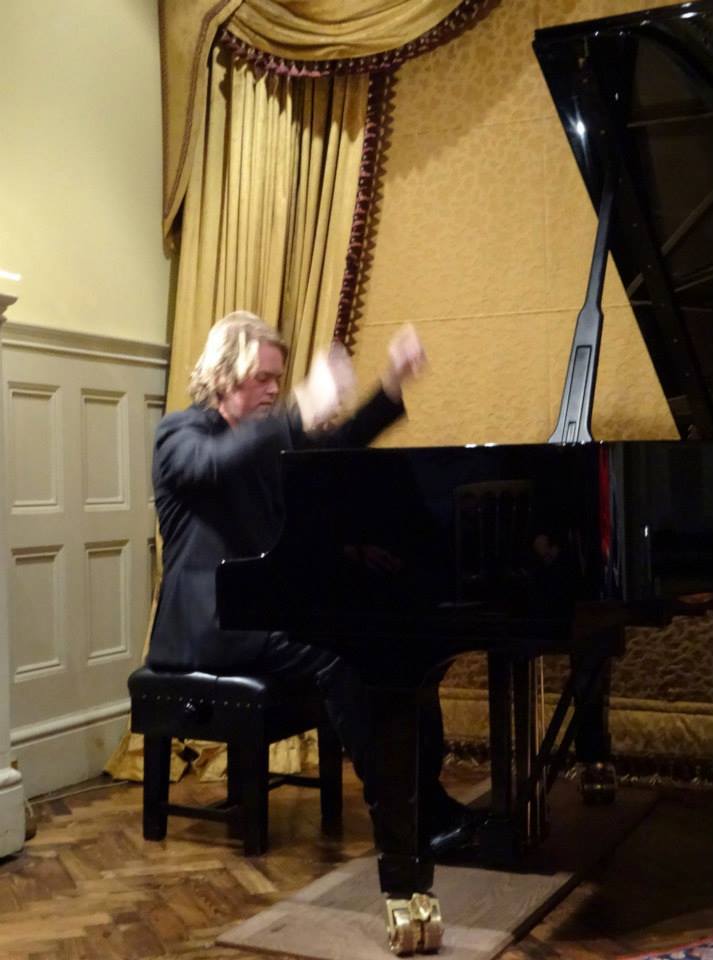
On Saturday the London Piano Meetup Group ventured south to Wimbledon for a recital at the showroom of Hanna Pianos. Nine pianists performed an interesting and varied programme of works by Shostakovich, Brahms, Granados, Chopin, Debussy, Scriabin, Stanchinsky and Szymanowski; we also enjoyed a performance of a clarinet piece by Paul Reade.

1452077_600409663360040_497822147_nHanna Pianos has had its showroom on Kingston Road SW19 since 1990. It’s a family-run business and the owner, Fadi Hanna, learnt his trade from a young age, observing and working with his father who established the business in 1960; meanwhile Fadi’s brother, Chucri, looks after the technical and tuning side of the business. When we visited the showroom was graced by a beautifully restored 1900 Bechstein, a Steinway Model O with a lovely burr walnut case and a 1927 Bluthner autographed by Kelenyi (?). We were lucky enough to play the Bechstein for our recital.

DSC_3952
Mr Fadi Hanna with LPMG co-hosts Frances & Lorraine


The audience, seated around the piano on stools and chairs, listened attentively and applause was given generously for every performance. The atmosphere was intimate and friendly, and one had the impression of everyone listening very carefully to such high-quality piano music. At the end of the event, Mr Hanna produced the most delicious baklava and other gifts for us. We were absolutely bowled over by his hospitality and generosity, and there was much positive feedback after the event, praise for both venue and instrument. We are hosting a masterclass with Graham Fitch at Hanna Pianos towards the end of this month, and we very much hope to host further recitals in the showroom.

1920 Steinway Model O with burr walnut case

A Hanna & Sons Pianos Ltd

London Piano Meetup Group

DanTong7423

Who or what inspired you to take up the piano, and make it your career?

Neither of my parents are musicians but there was always music in the house. My mother made tapes for me of Rubinstein or the Cortot/Thibaut/Casals trio and I fell in love with the music and these wonderful artists who were so full of love in their playing. I’ve kept that with me throughout my life as an ideal of what music is all about. My elder brother is also a concert pianist and, growing up, I always had someone to keep up with! I remember quite clearly deciding that I wanted to spend my life with the piano – when I was about twelve or thirteen.

Who or what were the most important influences on your playing? 

I was lucky to have wonderful piano teachers who were all very different. Hilary Coates at school and then Irina Zaritskaya and Paul Roberts at music college in London. Gyorgy Sebok and Andras Keller subsequently made a big impact when I played to them. But really, I am constantly being influenced by concerts that I attend, books that I read, interviews I hear (most recently a wonderful hour with Nikolaus Harnoncourt) and, perhaps more than anything, the wonderful musical colleagues with whom I’m fortunate enough to spend my life. I have grown up with some of the most inspiring and intelligent artists around, many of whom have remained close friends. A lot of us get together annually in January in the Wye Valley.

What have been the greatest challenges of your career so far? 

Life as a musician is one of constant challenges. You are put in charge of some of the greatest works of art in the world and must do your best not to damage them and show them in their best light. Long periods of concerts, one after another, can take a physical toll and it can occasionally be a gruelling existence, finding more and more mental and physical strength from somewhere for each performance. Of course, the pay off is that we spend our lives with the most sublime music, visit many places and meet many interesting and wonderful people. The greatest specific challenges have been keeping my festival (now in its fifteenth year) and London Bridge Ensemble alive, dynamic and creative over so many years.

Which performances/recordings are you most proud of?

I am hardly ever proud of recordings. Listening to yourself on a cd is a trying thing! Still, I think some of my discs with the London Bridge Ensemble just about pass the test; the Bridge piano quintet, Schumann’s Liederkreis op 24 and, most recently, Faure’s C minor piano quintet. In terms of concerts, I was proud of recent performances of Schumann’s C major Fantasy and Mozart’s C minor Fantasy. I am always particularly proud of performances that are acceptable, if broadcast live. This is always a nerve-wracking experience. I find microphones off-putting and they have an unwanted psychological effect that is hard to shake off. I recently stumbled across a tape of myself playing the Berg Op 1 piano sonata when I was sixteen years old. It became clear that I was pretty good when I was sixteen!

Do you have a favourite concert venue to perform in? 

The Great Room in Treowen Manor, home of my chamber music festival each January in the Wye Valley. It’s bursting at the seams with eighty people, many of whom are musical colleagues and there’s always a crackling log fire. Otherwise St Georges in Bristol and the Wigmore Hall in London. I’ve also recently been asked to curate a couple of projects at Kings Place in London, which is a fantastic venue for chamber music.

Favourite pieces to perform? Listen to? 

I always love performing Mozart’s E flat Piano Quartet, Beethoven’s ‘Archduke’ Trio, Janacek’s Piano Sonata and Schubert’s last Piano Sonata. Those of you who know all of these pieces (especially the three Viennese ones) will notice a certain shared temperament between them which probably says something about my character! I love listening to opera. I always return to Mozart and Britten, but Debussy’s Pelleas and Tchaikovsky’s Onegin are particular favourites.

Who are your favourite musicians? 

Alfred Cortot, Adolf Busch, Bela Bartok, Gerard Souzay. Ask me again tomorrow and the answers will be different. One cannot just live off the music-making of the past, though. I have been to wonderful concerts by Quatuor Mosaiques, Radu Lupu and Miklos Perenyi/Andras Schiff. The last, magical Susanna (Figaro) I saw was Aleksandra Kurzak. I always fall in love with Melisande, no matter who is singing.

What is your most memorable concert experience? 

Playing nearly a complete movement of Dvorak’s E flat Piano Quartet in the dark and from memory after the lights failed. I don’t know how we did it but it won us the biggest round of applause of the season! Playing Schumann’s Dichterliebe when both pianist and singer had just been jilted by the fairer sex. Poignant and painful, although I’m sure we were never better method actors! Hearing the first movement of Beethoven’s ‘Harp’ Quartet at a friend’s wedding.

What do you consider to be the most important ideas and concepts to impart to aspiring musicians? 

If you don’t love music unconditionally then it’s not the job for you.

There’s always more to learn. Be an avid student and have respect for the musicians of the past as well as the present.

Forget your instrument – it’s just a means to an end.

Every note means something.

Always be open. Nothing kills music more quickly than dogma.

Music doesn’t speak for itself. It speaks through us, the performers.

Tell us more about Beethoven Plus! 

It’s a very exciting project with violinist Krysia Osostowicz, based on the ten Beethoven Sonatas for violin and piano. We commissioned a new piece to partner each sonata, all written by different composers as their reaction to the Beethoven work in question. We have some great composers involved including David Matthews, Jonathan Dove, Matthew Taylor, Kurt Schwertsik and Judith Bingham. Beethoven is still such an important and influential figure, even for today’s composers (when we have approached them with the idea, enthusiasm has been immediate). It’s always rewarding and great fun to work with Krysia. She’s a wonderful artist, an eternal student, despite her huge experience with Domus, performing and recording sonatas, most notably with Susan Tomes, and latterly as leader of the Dante Quartet. 

What is your idea of perfect happiness? 

Being with someone you love, after a great performance of one of Mozart’s Da Ponte  operas, just as you open a very nice bottle of red wine.

What do you enjoy doing most? 

Watching cricket.

Daniel Tong was born in Cornwall and studied in London, where he now lives. His musical life is spent performing as soloist and chamber musician, as well as directing two chamber music festivals, teaching and occasionally writing. Outside the UK he has performed in Sweden, France, Belgium and Portugal. He has recently released his first solo CD of works by Schubert for the Quartz label. He also recorded short solo works by Frank Bridge for Dutton as part of a London Bridge Ensemble disc and broadcast Janacek’s piano sonata live on BBC Radio 3.

Full biography here

A new website has been launched by Jovan Haji-Djurich, a student of Kemal Gekic and his studio teaching assistant for 2 years at the Florida International University, Miami FL. Prior to studying with Kemal, Jovan worked worked with Alan Fraser (The Craft of Piano Playing Method) for several years.

Here Jovan introduces his new project:

It’s a subscription based website/service where awesome piano teachers like Alan or Kemal Gekic get to upload their teaching videos, masterclasses for other pianists to watch and they get paid for it.

Some of the core features are:

  • Up to 70% of the money collected from subscription fees gets used to pay the teachers.
  • Teachers are paid by the number of cumulative video views at the end of the month.
  • Various algorithms prevent misuse by the students and teachers as well. For example, a teacher can not create views on his own videos…etc
  • I developed a a unique ‘cost per view’ mechanism, which determines a cost of a single lesson view based on the number of total users, lessons, and total number of lesson views.

I built it myself using latest web technologies. I felt the need to share Alan’s, Kemal’s, or any great teacher’s teaching videos to the general public. How often can we afford to travel and play for a really good teacher. Or even just observe their masterclasses.

Head over to www.pianotechnique.org to find out more.

feat-800x357