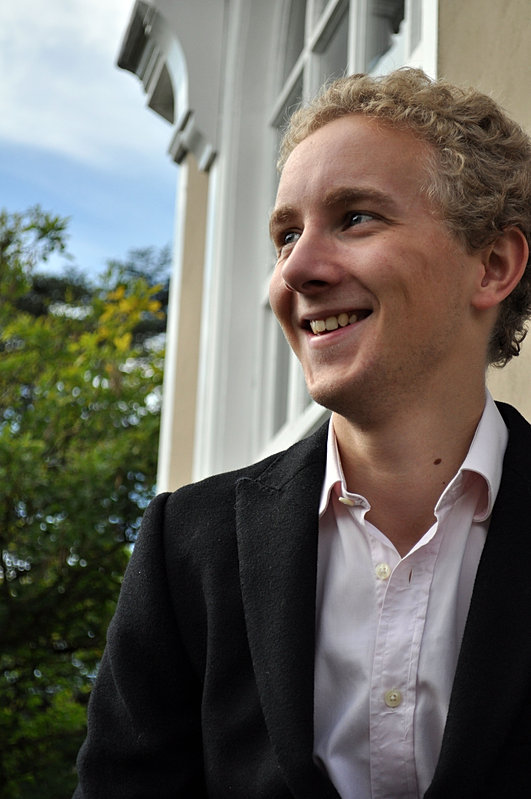
York2 is the piano duo of John and Fiona York

Who or what inspired you to take up the piano and make it your career? 

John: My mother played quite well, we had a decent upright and the best teacher in Eastbourne lived round the corner. She was recommended to my mother by our piano tuner!

Fiona: My father. He was an extremely talented amateur pianist who was torn between career choices – Law won but he loved seeing me develop into a fully-fledged professional.

Who or what were the most important influences on your musical life and career? 

F: My first teacher who was taught at Guildhall by Cimbro Martin, who also taught John, who also taught me…! The methods passed on to me are still going strong in my own teaching.

J: All four of my teachers – all very demanding and revealing – and my early, chance discovery of Debussy and French piano music in general which gave me direction for at least ten years at the start of my career.

What have been the greatest challenges of your career so far? 

J: Doing the Tchaikovsky competition was tough, demanding, horrible and a bit distressing – ultimately pretty pointless, too, considering that the UK government had only just evicted over a hundred spies from London!

F: In the early days, learning the big repertoire and persuading fixers and audiences that they really do want to hear the entire Planets Suite played on one piano!

Which performance/recordings are you most proud of? 

J: The York2 recording of Debussy’s La Mer – and one or two of our many Rite of Spring performances.

F: Of course the above, but also an extraordinary, impossibly fast, brilliant and thrilling four-minute piece called Impulse by Benjamin Wallfisch which he wrote for two pianos and two marimbas. We never actually met the marimba players…

Which particular works do you think you play best? 

F: The big orchestral duet works and, in total contrast, some of the ‘smallest’ salon repertoire such as Dolly Suite by Fauré or Jeux d’Enfants by Bizet which are extremely sophisticated in their own way and ever popular.

J: Those same pieces with York2 – and the Beethoven ‘cello works with Raphael Wallfisch.

How do you make your repertoire choices from season to season? 

[J and F discuss…] No particular plan – the usual delving into anniversaries perhaps, unusual repertoire perhaps, nice couplings and strong juxtapositions – whatever feels good and is attractive to promoters and audiences.

Do you have a favourite concert venue to perform in and why?

J: Like everyone else I’d always say the Wigmore Hall and, more recently, the main Kings Place hall near King’s Cross station. Both are beautiful, sound great and have real atmosphere.

F: The Singing Hall in St.Paul’s Girls’ School is a favourite – [J interrupts:I’d forgotten that one but absolutely agree!”]. It was designed and used by Holst in his role as Director of Music and the acoustic is still wonderful.

Favourite pieces to perform? Listen to?

F: To perform – The Rite. To listen to – Brahms 4

J: To perform – La Mer.  To listen to – Bruckner 8, or the entire Ring cycle.

Who are your favourite musicians? 

J: I’d always say one of the great orchestras before any soloist – but I admire some of the great singers – and also pianist Benjamin Grosvenor who has integrity and real class.  I really believe very few other pianists deserve the adulation they get these days – you probably know who I mean!

F: He might say that – I couldn’t possibly comment.

What is your most memorable concert experience? 

F: A particularly bad one was playing Lutoslawski Paganini Variations for two pianos, 20 feet apart, to six people at 11 o’clock at night in the Salzburg Festival and hearing the receding footsteps of one of those six, who turned out to be the janitor.

J: A bad one? – the Greenwich Festival 6-Steinway concert at Eltham Palace years ago, a horrendous, long, difficult, fractious, uncomfortable and very unpleasant experience.

A good one? – York2’s Wigmore Hall recital at my 30th anniversary concert.

What do you consider to be the most important ideas and concepts to impart to aspiring musicians? 

J: To read the score and study the context, not to impose ego or allow ignorance – only then you can allow yourself freedom with complete confidence.

F: To show the musical complexity of your repertoire and not patronise your audiences with over-simplified and obvious renditions.

What are you working on at the moment? 

J: Some enormous cello and piano sonatas for upcoming concerts – and the complete works of Rebecca Clarke and Ernest Bloch for cello.

F: Some tiny, utterly beautiful miniatures for a friend’s Soiree.

[F notes that J is keen to answer all of the questions as follows…]

Where would you like to be in 10 years’ time?

Still strong and still giving concerts – and still enjoying doing it!

What is your idea of perfect happiness?

J: Does it exist?  It sounds complacent.  Life should be, and is, a good mix.

Perfect Happiness? 

F chose just one question: A quiet mind – to love and be loved – an inextinguishable sense of humour.

York2John and Fiona York – four hands one piano


YORK2 has a reputation as the ‘piano duo with a difference’, gained through husband and wife team John and Fiona’s exploration of larger scale and contemporary scores, alongside the rich and familiar duet repertoire.  

Fiona and John have given countless concerts in the UK, on BBC Radio 3, in Australia, for CBC TV and TV Ontario Canada, on boats on the Great Lakes, at the Salzburg Festival, concertos at the Barbican Centre and at the South Bank in London. 

York2’s 2nd recording of ‘The Planets’ was released in 2010 on Nimbus, coupled with duet music by York Bowen. At that session, they also recorded, on a second disc, Stravinsky’s ‘Rite of Spring’, Debussy’s ‘La Mer’ and Ravel’s ‘Rapsodie Espagnole’.  This special repertoire was released in 2010 to critical appreciation and admiration. 

Their earlier recordings on the LondonHall label include minimalist music by contemporary Austrian composer Norbert Zehm, and their first recording (now deleted) of Holst’s ‘The Planets’ was recorded for Black Box in 2001. It was the world première recording of the composer’s own four-hands version and the disc also includes Holst’s complete piano solo works. 

As well as giving concerts, Fiona has been a long-standing teacher at several London schools.  She has worked in the junior departments of the Royal College, Trinity and Guildhall and this year marks her 15th year with the piano staff at St. Paul’s Girls’ School, London.  

John was Professor at Guildhall for 33 years and was Senior Music Head of Department at St. Paul’s Girls’ School where Holst was Director of Music for 20 years in the early 20th century.  During his time at the School, John discovered the long-forgotten four-hands score of The Planets in a cupboard in the room where it was composed, leading to York 2’s re-editing and recording of this great English score.  Tony Palmer, the well-known film director, included them in his Holst bio-pic ‘In the bleak midwinter.’ 

A highly successful and emotional recital of ‘The Planets’, the ‘Rite’ and ‘La Mer’ at London’s Wigmore Hall in 2004 marked the 30th anniversary of John’s début in that hall. Although York 2’s repertoire is so demanding, at only one day’s notice in 2010 John and Fiona gave a recital of ‘The Planets’ and ‘The Rite’ in a major festival in Madrid, to a full house, broadcast live on Spanish radio. 

The Independent and Financial Times reviewers were very enthusiastic –  

“York2 goes stratospheric!” – “the playing was enough to confirm the evening in its ambition, scope and sheer grit as something exceptional, duly exciting a prolonged ovation from its capacity audience”.


http://yorkpiano.co.uk

Who or what inspired you to take up piano and make it your career?

When I was 8 years old, I had a chance to play for a renowned pianist in Korea and I was very nervous for a whole week. One day before meeting her, I had a nightmare that she told me not to play piano and I cried a lot. That was the point when I realised that I want to play piano my whole life, no matter what. In fact, she was very lovely in person.

Who or what were the most important influences on your musical life and career?

My piano teacher for 5 years from age 10. She was a very active performer and I went to her every concert. From the moment when she would enter the stage with the conductor until the end of concert, the audience was enchanted by her. She was my absolute idol. She always told me that your music starts when you enter the stage and at her concerts she demonstrated to me what she meant. She was magnificent and it was my dream to be a pianist like her.

I am grateful that I have met so many wonderful musicians who are a big influence in my life and not just in music: especially Leon McCawley, Deniz Gelenbe, Gabriele Baldocci, Pascal Roge, Karl-Heinz Kämmerling, Ola Karlsson and Peter Grote.

What have been the greatest challenges of your career so far?

For a long time I played piano for someone else. One day I lost that person and I was really lost for a year. Slowly I learnt to love music again and play piano for myself. Now I will always have a reason to play my music because it is finally truly who I am.

Which performance are you most proud of?

I am fortunate to have played at prestigious concert venues all around the world. I enjoy playing at big halls, and was surprised when I had a life-changing experience at a lower standard hall. After the recital an elderly lady came to me crying. She was speaking Spanish, which I could not understand, but I could feel how happy she was. I was really touched and proud that I could make people happy, or happier, with my music. After that point I was reminded of the origin of music and my purpose in being musician.

Which particular works do you think you play best?

The music that means something to me.

How do you make your repertoire choices from season to season?

I aim to have a mixed repertoire so that there is something for me and for the audience.

Do you have a favourite concert venue to perform in and why?

Wigmore Hall in London, Palau de la Musica in Valencia and the Berlin Philharmonic are amazing and at the top of my favourites list.

On one occasion I played a solo recital on a big stage (the stage itself has a capacity of 500 people) in Korea. It was interesting for me as it was hard to control the acoustic. It was very challenging but gave me joy.

Favourite pieces to listen to?

I love listening to Chopin piano concerto recordings. Every pianists has a different interpretation.

Who are your favourite musicians?

Alfred Cortot and Jacqueline du Pre

What is your most memorable concert experience?

Performing the Prokofiev Piano Concerto no.3 for Alzheimer’s patients and a solo recital at an army base. I never had such a concentrated and enthusiastic audience.

What do you consider to be the most important ideas and concepts to impart to aspiring musicians?

Know yourself. Physically and psychologically.

What are you working on at the moment?

I am preparing two world premieres for a Wigmore Hall recital this month, by Stephen Montague and Gwyn Pritchard. These works were commissioned as part of my project to commemorate lives lost at sea – an idea that came to be after the tragic disaster of the Korean ferry MV Sewol on the 16 April 2014. I sometimes forget the many different sides of nature and tend to label it based on what is visible on the surface. For the second part of my recital I have selected pieces related to this idea, including the two premiered pieces.

What is your most treasured possession?

My Spotify subscription and Edwin Fischer’s recording of Bach’s Well-Tempered Clavier.

Identified by Gramophone as the ‘talent of tomorrow – today’, Jenna Sung gives her debut Wigmore Hall recital on 16th November 2014 as a prize for the 2013 Jaques Samuel Pianos Competition. The programme includes works by Haydn, Skryabin, Chopin and Ravel, together with the premiere of new works by Stephen Montague and Gwyn Pritchard. Further information and tickets here

Jenna Sung’s biography

Brouillards swathed the Wigmore audience in mist, yet the sound was never foggy”

Photo credit: Guy Vivien

Occasionally one comes across an artist who seems so at one with the music, that one can almost hear the composer at the artist’s shoulder saying ”yes, that is what I meant”. Such was the effect of French pianist François-Frédéric Guy’s performance of Beethoven’s final Piano Sonata, the Op.111, at London’s Wigmore hall on Friday night: a performance replete in insight and an emotional intensity which comes from a long association with and admiration for this composer and his music.

Read my full review here

Who or what inspired you to take up the saxophone, and make it your career? 

I learnt to play the recorder from my best friend in the playground when I was 6 years old. We would practise together every break-time and I was instantly hooked on playing music. My parents gave me the choice between the clarinet or the viola; my mother having played the viola at a younger age and my uncle the clarinet. I started having lessons with the woodwind teacher at my school and it was there that I was introduced to the saxophone. I heard the sound through the door from the pupil before me and I went home and told my parents “that is the instrument for me”.

I started the saxophone aged 9 and a year later, I performed my first concerto with the local orchestra, the Ronald Binge Concerto for saxophone and orchestra. I wish I could hear a recording of it now!

I went to the Purcell School of Music and studied clarinet with David Fuest and saxophone with Simon Stewart. I then ended up completing my degree and masters in performance at the Akademie fuer Tonkunst in Germany, with a former member of the Rascher Saxophone Quartet: Frau Linda Bangs.

Who or what were the most important influences on your musical life and career? 

My parents were very supportive of my playing and would always take me to hear classical concerts, both orchestral and specifically saxophone. But, it wasn’t until I heard The Rascher Saxophone Quartet and had lessons from Bruce Weinberger that I really realised what the saxophone could do. The sound they create, the way in which the instruments blend together and the amazing virtuosity in which the players can perform, effortlessly; I wanted to play like that! That is really where I decided the direction and style of playing and decided to study with Frau Linda Bangs.

What have been the greatest challenges of your career so far?

One of the hardest points in my career was the unfortunate sports injury which meant I had to have four operations on my hip, removing cartilage, cysts and bone. I continued playing, although it was and still can be painful to sit for long periods of time, sometimes sitting at all! My lecturers and teachers were very kind, letting me postpone exams until after surgery and letting me lie on the floor during lectures and rehearsals (mainly choir!) I really came to understand the importance of health: being healthy in your body but also in mind. I had the opportunity to spend time listening to other players, researching the saxophone and the history and feel that I am a more rounded player because of this.

Which performance/recordings are you most proud of?  

My final masters performance has to be one of my proudest moments. I played a programme which was 1hr 45mins long, including pieces for an 11-piece saxophone ensemble with percussion, a trio for xylophone, timpani and saxophone and also a piece for tenor saxophone and boombox. It was such a demanding programme, the adrenaline was racing and the audience were fantastic!

Which particular works do you think you play best? 

Even though people are surprised at the idea, I enjoy playing music from the baroque era the most. It dances and sings all by itself and is such a pleasure to play.

How do you make your repertoire choices from season to season? 

This all depends on the audience and venue I will be playing at. That’s a hard question to answer!

Do you have a favourite concert venue to perform in and why? 

I haven’t found it yet, although my dream (since I was a child and saw the proms there) is to perform a solo saxophone concerto on the stage at the Royal Albert Hall. I am performing at the O2 next year which has to be the biggest venue for me yet.

Favourite pieces to perform? Listen to? 

I enjoy performing all types of music, especially Baroque and rock n roll!

Who are your favourite musicians? 

The Rascher Saxophone Quartet were, and still are a huge influence and inspiration for me and I enjoy listening to their work very much. I also am a great fan of Maceo Parker, The London Community Gospel Choir and Anthony Strong.

What is your most memorable concert experience? 

Towards the end of my time in Germany, I performed a baroque Sonata with myself and my colleague Sarah Wuensche on soprano and Frau Linda Bangs on the baritone. I still cannot believe I performed alongside the woman who inspired me and moulded me into the musician I am today. I still have the recording and it brings butterflies every time I watch it.

What do you consider to be the most important ideas and concepts to impart to aspiring musicians? 

I think one of the most important things for any student, being old or young, is to have fun. Music is such a spiritual aspect of a potential fast-paced world and it can bring so much joy and happiness that if it isn’t fun to play, then maybe should be listened to. Passion enables dedication and practise, which in turn can create the most amazing and versatile of players on any instrument. Music is an important part of every life, whether it is being played or listened to.

What are you working on at the moment? 

At the moment I am the most recent member in a 1950s Rock n Roll band and I learning the repertoire by ear, listening to the original records. It’s a wonderful and lively genre of music and performing it in 50s attire is an exciting experience! The band is called The Wonderers and you can find them at www.thewonderers.co.uk !

I have recently founded a saxophone and cello duo, called SaxnCello and we are learning material ready for a series of concerts we have lined up next year. We are playing a wide range of music, from Mozart cello duets to tangos and even the theme tune from the Swedish Series ‘The Bridge’, which my husband has arranged for us.

It is an exciting time at the moment and I am enjoying be part of many different groups and genres.

What is your most treasured possession? 

My most treasured possession would have to be my soprano saxophone, a Buescher, curved gold saxophone from around the 1930s. I bought it from Frau Linda Bangs about half way through my studies and couldn’t give it back. Although it looks small and rusty the sound is sweet and round, producing a true saxophone sound that Aldophe Sax had intended.

Saira Clegg was born in July 1985 in London. She started the clarinet at the age of 8, and one year later started the saxophone. In 1997 she began studying both instruments with a scholarship under the Governments Music and Ballet Scheme at The Purcell School of Music. After leaving school she continued onto The Royal College of Music gaining a Foundation Scholarship for Clarinet and Saxophone. She then spent one and a half years studying with Bruce Weinberger in Switzerland, before restarting  and completing her Degree and Masters in Darmstadt, Germany with Linda Bangs-Urban.

At the age of 10, Saira performed her first solo saxophone concerto and one year later became the principal clarinettist of the English National Children’s Orchestra. Her last performance with the orchestra, at the Bridgewater Hall, Manchester (UK), was recorded for Classic FM radio. In 1999, she won the “Watford Twin Town” competition resulting in two solo recitals at the Rachmaninoff Festival in Novgorod, Russia. In 2001, Saira played the clarinet for Prince Charles at the UNESCO building, Paris. She won the “Three Rivers Young Musician” and “Watford Young Musician of the Year” in 2002. Saira has performed at Buckingham Palace, the Wigmore Hall, Bridgewater Hall, Royal Festival Hall, Queen Elizabeth Hall and St. Johns Smith Square.

www.sairaclegg.com