A guest post by pianist Clare Hammond


As a child, I used to curl up on the floor in front of the imposing speakers of my grandfather’s sound system and work my way through his extensive collection of LPs. A lover of the core classical repertoire, he had little beyond Haydn, Mozart and Beethoven, but these composers were amply represented. While listening to Beethoven symphonies, piano sonatas by Mozart and Haydn’s string quartets, I imbibed a sense that these works were made permanent, somehow concrete, by their incarnation on disc. It seemed that these renditions were ‘definitive’, in a way that I didn’t feel when listening to live music. I hoped that one day, I too would be able to record ‘the’ Moonlight sonata and somehow set my interpretation in stone.

Despite this orthodox musical education, my specialisms now veer somewhat to the side of the mainstream repertoire and I find myself releasing a disc of études by composers from across the globe; two Russians (Sergei Lyapunov and Nikolai Kapustin), a Pole (Karol Szymanowski) and a South Korean (Unsuk Chin). These études represent some of the most innovative, invigorating and imaginative writing for piano and have given me the chance to really delve into what the piano is capable of (and, rather less pleasurably, where my limitations lie!)

I started preparing for this disc many months before the recording sessions. This was partly because the repertoire is extremely difficult technically, and also because this was a very personal project in which I had invested a great deal of emotional and creative energy. I have developed a reputation for playing works that lie at the more elaborate and frenetic end of the musical spectrum, so these études are essentially my ‘core’ repertoire, where I felt most at ease and most stimulated creatively.

I practised the pieces on different pianos, in varying acoustics, and performed them to different audiences, in order to explore the sonic options available to me. I listened to recordings of the études by other pianists, to orchestral repertoire by the composers, and read about their work in order to ‘live’ the pieces and make them my own. I had long abandoned the idea of a ‘definitive’ recording or interpretation, but I thought that I had a clear idea of what I, personally, wanted to achieve. At least, I did before I set foot in the studio…

The first few minutes in front of a microphone soon put a stop to any notions of creating my ‘ideal’ recording, although not in as devastating a way as you might expect. When recording, as in performance, you are suddenly faced with a single instrument which you may not have played before. In my case, at Potton Hall in Suffolk, I had a beautiful Steinway Model D which had been expertly regulated and tuned. However, all pianos have their foibles and if yours doesn’t have the bloom in the higher register that you had set your heart upon, or the percussive timbre that you sought in the bass, you have to find an alternative solution.

I had not anticipated how dramatically altered my physical state would be. I was nervous, though in a different way from live concert performance. We had a finite amount of time (5 days) to record two discs of challenging repertoire, these études and works by Andrzej and Roxanna Panufnik. I wasn’t quite sure how far I could push myself, or for how long (8 hours per day before my wrists give up entirely…) as I’d never done anything this demanding before. The awareness of just how much effort both I and the wonderful team at BIS Records had put into assembling the project, and that my performance over the next few days could potentially undermine all of this, added an extra frisson of anxiety.

Fortunately, I was able to collaborate with producer Thore Brinkmann whose calm demeanour and consummate expertise made the whole process far easier and more enjoyable that I could have expected. We spent the first half hour warming up, with me at the piano and Thore at his desk altering the levels of the seven microphones poised some 12 feet off the ground in a semicircle around the piano. When I heard the first ‘playback’, I was astonished at the sound he had captured. It was so different from what I had heard at the piano. There was a clarity and a crystalline quality in some passages which had not been audible at ground level. Thus began my five-day guessing game where I made alterations at the keyboard whose result I could only hear minutes later in playback.

The specific character of one instrument, the resonance of an acoustic, or the choice of one brand of microphone, would seem to place limitations on the ‘ideal’ performance that I had in mind but, of course, in real life the most interesting results often come when you have to be most pragmatic. I started to respond to the situation and to find creative possibilities that I hadn’t previously considered. While I wouldn’t countenance incorporating the heady cry of a randy pheasant into a recording (and there was one point where I thought I would have to chase a number through the undergrowth away from the hall), certain effects were suggested by the depth of the sustaining pedal on the piano and, fancifully enough, by the vibrations of an aeroplane engine that had ruined a previous take.

It takes some time to fully appreciate that a recording is its own medium and most certainly not a convincing simulacrum of a live performance. For a start, there is no audience and the sense of reciprocal communication that you experience onstage is absent. Secondly, certain effects work much better on tape than they do in the hall. Why this should be, I do not know but there were a number of occasions where a take that I thought unusable, because of its vulgarity or my ineptitude, was by far the best in playback. While we tried to keep editing to a minimum, as with almost any recording, ours involved cutting and pasting tracks together to create a performance that never actually existed. Some may complain that ‘authenticity’ is lost but, again, this assumes that the aim of a recording is to recreate an ‘ideal’ performance for posterity. In reality, people listen to recordings very differently from a live performance and demand a greater level of accuracy and precision than a human being is capable of in one take. As a musician, knowing that if the next passage doesn’t go well you can always redo it, without having to jettison the performance up to that point, is enormously liberating. You are able to take risks that you would rarely contemplate in concert and that adds a vitality that is unique to the recording.

Fast forward nine months and I was able to hear the first edit of my Etude CD, around the time that the other disc, Reflections, of the music of Andrzej and Roxanna Panufnik was released. This was a sufficiently long time that the pieces sounded ‘fresh’ to me and I was intrigued to hear what my family and friends thought of the recording. I was struck, as I am again now that the disc has been released, by how differently people listen to a piece. The concept of a ‘definitive’ performance is only meaningful if you can find a ‘definitive’ listener and, of course, both are a nonsense. Listeners bring their own experience, preferences and emotions to a recording and respond accordingly. While this might seem frustrating for the musician, it is actually an intriguing process and has certainly opened my ears to elements that I didn’t initially hear when performing in the studio.

If this is my experience as a pianist, how does the composer feel, compelled to translate their ideas into inadequate notation and submit them to the whims of a performer, and that’s before encountering the uncertainties of the recording studio? It’s important to remember that in order to be authentic, any art-form must be to some extent human and imperfect. The loss of control that one experiences, whether performing on stage or recording, can and should become an integral part of the creative experience. Learning to do this is difficult, and I can’t say that I have succeeded, but the process of becoming receptive to uncertainty is an extremely important part of anyone’s musical and artistic development. When I was younger, I felt that I should strive towards an abstract ‘perfection’ in music. The messy reality is far more interesting.

Clare’s new disc, ‘Etude’, has just been released by BIS Records and is available from all major online retailers. 

“unfaltering bravura and conviction”, Gramophone Magazine

“style and substance”, The Observer

“imagination and bravura”, The Sunday Times

Acclaimed as a pianist of “amazing power and panache” (The Telegraph), Clare Hammond is forging a reputation as an advocate of new and unfamiliar repertoire. In 2014, she gave debut performances at 7 festivals across Europe, including the ‘Chopin and his Europe Festival’ in Warsaw, and world premieres of works by 10 composers. Clare has now released two discs with BIS Records; Reflections, of works by Andrzej and Roxanna Panufnik, and Etude, with études by Unsuk Chin, Sergei Lyapunov, Nikolai Kapustin and Karol Szymanowski.

More information is available at www.clarehammond.com/etude.html

Debussy updated for the modern age: Unsuk Chin’s Six Piano Etudes – guest post by Daniel Harding

Meet the Artist…….Clare Hammond

Review of Frances Wilson & Friends, South London Concert Series at Brunswick House, 22nd January 2015

by Lucy Butler Gillick

Brunswick House
Brunswick House

The last time I visited LASSCO Brunswick House, my husband and I were looking at furniture for our house in Clapham. Back then it was the place to go for interesting bits and pieces at prices that wouldn’t break the bank. It still is. But in those days the area was very far from a prime location. In the 10 or more years since, I have occasionally looked across from a car or bus as I pass through Vauxhall Cross and noticed the isolated Georgian house, standing in defiantly Dickensian splendour, on an island surrounded by sleek riverside architecture and brutally thundering roads.

Without the encouragement of my dear friend Fran [Frances] Wilson – the energetic co-founder and Artistic Director of the South London Concert Series – I would probably never have bothered to park the car or get off the bus or tube to explore any further. But her invitation to come along to an evening of intimate piano music was far too appealing to refuse. And the venue is practically on my doorstep…

Now, apart from the occasional school event, endured for the sake of my children, or dinner at Fran’s where the piano would inevitably form part of the programme (and a welcome one at that), I have never really experienced such a concert. So it was as a complete outsider to this exclusive piano playing world that I arrived last Thursday evening and finally re-entered the pillared portals of LASSCO Brunswick House. To be frank, I was slightly fearful that my bottom would end the evening sore from a long and laborious sit, after having my eardrums assailed by music that could potentially mean nothing to me at all.

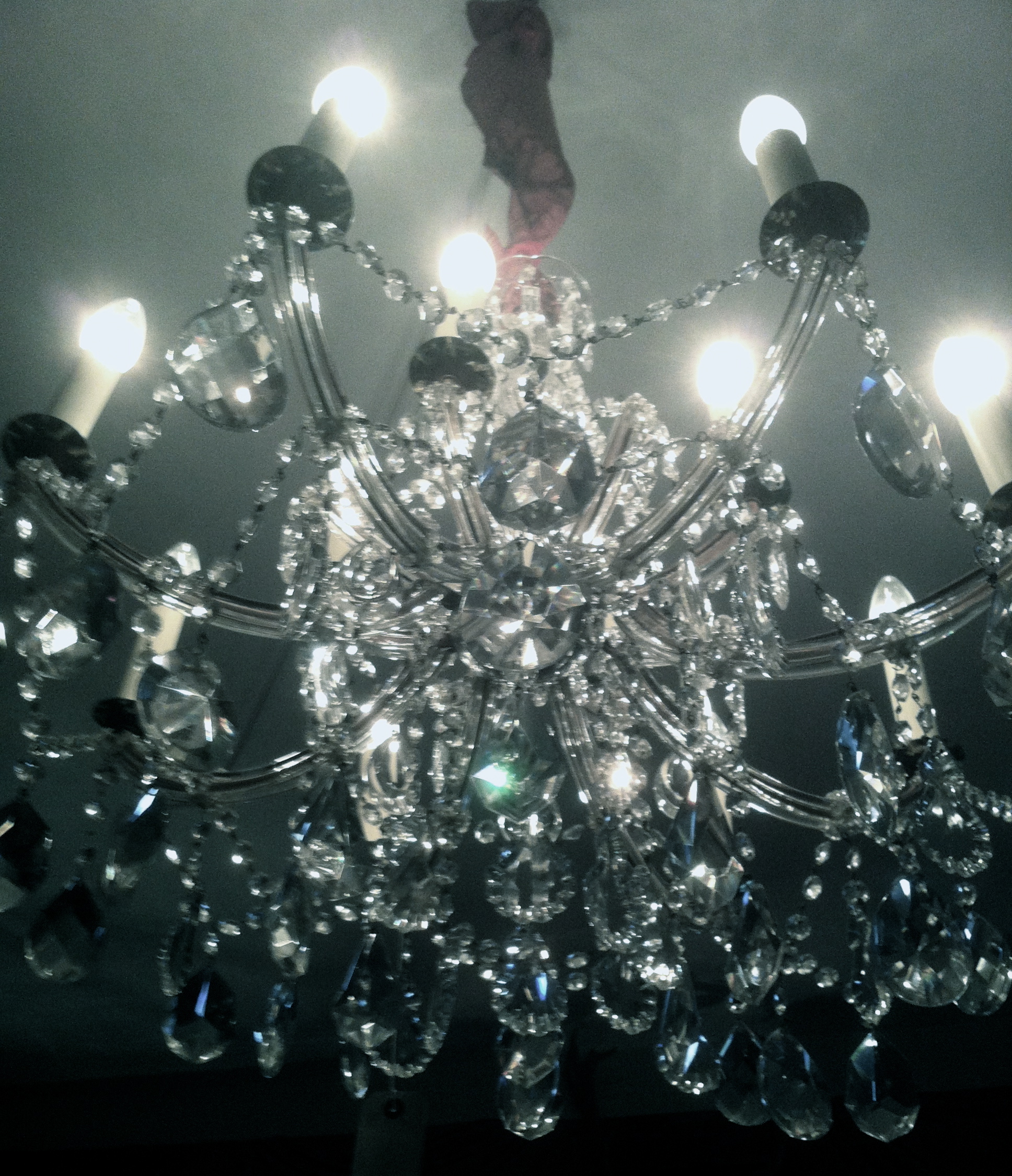
ChandelierBut what an appealing setting and pleasurable event it turned out to be. Downstairs is a cosy bar and lively restaurant, lit and furnished with scene-setting antiques that are – so far as I could tell from the tags – all for sale. For your starter you could order Mussels, Kale & Parsnip plus a Venetian chandelier; with perhaps Roast Lamb Leg and a sideboard to follow. Not bad going for the time-poor, multi-tasking city worker, en route home.

DSC_4092But it was upstairs that the salon vibe really took hold. The private concert room, the opulent Saloon with its belle epoque Bechstein grand piano, heavily swagged stained glass windows, old-fashioned school room-style chairs set in neat rows, lamps, lanterns, chandeliers and ephemera, was a genuinely atmospheric space. The very height of old-world decorous gentility, slap bang in the middle of one of London’s busiest junctions (better known for its gay clubs and pubs). Who’d have thought? It even smelt old-fashioned – a sort of pleasantly musty, sandalwood tang.

Once the concert kicked off, after a short introduction from Fran – dressed to the nines in a floor-length slinky red and mauve gown – the evening progressed apace. The concert included the ‘world premiere’ of a new piece by composer and guitarist Matthew Sear, as well as preludes, fugues, sonatas and impromptus from the likes of Debussy, Shostakovich, Menotti, Rachmaninoff, Scarlatti, Schubert and Satie – all favourite pieces of the artists performing that night. There was even a piece by the incongruously named Bryan Kelly (who sounds more like an Irish builder than an Australian composer to me), and a somewhat ‘difficult’ discordant work by Olivier Messiaen – apparently taken from ‘one of the greatest works for piano of the 20th century’ (the Vingt regards sur l’enfant Jésus) expertly played by Fran, who I think fancied challenging her audience into hearing something unusual at the end of the night.

The South London Concert series typically combines performances by talented amateur musicians with a special “guest spot” featuring professional and semi-professional players. On the evening I attended we enjoyed performances by José Luis Gutiérrez Sacristán, Petra Chong, Lorraine Womack-Banning, Rob Foster and of course our genial hostess Frances Wilson herself. They all looked and sounded amazing to my untutored ears and I would heartily recommend the South London Concert Series to anyone who fancies a very reasonably-priced introduction to the world of glorious piano music in an intimate setting, followed by an opportunity to meet and talk to musicians who are as passionate about their piano music as you probably are about your food, wine and chandeliers. What’s not to love about such civilisation? The only jarring note was re-entering the real world and wintry fug of Vauxhall Cross when it was finally time to head home…


Lucy Butler Gillick is ex-chief sub editor of The Sunday Telegraph Magazine and Harpers & Queen. She has written for many magazines and supplements over the years, on a variety of topics, but mostly on issues related to parenting. She now works in education. 


The South London Concert Series returns to LASSCO Brunswick House on 21st May for a concert by Australian counter-tenor Glenn Kesby. Full details here

www.slconcerts.co.uk

Who or what inspired you to take up a career in music?

As a teenager I was lucky to have Jeremy Carter as my piano teacher. I also revered the rock’n’roll pianism of Jerry Lee Lewis (and still do).

Who or what were the most important influences on your musical life and career?

I struggled during my first couple of years on the demanding joint course between Manchester University and the RNCM, but my third year was something of a revelation. I learnt reams during my piano lessons with John Gough (including, crucially, a fresh and non-stuffy approach) and also took composition lessons with John Casken and lectures in postmodern music from Kevin Malone and Shostakovich from David Fanning. It was at this point I knew I didn’t want to do anything else. Fulbright studies in the US with Ursula Oppens sealed the deal.

What have been the greatest challenges of your career so far?

Juggling a range of disciplines and trying (hard!) to excel in all of them. Alongside piano I compose frequently for many varied ensembles (that, strangely, hardly ever include piano – for example this one) and I regularly conduct performances of (mainly) new music. My work with CoMA (Contemporary Music for All) is really important because it involves getting amazing people from all walks of life participating in the music, and I also serve on the board of the Riot Ensemble in order to get the most cutting-edge of this stuff out there in concert. I love teaching and am lucky to supervise over 80 groups of all styles and genres as part of my role as Head of Chamber Music at the University of Chichester, and I also have a clutch of brilliant and talented students at the Junior Royal Academy.

Which performance/recordings are you most proud of?

I played Rzewski’s colossal ‘The People United Will Never Be Defeated’ in three venues last year, and I think I am proud to have scaled that particular pianistic mountain (although I haven’t been brave enough to listen to the recording yet!). I’m also pleased to have performed Lutoslawski’s terrific concerto – here’s a clip of the ending in my performance with the Northwestern Symphony Orchestra and Victor Yampolsky.

Which particular works do you think you play best?

Probably pieces by Shostakovich. I relate well to nervous energy, tragedy…. and comedy!

How do you make your repertoire choices from season to season?

Whatever I think will be fun to prepare and fun for people to listen to.

Do you have a favourite concert venue to perform in and why?

Hmm, tricky one. I like venues where it is easy to blur the boundaries between the performers and the listeners, so it’s more of a community experience. Maybe St Martin-in-the-Fields?

Favourite pieces to perform? Listen to?

Kevin Malone wrote me a wonderful and hilarious piece involving plenty of theatre called Count Me In. You can watch a performance here. I also love the sound of wind orchestras and have been lucky to have been involved in quite a few over the years. You can’t beat the Americans for their brass sound.

Who are your favourite musicians?

I’d have to include Pierre Boulez – a great musical polymath with an amazing conducting style. You can see every single composerly detail in the gesture. My American conducting teachers (especially Mallory Thompson) taught me the importance of this. At other ends of the spectrum I love Eddie Cochran and The Who.

What is your most memorable concert experience?

Probably my first outing of Amy Beth Kirsten’s ‘Speak to Me’ in which I have to adopt the persona of two female goddesses as well as play some really imaginative piano music. (You can listen to a performance here.) I’m playing this again in a Riot Ensemble concert on January 30th.

What do you consider to be the most important ideas and concepts to impart to aspiring musicians?

Just to give 100% energy and commitment to whatever is being asked of you, however big, small or unusual.

What are you working on at the moment?

This morning, the John Ireland ‘Phantasie’ Trio. I play in a piano trio with Ellie Blackshaw (violin) and Peter Copley (cello) and we are on a mission to present all three of the Ireland trios. They are wonderful and really reek of Sussex, which is where I live.

Where would you like to be in 10 years’ time?

Doing the same sorts of things, but with less anxiety about note learning/ preparedness.

What is your present state of mind?

Anxious about note learning/preparedness!

Adam Swayne works with a vast range of musical media and styles that go beyond conventional labelling. He is just as at home giving a solo piano recital or conducting an orchestra as he is organising musical installations in art galleries or composing for amateur ensembles. He takes an inclusive, informative and innovative approach to his music making that is drawing an increasingly large audience.

Adam is a graduate of the joint course between Manchester University and the RNCM. He gained first class degrees from both institutions, and an MMus from the RNCM. Manchester University gave Adam their highest award (Sir Thomas Beecham Medal) along with other prizes including the Recital Prize. Prizes from the RNCM included the John Ireland Prize and an award for performances of contemporary music.

In 2003 Adam was awarded a Fulbright Scholarship to begin doctoral studies at Northwestern University, U.S.A. He graduated in 2006 with distinction, having presented several U.S. premières of works by British composers.

Adam is now Senior Lecturer and Head of Chamber Music at the University of Chichester and piano tutor at the Junior Royal Academy of Music.

Adam’s Swayne’s full biography can be found on his website:

www.adamswayne.com

Brunswick House
Brunswick House

Last week, I gave a formal concert as part of the South London Concert Series (of which I am Artistic Director) at the wonderfully eccentric Brunswick House, in the ‘Embassy quarter’ of London’s Vauxhall. Part of the London Architectural Salvage and Supply Co (LASSCO), Brunswick House is a magnificent Georgian mansion just a stone’s throw from Vauxhall Station, the MI5 building and the glittering new apartments of the Nine Elms development. The house is home to an eclectic collection of antiques and salvaged curiosities, all of which are for sale, including the early twentieth-century Bechstein grand piano which graces the opulent first floor Saloon (price £6000). The venue provides a great backdrop to the kind of programmes I favour (an eclectic mix of music of different eras and styles) and also acts as a splendid talking point for the audience who can enjoy exploring the rooms beforehand. I was joined in the concert by four pianist friends, three of whom have careers outside of music for their “day jobs”. And this for me is where it gets interesting…..

All of us had clearly prepared very carefully for the concert: we’d had “practise performances” at home, for friends, and at our piano group, and I had already played the pieces I was performing at two public concerts in the weeks leading up to the Main Event. We had all tried the piano at Brunswick House in advance of the concert, and I spent a couple of hours there with the tuner a few days before the concert. On the day of the concert we arrived in good time, warmed up, chatted to one another, set up the video camera and checked the lighting over the piano, and then waited quietly for the concert to begin. No one betrayed any nerves, nor discussed how they might be feeling: we all knew that we had to deal with our anxiety in our own way. What was most evident to me was the sense of excitement and anticipation amongst my fellow performers (and I admit I was pretty excited too – the concert was a sell out and the audience mostly comprised friends and family which made for a very warm atmosphere). We all performed with confidence, poise, musical understanding, sensitivity and expression. Because we were playing music we liked and enjoyed, the experience was wholly pleasurable, and I think our affection for the pieces we had selected, and our friendship, shone through every note.

Euphoric performers after the concert (L to R: Frances Wilson, Lorraine Womack-Banning, Petra Chong, Rob Foster & Jose Luis Gutierrez Sacristan)

Anyone who thinks performing to a roomful of people is “easy” needs their head examined. Of course it may look easy – and one of the great skills of the performer is to present what appears to be an effortless, fluent and convincing performance. In order to reach this point, one will have put in many hours of lonely practising – note-learning, refining, adjusting and finessing the pieces. Each performance throws up interesting new things or highlights areas which need to be worked over again to be made more secure (this is why it is important to perform a programme several times). On top of this, one needs to know how to cope with the inevitable performance anxiety, to hone one’s stagecraft, select the right outfit for the occasion, practise wearing the concert frock and shoes (for women), try the piano at the venue, talk to the tuner, if applicable, find out where the green room/loos are, and generally do as much as possible to remain calm and focused in the final moments leading up to the performance.

On the day of the performance, whether it is a concert or a recital for an exam, festival or competition, I have a clear strategy which I always follows to ensure I arrive at the venue with a clear head and a rested body. Rushing around, over-practising or doing too much can leave one feeling drained and flustered, and this can heighten one’s anxiety. In all the excitement of the actual performance, it’s easy to forget that one expends a vast amount of energy, in particular brain energy: keeping body and mind rested in advance of the performance is crucial.

When I arrived at Brunswick House a couple of friends of mine were already at the bar and greeted me eagerly, admiring my dress and wishing me luck for the occasion. I didn’t want to linger to chat (keeping the head clear!) and I promised I would speak to them afterwards. In terms of final preparation, lately I have become interested in “mindfulness” and have been applying it to my performing. At a concert I gave in a very cold church on a less than perfect, but huge Petrof piano a few weeks ahead of the Brunswick House gig, I decided to employ some mindfulness techniques to play “in the moment” and not worry about what happened. I was pleased with the resulting performance and instead of dwelling on “what might have been”, I went to the piano to practise the next day with the thought “what can I do differently/better next time?”. Of course there were areas of my pieces which needed special attention, but there was nothing that caused me serious worry. And in any event, after the concert, there is nothing to be done, for we can’t go back and change what has already been.

As performers we are often our own worst enemy – and all my pianist friends, professional and amateur, are frightful perfectionists. We worry about our note-learning, our memorisation, our expression, musical understanding, how we communicate to the audience, and so much more – and of course we want to give a note-perfect and characterful performance on The Day. It is crucial that we are perfectionist in the practise room because this will enable us to do the correct, careful preparation for the performance. Looking at the video of the concert afterwards of course there are moments when one might wince a little and wish that you’d played this or that note or phrase differently. The audience, however, enjoys the music in a different way, and a well-rehearsed, fluent performance which is rich in expression and communication will engage an audience, no matter if there are a few slips or errors (in fact, audiences rarely notice the mistakes we fret so much about, and people who go to concerts to gloat about spotting errors in the performance are thankfully a rare breed).

The photographs my husband took of the event clearly demonstrate that we had a really wonderful evening: as one of my co-performers said afterwards “it was an unforgettable experience of music and friendship” – and the congratulations and bravos we received from the audience were a testament to how much everyone had enjoyed the occasion. This continued into the bar, some of us staying very late before venturing out into the freezing January night.

The day after a concert one often hits the ground with an unpleasant thump. As the adrenaline leaves the  body, one experiences a distinct “low”. This is often compounded with a deep tiredness, of brain and body, and it may be hard to motivate oneself to do anything the day after a concert (in fact, I took two days “off” the piano and instead lolled around the house, glum and moody, much to the disgruntlement of the rest of my family!). In fact, the best remedy for this special kind of post-concert depression is to get back to the piano and get working again. In my case, I was excited to start practising again because I had new work I wanted to look at, and other pieces which needed to be brought back up to scratch for a private charity concert in which I am performing in the Spring. What remains of the Brunswick House concert are memories of a very special evening, of music played by friends, with friends and for friends, an important reminder that music was written to be shared. We have photographs too, and videos, as mementoes of the event, and I would like to thank my co-performers, and Rebecca who turned the pages for me, for their special and wonderful contribution to a magical evening.

www.slconcerts.co.uk

LASSCO Brunswick House

Further reading

The Day After the Concert

On Performing

Performance Anxiety Anonymous