
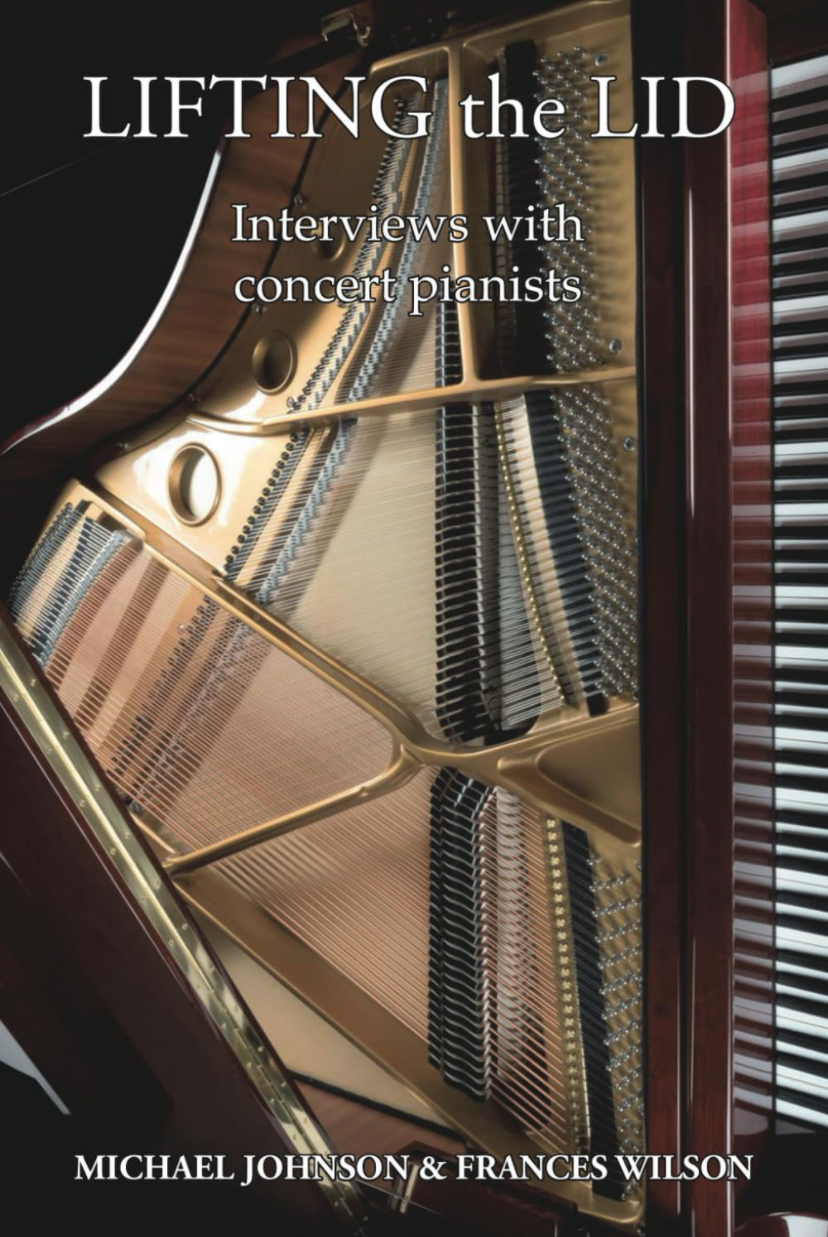
Lifting the Lid: Interviews with Concert Pianists – Michael Johnson & Frances Wilson (AKA The Cross-Eyed Pianist)
Pianists have an aura of mystique. More often than not, alone on the stage with just that box of wood and wires for company, stretched before the performer like a sleek black limousine, pianists seem more removed, almost other-worldly, than other classical musicians.
There is a great curiosity about what classical musicians do, not just life on the concert platform – the visible, public aspect of the profession – but ‘what musicians do all day’, as it were. A certain urban mythology surrounds the working life of the concert pianist; we may imagine pianists slaving away at their instrument for hours on end, cut off from family, a social life, or the normal activities of daily life. For how else could these people learn and finesse so many notes, so many details, in order to bring the music alive for us in performance and on countless recordings?
In reality, the life of the concert pianist today is rather different from the clichéd image of the wild-haired virtuoso, confined to their practice room or studio with only the instrument and its literature for company. A startling level of commitment and executive function is required to learn, memorise and perform complex music; added to that, the profession today is highly competitive, tough, often lonely – yet as these interviews reveal, the instrument and its repertoire exert a strong attraction, seducing would-be professionals from a young age and continuing to bewitch, delight, frustrate and excite.
The interviews in this book offer remarkable and often surprisingly honest insights into life as a professional pianist today – from years of intense study with some of the leading pianist-teachers and pedagogues of our time to practicing and performing, repertoire and recording. There are also more esoteric reflections on the nature of “success” as a musician, and advice for young musicians who are considering a professional career.
I must bore some people because I don’t move around when I play. Some people take this as emotional detachment but my contention is that one should come to concerts to listen, not to watch… Reproducing my gestures just wouldn’t work. (My plain) always looks effortless, like I’m just brushing the keys, but there is force at work, a lot of force.
Marc-André Hamelin
Some of the world’s greatest living concert pianists are included here – amongst them, Marc-André Hamelin, Angela Hewitt, Gabriela Montero, Stephen Hough, Joanna Macgregor, Rudolf Buchbinder, Francois-Frederic Guy and Tamara Stefanovich – but we have also included interviews with lesser-known pianists and younger artists too, who are beginning to make their mark on the international stage.
Think about what the role of a musician is today and how you can be at best useful for today’s society – for me certainly not playing only older repertoire, but thinking how to link music of all times to extraordinary creations of today. Challenge yourself by not copying someone else’s path …In short, less image, more substance
Tamara Stefanovich
The interviews have been selected from face-to-face interviews conducted by Michael Johnson before and after concerts and at music festivals, and from Frances Wilson’s popular Meet the Artist series, launched on this site in 2012 and now comprising a significant archive of over 500 interviews with musicians, composers and conductors active today.
If we are still going to persuade people to come and hear live music, we have to find ways to make that experience more meaningful and relevant, be it collaborating with other genres such as dance, the visual arts or theatre, working with living composers, or simply being able to talk to your audiences in an engaging manner.
Margaret Fingerhut
Following in the footsteps of titles such as Dean Elder’s Pianists at Play and David Dubal’s Reflections from the Keyboard, Lifting the Lid is an important survey of the thoughts and attitudes of today’s professional pianists and a significant resource for all those who are fascinated by the piano and those who play it.
Lifting the Lid is available in paperback from Amazon.com
Frances Wilson writes….. It was one of those serendipitous moments when journalist Michael Johnson contacted me in spring 2020 to suggest a collaboration project. Michael had contributed articles to this site, and I knew Michael’s writing for International Piano and Facts and Arts. It was his idea to pool our joint resources and collaborate on a book of interviews with concert pianists. I probably wouldn’t have agreed to the project had we not been in the grip of the first Covid-19 lockdown; I had very little work at the time, and desperately needed a focus and a distraction from the monotony of lockdown.
We had plenty of material, too much in fact, and so this book represents just a small selection of the many interviews we originally proposed for inclusion. While we have included some of the “big names” of classical piano, the interviews were chosen more for their interesting qualities rather than the reputation of the interviewee. I hope that readers will find these interviews insightful, giving a glimpse “beyond the notes” and the concert stage to the daily exigencies of “being a pianist”.
Frances Wilson, March 2024
“Few people ask musicians more pertinent or revealing questions than Frances Wilson…..and so the answers of her interviewees are always interesting.” – Sir Stephen Hough, concert pianist
“Frances Wilson’s Meet the Artist series is something I read every day to discover what musicians from around the world are doing and thinking. It is a fascinating behind-the-scenes glimpse into their challenges, influences and experiences via probing interviews. I highly recommend it.” – Beth Levin, concert pianist
“Not since David Dubal’s ‘Reflections from the Keyboard’ have I read a set of interviews in which music and the written word join hands so compellingly.” – Jack Kohl, concert pianist and author of ‘Bone Over Ivory: Essays from a Standing Pianist’
“Music critics have an ear. Plastic arts critics have an eye. Michael Johnson has both! This asset gives rhythm and colours to his interviews. He catches the personalities of the great pianists and reveals the little details that make them familiar to us.” – Séverine Garnier, editor of ‘Classique mais pas has been’, critic and music writer











 The Cross-Eyed Pianist