“Lots of people ask me what to listen to from 20th Century composers… so I’ve compiled a playlist of 20th Century Piano Music with a few token ensemble pieces in there.”
Pianist Christina McMaster shares her mixtape of music from Ligeti to Aphex Twin…..
20-year old American pianist, Eric Lu, has been awarded first place and the Dame Fanny Waterman Gold Medal at the prestigious Leeds International Piano Competition 2018, a triennial event which is widely regarded as among the most coveted prizes in the musical world. He also won the Terence Judd Hallé Orchestra Prize.
International star pianist Lang Lang, Global Ambassador of the Competition, presented the prizes following the last Concerto Final with the Hallé, conducted by Edward Gardner in Leeds Town Hall.
In addition to the £25,000 cash prize, Lu receives a ground-breaking portfolio prize designed with long-term career development in mind. It includes worldwide management with Askonas Holt – one of the world’s leading arts management agencies; an international album release on Warner Classics – one of the foremost global classical music recording companies, and a range of performance and recording opportunities with BBC Radio 3. The prize also includes a host of performance engagements with high profile promoters, including with some of the world’s premier venues and orchestras, such as London’s Wigmore Hall and Southbank Centre, the Hallé and Oslo Philharmonic Orchestras.
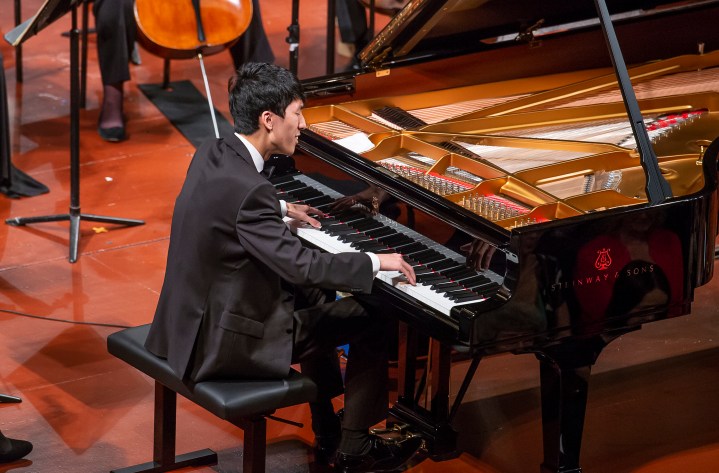
Eric Lu playing Beethoven’s Piano Concerto No. 4 in the Final of Leeds Piano Competition
On Thursday [20 September], Lu opens Royal Liverpool Philharmonic Orchestra’s new season under the baton of Vasily Petrenko, performing Beethoven’s Piano Concerto No. 4 in G major, Op. 58. On Friday [21 September], Warner Classics releases a digital single of a highlight from his Competition performances, and, on 2 November, a full album, including Lu’s live Concerto performance from the Final with the Hallé conducted by Edward Gardner, as well as a selection of recital repertoire from the earlier Rounds.
Second place, £15,000 and the Yaltah Menuhin Award for the greatest collaborative chamber performance, was awarded to 28-year old German pianist, Mario Häring.
Xinyuan Wang, 23 from China, was third and received £10,000. The Audience Award, which was, for the first time this year, opened up to a global audience through online streaming by medici.tv, also went to Wang, who will have a concert broadcast on medici.tv.
Both Häring and Wang will give major recitals in St George’s Hall, Liverpool, on 17 and 18 September 2018 as part of their prize, and will each – like Lu – have an opportunity to give a solo recital at London’s Wigmore Hall in 2019. A full list of concert engagements for the prize winners is available here.
All the prize winners will have long-term mentoring from Patron Murray Perahia, Co-Artistic Director Paul Lewis – who also chaired the jury, and other members of the performer-led jury which included Sa Chen, Imogen Cooper, Adam Gatehouse, Henning Kraggerud, Thomas Larcher, Gillian Moore, Lars Vogt and Shai Wosner.
The prize presentations followed the conferment of an honorary degree on Lang Lang from the University of Leeds, the Competition’s Principal Partner.
Lang Lang said:
“The Finals of The Leeds will stay in my memory for a long time. It has been a privilege to witness so much extraordinary talent on stage and an honour to receive a Doctorate from the University of Leeds. I’m extremely proud of my association with the city of Leeds, with the piano competition – which is doing so much to unite excellence and accessibility – and with the University. It is truly is the city of the piano and I look forward to returning.”
Paul Lewis, Chair of the Jury and Co-Artistic Director of The Leeds, said:
“All the pianistshave shown extraordinarytalent, passion anddedication throughout the Competition, and it goes without saying that the standard of playing has been remarkable. Many of the world’s greatest pianists have started out at The Leeds and I’m certain all the 2018 Finalistshave bright futures, and we look forward to supporting what we believe will be successful and fulfilling careers.“
The Leeds hugely expanded its programme for 2018, going beyond a single competition to become a city-wide celebration of the piano. With a new programme of talks, masterclasses, exhibitions, free family events, schools projects, and concerts – as well as The Leeds Piano Trail, which invited the public to play on 12 beautifully decorated public pianos in the city centre – The Leeds had the opportunity to share its passion for the piano with more people than ever before. The majority of the public pianos will remain in place for the foreseeable future, continuing the Competition’s legacy for new and wider audiences.
medici.tv’s extensive coverage, supported by the University of Leeds, which began in August and ran throughout the Competition, reached audiences in more than 3,700 cities in 140 countries. It was particularly popular in the UK, USA, China, Japan and Germany. Millions more enjoyed the Finals on BBC Radio 3, which broadcast live from Leeds Town Hall and also covered all the Semi-Finals.
All rounds of The Leeds remain available to watch at leedspiano2018.medici.tv for three years, and BBC Radio 3’s extensive coverage of the Semi-Finals and Finals is available via BBC i Player Radio. The Finals are broadcast on BBC FOUR television on Sunday 23 September.
Of course we know the results now and warm congratulations go to all the finalists and prizewinners.
My brief thoughts on tonight’s performances are again drawn from notes made during the live stream broadcast. It’s not the same, watching at home. How can it be? One loses the special, palpable excitement, the tremors of anticipation which vibrate through the concert hall and the social spaces around it, but the MediciTV live broadcasts have been excellent. I hope this splendid initiative will continue into the next Leeds Competition.
Xinyuan Wang
Xinyuan Wang – Schumann Piano Concerto in A minor, Op.54
A pleasure to hear the Schumann Concerto – it is not performed nearly enough, and Xinyuan Wang brought a warmth and richness to his sound which really suited this heartfelt and deeply romantic music. I felt he really caught the scale and sweep of the work and neatly captured its fleeting, shifting moods and changes of pace. His sound palette was varied and contrasting and he brought a pleasing muscularity to the music, especially in the finale. The second movement had a lovely dialogue with the orchestra and a genial character. The transition had mystery and suspense, though I wanted a little more heorisim in the finale. A poised, assured performance with much communication and rapport with orchestr and conductor. The spontaneous thumbs up by Xinyuan Wang at the end of his performance was rather charming too.
Xinyuan Wang was awarded the MediciTV Audience Prize and Third Prize.
Eric Lu – Beethoven Piano Concerto No.4 in G, Op.58
Eric Lu
Lu impressed in the earlier rounds – his Chopin B-flat minor Sonata and Fourth Ballade were particularly fine displaying a maturity beyond his 20 years. The Beethoven felt natural and spontaneous with a fantasy-like air to the opening movement. Great clarity and attention to detail, but never at the expense of the expression and character. Lu’s Beethoven was romantic, but never sentimental.
The slow movement had a wonderful contrast between the gruff, punchy interjections by the orchestra and the piano’s serene, calming responses. Again, Lu caught the fleeting moods with exquisite control and tone. The finale was joyful and robust, revealing how Beethoven uses structure and texture rather than pure melody to create drama and excitement. A really thrilling, satisfying, maure and deeply sincere performance.
Eric Lu won the Terence Judd prize, awarded by the Hallé Orchestra and the Dame Fanny Waterman Gold Medal.
DEBUT Treehouse presents a special concert in support of Arts 4 Dementia in a unique intimate venue in Shoreditch, with a wonderful line up including the Chagall Piano Quartet, led by award-winning pianist Ian Tindale
The Treehouse, a residential apartment in the heart of Shoreditch, is also a hidden bohemian gem of a concert venue. Surrounded by hundreds of fairy lights, beneath a vaulted wooden ceiling with plants draping from the rafters, guests gather casually around a magnificent full-size concert Steinway piano. The Treehouse provides an informal setting and a relaxed ambiance in which to enjoy high-quality classical music.
Arts 4 Dementia believes that people living with dementia and their carers have the right to enjoy life to the full. Participating in arts activity, rekindling and learning new artistic skills enables them to bypass dementia symptoms and enjoy new creative experiences together.
Arts 4 Dementia develops arts programmes to empower, re-energise and inspire people with early-stage dementia and carers through challenging artistic stimulation, to help them live better for longer in their own homes.
DEBUT Treehouse was co-created by Lizzie Holmes (soprano and founder of DEBUT) and Ross Elder (owner of the Shoreditch Treehouse). Since teaming up with Airbnb Experiences in 2017 Lizzie and Ross have hosted over 30 sold out DEBUT Treehouse Concerts to over 1,800 guests and showcased over 125 rising star musicians.
The Cross-Eyed Pianist is free to access and ad-free, and takes many hours every month to research, write, and maintain.
If you find joy and value in what I do, please consider making a donation to support the continuance of the site





 The Cross-Eyed Pianist