
The first in an occasional series of podcasts, using my own articles as the basis for AI-generated conversations.
François Dumont: Discovering Debussy’s Blüthner Piano
Playing Debussy on his Blüthner
Playing Debussy on his Blüthner was a ‘head-spinning experience’ – guest article by Michael Johnson
French pianist François Dumont has still not quite recovered from ‘the excitement, the anxiety’ of playing “Clair de Lune” on Debussy’s own Blüthner piano in a remote French museum.
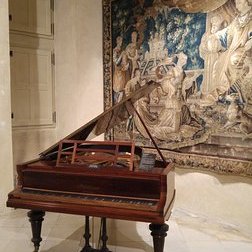
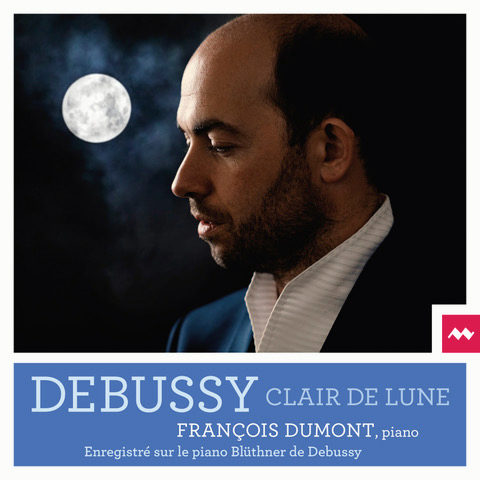
Dumont is one of the select few pianists ever allowed to touch the instrument, now fully restored and in mint condition. It was his credibility as a Debussy player that persuaded museum management to grant access.
Dumont has just released his new CD of Debussy piano music (Clair de Lune LaMusica LMU035) played on the vintage Blüthner at its resting place in the Labenche Museum in Brive-la-Gaillarde, not far from Bordeaux.
He recalled in our interview (below) how it felt to press a few keys the first time. ‘I sat down and timidly put my fingers on the keys… and it was just magical!’
The sound is indeed unique to the modern ear, a resonance intentionally soft and continuous, unlike the more glassy pedaled attacks of a Steinway grand. Dumont says changing to a nineteenth-century Blüthner is fascinating and deeply satisfying musically. Personally, I grew accustomed to his recording only after four or five hearings.
He puts the Blüthner to work on selected parts of Debussy’s Bergamasque Suite, Estampes, and Children’s Corner. His sensitive playing is as touching in the pianissimo as in forceful fortissimo. He recalled for me that he did several takes of “Clair de Lune” before he was satisfied. ‘I repeated it until I found the ethereal colours, the warmth of the melody I was looking for,’ he said.
Dumont thus joins a stellar group of established Debussy interpreters from the twentieth century and more recently performers such as Daniil Trifonov, Angela Hewitt and Steven Osborne. A busy recording artist, he has made about 45 CDs across a wide range of repertoire..
Dumont’s talent is in great demand in Europe where he maintains a punishing schedule of solo recitals and ensemble dates, as well as chamber orchestra works, in the United States, Latin America, China, Japan and South Korea.
Here are excerpts from our email exchanges about the new Debussy CD and the original Blüthner piano featured on it:
How long had this ancient Büuthner piano been idle? Shouldn’t it be falling apart?
Debussy bought the Blüthner in 1904 and kept it until his death in 1918. It was acquired by the Labenche Museum in Brive in 1989 and was fully restored, keeping the original strings and most of the original action
Are you the first pianist to be granted access to it?
There have been some others but very few. For me, it was an unbelievable privilege – a head-spinning experience – to have had access to it.
How were you chosen?
One needs to have real credibility and experience in playing Debussy to get the authorization. The museum generously offered me the use of the piano for the CD.
What is your memory of first sitting down and touching the keys? Were you nervous, excited, worried, afraid?
I will never forget that moment. I had travelled all the way from Lyon, over four hours by car, just to try the piano for an hour. I was very excited but also anxious. How would it sound, in what state would I find it? Would I feel comfortable creating my own sounds? I was afraid of being disappointed. I didn’t quite know what to expect.
It must have been a kind of electric feeling.
Yes, I sat down and timidly put my fingers on the keys… and it was just magical! I played my whole program without stopping. I was completely drawn to the originality and variety of colours.
Did you feel a spooky connection with Debussy, his ghostly presence hovering over you?
Yes, I suddenly felt I was transported to Debussy’s time, hearing the sounds as he was hearing them, playing the instrument he was playing. It is actually quite intimidating. Just imagine, some of the works on my CD, like “Children’s Corner”, were probably composed on this very instrument. A considerable amount of his music was seeing the first light of day on that Blüthner. It must have been like a laboratory for him.
How has the Blüthner design evolved since the 1850s?
The design and mechanics have indeed evolved, together with the sounds aesthetics, style and repertoire. Of course there is the question of parallel strings; now Blüthner uses crossed strings, like almost all modern manufacturers.
Why is the “fourth string” so important?
One of the specifics of the Blüthner piano is that string, called the Alicot. In the high register, instead of three strings, you find a fourth one that is not struck by the hammer. It resonates freely, by sympathy. creating a richness of color and vibration across all 88 keys.
How do you rate the Bluthner compared to the more dominant brands?
One has to remember that at Debussy’s time Blüthner was one of the most prominent brands, together with Bechstein, Erard and Pleyel. I find that Debussy’s Blüthner has a very beautiful range of colors, from bright to mellow to dark. It offers much more individuality than many modern instruments.
But isn’t it a smaller model, intended for the salon, not the concert stage?
True, when it comes to dynamic power you cannot compare it to today’s main brands. It is a chamber instrument, not even a half grand. It suits perfectly the room where it is now, surrounded by the museum’s beautiful tapestries.
What is the real value of the fourth string?
I am very seduced and intrigued by it, as it adds an element of resonance, a way of blurring the sounds, in the good sense. It is ideal for, let’s say, Romantic or Impressionistic music. I am not sure it would suit Baroque or Classical repertoire as well.
Does this fourth string alter other aspects of your playing, such as pedaling, control of dynamics or intense listening as you play?
Absolutely, many aspects are affected. Principally, you actually don’t need heavy pedaling, as you have a natural aura around the sounds. So you can keep precise pedaling, or sometimes experimentiation, to create really astonishing, impressionistic effects.
Don’t you have to work hard to control the sound you produce?
Yes, you have to listen very attentively, as the resonance is sometimes unpredictable. It is quite capricious, so you constantly need to adapt, which is artistically challenging but also very inspiring.
What musical qualities have you been able to draw from the Blüthner that you could not create with, say, a Steinway?
Well, the Steinway is so perfect, even, smooth and powerful at the same time, with absolute tone control. Debussy’s Blüthner is quite the opposite – capricious, uneven, with a very different character to each register. There is always a surprise with the Blüthner, which creates an element of risk which artistically pushes you to go further. For “Clair de Lune”, which we recorded at night, I had to do several takes till I found the ethereal colors, the warmth of the melody I was looking for. This piano has a unique vibration and warmth. You can really make it sing.
How did the piano affect your interpretations of the three Debussy cycles you chose for your CD?
I felt I was inspired to be freer, with more personal rubato and more creative with colors. On this piano you can really paint the tones.
But you cannot push it to produce, for example, the Russian School of “fast and loud”?
No, it cannot provide huge power but you can achieve many pianissimo dynamics, and subtle changes of sound and articulation. I also realised that some of colors were quite bright and contrasted, not just the pastel qualities usually associated with Debussy. This instrument taught me a different aesthetic, and pushed me toward greater flexibility and individuality.
Will other pianists be tempted to apply for access ?
Yes, I am sure that other pianists will be tempted by this wonderful adventure which brings us closer to Debussy and gives some insight into the interpretation of his works.
Contemporary Poetry Meets Choral Music in Living Voices
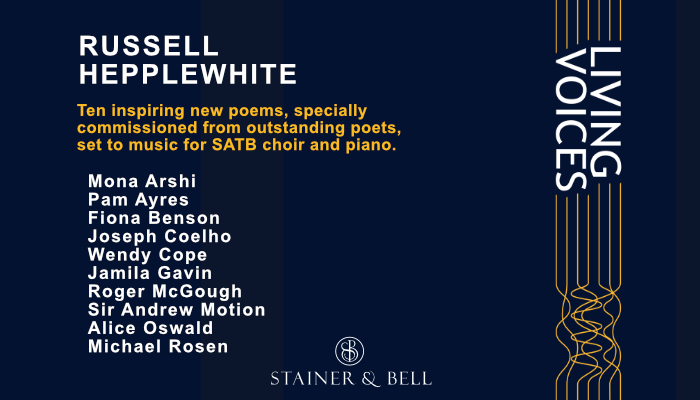
Living Voices is a new collection of ten inspiring choral pieces composed by Russell Hepplewhite. This innovative project brings together the talents of Hepplewhite and ten of Britain’s most outstanding contemporary poets, each commissioned to create poetic responses to our world today.
The idea for Living Voices originated with Russell Hepplewhite, who invited the poets to offer their diverse reflections on the nuances of modern life. The resulting poems explore a wide spectrum of human experience – birth and death, youth and age, sickness and health, landscape and memory. The emotional scope of the collection is equally varied, encompassing pieces that are light-hearted and comic alongside those that are profound and moving.
Accessible and rich in expression, Hepplewhite’s music proves a perfect partner for these contemporary texts. Drawing on his extensive experience writing for the theatre, his compositions aim to translate the poets’ messages into a vibrant collective choral sound. Living Voices promises to engage anyone drawn to the telling interaction of contemporary life and art.
The ten distinguished poets who have contributed to this unique collection and the titles of their commissioned works are:
- Mona Arshi – Tender
- Pam Ayres – Leaving
- Fiona Benson – Three Trees/Angel
- Joseph Coelho – The Diarist’s Pages
- Wendy Cope – I Wake
- Jamila Gavin – Song of Flight
- Roger McGough – The Good Ship Attenborough
- Andrew Motion – ‘from: Gravity Archives’
- Alice Oswald – Riddle
- Michael Rosen – True Story
Ten selected choirs around the UK will each give the world premiere one of these new choral works over the coming months. The project has been funded by private donations and support from the Finzi Trust.
Performances:
5th April I Wake by Wendy Cope, Exeter Festival Chorus, St Peter’s Church, Budleigh Salterton
10th May Leaving by Pam Ayres, Gloucester Choral Society, Gloucester Cathedral.
17th May The Diarist’s Pages by Joseph Coelho, Highgate Choral Society, St Michael’s Church, Highgate
14th June ‘from: Gravity Archives’ by Andrew Motion, Wimbledon Choral Society, Wimbledon High School
21st June True Story by Michael Rosen, Epsom Choral Society, St Andrew’s Church, Cheam
26th June Riddle by Alice Oswald, Whitehall Choir, St Andrew Holborn
5th July Song of Flight by Jamila Gavin, Birmingham Bach Choir, Malvern Priory
5th July Tender by Mona Arshi, Divertimento, St Nicholas Church, Warwick.
5th July The Good Ship Attenborough by Roger McGough, Hexham Orpheus Choir, Hexham Abbey
12th July Three Trees/Angel by Fiona Benson, Voices of Hope, Alnwick Playhouse.
This collection promises to be a significant addition to the contemporary choral music repertoire, offering pieces that are both musically engaging and thematically relevant to modern audiences. The music will be published by Stainer & Bell in summer 2025.
Read an interview with Russell Hepplewhite about Living Voices
Reimaginings and Transcriptions: Vivaldi and Bach in London
The penultimate weekend in March saw me in London for two exceptional concerts in particularly lovely settings. The experience was enhanced by the company of friends and a delicious meal with a wonderful view across Smithfield (former meat market, now the new site for the Museum of London) to St Paul’s cathedral.
A Season to Sing is a reimagining of Vivaldi’s evergreen The Four Seasons for mixed voices by British composer, vocalist and music director Joanna Forbes L’Estrange. A co-commissioning project between the composer, The Royal School of Church Music (RSCM) and over 50 choirs around the world, A Season to Sing was written to mark the 300th anniversary this year of Vivaldi’s The Four Seasons.
The London ‘launch concert’ took place on Saturday 22nd March at historic St Bartholomew-the-Great, a beautiful ancient church in the City of London. Luminosa Music, an exceptional amateur choir (who impressed with their pitch-perfect timing and exquisite, colourful sound) performed the music, the first half comprising choral pieces by Joanna, her husband Alexander L’Estrange, and works by Monteverdi and Thomas Morley, all with a seasonal theme. This set the scene nicely for the second half and A Season to Sing.
The Four Seasons is a perenially popular work, and this is is not the first time it has been ‘reimagined, Max Richter’s Recomposed, being the most famous example. But A Season to Sing is the first time this music has been reimagined for voices. As Joanna says in the concert programme notes, ‘...re-imagining in no way diminishes our respect for the original compositions. On the contrary it offers a new perspective….’ – this latter point being the most striking and magical thing about A Season to Sing.
Think you know The Four Seasons? Think again! Here, the orchestral version is transformed into a colourful extravaganza of sound which makes full use of the human voice (and other parts of the body) to bring Vivaldi’s seasons vividly to life – from whistled birdsong in Spring to “body percussion” to evoke the storm, a bagpipe’s drone and even some Swingle-style wordless ‘scat’ (Joanna was music director of The Swingle Singers for seven years, and the middle movement is dedicated to the group’s founder, Ward Swingle). New details from the original orchestration are revealed by the choir, such as interior lines and textures, and the entire piece feels as fresh as a spring shower. It’s full of affection too, and wit and warmth. It’s a wonderful tribute to this much-loved music.
The Four Seasons is the first piece of classical music I remember listening to as a child. I have very vivid memories of dancing around the room to the 3rd movement of Autumn
Joanna Forbes L’Estrange, composer
A Season to Sing is being performed around the world by the choirs who took part in the commissioning project (find details of all performances here). The score will be published by the Royal School of Church Music on 1st June (pre-order here).
Sunday afternoon and another concert at a lovely venue, this time the 1901 Arts Club, London’s most stylish and convivial small venue. This was a special concert to celebrate the 340th birthday of J S Bach and to launch American pianist Eleonor Bindman’s new album ABSOLUTE – her own transcriptions for piano of Bach’s Lute Suites BWV 996-998.
A lifelong love of J S Bach has led Eleonor Bindman to produce a number of important transcriptions for solo piano and piano duo of his music for other instruments, including the evergreen Cello Suites and the Brandenberg Concertos. In this latest addition to her catalogue, Eleonor has turned her attention to works originally composed for the lautenwerk or lautenwerck (lute-harpsichord), one of Bach’s favourite instruments, similar to the harpsichord, but with gut (or nylon today) rather than metal strings.
The small size of the music salon at the 1901 Arts Club lends itself to “haus konzert” style performances (such as Bach might have known) and the ambiance at this concert was warm and friendly.
Like Joanna’s reimagining of The Four Seasons, Eleonor sees transcriptions as a vehicle to “revive interest in original compositions”, shine a new light on the original work and “increase their popularity”. And just as in A Season to Sing, new details of dynamics, texture, counterpoint and more are revealed in this transcription for solo piano.
But for me the most satisfying aspect of Eleonor’s concert was her ability to bring so much colour and nuance to the music. Her range of sound was impressive, but never too much nor too little. Perfectly balanced to suit the small size of the venue, she brought both intimacy and grandeur (we can thank Bach for that!) to the music. I don’t think I have ever heard the Steinway at the 1901 played better!
The following day I met Eleonor for a most enjoyable, leisurely lunch, replete with much ‘piano chat’ and conversations about food.
ABSOLUTE is out now on the Orchid Classics label and on all major streaming platforms.




 The Cross-Eyed Pianist