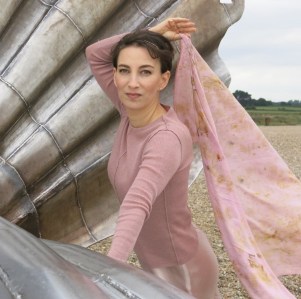
Guest review by Adrian Ainsworth

What an exhilarating record this is. ‘Future Relics’ is the debut album from guitarist Kevin Daniel Cahill, and I think one of the reasons I love it so much is that it feels like it was made not only by a superb musician, but a great listener. As a result, it’s a great listen.

Reading a description of ‘Future Relics’ might initially make you think it’s more like two mini-albums or EPs gathered into one, as Cahill has assembled two very different ‘groups’ of pieces. One set is a series of classical commissions from composers he asked to write for the album, while theremaining tracks, written by Cahill himself, are rock instrumentals.

There’s certainly an intriguing legacy of ‘split personality’ albums in the rock world, where side one might have had the hits but side two was a playground. You might think of the ‘Abbey Road’ medley, or Berlin-era Bowie’s instrumentals on ‘Low’ and ‘Heroes’ – or even Kate Bush’s piece of audio-theatre, ‘The Ninth Wave’, taking up half of ‘Hounds of Love’. Others among you might come at this entirely differently, perhaps after a listen to fellow classical guitarist Sean Shibe’s recent ‘soft / LOUD’ album, half acoustic/ancient, half electric/modern.

But having identified these two separate sides of himself and his art, Cahill goes one step further and mixes them all up. Dovetailing the different styles of track in this way might seem, to coin a phrase, like a small step. But for the listener, it really is a series of giant leaps, with huge dynamic shifts from speaker-busting riffs and percussion to sparse, delicate picking. (The album is of course available digitally – so you can play any individual tracks you like, in any order you want. But as a measure of how important the sequencing is, I was interested to find that the only physical release of ‘Future Relics’ will be on cassette: the hardest format to ‘shuffle’…)So how and why does it work?

The album perhaps gestures most strongly towards the avant-garde with the commissioned tracks. Featuring Cahill solo, they are often steady and measured, almost at times with an improvisational, ‘working-things-out’ feel. The pieces are not in the least predictable, drawing all kinds of different timbres and harmonics from the guitarist. The combination of careful beauty and occasional savagery make you feel that whatever your accustomed style of player – from Xuefei Yang to Derek Bailey – something will resonate with you here. My personalfavourite of these is Ninfea Crutwell-Reade’s ‘Wallflower’ – slightly more fleet-footed, it starts with what sounds like a chiming lead line, only to use it to create cyclic rhythm, while a ‘true’ lead comes in simultaneously, keening, adding a ‘sheet’ of sound almost to ‘”Heroes”’ effect. Haunting yet joyful – a wonderful work.

Despite their immense heaviness at times, the rock numbers also deploy resources with real care and precision. Cahill provides most of the tracks’ heft, with hooks, riffs or drones as required, and gives generous periods in the spotlight to acrack team of fellow musicians. For example, violinist Abigail Young provides the exotic, hypnotic swirl central to ‘We’ve Taken Aqaba!’. On both this track and the fearsome ‘For Deckard’, Graham Costello plays the drums more or less as a lead instrument, driving the piece forward while constantly shifting patterns and rhythms and increasing the intensity. Cahill again finds melody in the metallic, fashioning distorted chords into tunes.

But it isn’t all strum und drang, with quieter electric pieces punctuating the album. The gorgeous, but propulsive shimmer of ‘They speak in never ending light / Resting place, God’s Acre (For Andra)’ manages to look both ways – towards the cyclic sound of ‘Wallflower’ and the more driven, agitated thrust of ‘For Deckard’. The expansive sound occasionally made me think of the peculiarly Scottish feel of ‘Big Music’ (as coined by the Waterboys’ Mike Scott) in whatever form that may take for you: whether it’s split-second echoes of Local Heroics,  or sudden bursts of barely-controlled Mogwai-style power.

Of course, it’s Cahill himself who is the unifying force across the whole record. He has shaped it – clearly he absorbs and goes on to write and play all the different styles of guitar music he loves. At the start of the album, we hear muffled voices and noise, as if the overall experience is going to represent a kind of ‘KDC FM’, with us moving between the various stations.

There’s also a strong sense that Cahill is channelling all these sources of inspiration into one style: his own. For all the reference points I’ve mentioned, throughout the album, he sounds like no-one other than himself – graceful, yet rhythmically robust on both the self-penned and commissioned material. I think the production is also a key element: ‘Future Relics’ is very concerned with the physicality and action of playing. We can hear the movement of hand and fingers against strings; the breathing; ambient hum and static – whatever’s going on, you feel like you’re in the room. This analogue touch will only be enhanced when played on a not-quite-silent cassette.

By representing his wide variety of musical passions, Cahill has made a bold record which will certainly introduce some listeners to styles of music they might not have been expecting. In doing so, however, he has in fact made an admirably coherent statement, demonstrating how one’s own work can successfully reflect many sides to the same person.

Rewarding; recommended.

Future Relics is released on 27 June. More information

Meet the Artist interview with Kevin Cahill


The Stabat Mater, a Medieval hymn which portrays Mary’s suffering as Christ’s mother during his Crucifixion, has been set to music by numerous composers, most notably Pergolesi, Schubert, Dvořák, Pärt and Macmillan. In this new setting, Pietà, a co-commission from the Bournemouth Symphony Chorus and St. Albans Choral Society, British composer Richard Blackford interweaves the text of the Stabat Mater with poems from the ‘Requiem’ cycle by Anna Akhmatova, whose husband was taken away and ‘disappeared’ by Stalin’s KGB; her son was also arrested and she feared she would never see him again. In our troubled, turbulent times, contemporary Pietàs are tragically all too familiar – refugee parents desperately cradling babies and children, mourning mothers in war-ravaged communities, the anger and grief of victims of tragedies like the Manchester Arena terrorist attack or the Grenfell Tower fire…. Through the settings of Akhmatova’s poetry, Blackford makes the Stabat Mater a universal reflection on grief and loss – and the attendant rage, pain and incomprehension.

For seventeen months I’ve pleaded

Pleaded that you come home,

Flung myself at the hangman’s feet

For you, my son,

For you, my horror

from ‘Requiem’ by Anna Ahkmatova

Blackford chose the title after seeing Michelangelo’s marble Pietà in Rome, and, like the sculpture, his new work encompasses grief, rage and sorrow with tenderness, poignancy and, ultimately, beauty and hope. The work is scored for string orchestra, chorus, children’s choir, mezzo-soprano, baritone and solo saxophone. While the chorus and soloists present the main narrative – the pain and grief of Mary and Anna Ahkmatova – the saxophone provides a third, abstract voice, the voice of every grieving mother. Blackford chose the soprano saxophone to create “a modern instrumental dimension, very close to the sound of the human voice”.

michelangelo-pieta-index-new
Michelangelo’s Pietà (St. Peter’s Basilica, Vatican City, Rome)

In its world premiere performance on 22 June 2019 at Poole Lighthouse, Pietà was preceded in the first half by Fauré’s Requiem, which was given a meditative, other-worldly performance by the excellent BSO Chorus under Gavin Carr, with soloists Issie Curchin and Stephen Gadd. This provided a wonderful foil to Blackford’s music, which is intellectual and sophisticated, yet accessible in its use of carefully-crafted melody and counterpoint. Rooted in tonality and modality, Pietà is characterised by rhythmic dynamism, breadth of expression and lush textures, redolent of Janácek and Syzmanowski. The use of a children’s choir (in the fifth movement of the work) is a nod to another of Blackford’s influences – Benjamin Britten – and provides an episode of innocence and sweetness in this grief-scorched narrative.

With powerful, operatic singing by mezzo Jennifer Johnston and baritone Stephen Gadd, a fine, emotionally engaging performance by the BSO and BSO Chorus (whose intonation, timing and precision was impressive), the entire work has a filmic, visual quality with its gripping narrative and vividly descriptive scoring – tumultuous strings, passionate dramatic climaxes, ‘snapping’ pizzicato in the cellos (to represent Christ’s flagellation), jagged syncopated rhythms, an acapella movement of intense concentration and beauty. Organised in three parts, Pietà moves from grief and rage to redemption and hope via nine distinct movements. The obligato saxophone, eloquently played by Amy Dickson, provides a unifying link between the movements, initially haunting, mournful and timeless, evocative of an ancient shawm, and later calm and tender as the music moves towards its hopeful, redemptive close.

An absorbing and committed performance by all, supplemented by detailed programme notes by the composer with translations of the text.

This arresting, emotionally intense and accessible work for choir and orchestra receives its London premiere at Cadogan Hall on 19th October. A recording on the Nimbus Label is expected very soon.


Meet the Artist interview with Richard Blackford


tasmin-little

Who or what inspired you to pursue a career in music?

It was quite by chance – I feel ill with chicken pox and was bored so I began to teach myself the recorder. I really loved playing an instrument and when I was better, I started the piano and the violin

Who or what have been the most important influences on your musical life and career?

Yehudi Menuhin was a huge influence of course…..but I think that all the teachers at school had their own influence and we learned from all of them. Since leaving school and performing professionally, many conductors have influenced me, especially Richard Hickox and Sir Andrew Davis

What have been the greatest challenges of your career so far?

Performing the Ligeti violin concerto – it’s hugely difficult and really challenges the player in every way!

Which performances/recordings are you most proud of?

I am very proud of my Elgar concerto with Andrew Davis and Royal Scottish National Orchestra. It won a Classic BRIT Award and I felt very happy as I waited a long time to record it, so I felt I gave my very best.

Which particular works do you think you perform best?

I’d like to think that I am able to bring some insight into every composer that I choose to perform. If I don’t feel an empathy with a composer or piece, I prefer not to play it! I’d rather leave it to people who like it, and play the things that I like most. That said, I have a huge repertoire so I haven’t exactly limited myself!

How do you make your repertoire choices from season to season?

There are various factors to consider – who I’m playing with and the repertoire that they like. Orchestras often have their own ideas regarding repertoire and then I like to learn new pieces every year so I am always programming new things.

Do you have a favourite concert venue to perform in and why?

I adored playing in Carnegie Hall – the floorboards are alive with history, it’s so inspiring!  I was playing with Simon Rattle and the Berlin Philharmonic Orchestra so I was in amazing company!

What is your most memorable concert experience?

It’s hard to choose because I have had so many fantastic experiences but probably my concert in the Royal Albert Hall at the Last Night of the Proms – the atmosphere was so amazing and so friendly! I also enjoyed playing for 40,000 people in Hyde Park – very exciting indeed to see all those faces!

As a musician, what is your definition of success?

My definition of success is simply to be playing to the very best of my ability.

What do you consider to be the most important ideas and concepts to impart to aspiring musicians?

The most important thing is to be yourself. Anything less than that will come across as un-natural and superficial so it’s important to be authentic

Where would you like to be in 10 years’ time?

I’d like to be enjoying a career in broadcasting, as well as some motivational speaking, plus finding some time for hobbies and seeing plenty of my friends and family!

Tasmin Little performs at Music at Paxton with pianist Piers Lane on 23 July in a programme including music by Schubert, Brahms, Ireland, Vaughan Williams and Franck.

Further information


Tasmin Little has firmly established herself as one of today’s leading international violinists. She has performed on every continent in some of the most prestigious venues of the world, including Carnegie Hall, Musikverein, Concertgebouw, Philharmonie Berlin, Vienna Konzerthaus, South Bank Centre, Barbican Centre and Royal Albert Hall, Lincoln Center and Suntory Hall.

Read more

Guest post by Caroline Bjälstam

I can imagine that an Artistic Director receives hundreds of proposals per day from artist managers like me around the world, wanting their artist to perform in that beautiful concert hall. Many emails are probably not even read and or considered. It is partly understandable: it takes time to go through new proposals, and time is money. It is easier to hire that artist who has already managed to reach the top by playing in important concert halls and has achieved excellent reviews in the media.

If you are in this industry, you know that a lot has to do with the right connections and the right name. If your artist has the right name, he or she is automatically “in”. These top artists are wonderful players, no doubt about that, but do they necessarily transmit their inner feelings and emotions to the public?

The other day I listened to a wonderful concert pianist who is world famous. I listened to a recording of Chopin’s Ballade No. 4 and technically it was outstanding. Absolutely outstanding. But I did not feel anything when he interpreted the piece. For me it was totally empty, I could not feel what he was trying to transmit. I am sure that anyone with sense for music would feel the same, but in a concert hall this name would sell. He is already famous.

I sent the recording of the same piece interpreted by the artist I represent, István Székely to a connection I have on Linkedin, Christina Cooper, who is a Performer Coach. She took time to listen to the recording and responded that she was totally blown away by this recording: “What stuck me the most was the intimacy and connection, it was as though every note was speaking from the essence of his soul.  I can see why you choose to work with István”. Yes, this is the reason I have chosen to co-work with him. For this exact reason, because he gives a true meaning to my work as a Manager. I believe in him 100% and I know that those who decide to contract him also share my belief. His playing leaves an impact on people. Not only is he an extraordinary and technically amazing pianist but every single note has a special meaning, and this is what I want the world to see and hear. Many artists seek and desire fame, maybe because they think it will bring validation. The reason I choose to work with my artist is because I know he has the ability to transmit something very powerful to the audience and leave an impact on people. I want people around me to stay with his name and remember the effect his playing had on them. This is my goal, to spread this joy and feeling to other people around me.

Recently, István performed Liszt’s Concerto no. 1 and Totentanz as a soloist with the extraordinary Academic Symphony Orchestra of the North Caucasus State Safanov Philharmonic. The public was absolutely astonished and the Artistic Director said afterwards that she expected success but not at this level. “It was incredible!! Absolutely sophisticated! Absolutely impeccable, I mean your Liszt“, were the words after by Svetlana Berezhnaya, Artistic Director and Concert Pianist.

If I were an Artistic Director, I would enjoy every moment listening to beautiful recordings sent to me and I would choose an artist that truly touches my soul. I would dare to change the pattern and bring new life in to my concert hall. After all, a lot is about marketing and how you present the artist that will perform. Not all public are aware and are able to follow the names of the top pianists, they trust fully what the concert hall presents. But unfortunately, I am not an Artistic Director…..


0

Caroline Bjälstam holds a Masters degree in Business Administration from Stockholm University, Sweden, and is the President Founder of Rotary Club L’Alfàs del Pi International.

Caroline Bjälstam Artist Management is a classical music artist management company based in Spain and the official Manager of the Hungarian concert pianist István Székely. The company is  based in Spain and provide Worldwide Management.

www.cbartistmanagement.com