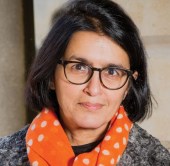
Who or what inspired you to take up piano, and pursue a career in music?

The natural long-term choice for me would have been the violin, or at least a string instrument, as my father was a violinist with the Orchestre de Paris and my grandfather was the Principal Violist of the same and of the Paris Opera Orchestra before that. And naturally, violin was my first instrument, but one I abandoned within just months of starting it. I am not entirely certain why – perhaps I should ask my father about it actually – but a new, shiny black lacquered piano appeared in our house one day and I immediately felt pulled to it. I found a world richer than any other I had known until then, one which gave my imagination free rein and which completely absorbed my attention. Piano just felt natural to me, an extension of my own physical and spiritual being, and still does, although I am far from chained to it or obsessive about it. Of course, learning to play the piano while growing up was not always a smooth road, and I was not always disciplined or desirous of playing, especially as the pressure mounted (I did play many hours each day, usually). But I never questioned my choice of instrument, and I feel like it was always the right one for me. And when adults inevitably asked me what I wanted to do later in life, I always said that I wanted to be a pianist. It seemed like a perfectly natural answer and one which was easy for me to imagine, as I already had experience regularly attending concerts and seeing professional pianists solo with the orchestra. With that said, as a teenager and young adult I did question my choice of career, and tried a number of different things before finally making music my life…

Who or what have been the most important influences on your musical life and career?

My parents, of course, who supported and guided me all along. And some of my teachers, some of whose influence was particularly important, of which I can cite Aïda Barenboïm, my first real teacher (Daniel Baremboïm’s mother) who gave me my musical foundations; Elena Varvarova, with whom I massively improved my technique and discipline; Brigitte Engerer, who guided me in a period of uncertainty; Rena Shereshevskaya and Vladimir Krainev, who gave me confidence and brought me to a truly professional level; and Earl Wild, who encouraged me to go where the music took me. I also have to acknowledge Ursula Oppens and James Giles who exposed me to America’s rich musical world which I did not know much about. I was also lucky to learn bits and pieces from, and be supported by, Carlo-Maria Giulini, Maria Curcio, Charles Rosen, and Kurt Masur, all of whom added something important to my musical journey. But then, my life has also been filled by books, films, museums, travel, and people near and far. It is one thing to learn how to play and how to be a good musician, and it is another to experience life and learn about oneself and one’s humanity, which then should come through in the expression of music.

What have been the greatest challenges of your career so far?

My career has been unusual, and I have always been out of the system. I have never liked the idea of competition in music, whether in formal or informal terms. Either music is an art or it is a sport, and I don’t believe a sport-like competition is how you hone and find the best artists, even if on occasion you do in a sort of coincidence (although without a doubt, true artists will be true artists no matter how they build their career). The reality is that there is a selection process that occurs anywhere you are, whether formally through a competition or a conservatory entrance audition, or through the acclamation or lack thereof of a public and the press. I don’t personally like to participate in something that to me seems antithetical to the development of the artist and the meaning of music. I say this only because my refusal to play that game has probably penalized me in some ways, and made it harder for me to find my place in the so-called music business.

I have also allowed myself to live life and take the time to learn life from a wide-array of experiences, to find where my truth lies and why I even bother being a musician. And then I also have been active as a teacher, as a concert and festival organizer, and as a recording and film producer of sorts, learning along the way many skills that help me express my personal artistic vision more fully and effectively. I am also quite certain of the joy I feel when sharing something I love with an audience: indeed, music is both uniquely personal and also uniquely communal. For this reason, I hope I will have the chance to share my love of Bach’s Well-Tempered Clavier with as many people as possible, both through the album as well as through performances down the road.

Which performance/recordings are you most proud of?

While I began my musical life at the very tender age of three, four years old, and began my performance career at ten, I never rushed into making recordings until I felt sure enough of what I had to say, knowing that there was no absolute need to engrave music permanently that had already been recorded by others before, unless there was another compelling reason to do so. Perhaps surprisingly at this stage of life, my recording of Bach’s Well-Tempered Clavier is my first solo release, but I am not shy of saying that I am exceedingly proud of it and happy to have made it just that way. And while my playing of Bach has already changed since I made the recording, I feel that it is a very accurate representation of who I am as a musician.

I am also still proud and honoured to have given the World Premiere performances and recording of Beethoven’s Piano Trio Hess 47 with my Beethoven Project Trio back in 2009 in Chicago and New York, an adventure forever engraved in my memory.

Which particular works do you think you play best?

I like to get under the skin of the composers whose music I play. When I begin to explore a sound world, I want to go deep and feel the sensitivities and emotions of the composer who wrote that music, which is one of the reasons I like to isolate a composer and focus very intensely on that one artist, usually making pilgrimages to the places where that composer lived and worked and reading a lot, along with exploring as much of his or her music as possible. For big composers, I do think it’s a very valuable experience to really go deep, which is what I did with Bach and his Well-Tempered Clavier, and is what I am doing now with Beethoven as I prepare to record his complete sonatas. Those two composers will always be very close to my musical heart, as well as Rameau, Mozart, Chopin, Debussy and Ravel. I also love Brahms, but am taking my time to take a full dive into his world. More importantly, life is usually circular, and I approach these composers many times, over time and in due time, and until the time I feel ready to go straight to the heart of what they mean to me. As far as specific works that I play best, I don’t think that is as relevant as just feeling close to a composer’s musical language and being free to express my own sensitivity through that adopted language.

How do you make your repertoire choices from season to season?

I don’t play the seasons game. Music and a musical life have to remain organic, natural, flowing. I cannot force myself to think in terms of seasons. I simply go where my passion takes me and let things fall into place as they will. I am human, and more importantly a musician, not a bureaucrat. As long as I have joy to play a program, I will do so. If for any reason I lose that joy, the program will change. What I do guarantee is that I will show up, barring any impossible situation, where I said I would, and I am always game for a challenge. But I will never do anything that will threaten the joy of music making, and the desire to share something that rings true to me at a specific moment. The idea that I can program something more than one, two or three years in advance rings hollow to me, with the probable exception of Bach’s Well-Tempered Clavier, which I have never grown tired of and don’t expect to. But clearly I also love to take my time to explore one work or one composer, and that usually lasts two or three seasons at least…

Do you have a favourite concert venue to perform in and why?

No. As long as there is a minimal amount of climate comfort, and a decent piano, and more importantly a curious audience, I am happy. But I will say that I never had as much pleasure as I did when recording the Well-Tempered Clavier in Weimar’s historic Jakobskirche and on a very unique Hamburg Steinway D that I had found in Paris, through Régie Pianos. Everything about the acoustic and physical experience there was satisfying, and I suppose that’s a good thing when it comes to making a permanent record!

Who are your favourite musicians?

I don’t know. There are lots of musicians whom I admire, and who have made some great recordings, who have performed some memorable concerts, who have moved me, dead or alive, at one time or another of my life. Some musicians have done it more regularly than others, but it’s so subjective, even to me! And truly, for the most part, there is no debate to be had on most of the great musicians. In no particular order, Artur Rubinstein, Josef Hofmann, Dinu Lipatti, Vladimir Horowitz, Claudio Arrau, Marcelle Meyer, Pau Casals, Jascha Heifetz, Henryk Szeryng, Georg Solti, Leonard Bernstein… to stay only with the dead, and to remain terribly incomplete. But I love going down rabbit holes and listening, either to radio, one of the streaming services, or just randomly picking through my record collection, and acquainting or reacquainting myself with a musician. But I am not a guru seeker, so while I enjoy listening, going to concerts, and so on, I am also happy with silence sometimes, which is a great teacher of music.

What is your most memorable concert experience?

I’ve been to many. A performance of Eugène Onégin with Valery Gergiev conducting his Mariinsky orchestra and singers in Paris some twenty years ago has stayed with me emotionally. Deeply memorable also was a masterclass given by Kurt Masur in New York where he showed the arm-waving student conductors how to conduct without even moving his arms (and of course do it better)! It taught me the power of intention and focus.

As a musician, what is your definition of success?

There are several sides to success and different ways of understanding the meaning of success as a musician. For me, first, it is being able to express myself from the fount of my inner truth, in other words, it has to ring true to me first, and remains entirely personal, involving no one else, and which is only possible following a long inner journey of discovery and experience. Second, it is succeeding in the practical sense, having the ability to make albums, to perform, and to transmit what one has learned, in such a way as to be free from need and free to be creative. But that sometimes comes and goes with life’s many ups and downs! So then I hold on to my first precept.

What do you consider to be the most important ideas and concepts to impart to aspiring musicians?

Stop practicing! Begin living! Seriously, if you know how to play scales and arpeggios, know how to read music, and have covered some basic repertoire from different periods, your basic instrumental education is over. I think way too many musicians try the athletic approach to music, and think they have to be as good if not better technically than the current stars. Perhaps so, in a sense, okay, fine. But a big part of learning to be a good performer, even a good technician, comes from loosening up and taking a step back. Live! Love! Make mistakes! Learn! What else is true music, true art about, if it is not about life? The practice room is too small to let life in. Don’t let life slip by, and find your truth through experience, through the highs and the lows of it all. Confront yourself to reality, not theory. The conservatory is not the place to learn to be a musician, but only a technician. That’s fine for a bit but don’t expect too much from it, if you really have it in you to be a musician. Stop studying as soon as you can, and you’ll have a greater chance of becoming a musician someday.

Where would you like to be in 10 years’ time?

A good place, on a cooler and calmer planet, in harmony with my environment and humanity both physically, emotionally and spiritually.


A concert pianist since his formal debut at age ten in Paris, George Lepauw has performed ever since as a recitalist, chamber musician, vocal collaborator, and soloist with orchestra. He also occasionally collaborates with musicians from other musical genres, including cabaret, musical theater, traditional Chinese and Persian music, flamenco, blues, and pop.

Read more

Guest post by Nick Hely-Hutchinson

The first in a series of guest articles exploring people’s personal responses to or relationship with Beethoven and his music.


Beethoven and me go back a long time. I recall precisely the first occasion I heard his music.

I was taken as a young child to one of the early Charlie Brown films. Along with Linus and Snoopy the dog, Schroeder is Charlie Brown’s closest friend. But the other passion in Schroeder’s life is Beethoven. He is, you might say, nuts about him.

beethoven1600x372

During the film, Schroeder plays the slow movement from the Pathétique sonata, and I went home resolved to learn the piece. (Battling the two outer movements came some years later. This became something of a pattern for me – “Oh, I could play that!”, only to discover that Beethoven rarely composed simple stand-alone works.)

You are going to read a great deal about this complex man during 2020, this being the 250th anniversary of his birth. I am no expert, no musicologist, just an amateur enthusiast, but Ludwig van Beethoven gets my vote as being one of the most influential people ever to grace the planet. The simple truth is that he threw away all the rules, and nothing in music, perhaps even the wider arts, was the same after him.

Readers of my blog, manuscriptnotes.com, will know that Schubert is my favourite composer. But if I had to single out the one composer who had, has, the greatest impact on me in so many ways, it would have to be Beethoven. In the context of classical music, I am minded to replace the word ‘music’ in John Miles’s famous lyric to read ‘”Beethoven was my first love and he will be my last.”

Why so?

It may sound hokey, but in Beethoven’s music you have everything of what it means to be human. Schulz’s cartoon above says it all. His irascibility, temper, scruffiness, woeful love-life, manifold dwellings, poor personal hygiene are all well known; as is his near thirty-year struggle with deafness, a particularly cruel infliction for a composer. All of these traits and frustrations are writ large in his music: never before has the personality, the humanity, of a composer been so glaringly revealed in his output, whether symphony, concerto, sonata, choral work, or chamber. All his music speaks to us of life itself.

Lest you charge me with spewing out sentimental nonsense, let me try and demonstrate it with a piece of music with which you may not be familiar.

Beethoven wrote sixteen string quartets, a form first used by Haydn, then developed by Mozart. Conveniently, these fall into three periods in his life, early, middle, and late, and it is the slow movement of one of the late ones, no.13, which sums up this humanity more than any other piece I know.

Writing about music is notoriously difficult, and nothing demonstrates that better than this. The 5th movement, the Cavatina, does not have a tune per se that will leave you humming it later. Marked molto espressivo, you may not ‘get’ it at first. I didn’t. But after a few listens you will want to submit to its profound and indescribable beauty, yearning for it to go on when it comes to a sudden halt. At its heart is a searing violin, the music soon enfolds you in this heart-wrenching blanket of tenderness. Half way through, there is a brief ‘choke’, a change of tempo, and it is widely believed that a blotch on the original score is a tear from the eyes of its composer.

Beethoven could only hear these notes in his head – he couldn’t test anything out on a keyboard. Composed less than two years before his death, you can feel the aching sorrow at his condition, but also a sense that after all the bang, crash, wallop we associate with Beethoven, this, more than anything else, (and he wrote some truly gorgeous slow movements) is the purest summation of the man, his music, his life – and, by extension, humanity itself.

If that consigns me to Pseud’s Corner, I go willingly.


Nick Hely-Hutchinson worked in the City of London for nearly 40 years, but his great love has always been classical music. The purpose of his blog, Manuscript Notes, is to introduce classical music in an unintimidating way to people who might not obviously be disposed towards it, following a surprise reaction to an opera by his son, “Hey, dad, this is really good!“. He is married with three adult children and is a regular contributor to The Cross-Eyed Pianist.

There’s a Twitter account called Richard Feynman, after the American theoretical physicist and Nobel prizewinner. He was also a renowned pedagogue and many of the tweets from this account are quotes from Feynman on teaching and learning. While his speciality may have been physics, his approach to teaching and learning is universal. For those of us who teach and study music, there are some wonderful Feynman nuggets to inspire and motivate. Here are just a selection:

As you would expect from someone with a mind like Feynman’s, he advocated curiosity and questioning, challenging perceived norms and standard ways of doing things. I particularly like this rejection of rote learning:

And this, which I feel is an excellent manifesto for musicians:

And finally this one, which for me really sums up how, as musicians, we should practice our craft on a daily basis (for “Mathematics” substitute Music):

Guest article by William Howard

howardskempton_forwebsite
Howard Skempton

Howard Skempton is one of the UK’s most engaging and distinctive composers. Now in his seventies, he has produced a large and varied body of more than 300 works. Amongst these are over 100 pieces for solo piano, which he describes as the ‘central nervous system’ of his work. It is a treasure trove for both amateur and professional pianists, in which most of the pieces are very approachable from a technical point of view (in contrast to a great deal of contemporary piano music) whilst being at the same time hugely rewarding to explore and perform.

Almost all of Skempton’s piano pieces have been written for friends and colleagues or for special occasions. They are predominantly short, tonal and sparingly composed, with very few notes to the page. Many of them look very simple and are, in fact, quite easy to sight read, but, in my experience the only time these pieces are ever easy is when you are sight-reading them. As soon as you start practising them the challenge begins. Their apparent simplicity is deceptive, a conclusion reached in an excellent programme on BBC radio 3 recently called The Simple Truth, in which Tom Service explored the subject of ‘Simplicity in Music’. Commenting on one of Howard Skempton’s short piano pieces, he said “Simple, isn’t it…well, you try composing it!”. I would add “try playing it!”.

One of my favourites is Solitary Highland Song, which he wrote in 2017 for a collection of love songs for solo piano that I commissioned. When the piece first arrived, I immediately read it through and found it deeply moving. In fact, I couldn’t get it out of my head for days. It consists of a simple and haunting eight bar tune, repeated six times, each time slightly differently. The dynamics start at pp, progress to mp and return to pp. Nothing complicated here. And yet I remember practising the piece for hours and hours before I gave its first performance, and I still practise it a lot before a performance. Why? The simplest answer that I can give is that it takes time to really hear the music. Skempton’s musical language is so distilled and pared down that every note, chord and musical gesture must be perfectly calibrated. Quite apart from the question of mastering total control of touch and voicing, the performer must seek out the essential character of each piece by learning to be open to what is interesting within the music, rather than trying to make the music sound interesting. There are no short cuts in this process. Skempton deliberately gives only minimal performance instructions, so that performers are invited to participate in the music and develop their own awareness of subtle changes and shifting patterns. The more I play Solitary Highland Song, the more I become aware of the genius behind every choice the composer has made: the subtle changes of register, for example, or the distribution of notes in chords and unexpected changes of harmony and rhythm. For me the piece is an enduring delight, and, I think for others too, since it has recently achieved the wonderful landmark of being heard over a million times on streaming platforms.

An example of an even sparser piece would be the third of the Reflections, a collection of eleven pieces that Skempton wrote for me between 1999 and 2002. It consists of four two note chords, a ninth or tenth apart, which are repeated in a different order eight times. The only performance instructions given by the composer are that the chords should all be played approximately two seconds apart, ppp and pedalled throughout. Where is the challenge here? Well, for a start, it is not easy to sustain molto pianissimo playing with a consistent sound, even for just over a minute. The more you play the piece, the more your listening becomes tuned in to the slightest blemish, or bumped note. And the more you listen, the more you start to become aware of the harmonic resonance shifts in different ways as the order of the chords change. By the time I came to record this piece, my ears were highly sensitised to the point where the tiniest imbalance in a chord would sound like a catastrophe. But it became very clear in the recording sessions that what brings a performance to life for the composer are the tiny unexpected or unplanned things that happen and the way a performer responds to them. In his characteristically gentle and encouraging manner, Howard Skempton decided that what we might have called ‘blemishes’ should be referred to as ‘involuntary refinements’! For him, the most important thing is to keep the music alive at every moment rather than aim for clinical perfection.

I recommend this repertoire strongly to fellow pianists at every level of ability. You will find pieces that are hauntingly beautiful, others that are quirky and playful; they are always imaginative, beautifully crafted and unpredictable. As well as giving a huge amount of pleasure they can teach us a great deal about our relationship to the keyboard and about how we listen to ourselves. Having totally immersed myself in Skempton’s music recently, I find that all the other repertoire I am coming back to sounds new and refreshed to my ears.

Scores are easy to obtain. Oxford University Press have published three volumes of Skempton’s piano pieces, which are reasonably priced. Most recently Howard Skempton has taken on the challenge of writing 24 Preludes and Fugues, an intriguing cycle of miniatures covering all 24 major and minor keys, written last year and lasting barely 23 minutes. These will be published by OUP in the coming months.


William Howard’s recording of Howard Skempton’s 24 Preludes and Fugues (2019), Nocturnes (1995), Reflections (1999-2002) and Images (1989) will be released on Orchid Classics (ORC100116) on 14th February. Pre-order here.:

Anyone who pre-orders the album can enter a prize draw to win one of five copies of Solitary Highland Song, signed by the composer. Please forward your order confirmation email to mail@williamhoward.co.uk before 14th February.

The album will be launched with a recital by William Howard at Kings Place on Wednesday 12th February at 7.30pm in which he will play works by Bach, Schubert and Howard Skempton. Tickets and further details here

Meet the Artist interview with William Howard

williamhoward.co.uk

orchidclassicsorc100116