
Do you ever get the feeling you are watching yourself playing, seeing yourself from a distance, as if sitting in the audience?
Sports people describe this quasi out-of-body sensation as being “in the zone”. It is related to “flow”, a psychological concept first proposed in 1969 by Hungarian psychologist and professor Mihaly Csikszentmihalyi, in which the person performing the activity is fully immersed in a feeling of focus, deep involvement, and enjoyment in the process. In short, flow is a total absorption in what one is doing. It occurs when one is engaged in an activity regarded as highly self-rewarding and characterized by clear goals, unambiguous feedback, a loss of self-consciousness and a balance between the challenges and skills required to best perform it.
According to Csikszentmihalyi, flow is a single-minded immersion and represents the ultimate in harnessing the emotions to perform and serve. The emotions are contained and channeled, energised and aligned to the task at hand; one may also experience a heightened sense of freedom, disengagement and lost time, as if everything is happening unconsciously. Flow can create a sense of confidence, enjoyment or even ecstasy, but fundamentally it is about absolute focus and intense concentration.
The best moments in our lives are not the passive, receptive, relaxing times . . . The best moments usually occur if a person’s body or mind is stretched to its limits in a voluntary effort to accomplish something difficult and worthwhile
Mihaly Csikszentmihalyi, 1990
A flow state also includes physical attributes, such as a feeling of synergy between mind and body, and the sense of everything working smoothly: the joints feel well-oiled, the muscles are warm and super-responsive, movement feels effortless.
Csikszentmihalyi defines the eight characteristics of flow as:
- Complete concentration on the task
- Clarity of goals and reward in mind and immediate feedback
- Transformation of time (speeding up/slowing down)
- The experience is intrinsically rewarding
- Effortlessness and ease
- There is a balance between challenge and skills
- Actions and awareness are merged, losing self-conscious rumination
- There is a feeling of control over the task
Flow state, in musical practice and performance, is hard won, however, and while Csikszentmihalyi believes that music and flow are closely linked – mainly because music is a positive, pleasurable activity that can sustain intrinsic motivation, one of the chief features of flow experience – people with particular personality traits are more likely to experience flow than others. Such people have what is called an “autotelic” personality, characterised by curiosity with a predilection for doing things for their own sake rather than chasing an external goal, persistence, conscientiousness and the ability to successfully manage a rewarding, positive balance between the challenge and one’s skill level. Research has shown that people with a tendency to anxiety, neuroticism and self-criticism are less likely to experience flow.
For the musician, flow is a significant intrinsic motivator because a flow state can induce positive emotions and pleasurable sensations, and achieving flow in practising, for example, will encourage one to stick to the task. In this respect, flow is related to self-determination, self-esteem, autonomy and resilience – all imperatives for the musician – and the ability to find joy in challenges and the motivation for mastery is essential to one’s personal musical development.
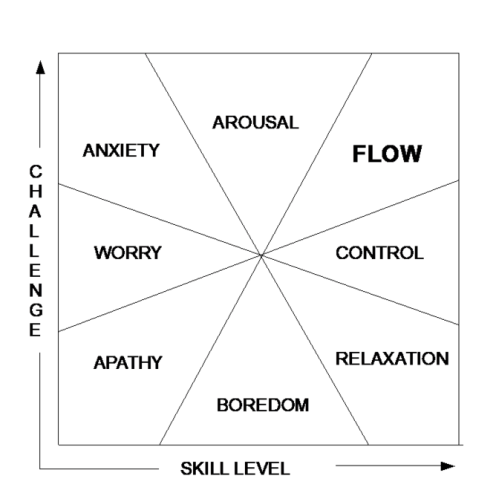
Csikszentmihalyi’s nine dimensions of flow:
1. Challenge-skills balance: If the challenge is too great, we grow frustrated; too easy and we get bored. In the flow experience, an equal balance between the challenge and our skill ensures we are engaged by the task, not overwhelmed by it.
2. Action-awareness merging: Merging results in a feeling of body/mind unity and unity between musician and music.
3. Clear Goals: in a flow experience, when musicians have clear goals, they know what needs to happen, engage with the task, and let go of irrelevant stimuli and distractions that may interfere with their performance.
4. Unambiguous Feedback: Direct, immediate feedback is constantly present so that we can remain connected to the activity and adjust our reactions accordingly to meet current demands.
5. Concentration on the task at hand: intense concentration narrows our attention to exclude unnecessary distractions. When absorbed in the activity, we are only aware of what is relevant to the task at hand.
6. Sense of control/no fear of failure: Control helps us overcome anxiety. When in flow, musicians often report feeling they give their best performances.
7. Time transformation: When in flow we experience a distorted sense of time – it speeds up, slows down or stops. This can occur during practising or in performance, when one is intently absorbed in the task.
8. Autotelic experience: Flow is an intrinsically rewarding experience: the activity is done for its own sake, an end in itself, and produces feelings of satisfaction, fulfilment and pleasure.
9. Loss of self-consciousness: When in a flow state, we experience a reduced self-awareness, including a transcendence of the self. Lack of self-consciousness results in an pleasurable experience because we no longer experience anxiety, fear, or self-doubt, and the inner critic is silenced.
The unselfconscious musician is unconcerned with criticism, real or imagined. There is no fear of failure, no consideration of an unsuccessful performance. These moments of unselfconscious action allow one’s potential to be fully realised, without the limiting influence of anxiety. Musicians treasure such moments, as they bring physical and emotional freedom, and a sense of conviction and natural artistry to their performance.
The paradox is that when one is performing in a flow state, the music will appear effortless, spontaneous, created “in the moment”, yet is the result of many thousands of hours of concentrated, focussed practising, the intense honing of one’s skills and the acquisition of mastery. The British pianist Stephen Hough has a good description for this, that one must be “a bohemian on stage” and “a perfectionist in the practice room”; in effect, that artistic freedom is achieved through intense discipline.
We can create the right circumstances in the practice room to achieve flow. These include:
- a heightened awareness of touch (for the pianist, the pads of the fingers)
- tension-free whole-body movements to create a sense of oneness with the instrument and the music
- quality of sound and constant self-feedback (“do I like this sound?”, “what can I hear?”)
- avoid over-thinking and replace negative self-talk with positive affirmation
- appreciate and transmit the meaning of the music and be alert to its imagery and narratives
- always play with expression, even when practising scales or exercises
- remain “in the moment” when playing
Practising with this mindful awareness increases our ability to bring joyful and absorbing feelings of flow into performance, resulting in greater expression, conviction and emotional engagement, physical freedom, quality of sound, and reduced anxiety.
For the audience too the experience may be equally absorbing, a sense of being at one with performer and music, a state of relaxed concentration, and, literally, “going with the flow”…..





 The Cross-Eyed Pianist