
Guest post by Walter Witt
We live in a crazy world. Some would say a world out of control. Fake news from politicians themselves instead of fake news about them. Conspiracy theories pushed by populist (read authoritarian) leaders – or as the case may be, soon to be ex-leaders. “End of timers.” “Anti-vaxxers.” “Science deniers.” Unchecked corruption, without the slightest regard for what was once called the rule of law. And, as if that weren’t enough, the world faces the prospect of a never-ending pandemic, a virus simmering among us, killing the elderly and young alike, while people refuse to wear masks just to make a “political statement.” How then, amidst all of this, and more, can music, the simple act of studying the piano, help us resist this real world onslaught? How does studying piano help us improve the quality of our everyday lives?
I suspect there are some of you who are musicians and are simply curious about what I am going to say. Others who are professionals with non-professional artistic interests, interests which you work hard to pursue. Others among you who are parents and wondering how in the dickens you are going to convince your kids to stop surfing Instagram or Snapchat and instead practice the piano for at least 15 consecutive minutes..
Around 10 years ago, my daughter, who was 9 at the time, had taken the delightful habit of dancing while listening to me play a Chopin Etude or a Brahms Intermezzo. One day, while I was practicing, she turned to me and asked: “Papa, who taught you to play like that?” Her question got me thinking. Who was it in fact who taught me to play? And what did I really learn from them, not only about the piano, but about the important lessons of life? Or about myself? And why am I even doing this ‘piano thing’ anyway, sitting at a keyboard while my back gets stiff – what’s the point?
Unbeknownst to my daughter – and, thankfully I did not drop these weighty questions on her then as she would have no doubt run from the room, hands in the air, screaming – I started to put pen to paper and write down my thoughts.
Learn what it means to accept challenges
I realize now what my father, a surgeon but also a pianist and organist equally talented in both instruments, meant when he said: “sitting down at the piano can be the hardest part of playing the piano.” There is a moment when you decide to learn a piece. Something tells you there is no alternative. No more playing around with a melody here or a passage there. It is like thinking of that client or project, mulling it over, but never actually signing the contract.
So you accept the challenge before you. You realize it is time. Sometimes it can take years – like finally saying hello to a neighbour. You meant to do it earlier, thought about what to say, but you never started the conversation. It was too much effort at the time or something else came up. There was always an excuse. But now you are going to learn this piece because you want to yourself, not because someone else wants you to. So you start that long difficult job or project. You say hello to that neighbour. You finally greet the music before you.
When I start a new piece, I invariably think of my beloved childhood piano professor, Mae Gilbert Reese, a student of Nadia Boulanger at the American Conservatory near Paris. I see her standing next to me. She is saying: “this is the beginning of a journey. I helped get you to this point but you brought yourself here alone. The journey will be difficult. You will stop at points as you travel, stumble over notes, get stuck in a phrase and think you cannot move forward, that there are too many obstacles. Your back will ache. Your fingers will ache. But you know what the piece must sound like. You can hear it. You can see where your destination is, so you go on. You return to the piano and get on with it.”
Then when I start the piece, my reflexes turn on. I am an athlete again. A pianist approaches the entire act just as an athlete does, investing oneself fully in the moment, through a process of constant self-preparation.
Respect your body
There are exercises Mrs. Reese taught me – how to relax your arms, your hands, your wrist, your fingers. Lean over and let your lower back muscles stretch out naturally. Your upper body slowly drops the ground as gravity takes over. Let your hands drop flat on the ground, watch them drop. Soak your hands in hot water for a minute. Do this first. Then sit down at the piano.
Prepare yourself physically first for what is ahead. Always do this, no matter what you do.
Take your time.
When you start a piece, you sight read. It’s the same as looking over a job and preparing an action plan for the project first. Your reflex is to go fast. Resist this reflex. Start at quarter tempo, no more. Simply listen more closely to the harmonies and the structure of the piece as you play it slowly for the first time. You are outlining the job ahead. Think of the composer writing the piece out with his pen, the time he or she took to write each note. So slow down, watch your hands and examine each note. The notes enter your fingers correctly from the start this way. You are starting what could be a difficult task, trying to solve a problem. It is like a relationship which can be difficult. There are emotions to sort out. You have to decide what to do.
Start slowly and later, you can speed up. When you learn to drive you don’t drive on the highway first, especially with a brand new license. You start on the surface streets. There will be time for the highway later.
Think of what are looking at while you are looking at it
When I was a kid, I needed to remind myself this early on. The reason was I did not see well sometimes, even with my glasses, perhaps why I am not as a good a sight reader as I would like to be. It really is a question of eyesight. You need to see what is in front of you on the page. It’s like seeing what’s in front of you in life and focusing on it. If you do this, you are fortunate – seeing something for precisely what it is, and not thinking you see something when in fact you don’t.
Sometimes it is easier to see what you want, in certain instances. All of us do this. It is a human frailty, perhaps linked to our capacity to dream, a gift which distinguishes us from animals, as far as we know. One’s dreams do not have to be an entirely new world or creation either. They can be the slightest of differences from reality.
I can remember taking off my glasses just to see how long I could get around my day without them. So what if things are a little blurry, right? I would leave them off. Unfortunately, my glasses had an annoying way of disappearing that way! So I kept my glasses on. To see things as they are in life – the sharp details of responsibilities. Don’t worry about taking the time it takes to see something and to understand it. Resist the temptation not to look at the hard edges. It may be perfectly human to do so, but you can’t afford to do it, especially in today’s world.
Learn how to listen – really listen!
Most people have no idea what listening means.
My sister and I used to play a game, before I started the piano. My sister would sing a note. I would go to the piano, look at the keyboard, and play the note. Then she would sing a melody. I would listen and sing it back. Then I would play it on the piano. My sister would then turn me around and tap a chord on the piano while I faced the wall and ask me what chord it was. I would go back to the keyboard and play the chord. To end the game, she would finally lift both hands and – in a surprisingly energetic gesture – bring both hands down, randomly, on the keyboard! I would return to the piano, find the notes and play them. I had perfect pitch but more importantly, I learned early on to listen.
Sometimes when I practice a piece, I play the right hand quietly or not at all, moving my fingers like phantoms floating lightly over the keys. Then, as the fingers of my right hand move silently, I play the left hand full voice. I listen closely to what the left hand is saying. I hear new voices that were previously neglected.
Walk in the streets, close your eyes and listen to what you hear. Listen to bits and pieces of conversations as people pass by. A couple are talking about each other’s workday — “this girl in my class is very shy” a woman, a schoolteacher, says to her husband. “I can’t stand my job anymore,” the husband says to his wife. You hear a mother encouraging a child riding her bicycle for the first time. “Very good – keep going,” she says. “Very good.” Then other people approach. You can hear them greeting each other. You listen to their steps as they pass. You listen to the wind moving through the trees. Concentrate on listening to the moment itself. You will be surprised how much better you listen afterwards.
Beware of the pedal
No pedal at first. The pedal has a way of making you think you play better than you do. The pedal is like a hoax that you perpetrate on yourself. It is similar to a good bottle of wine: you wake up at some point, probably with a hangover, and realize that without that pedal, without that bottle of wine, you are not quite as beautiful as you thought you were! Be honest with yourself – no pedal to start.
Look ahead
Always. When you work through a piece, remember that you are going somewhere – that the music has to go somewhere. Think of the notes you are playing but also the next note, the next phrase. Prepare yourself. Position your hand. Construct your fingering for where you are going next.
Get yourself into position first, no matter what you do in life. Otherwise you may have to improvise a passage to survive (this happens to everyone these days!). Think where you are going first, anticipate. Plan on how you are getting there, then act accordingly. Think of where you are going as you go.
Remember to rest
Close your eyes for 5 minutes. Drop your arms by your side — no movement, just like that stretching exercise. I remember how Mrs. Reese would stop me abruptly after a long session on a piece: “I think we’ll stop for a while here, go on to another piece. We will come back later,’’ she would say. She knew that the intensity of music fills you completely. You become saturated. Music, particularly great music, is that way, particularly when you perform it. Stop to rest no matter how large the problem may appear to be. Then start again.
Be conscious of your environment
Always remember the key you are in as you play. You are A minor, or F minor, or E-flat major. Think of the flats or the sharps. It is like your surroundings on a journey. Are you in the city? In the country? Are you surrounded by people? Are you alone? Think for a moment and then play the scale on the piano, just to clear your mind. Stop and think of the place you are in and then return to the problem. You will have a better idea where you are going if you do.
Watch your time
Watch your time when you practice. Keep moving through the piece, otherwise you will become tired. Or hungry. You will call it quits! Your body simply becomes weak. Later on in life, you become conscious of the limited time you have left. It will weigh on you and can even become your greatest suffering. We all must guard against wasting time in life on things we can’t control, no matter how crazy they may seem. Keep track of your time on this earth.
Don’t fool yourself with the easy parts
Whatever you do, don’t play the easy parts first! They are like the downhill slopes on a cross country race. Instead, go straight to the difficult passages. My teacher, Mrs. Reese, would call these the “technical” passages, sections of a piece that seem impossible to start. The ones that scare you and are terrifying to look at, even on the page. The technical passages are the challenges which you will face in life. Go straight at them. Do not flinch or look for the easy way out. You will delude yourself and end up going nowhere.
Take notes
Keep a pencil ready with you to mark your thoughts as you go. Mark comments on your performance but above on the performances of others. As you are play the passages, mark the score and write down your thoughts. Note the dynamics, the crescendos and diminuendos in your life as you live it.
My father was a champion note taker – he had to be, writing histories and physicals on his patients or surgical reports. My father wrote me letters over the years, no matter what continent I happened to be on at the time. They were just short notes, to say he was thinking of me or to let me know how things are. The letters were never long. Nor were they ever in the least way self-aggrandizing. In fact, I never recall a single time in his letters when he mentioned an honour conferred on him in the course of his work, although there were many. I read these letters again sometimes as they have given me comfort through the years. It wasn’t until later however that I realized I had been reading his notes to me, in my piano, every day. “Don’t hurry,” he tells me in the margins of my Cortot edition of Chopin’s Fourth Ballade, marked in pencil at the recapitulation. “Steady,” he says, at the beginning of the coda at the end of the piece. I see my father’s handwriting next to Mrs. Reese’s in the margins of the same score. They are invariably clear, concise written words – “hold,” “softly,” “slow down.” Clear and concise. Sometimes they are simple translations from Italian or French for example —‘Spianato’ –Italian ‘spanare,’ to smooth over, simple, plain” …. ‘La fille aux cheveux de lin’ : The maid with the flaxen hair. My father never spoke French, or Italian for that matter. He understood however the importance of language, of precise meaning, and certainly for the purposes of his piano.
Classical music is a precise business, and a precise business merits note taking. Every note and phrase, the sense of a phrase and what each phrase means, counts. The composer intended each phrase to mean something. So take the time mark even as you are playing. Sometimes I will lift my left hand and mark as I play while my right hand continues playing, circling a note to accent, marking “piano” here, “pianissimo” or “forte ” there. It is like writing a journal. You jot down the relationships which count for you, whether you made the right decision to go somewhere or meet someone. Perhaps you see something beautiful which delights you. Or something else which repels you. Write down your thoughts as you go through life wherever you are. You will come to think differently of the journey.
These “lessons from the piano” will resonate more with some perhaps, and less with others. On the whole however, they are lessons that have served me well, keeping me strong, particularly in difficult times such as those we are living through today. I hope they will do the same for you.
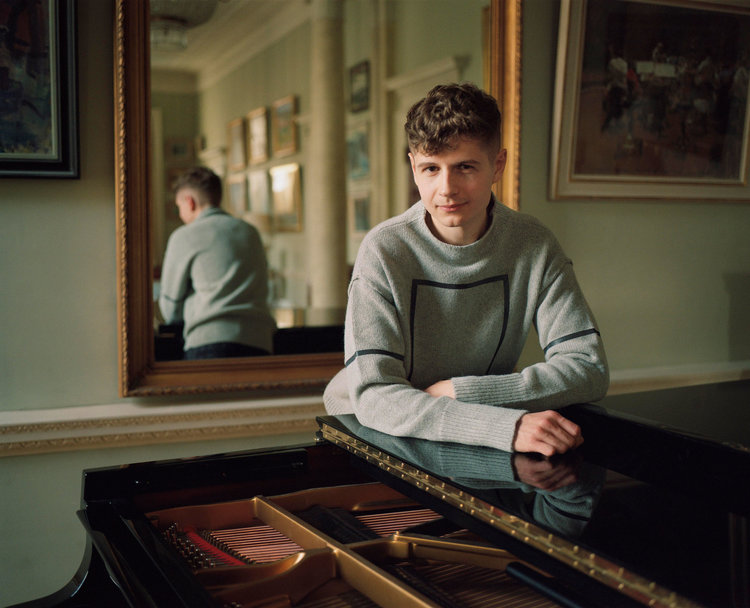
 Walter Witt is a classical pianist, composer and educator based in Paris. A lifelong student of the works of Chopin, Walter captivates audiences with his innate musicianship and dynamic presence at the piano. Together with his advocacy for classical music and its educational importance, these talents make him one of the most compelling figure in classical music today.





 The Cross-Eyed Pianist