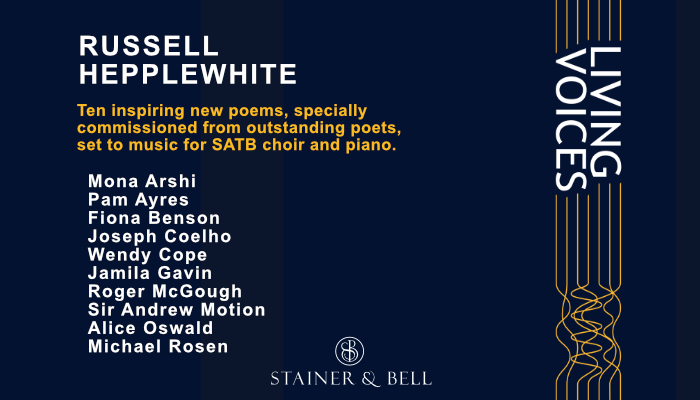
Living Voices is a new collection of ten inspiring choral pieces composed by Russell Hepplewhite. This innovative project brings together the talents of Hepplewhite and ten of Britain’s most outstanding contemporary poets, each commissioned to create poetic responses to our world today.

The idea for Living Voices originated with Russell Hepplewhite, who invited the poets to offer their diverse reflections on the nuances of modern life. The resulting poems explore a wide spectrum of human experience – birth and death, youth and age, sickness and health, landscape and memory. The emotional scope of the collection is equally varied, encompassing pieces that are light-hearted and comic alongside those that are profound and moving.

Accessible and rich in expression, Hepplewhite’s music proves a perfect partner for these contemporary texts. Drawing on his extensive experience writing for the theatre, his compositions aim to translate the poets’ messages into a vibrant collective choral sound. Living Voices promises to engage anyone drawn to the telling interaction of contemporary life and art.

The ten distinguished poets who have contributed to this unique collection and the titles of their commissioned works are:

  1. Mona Arshi – Tender
  2. Pam Ayres – Leaving
  3. Fiona Benson – Three Trees/Angel
  4. Joseph Coelho – The Diarist’s Pages
  5. Wendy Cope – I Wake
  6. Jamila Gavin – Song of Flight
  7. Roger McGough – The Good Ship Attenborough
  8. Andrew Motion – ‘from: Gravity Archives’
  9. Alice Oswald – Riddle
  10. Michael Rosen – True Story

Ten selected choirs around the UK will each give the world premiere one of these new choral works over the coming months. The project has been funded by private donations and support from the Finzi Trust.

Performances:

5th April I Wake by Wendy Cope, Exeter Festival Chorus, St Peter’s Church, Budleigh Salterton

10th May Leaving by Pam Ayres, Gloucester Choral Society, Gloucester Cathedral.

17th May The Diarist’s Pages by Joseph Coelho, Highgate Choral Society, St Michael’s Church, Highgate

14th June ‘from: Gravity Archives’ by Andrew Motion, Wimbledon Choral Society, Wimbledon High School

21st June True Story by Michael Rosen, Epsom Choral Society, St Andrew’s Church, Cheam

26th June Riddle by Alice Oswald, Whitehall Choir, St Andrew Holborn

5th July Song of Flight by Jamila Gavin, Birmingham Bach Choir, Malvern Priory

5th July Tender by Mona Arshi, Divertimento, St Nicholas Church, Warwick.

5th July The Good Ship Attenborough by Roger McGough, Hexham Orpheus Choir, Hexham Abbey

12th July Three Trees/Angel by Fiona Benson, Voices of Hope, Alnwick Playhouse.

This collection promises to be a significant addition to the contemporary choral music repertoire, offering pieces that are both musically engaging and thematically relevant to modern audiences. The music will be published by Stainer & Bell in summer 2025.

Read an interview with Russell Hepplewhite about Living Voices
An interview with composer Russell Hepplewhite

What was the initial inspiration behind the Living Voices project?

Firstly, I love working with words – almost all the music I compose is to be sung. I’d been talking with the publishers Stainer & Bell about a new collection of choral works for a while, and so I began thinking about texts. I came to the realisation that I’m not really interested in setting words by deceased poets anymore – it’s too one-sided with no possibility of collaboration! Instead I wanted to create a connection with living writers, to communicate and work together; to better understand their words with honest conversations about their intentions; and to hear their responses to my music. So the idea was born – and the next step was to find the ten poets I most wanted to work with, and to see if they might be interested in being part of the project. The final step was to choose a theme, and so I decided to go for as broad a subject as possible, to enable as wide a variety of responses as I could obtain. I therefore asked each poet to write about something connected with ‘life,’ and said they could choose to write in any style and with any tone.

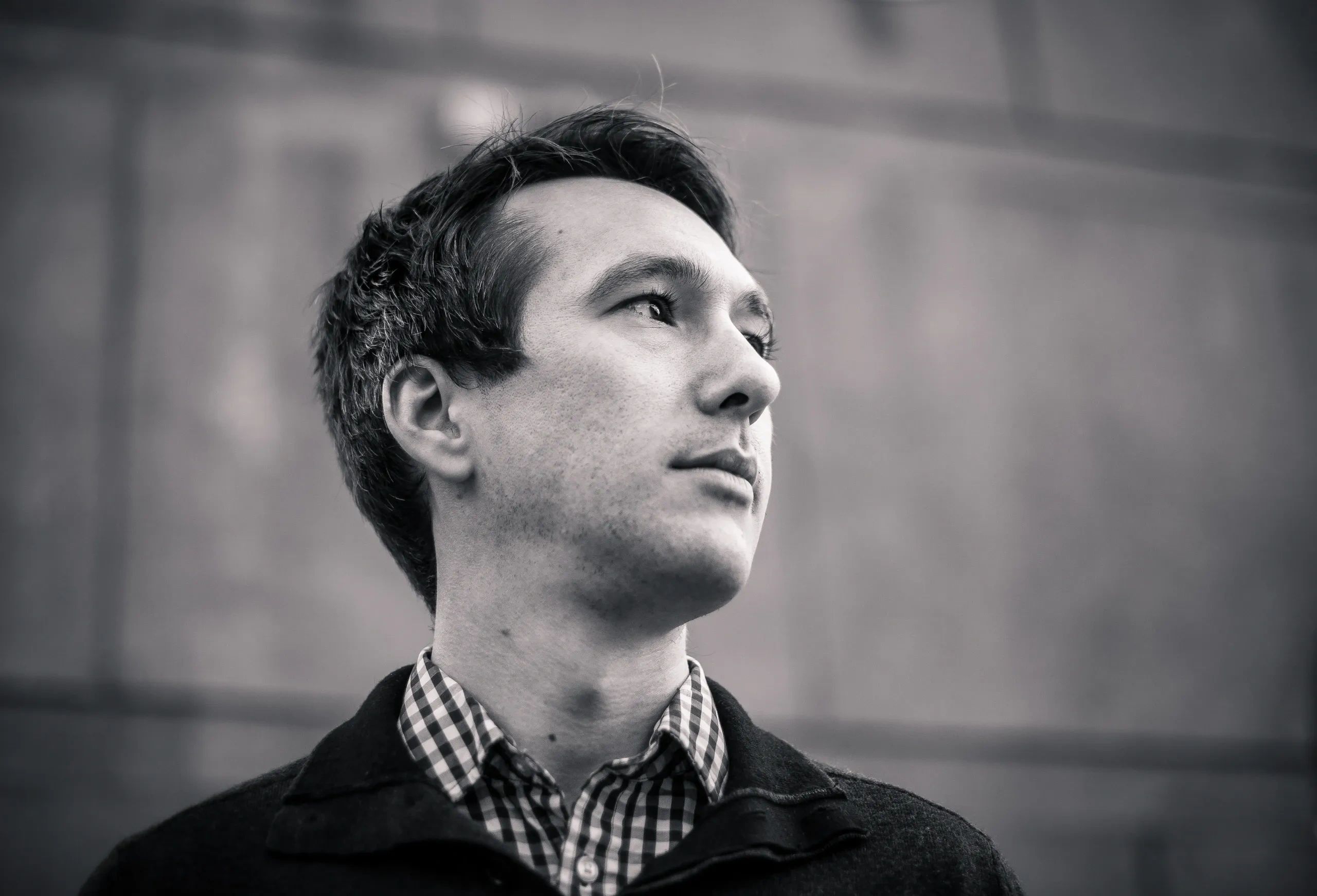
Russell Hepplwhite, composer

Tell us more about the process of selecting the ten poets and how their diverse writing styles/voices and perspectives informed the overall collection?

I simply selected truly brilliant writers that I really wanted to work with. All the writers share something – an ability to write directly, with laser-like clarity, and also a sense of accessibility. I’m interested in poetry that can be understood on first hearing/reading, but that also has more layers to be appreciated upon further exploration. Setting the various poems was fascinating, because I could see whether my own compositional style changed according to the poet that I was setting. I like to think the collection has lots of variety within it as a result of this approach, but that it all still sounds like my music.

How did you approach setting the texts to music for SATB choir and piano, particularly considering the range of themes/emotions explored in the poems?

When I was setting the texts, it was all about the words. So I read the poems, re-read several times, worked out the underlying tone or emotion, and then without any further ado, began setting them. With everything I compose the very first step is the absolutely crucial one – if I can’t find a way in then nothing else can follow; whereas once the piece is underway it becomes like a game of chess – a series of next moves to be made. So, with each poem I was looking for that first step – and mostly this happened very quickly – in the case of some poems it was a couple of chords I liked, with others it was a rhythmic pattern to fit a specific pair of words for example. Something that did surprise me on this journey though was how my appreciation of the poems changed and grew as I went along. At some stage, I can honestly say that each of the ten poems has been my personal favourite.

How has your other choral and opera writing informed your compositional approach/choices for Living Voices and the aim to create a “vibrant collective choral sound”?

With this collection I worked hard to create pieces that are colourful and imaginative, but fundamentally I wanted to do justice to the original poems. The aim was to compose music that would be accessible to the vast majority of choirs, but that still has enough challenges to keep everyone interested. I guess my other work has just made composing a lot easier since I have strategies and familiar processes which I adopt when composing. I also no longer feel any pressure about what I compose – I just write what I want to listen to, and hope others will feel the same.

Given the themes of Living Voices encompass aspects of modern life such as birth, death, youth and memory, what do you hope audiences will take away or reflect upon after experiencing these pieces?

I hope people can relate to both the words and the music, and to appreciate how the two fit together. Some of the texts pack a profound punch on first reading, such as Joseph Coelho’s ‘The Diarist’s Pages’ which tackles the idea of things in life coming round in circles, while others take a more light-hearted approach to make an equally significant point – I’m thinking of Roger McGough’s ‘The Good Ship Attenborough,’ for example, where the climate emergency is explored courtesy of a particularly playful approach.

And what do you hope choirs will take away from singing these pieces?

Goes without saying really, but I want people to enjoy singing them, and to get involved with the ambition of the collection – if they like singing one of the works I really hope they will be inspired to learn another one!


Living Voices is a new collection of ten inspiring choral pieces composed by Russell Hepplewhite. This innovative project brings together the talents of Hepplewhite and ten of Britain’s most outstanding contemporary poets, each commissioned to create poetic responses to our world today.

Find out more here

Brighton-based pianist Helen Burford presented a varied and creative programme of music in a Sunday afternoon concert as part of the Brighton Fringe Festival. Praised for her innovative and joyful approach to programming, the concert included three world premieres by contemporary British composers Georgina Bowden, Sadie Harrison and Barry Mills interpersed with works by Bill Evans, J S Bach, Claude Debussy and Chick Corea.

The concert opened with what I have come to regard as Helen’s “signature piece”, the haunting and hypnotic Incarnation II by Japanese composer Somei Satoh. Twelve extraordinary minutes of an absorbing soundscape, the work relies on primarily on the prolongation of vibrations (repeated notes) and is an exercise in control on the part of the performer who is given free will in the work as to how long it should last. Through these devices, the work conjures up the most extraordinary sonorities – horns, cellos, bells, drums. This was followed by the first premiere of the afternoon, ‘Hymn for Piano’ by Georgian Bowden, which also explored the sonorities of the piano in contemplative chords and gentle movements around the keyboard, and was played with a simple sensitivity by Helen.

Helen is noted for unusual programme juxtapositions and at first placing a prelude and fugue by J S Bach with Bill Evans’s jazz classic ‘Peace Piece’ may seem curious. But in the fact it proved fascinating, for the arabesques in Bach’s writing were neatly reflected in filigree improvisatory motifs in Peace Piece, all set over an ostinato bass line redolent of Satie’s Gymnopedies. This also set the scene for Sadie Harrison’s Four Jazz Portraits, written for Helen and inspired by jazz greats Bill Evans, Thelonius Monk, Fats Waller and Albert Ammons. The four miniatures all contained witty references to these jazz greats, and were delivered with deftness and humour by Helen.

The third part of the programme stepped away from jazz and into music inspired by the landscape. Debussy’s Bruyeres from the second book of Preludes evokes heather (or a town in northern France). This was paired with Barry Mill’s ‘Evocations’ whose titles – Falmer Pond with Ducks, Geese and Gulls, The Rowan Tree and Clouds forming, Clouds dissolving (Homage to Debussy) – suggest similar settings to Debussy’s work. The works by Mills recalled Debussy in their colourful harmonies and trimbres, and swirling movements.

The concert closed with a triptych by Chick Corea – ‘Where Have I Loved You Before’, ‘Where Have I Danced With You Before” and Where Have I Known You Before’ – all played with affection and an acute sense of their improvisatory nature.

Details of Helen’s forthcoming concerts here

www.helenburford.com