
Woolf String Quartet & Duncan Honeybourne, Chamber Music Weymouth lunchtime concert, Wednesday 25 February 2026
Woolf Quartet are: Zosia Herlihy-O’Brien (violin), Emily Harrison (violin), Beatrice Slocumbe (viola) and Hoda Jahanpour (cello)
When the audience comes out of a concert with words like “incredible!”, “brilliant” and “that was absolutely superb”, you know the musicians, and the music, has touched them. And that is what happened on Wednesday, 25 February, when the Woolf Quartet returned to Weymouth to impress the lunchtime concert audience once again. This London-based string quartet was formed at the Royal Academy of Music, and they take their name from author Virginia Woolf, as they often rehearse in Bloomsbury, close to where she lived.
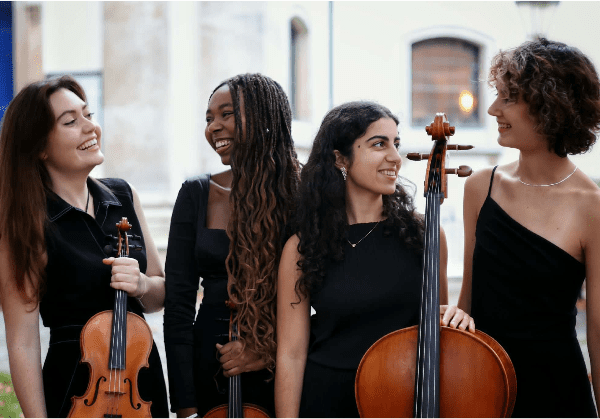
They made their Chamber Music Weymouth debut in 2025 and wowed the audience with an engaging programme that featured Debussy and a piece by the quartet’s cellist, Hoda Jahanpour. This time they were joined by pianist and CMW Artistic Director Duncan Honeybourne to perform just one piece – Brahms’ Piano Quintet in f minor. A big-boned work of symphonic textures and narrative breadth, it has the expansiveness of Schubert in its four movements, and is one of the most challenging and important works in the chamber music repertoire. It asks of all the musicians virtuosity, stamina and cohesion, and an ability to navigate many modulations, complex rhythmic shifts, and fugal passages. It’s a monumental work, emotionally intense and physically demanding, and a challenge for any ensemble – and one which the Woolf Quartet rose to with commitment, maturity and musical insight.
It’s rare to feel a thread of concentrated energy through an entire concert – not an easy feat for musicians to achieve – but the Woolf Quartet, with Duncan Honeybourne, succeeded in doing just this. It’s a credit to them – and a mark of the infectiousness of their concentration – that the audience was almost completely silent for the entirety of the concert, listening intently to Brahms’ shifting soundworld and the emotions it suggests.
The Woolf Quartet, both individually and together, brought much colour and nuance to the music. Brahms’ writing gives each player a chance to shine. The ensemble playing was precise and committed, amply matched by Duncan Honeybourne, who made light of Brahms’ rather unforgiving piano textures. Most engaging, though, was that the musicians clearly enjoyed themselves. It’s always a pleasure to see performers truly immerse themselves in music that they love.
Catch the Woolf Quartet if you can – you won’t regret it! They will be at London’s Wigmore Hall on Saturday, 2 May, where, I’m told, they will be performing a piece they have written together, as well as music by Shostakovich.
Chamber Music Weymouth’s lunchtime series continues on Wednesday 11 March with a recital by distinguished pianist Margarat Fingerhut. Find out more




 The Cross-Eyed Pianist