Who or what inspired you to take up the violin and pursue a career in music?

I come from a family of professional musicians, and it was always clear that I would do music. Moreover, because my older sister already played the violin, I wanted to do the same under any circumstances.

Who or what have been the most important influences on your musical life and career?

My mother practised with me very often. When I left the Soviet Union at the age of 13, I finally discovered contemporary music. To me this meant freedom, and became the central mission of my musical life.

What have been the greatest challenges of your career so far?

It was sometimes difficult to stay the course at the beginning, when many “experts” tell you that you are wrong and should play differently. But I guess nothing is easy in my career. I move forward the only way I know how to.

Which performance/recordings are you most proud of? 

The one recording closest to my heart is “Take-Two” (Alpha Classics) where I collected dear friends to record duets from the last millennium. The booklet – which I wrote together with my then 8-year old daughter and my husband – explains music history and my philosophy of interpretation as if to a child. One piece (“Das kleine Irgendwas”), composed by Heinz Holliger, is based on a text by my daughter.

Which particular works do you think you play best?

People perceive me as being at my best in recent and contemporary music, probably because in that repertoire nobody can tell me that I am wrong. But I do not see much difference between old and new music. I can play both well and not so well – and both at the same time.

How do you make your repertoire choices from season to season?

Well, it depends very much on the partners. Recently I took up the voice part of Schönberg’s “Pierrot Lunaire” because I had a painful arm condition and could not practice the violin as usual. I love this piece very much and will perform it often, for example with Berlin Philharmonic. And now I’ve taken up Kurt Schwitters “Ursonate”, a Dadaistic nonsense poem, also for voice, which I will perform with my clarinetist friends Reto Bieri and Anthony Romaniuk.

Do you have a favourite concert venue to perform in and why?

I am almost immune to venues… to me the kitchen, the casino, the church, it doesn’t make much difference. What is central to me is the piece, the message.

Who are your favourite musicians?

There are too many to name them all. But let’s mention two unknown ones: the young conductor Aziz Shokakimov, an astonishing talent of primordial power, he will go very far. And then my piano partner, Polina Leschenko, not a musician, but a poet of colours and perfumes, technically on a level with Cziffra or a young Pogorelich. She likes to practice and to play, she loves music, but everything is just for herself. She is not at all interested in a career, therefore only insiders know her. I try hard to get her out of her ivory tower.

What is your most memorable concert experience?

There are many, however last year particularly during the tour with Saint Paul Chamber Orchestra where I thought we reached a level of mystery I didn’t think possible.

As a musician, what is your definition of success?

When you can play what you like, in the way you like and with whom you like. When you have attained that, you have to stay curious, reinvent yourself and your repertoire all the time to prevent yourself becoming bored or burned out. Gidon Kremer is a model of how to do this.

What do you consider to be the most important ideas and concepts to impart to aspiring musicians?

First, only take it up if you cannot do otherwise. Without talent music is a sad job. Learning an instrument to perfection is already difficult but not nearly sufficient: you have to learn to understand the construction and the meaning of music. For this, studying composition is a very efficient way, even if you are not a great composer. Then you have to read biographies, history, letters. You have to study manuscripts and art history: paintings by Turner can teach you a lot about violin playing. Only then will you be able to keep fellow musicians and the public interested in what you are doing.

What is your idea of perfect happiness?

If you and your loved ones are safe and in good health, if everybody has a worthwhile occupation and earns enough for a decent living in a functioning state. What do you need or want more?


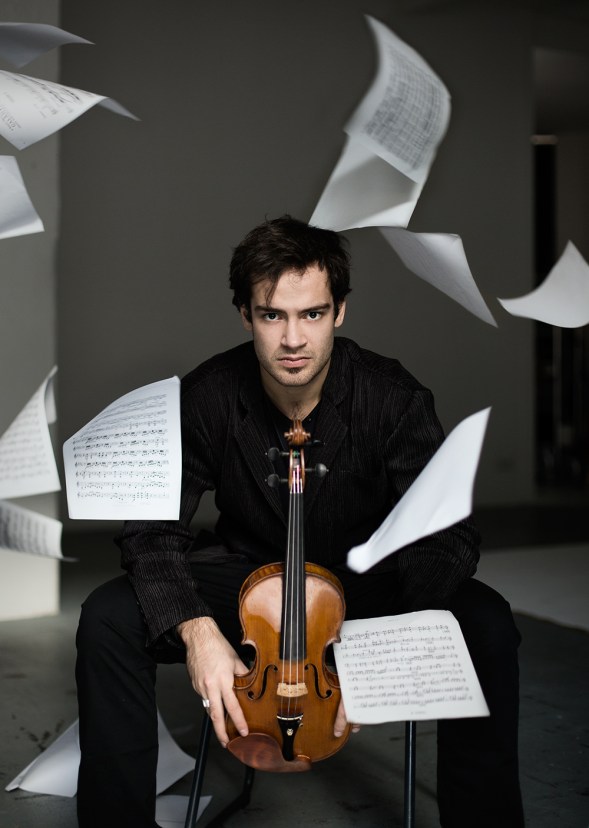
Patricia Kopatchinskaja’s new album Deux – Music for Violin & Piano by Bartok; Debussy; Poulenc; Ravel with Polina Leschenko is available now


Violinist Patricia Kopatchinskaja’s versatility shows itself in her diverse repertoire, ranging from baroque and classical often played on gut strings, to new commissions and re-interpretations of modern masterworks.

Read more

(Artist photo: Julia Wesely)

IMG_829184A57052-1(1)

Who or what inspired you to take up the violin, and pursue a career in music?

Although neither of my parents were musicians, they were both very musical and liked to listen to classical music, so we often had BBC Radio 3 on at home and recordings of violin concerti by Elgar with Menuhin and Sibelius by both Heifetz and Ginette Neveu, were important influences. Apparently they discovered I was musical because the Sunday school teacher told my parents I was leading the singing at the age of 3!! Actually I don’t have such a great voice, but aim to sing through my violin. I am very grateful to my parents, who were not at all wealthy, for prioritising giving me piano lessons from the age of 6, over material things – they used to make some of our clothes and furniture and were generally very creative, which has imbued my life. I took up the violin 3 years later at school in shared lessons and was offered a Junior Exhibition to the Royal College of Music on both instruments and later a Foundation Scholarship to the RCM with a violin bought for me by my parents for £20. I had thoughts of becoming a composer when I was quite young and enjoyed harmony and music theory but my passion for the violin took over – I loved the possibilities, it’s such an expressive instrument and this is what made me pursue a career as a violinist.

Who or what have been the most important influences on your musical life and career?

I was lucky to be awarded the Fulbright/ITT Fellowship to study for a master’s degree in New York for 2 years with some very fine teachers – Donald Weilerstein (then leader of the Cleveland Quartet and a most inspiring musician), Sylvia Rosenberg, a real artist who’d studied with Nadia Boulanger as well as Ivan Galamian, and Dorothy DeLay at Juilliard and the Aspen Festival. But I later learnt as much from Jean Gibson – that “your body is your instrument” – to be free to channel and express the music. When I tour I’m likely to be be found in an art gallery; I find looking at paintings from Rembrandt and Vermeer to Cezanne, Monet and some abstract expressionists, very enriching.

Some of my most extraordinary musical influences in performing have been with Norbert Brainin and Ivry Gitlis. Being the violinist/violist in the Fires of London at the start of my career led me to meet all sorts of composers who then wrote works for me, such as Brian Elias, which has been a significant thread through my musical life.

What have been the greatest challenges of your career so far?

Funding and fundraising (for which we are not trained) has become more and more difficult. I feel so passionately about being a musician and not selling my soul so there’s time to devote to one’s art, that in order to do so, I’ve often lived quite frugally. My generation were supported in our studies whereas now it has become more difficult with tuition fees, living costs and buying an instrument. To be a fine musician requires great sensitivity and yet in daily life it’s challenging not to be too sensitive and affected by things. I also think there is not enough appreciation that artists can improve with age! I think my playing has gradually developed over time. There’s a lot of emphasis on the latest talent of course, but you can take on too much at that stage when you’re flavour of the month whereas later on, where you know the music better, you can return to works with added experience and perhaps wisdom.

Which performance/recordings are you most proud of?

The Grammy-nominated Lou Harrison Violin Concerto with Percussion Orchestra (‘FiddleSticks’ album with new works for violin and percussion), my NMC Artist Series disc ‘In Sunlight: Pieces for Madeleine Mitchell’ with a range of works written for me by composers including James MacMillan, Michael Nyman, Nigel Osborne etc., and a personal collection of favourites – ‘Violin Songs’. I’d very much like to pay tribute here to the pianist Andrew Ball, my musical partner for some 20 years in concerts, broadcasts and 3 albums.

Which particular works do you think you play best?

There is so much fine music I like to play. Perhaps late romantic/early 20C works like Bruch Violin Concerto, Franck and Elgar violin sonatas and the more lyrical contemporary works suit me best however.

How do you make your repertoire choices from season to season?

It depends on what I may be asked to perform, when I’m able to devise programmes or perhaps premiere a new piece. I’ve always loved putting programmes together, aiming for a good balance and being attuned to the situation – the audience or the occasion. I have eclectic tastes and enjoy playing a wide range of music from c1700 to the present and sometimes combining with the other arts.

Do you have a favourite concert venue to perform in and why?

Wigmore Hall, of course because of the sound and the atmosphere, also St. George’s Bristol, Djanogly Hall Nottingham and Carnegie Hall, but also venues such as some country churches – I was invited to be artistic director of a summer series called Music in Quiet Places with chamber music which was very special.

What is your most memorable concert experience?

Too many to list but my Century of British Music recital for the Queen’s Diamond Jubilee, both in Rome and in the US, receiving standing ovations and the first performance I gave of Messiaen Quatuor pour la fin du temps in the group I formed with pianist Joanna MacGregor in a special 6th century church, St Illtyd’s, which led to performances at the BBC Proms and a recording at Snape Maltings.

As a musician, what is your definition of success?

I think to be able to say you’ve played your best, reached audiences in all sorts of places with the music and enjoyed it.

What do you consider to be the most important ideas and concepts to impart to aspiring musicians?

To aim to be a well rounded, cultivated musician, to have your eyes and ears open beyond your own instrument and to the other arts, nature and so on.

Where would you like to be in 10 years’ time?

Still playing well and perhaps in a wonderful chamber group.

What is your most treasured possession?

My violin, which has been my companion in concerts in some 50 countries and my hearing and vision. Although not my possession, my life treasure is my daughter.

What do you enjoy doing most?

I enjoy playing music I love, to the best of my ability and I very much enjoy travelling (including swimming in warm seas). Listening to music, from Mozart operas to Jazz, but I also cherish silence – the most profound I ever experienced was in the Namib dessert when I was on tour giving concerts for the British Council.

What is your present state of mind?

Grateful, thinking back over all the things I’ve done, people I’ve met and worked with, amazing places I’ve visited through music and to Frances Wilson for hosting this interesting series.

MADELEINE MITCHELL has been described by The Times as ‘one of the UK’s liveliest musical forces’ (and) ‘foremost violinists’. Her performances as a soloist and chamber musician in some 50 countries in a wide repertoire are frequently broadcast including the BBC Proms, ABC, Bayerischer Rundfunk and Italian TV. She has given many recitals in major venues including Lincoln Center New York, Wigmore and South Bank Centre London, Vienna, Moscow, Singapore, Seoul Centre for the Arts and Sydney Opera House. She’s performed as soloist with orchestras including the Royal Philharmonic, Czech Radio, St Petersburg Philharmonic and most recently the BBC National Orchestra of Wales, in the concerto written for her by Guto Puw, which will be included on her forthcoming album, Violin Muse, of world premiere recordings by established UK composers, for Divine Art.

Mitchell’s acclaimed discography for which she has been nominated for Grammy and BBC Music Awards, includes works written for her by composers such as James MacMillan and the popular ‘Violin Songs’ – Classic FM CD of the week. She has also championed early 20C British music in performance internationally and in recordings. A highly creative artist, Madeleine devised the Red Violin festival under Lord Menuhin’s patronage, the first international eclectic celebration of the fiddle across the arts. She’s also created programmes with poetry and unique collaborations with voices and solo violin with percussion and has been Director of the London Chamber Ensemble for many years. Madeleine Mitchell won the Tagore Gold Medal as Foundation Scholar at the Royal College of Music where she is a Professor and the prestigious Fulbright/ITT Fellowship to the Eastman and Juilliard Schools in the USA, where she regularly returns to give concerts and master classes.

www.madeleinemitchell.com

r8a0839-2-web
(photo: Nikolaj Lund)
Who or what inspired you to take up violin and pursue a career in music?

This was an easy choice, everybody in my family was playing the violin. It was almost a “Mother language”. I HAD to talk this language if I wanted to be understood, or understand what was around.

Who or what have been the most important influences on your musical life and career?

In my early life, as I said, my parents and my family, but then, later on, the absolute love of the music and the need to create sounds!

What have been the greatest challenges of your career so far?

All the competitions that I have done were a great challenge till today. But I understand now, that the biggest challenge ever happens each time I come to play a concert for an audience who expects to hear something special, something they will remember; this is  very challenging!

Which performance/recordings are you most proud of?

I unfortunately don’t remember so well which concerts went well, but I remember very well the bad ones. I always try to recall what actually made an experience not so good, so that I know what to do for the next time. The greatest concert was probably a recital, where I felt the biggest connection with my partner. That was incredible.

Which particular works do you think you play best?

Probably the ones that I believe in the most. Meaning, when I study the piece in its context and the main idea, touches me. When the music, or its purpose doesn’t really touch me, I am afraid I can’t be sure of giving my best in it…

How do you make your repertoire choices from season to season?

I of course look into the big repertoire pieces that I haven’t played yet, and then try to combine them with maybe lesser-known pieces that fit well with the mood, character, and again touch me enough to be able to transmit it to the audience.

I always try to keep something that I’ve already played, so that not always everything is new!

Do you have a favourite concert venue to perform in and why?

I’ve discovered a lot of dry, beautiful and great sounding concert venues! Every concert hall for me has a very personal history: I simply try to remember every concert, and all the circumstances of each hall where I performed.

I enjoyed very much the Philharmonie in Cologne, because of the shape of the hall and its unbelievable acoustic.

Favourite pieces to perform? Listen to?

Well, probably the one I love to play the most is J S Bach, no surprises there. Simply because I always find new harmonies to underline, or listen to. The writing is perfect, so evident and clear, one always discovers more and more complexity in his music.

I would say my problem is that I sometimes want to show my “personal discoveries” too much, and then it becomes a personal fight:

What I want to show as personal intention / what needs to be kept natural and be played in a more “hidden” way. For this reason, I also love playing Ysaye’s music, where a lot is happening and there is rather more room for personal interpretation.

Who are your favourite musicians?

From the ones I have been listening to lately: L. Kavakos, C. Eschenbach, M. Goerne, V. Gergiev, M. Pressler, S. Edelman…

What do you consider to be the most important ideas and concepts to impart to aspiring musicians?

I believe that today it is becoming more and more difficult to hold on to the principles of “great culture”.  We are the people who have the chance to be part of it, we have a great but very difficult mission – we have to keep it alive. I really think that a great part of our humanity is kept in the Art, as much in the “understanding” of it, as in its “producing”. This is why new and young artists have to hold on to something that maybe doesn’t bring that much success, or money, or fame. They have to bring something much more powerful (and not to themselves) – feelings, happiness, support, unity, and thousands of images.

All those elements are the true benefits of the music that we are sharing.

You’ve just been announced as the new London Music Masters Award Holder, tell us more about this?

It is a very new episode of my life starting, and I am really looking forward to the fresh new contact with Great Britain! Passionate people, passionate musicians!

I will be given the opportunity to introduce my concepts of instrumental playing and music making to the growing new generation of people/audiences in schools, for example. I really hope that my English will be good enough for the people to understand some of my twisted notions!

What are you most looking forward to about working with London Music Masters?

Meeting different people, and learning from them!

Where would you like to be in 10 years‘ time?

In a place where there would be unlimited space for love, friendship, and where I could be in a good enough shape to make music on a very high level

What is your idea of perfect happiness?

To be surrounded by truly honest and loving people.

What is your most treasured possession

Hum… Material possession..? Nothing… (Yet?)

What is your present state of mind?

In a very good mood.

Marc Bouchkov was born 1991 into a family of musicians. He received his first lessons at the age of five from his grandfather, Mattis Vaitsner. His first public appearance was just one year later. In 2001, he joined Claire Bernard’s studio at the Lyon Conservatoire National Supérieur de Musique; he transferred to the Paris Conservatoire National Supérieur de Musique (CNSM) in 2007. There, he began studies with Boris Garlitzky, who has been his mentor ever since, and offers him invaluable guidance for honing his craft. The following years saw participation in master classes and invitations to festivals in Moulin d‘Ande, Troyes, and Bordeaux (France), Viterbo (Italy) and New Hampshire (USA).

Marc Bouchkov is the recent recipient of a London Music Masters award

Marc Bouchkov’s website

rachel_podger_photo
(Photo: Jonas Sacks)

Who or what inspired you to take up the violin, and pursue a career in music?

Playing or hearing music around me was such a normal occurrence when I was growing up. From an early age I was involved in many concerts a year, whether playing or singing, that I didn’t need to choose whether to do music; the choice was more about which directions within music to take, and also where to study after school in Germany.

Who or what have been the most important influences on your musical life and career?

Peter Werner, a Eurythmy teacher and conductor at the Steiner school I went to in Kassel, Germany was an important influence on me. He had enormously creative energy which sometimes became feverish. His rehearsal technique was engaging and involved every player in the (big) school orchestra, and he taught me how to listen. I remember hearing Gidon Kremer and Reinhard Goebel in Kassel and being stuck by their different sound worlds and charismata.  And then of course my violin teacher at the Guildhall School of Music, David Takeno, who was much more than a violin teacher, but connoisseur of all musical styles with an uncanny musical intelligence, knowledge and generosity in his teaching.

What have been the greatest challenges of your career so far?

Apart from playing concerts when I’m jetlagged or ill (!), the hardest thing for me was playing Bach solo recitals after I had my first baby, (15 years ago) when I could hear her screaming backstage because the milk had run out, and all my instincts were telling me to run to her – but I was in the middle of the C major Fugue!!

Which performance/recordings are you most proud of?

Tricky one, as there are always things you want to play again when you come off the stage… But I quite like the Biber Passacaglia on my disc the ‘Guardian Angel’ and also the Bach A minor Concerto with my group Brecon Baroque on the Bach Violin concerto disc (both Channel Classics).

Which particular works do you think you play best?

That’s another tricky one to answer… I commit myself entirely to whatever it is I’m playing, and I adore most of what’s on the musical menu. But Bach, Mozart and Vivaldi stand out for me…

How do you make your repertoire choices from season to season?

Repertoire choices are often decided by the theme of a festival, or the preferences of a promoter, recording plans and the recording back catalogue, so in the end there actually isn’t that much choice left! Who knows, if I had a completely new season to choose without any strings attached (as it were!) I might come up with Schubert and Brahms!

Do you have a favourite concert venue to perform in and why?

There are a few concert halls I’ve played in that seem to make you play like a dream…one of them is the Symphony Hall in Boston, another the Suntory Hall in Tokyo and then I absolutely adore playing at the Wigmore Hall in London.

Favourite pieces to perform? Listen to?

I adore listening to styles I don’t get to play like polyphony, music from the Renaissance, symphonic repertoire, Jazz…I get to listen to some pop too since I have teenage daughters…I always wake up to ‘Breakfast’ on  BBC Radio 3 and look forward to their ‘Bach before 7’ slot, but am continually intrigued by all I get to hear.

Who are your favourite musicians?

Creative ones! I’ve been lucky to play/work with many of them…Trevor Pinnock, Gary Cooper, Pamela Thorby, Richard Egarr, Phoebe Carrai, Elizabeth Blumenstock, Pavlo Beznosiuk, Jane Rogers, Alison McGillivray, Marcin Swiatkiewicz, Robert Hollingworth, Julian Podger (yes, my brother!), Alfredo Bernadini and many more…and then there’s the amazing Kris Bezuidenhout!

What is your most memorable concert experience?

There are many amazing moments I’ve been lucky to be part of, and often while performing with a larger group of musicians when there is a sense of unity within the music making.

Once while playing the Biber Mystery Sonatas in concert I was struck by the physicality in the ‘Crucifixion’ Sonata and got so involved in that aspect that I didn’t hear the applause afterwards and just stood there for a while (or so I’m told!) looking like I’d been the one crucified…

Another time playing the ‘Erbarme Dich ‘ aria from the Matthew Passion with Trevor Pinnock and The English Concert when I was pregnant and my unborn baby was utterly still while I stood up alongside the alto and played that heartfelt piece about mercy. Afterwards when I sat down the baby kicked and danced to the rest of the piece!

What do you consider to be the most important ideas and concepts to impart to aspiring musicians?

Practise intelligently, i.e. use your time well and efficiently and set yourself goals, even if it’s within a ten minute time frame, or even within one phrase. The relationship between musical intention and execution is essential, and it’s good to ask yourself how you’ll best get from one to the other. Aimless practice might help some mechanical workings, but is less effective. If your musical intention is unclear or confused, read the score in your head, sing it or parts of it, imagine how it might sound, play one part and sing the other, read it like a book on the train! Self-belief is utterly important, but so is an acute self-awareness. Lastly: try to keep the big picture in view!

Where would you like to be in 10 years’ time?

Happy, healthy, loving life and playing music.

What is your idea of perfect happiness?

Happiness is fleeting – I’d like to make sure I never miss one of those uplifting moments that seem to come out of nowhere and are a complete gift.

What is your most treasured possession?

My violin.

What do you enjoy doing most?

Looking at the sunset over the Brecon Beacons sipping a glass of white wine with my partner.

What is your present state of mind?

Looking forward to getting home! (Am writing this on a plane after a concert with EUBO in Regensburg!)


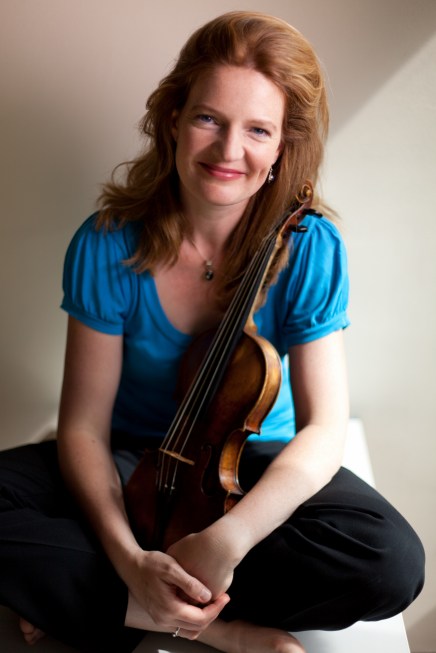
Over the last two decades Rachel Podger has established herself as a leading interpreter of the Baroque and Classical periods and has recently been described as “the queen of the baroque violin” (Sunday Times). In October 2015 Rachel was the first woman to be awarded the prestigious Royal Academy of Music/Kohn Foundation Bach Prize. She was educated in Germany and in England at the Guildhall School of Music and Drama, where she studied with David Takeno and Micaela Comberti.

Rachel Podger’s website