Composer Thomas Hewitt Jones releases his latest Christmas work, ‘The Shepherd’s Tale’ and offers the chance to join an online singalong with the Choir of King’s College London on Saturday 12 December, encouraging choirs who are unable to sing together during COVID-19 to be able to take part in choral singing at home while spreading some good-humoured seasonal cheer.
Originally commissioned by Battersea Choral Society for their 20th Anniversary celebrations in December 2018, ‘The Shepherds’ Tale’, the latest collaboration between composer Thomas Hewitt Jones and poet Matt Harvey, is a warm-hearted retelling of the Christmas story from the perspective of the shepherds and is among Thomas’ most directly appealing choral works to date. Straightforward to learn and a joy to sing, the music moves from dismay to celebration in its kaleidoscopic fifteen minutes’ duration, broadly laid out in five sections that follow the emotional pilgrimage of the shepherds in all its doubts, longings, and final affirmations. ‘The Shepherds’ Tale’ places centre stage the wonder of these lowly observers of the earth-shattering events, more often recounted artistically through the eyes and ears of the Magi and the Holy Family.
The COVID-19 pandemic has massively affected choirs around the UK and choral singing is currently only permitted in distanced form until vaccines are fully available to the general population, yet the Christmas season is normally the focal point of the year for many choirs.
Thomas Hewitt Jones says “2020 has been a difficult year for many of us, so to spread some joy at the end of the year I wanted to make something that has ‘feel-good’ factor while respecting and celebrating the best of seasonal tradition. In normal times, choral singing is one of the most inclusive areas of our culture and I wanted to bring a smile to the face of singers everywhere this Christmas, even if they can only sing at home. My hope is that this online singalong will spread some Christmas joy for people of all denominations, celebrating the universal message of hope & rebirth while encouraging musicians everywhere to practice their sight-singing!”
Lyricist Matt Harvey says “It was a pleasure to work with THJ on A Shepherd’s Tale. It’s always worthwhile to revisit and reimagine the old stories. And to interrogate them from a contemporary perspective.“
Publisher Antony Kearns, MD of Stainer & Bell Music Publishers, says “This wonderfully warm, good-humoured new work for choir and small orchestra is the latest from the Hewitt Jones/Harvey writing stable. Lasting 15 minutes, this through-composed retelling of the Christmas story from the shepherds’ perspective offers an unashamedly tuneful yet emotionally complex journey, which is sure to delight performers and audiences alike.”
Get into the festive spirit! Follow the bouncing sheep and sing along with King’s College Choir, London.
I was delighted to take part in Jon Jacob’s Thoroughly Good Podcast project with composer Thomas Hewitt Jones (who happens to be one of the first people to feature in my Meet the Artist series). We met in the crypt bar at St John’s Smith Square (one of my favourite music venues in London) to talk about blogging, composing, concert going and more…..
I don’t go to the British Museum as often as maybe I should. My education in ancient civilizations sadly ceased the minute I left primary school. However I still love the Greek myths. I have happy memories of fashioning the Greek gods and heroes from papier-mâché and chicken wire in class and recall my felt tip drawing of Prometheus writhing in agony as an eagle pecked out his liver!
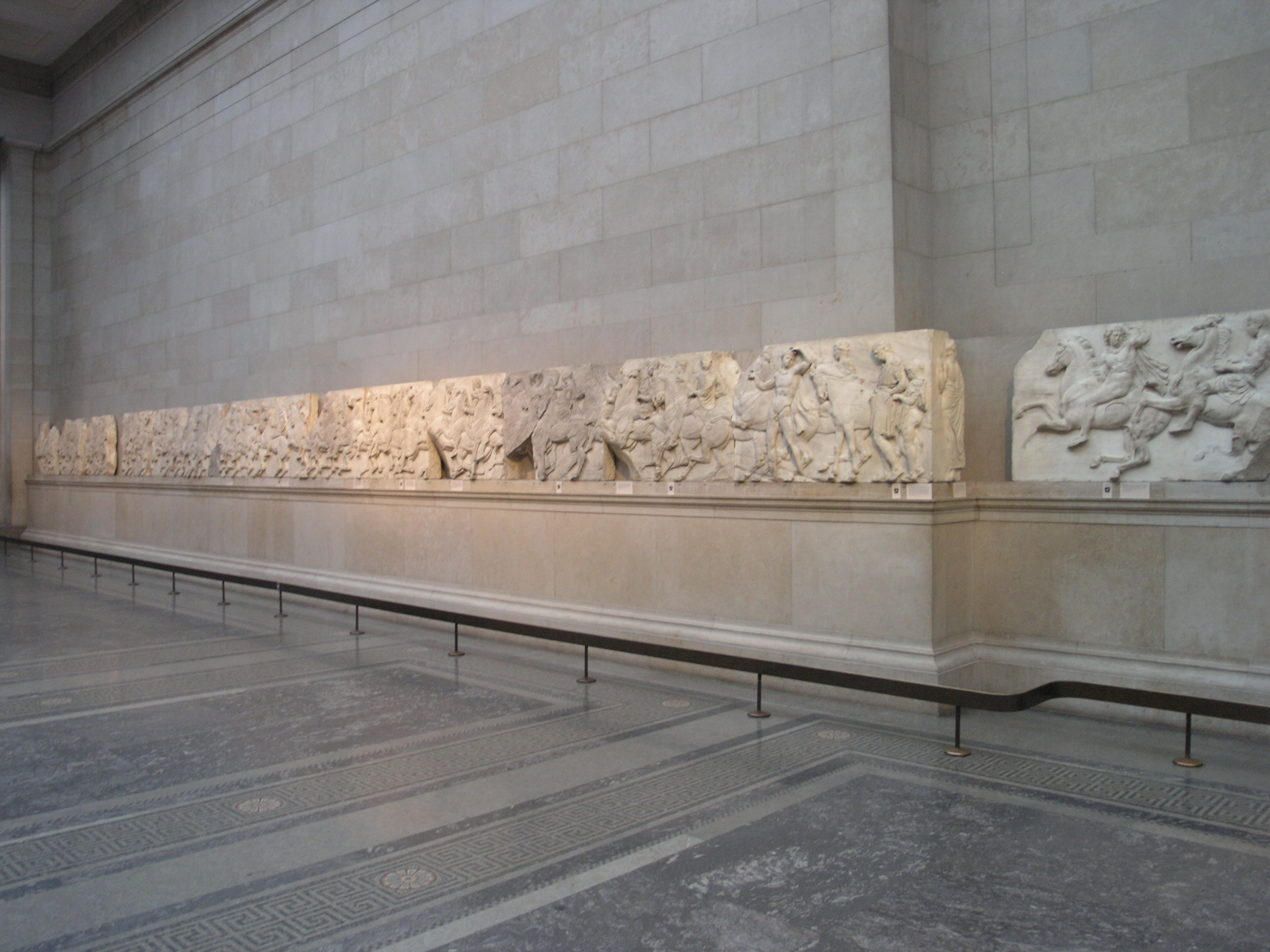
When I received an invitation to attend a talk and musical concert at the British Museum about the Parthenon Frieze in June, it seemed the ideal opportunity to renew my interest and to learn something of the precious exterior ornamental band which ran around the 2,500- year-old Parthenon temple. I also wanted to know what all the fuss was about, why lawyer Amal Clooney, one month after marrying superstar George, was taking up the Greek cause to return the priceless marbles to Greece. Today, around 60% of the frieze is housed in Room 18 of the British Museum, the majority of the remaining 40% resides in the Acropolis museum.
The Parthenon Freize at the British Museum (picture source: Wikipedia)
So I set out on a gloriously sunny evening in June with the words of my friend Molly Borthwick (generous supporter of that day’s event) whirling around in my mind: “You haven’t met Ian (Jenkins), you haven’t heard him speak! He’s the world expert on Greek and Roman sculptors. You’ll lurvv him!” When Molly says these things, I listen.
An hour later I was in the back row of the lecture hall. Without any ceremony a silver-haired Ian Jenkins walked on stage, looking the part of Victorian gentleman and flamboyant academic in his slightly creased, pin-striped suit and a silver watch chain, from which hung his museum key. From his lectern he perused the audience. I scanned the room myself. My gaze flitted across the packed lecture hall composed of suited men and women in heels and summer dresses, over to a younger crowd nearer to where I was sitting, in jeans, sneakers and dark tee-shirts, some of whom, started to canoodle the minute they sat down.
I went back to reading the programme: “Ian is the curator of the Museum’s critically acclaimed exhibition ‘Defining beauty: the body in ancient Greek art”. “The body” I thought to myself, a theme which is bound to get the punters in at the British Museum. Tonight however, Ian’s angle had changed. We were being offered: ‘The Parthenon Frieze: a symphony in stone’. As I am a great classical music lover and a Wigmore Hall regular, I was intrigued by the musical connection. This, coupled with the fact that we were going to be treated to a live UK premier of newly commissioned work entitled Panathenaia which had been inspired by the Parthenon frieze.
Ian explained that the frieze was the decorative sculptural upper band of marble, which originally ran off the entrance to the Parthenon temple. The frieze evokes the ‘Great Panathenaia’, the festival held every four years to celebrate the birth of Athena. Here we had to imagine it in situ: two parallel processions progress along opposite sides of the building towards their finishing point on the east wall. We see horsemen, chariots, animals for sacrifice, young women and magistrates or tribal heroes. There are chariot races that day and music competitions, the prizes special jars, filled with olive oil, with a depiction of the event on them. The high point of the ceremony is the presentation of the peplos or sacred cloth, newly woven, to adorn an ancient olive statue of Athena. Presiding over these festivities are the gods and goddesses. The interesting thing, Ian tells us, is that there is a question mark over whether the gods are viewing these events from on high – that is from Mount Olympus – or down at the Temple in Athens, suggesting perhaps the merging of the human and the divine. Have humans become godlier or have the gods become more plebeian? There is a pause whilst we take this in. A man in front of me stops tapping the screen on his iPhone and looks up, as if he has just woken up to this momentous question left hanging in the air. He looks around vaguely then bows his head again and resumes his silent tapping.
Ian’s talk becomes more and more fascinating as he draws all sorts of modern artistic parallels with the frieze. He sees the same arrangement of horses in a work painted by the great artist Mark Gertler in 1916, ‘The Merry go round’ and so on. And then comes Ian’s tour de force. “The symphony” which is to be found in the Parthenon Frieze. Ian starts to show us slides of his transcription of the frieze, which he has converted into a sort of Braille, in which the numerous figures seen from above, are represented by simple shapes. And here I quote from the Panathenaia librettist Paul Williamson, as I’m not a musicologist : “The heads of the horsemen, for example, are shown as ovals, laid out in rows to indicate the depth of field. The effect of the semibreve-like ellipses arranged on staves, as it were, is incredibly like musical notation.”
Oh my! My brain is now reeling, I am eager to hear the music to give it a rest.
Full of anticipation we leave the lecture hall, and make our way up a grand staircase to Room 18, the Parthenon frieze viewing gallery.
Twenty minutes later, having finally settled in our seats, we are able to admire the frieze for real; we stare at the sections of white marble sculptures on the walls, beautifully lit, looking so clean, the figures so beautifully fluid and lovingly preserved, though incomplete. It is hard to believe that they are so ancient. The TV camera is there with Patricia Wheatley, formerly with the BBC and head of the BM Broadcasting unit, the photographers with their telescopic lenses, all now aiming at the stage, for the choir, two sopranos, the orchestra and lead violinist Hugo Ticciati (soon to be playing at the Wigmore I noticed with interest) has just stepped in. The enthusiastic Ticciati starts speaking a little fast on the stage, but it doesn’t matter, all I need to know is in the programme, namely that it was he who had the idea of commissioning this work in the first place. Ticciati enlisted the services of award-winning composer Thomas Hewitt Jones (Winner of the 2003 BBC Young Composer Competition) and they chose Paul Williamson to write the libretto. Ticciati and his orchestra performed the finished work once in Sweden last summer, at a summer festival he organises, and instead of the Parthenon, a rock-balancing artist was called in to reconstruct his own frieze with some stones from a nearby lake. Apparently the last irregular diamond of stone was put in place as the music ended.
Wow! I thought, not bad, not bad at all. But even a rock-balancing artist cannot compete with these beautiful smooth, sculpted warriors running along the wall.
A young bearded conductor steps up on stage with tight corkscrews curls, followed by two late musicians, who, cowering with embarrassment and grasping their violins quickly find their seats.
Panathenaia is a Cantata in eight movements for string orchestra, timpani, soloists and choir. The hugely talented composer, Thomas Hewitt-Jones drew his inspiration from certain figures from the frieze and temple statues.
The instrumental Prelude opens with the tense plucking of strings and jagged rhythms, then the full orchestra enters into a slow lumbering movement of strange, mysterious sounds marking the start of the Athenian procession or is it the wars that preceded the building of the Parthenon temple, as there is the rumble of drums. We are transported back to c. 495-429 BC, where the instruments one imagines to have such different discordant sounds.
In marked contrast, the following “Temple” movement with the Choir, is one of beautiful high, ethereal voices, denoting the harmony and beauty of the land and holy building where justice reigns: “This ancient land’s an orderly/Arrangement, wrought from flowing forms”.
“The Weaver’s Song” following, sung with great feeling by the fine blonde soprano Paulina Pfeiffer is both mournful and serious in tone – serious because she is weaving the sacred cloth which will clothe the statue of Athena, therefore a great responsibility – mournful – because she is alone, separated from her warrior boyfriend who is taking part in the chariot races during the festival: “Eros, has made me dull”. Apparently in rehearsals, Paulina, was disturbed by her voice ricocheting off the frieze in Room 18. She was, I was told, holding back tonight, and I noticed her shoulders stiffen a little as one particular high note echoed around our heads. The effect however was thrilling!
I loved “The Lyric Suite”: Hugo Ticciati’s achingly beautiful violin, sometimes so haunting and then the unsettling bassoon, plucking of strings and tympani which crescendos into a full-blown orchestral swell setting things up for Prometheus and his challenge with the gods.
In “Prometheus” we had the gorgeous pairing of the blonde soprano and dark mezzo-soprano, Karolina Blixt. Blixt looked very striking in her Grecian ivory dress and liquid eye liner eyes which flashed at the audience, causing quite a ripple amongst the male members who looked up at her in complete reverence (I see a star in the making). “Ah but the gods have lost their spark” they sing signifying the decline in the influence of the gods, making way for Prometheus who “…freed the agent of change/That far-seeing rascal”. The sopranos snarl the word “rascal”
In “Shadows in a dream” the choir asks what harmony is possible when humanity inherits the earth? Tympani – storm rumblings loud then soft and distant, set the scene for the following “Birth of Pandora”, Zeus’s revenge on humanity. I loved the amazing anarchic dance of the satyrs attending the birth of the beautiful, ‘baneful’ Pandora. “Caper on your crooked legs” – wonderful alliteration by Paul Williamson the librettist. And finally the Coda – plucking of double basses like footsteps fading away. The music has turned full circle. We are back to where we started.
Loud applause. Ian Jenkins the curator, the musicians, singers, composer, librettist and conductor, had transported us into another world, another time. It had been an exciting, illuminating experience, one that I am very keen to repeat. These sorts of happenings however are rare and require money, time, commitment and passion. Vision too. I felt privileged to have attended such an event.
Since then I have returned to admire the frieze in the British Museum twice!
Discover this extraordinary composition performed by orchestra and singers for the first time ever in the British Museum’s Duveen Gallery, which houses the Parthenon Sculptures. Surrounded by these stunning carvings, Panathenaia celebrates their artistry and tells the story portrayed in the timeless stones.
Karine Hetherington is a teacher and writer who lives in London. A dual-British and French national, with a Russian ancestry thrown in, her short stories and novels reflect her passion for both the detail and grand sweep of European history. After studying creative writing at Birkbeck College in London, Karine has been telling stories that have brought history to life, with tales of love and adventure that draw on the detail of real events and real lives.Karine’s novel ‘The Poet and the Hypotenuse’ is available now. Read an extract here
Who or what inspired you to take up singing and make it your career?
I think everyone in VOCES8 was very lucky to have some amazing music teachers as we grew up. Many of sang in cathedral choirs and 3 of the founding members were choristers at Westminster Abbey. When you get so completely immersed in choral music from such an early age, I think you either fall in love with it or move away from it completely, and we were the former! We’re very lucky to have a full time job making music with VOCES8 – it’s a wonderful career to have!
Who or what are the most important influences on your singing?
With 8 different musicians in the group, there are always plenty of musical influences flying around, and that’s what makes working together as an ensemble so exciting. Where Barney or Charles might revel in our early music, and Emily would probably sing Bach all day long, we also all love different genres of music too – Paul loves jazz, and Dingle has a very eclectic musical palette…. All of this feeds into our music making. While we’re an a cappella group, it also helps that some of us play musical instruments too. Rob is a professional organist whenever he has a spare minute to play.
What have been the greatest challenges of your career so far?
Musically, I think our first couple of recording projects were really challenging, but for different reasons. We recorded ‘Aces High’, an album of jazz, pop and James Bond songs, in 2009 in California, and the process was incredibly challenging for all of us. Then, when we recorded the Bach Motets album in 2010, we were challenged, musically, in an entirely different way. We love both discs, but as we look back on those recordings, I think we’re so proud of them because we know how much effort went into them.
What are the particular challenges/excitements of working with an orchestra/ensemble?
We spend a lot of our time teaching – we work with about 25,000 young people every year! – and last night we were talking with a group of singers about this very topic in Bedford!
Being a full time performer is wonderful, but there’s something special about being part of a small team. I love being onstage with the same group of people each night, sharing with our audience a concert that we’ve spent months piecing together in the rehearsal room.
Having a vibrant rehearsal environment in which we can all share artistic ideas and then bringing that to life on stage is just great fun! In VOCES8 we have 8 very different personalities too, and that can sometimes be a challenge! We’ve been together now for such a long time that any arguments are always resolved, and I suppose we feel rather like one big family! I know I’m lucky to be surrounded by such a talented and passionate group of people!
Which recordings are you most proud of?
Ha ha! I think I’ve answered this one – if I had to choose one, it would be ‘Aces High’. I think, looking back on this in years to come, we’ll realise that we created something completely new with that album, and I don’t think I’ve found another album in that genre that I prefer, which means I must be happy with how it turned out! It was also amazing to be recording in California and working with the most amazing production team you could possibly imagine.
Do you have a favourite concert venue?
In VOCES8 we’ve been really lucky to perform in some fabulous venues…. And while it’s hard to beat some of the top London venues (nothing is ever quite as scary as performing in your home town!), the NCPA in Beijing was just staggering, and the outdoor amphitheatre in Vaison-la-Romaine was a joy to sing in.
Who are your favourite musicians?
So many that I couldn’t even start to name check them all, but I’d go for Miles Davis as one…
What is your most memorable concert experience?
Headlining the first ever classical music festival in Kenya on a huge outdoor stage will live forever in my mind I think! But we’ve had so many inspiring, emotional, spiritual and sometimes simply funny places to sing… every day is different!
What is your favourite music to perform? To listen to?
That depends entirely on my mood. This week in rehearsal we’ve been looking at Byrd, Panufnik, Marcello and Simon and Garfunkel…. All for different upcoming projects, and all great in different ways.
What do you consider to be the most important ideas and concepts to impart to aspiring musicians/students?
Be open to as much as possible, dedicate yourself to what you want to achieve and then work out how you’re going to get there. Don’t every worry about someone telling you that they don’t like what you’re doing. Art is subjective. And in the world that we live in, being as multi-faceted as possible is always going to be helpful for you.
What are you working on at the moment?
We’ve just finished recording the music for the Olympic Mascots with our composer-in-residence, Thomas Hewitt Jones; we’re working on music by Roxanna Panufnik for a recording linked with our publishing house, Edition Peters, next month; we have a recording project in France with our good friend Patrick Ayrton in the summer and then a busy touring schedule to France, Germany, Spain, Taiwan and Italy to keep us on our toes! Oh, and we’re publishing our first VOCES8 Songbook in July too… then throw into the mix all of the education projects that are coming to an end as the school holidays beckon, and you can imagine we’re not getting to sleep very much at the moment!
Where would you like to be in 10 years’ time?
Happy wherever I am!
What is your idea of perfect happiness?
That changes by the day, but feeling like I’m enjoying my life and also able to contribute to the happiness of others.
What is your most treasured possession?
My iPhone and I are pretty inseparable…!
What do you enjoy doing most?
When I’m not making music, I love sport…. And food, wine, films, books…! Hmm.
What is your present state of mind?
I need another coffee!
Like several members of the group, Paul’s musical life began as a treble in Westminster Abbey. His singing continued at Bedford School, where he held a music scholarship, and later at King’s College, Cambridge, during his gap year. Whilst studying PPE at the University of York, he spent much of his time performing musical theatre and jazz, most notably appearing in a production of Candide. At this time he was also a member of the RSCM’s Millennium Youth Choir. Upon graduating in 2004 he embarked upon a successful career in corporate training and events with the New London Orchestra and the Irish Chamber Orchestra. In August 2006 Paul assumed the position of CEO for Voces Cantabiles Music.
Paul’s light baritone has made him the perfect choice for VOCES8′s early repertoire. An experienced performer in jazz and music theatre, he also provides the group with the American twang for the lighter repertoire. A height-based comedic partnership with his fellow bass, Dingle, has amused audiences the world over.
Alongside his singing duties with VOCES8 Paul leads the Hatch My Ideas! initiative run by Voces Cantabiles Music. Paul shines both as a Workshop Leader and Manager, and the projects he and his team have designed have innovated music education in UK.
The international award-winning octet, VOCES8, has established itself at the forefront of British a cappella. Performing a repertoire ranging from Renaissance polyphony to unique Jazz and Pop arrangements, the group has been praised for stunning performance, exquisite singing and creating a sound that spans the entire range of vocal colour.
Founded in 2003 by ex-choristers of Westminster Abbey, VOCES8’s career has developed both in the classical choral scene and the world of a cappella with an annual touring schedule that takes the group to Europe, the USA, Africa and Asia. Highlights include performances at the Royal Festival Hall, the Wigmore Hall, Tel Aviv Opera House and the National Centre for the Performing Arts in Beijing.
With an ongoing programme of recordings and live broadcasts VOCES8 is heard regularly on international television and radio including Deutschlandradio Kultur, ARTE TV and the BBC.
VOCES8 plays a key role in the education work of the non-profit foundation VOCES CANTABILES MUSIC. The group leads innovative workshops as part of larger outreach projects in two hundred schools throughout the UK and internationally. VOCES8’s education work extends to workshops and master- classes for people of all ages and abilities with the aim of inspiring creativity through music.
The Cross-Eyed Pianist is free to access and ad-free, and takes many hours every month to research, write, and maintain.
If you find joy and value in what I do, please consider making a donation to support the continuance of the site







 The Cross-Eyed Pianist