Guest post by Alexandra Westcott

This article about learning the piano, the skills and the memories was lovely, and jogged my own memories of myself both as student and teacher.

I was about 6 when I used my sister’s books to learn the piano – they had photos for hand positions and finger numbers and that seemed all I needed (I’ve no idea to this day how I learned the rhythm and counting; I don’t remember reading about it but I must have!). I raced through the books and started fiddling with any music floating around, which was a fair amount as my Mum was a singer and also played the piano. I remember having the C major Mozart sonata at home and learning two pages during each holiday when home from boarding school at around 8 or 9. At this point Mum asked me if I wanted lessons, and because all my friends hated it (they hated the
practice); I said no because I loved playing, but she obviously ignored me and I ended up with a teacher I adored with whom I became very close.

I played the piano in all my spare time to the extent my reports used to say ‘she spends a lot of time at the piano’ and during prep, having done my homework as fast as possible, would skip off to the music rooms. I was fussy even then about the piano I played, and only the teachers’ or the grand in the assembly hall would do! None of the awful practice pianos for me!
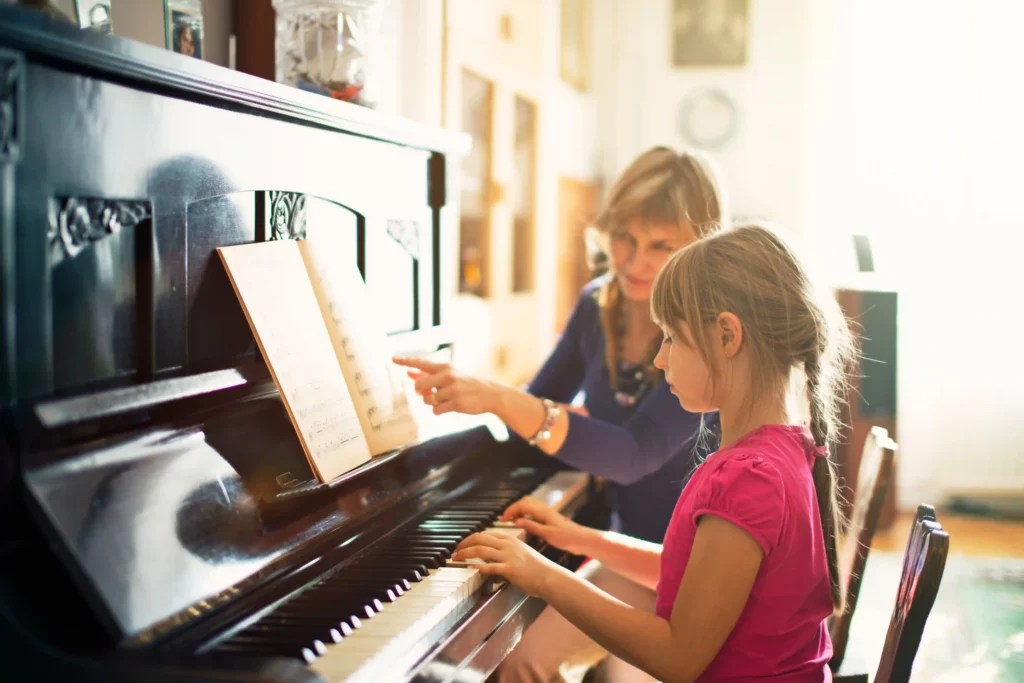
During my time at school with this wonderful teacher, me and a group of friends would be taken away for a weekend each term to him and his wife at his amazing ancient cottage. He was the church organist and ran the church choir so we ate well on local Devon produce that he was given by local friends and members of the church. At times we also had breakfast in bed (often sugar on toast!), It was all very idyllic and I stayed in touch with him and his wife until they died.

For the 6th form I left there and went to a college local to my home, so I changed teacher and went to a local music school during my A levels. A completely different teacher and one the parents were scared of but the pupils loved. We did Sunday concerts at her house, always with cake, and a large concert once a year at the 6th form college at which she got her advanced students to do a movement of a concerto with her school orchestra. I did the first movement of the Schumann. I never wanted to be a concert pianist but this was good experience and I later had the chance to play on a few occasions with another orchestra, and for one of the concerts performed the whole of the Schumann. It brought back many memories.

I had another teacher for my degree, and then had a break in formal lessons before returning to a commitment to my own playing in my 20s. I had a local teacher for a year but then met Nelly Ben Or and knew I had to learn with her.
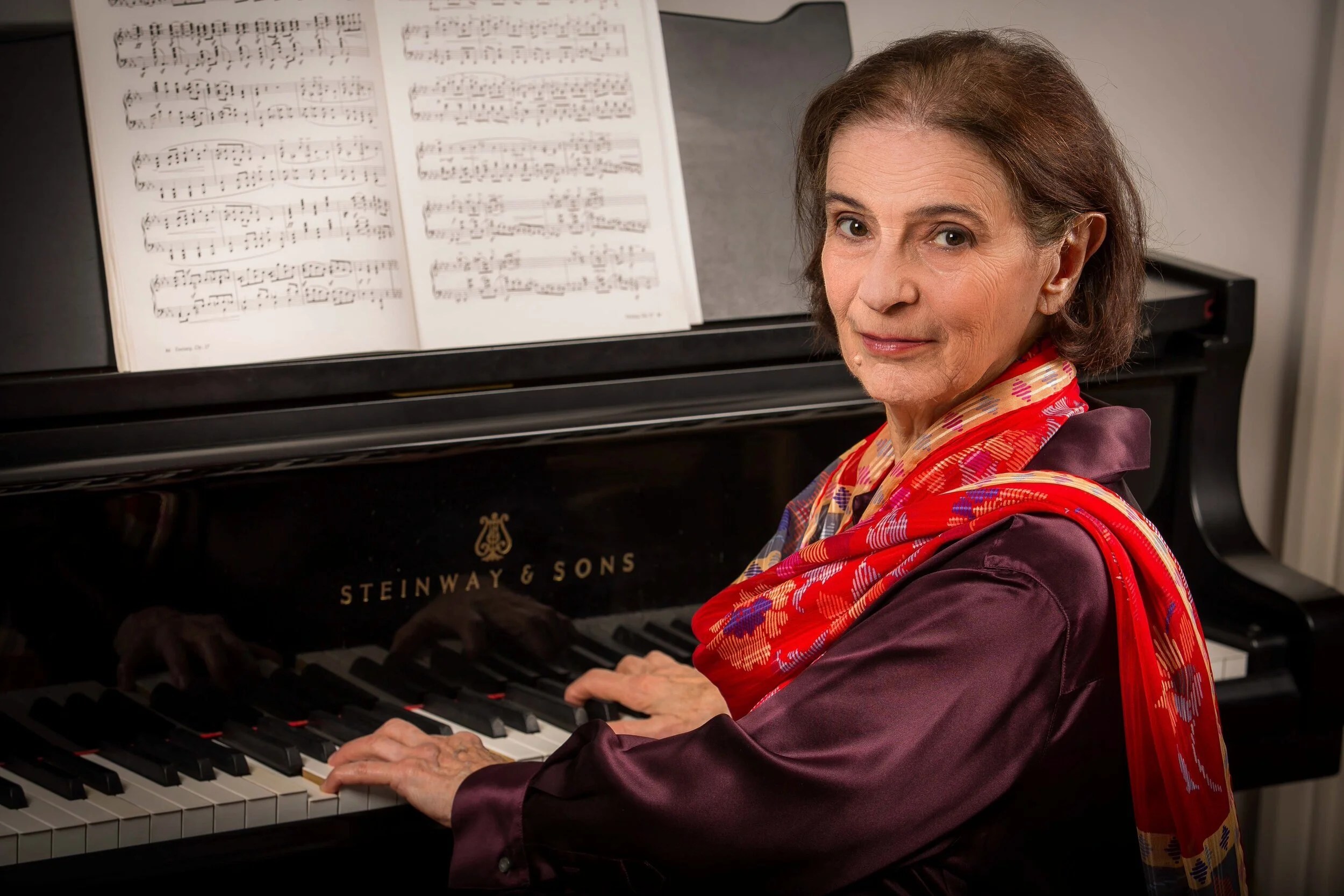
Nelly Ben Or

I studied with Nelly for many many years undoing my bad habits in order to acquire new and better ones and becoming a much better pianist, and a better teacher for that. I would often have lunch along with my lessons, and, again, house concerts and other performances enhanced the lessons. And, yes, you guessed it, always with accompanying food and drink.

As a teacher myself I became the sort of teacher I had grown up with; I had close bonds with my students, always had house concerts and local concerts both with tea parties afterwards, usually some chocolate for after lessons, and often would become close friends and either take them out for tea when young, or stay in touch later on.

Piano teachers, or any instrument teacher, hold a particular place in the life of a child. Such a close bond is formed and often many confidentialities shared. There needs to be trust for something that is hard to learn and something that needs self expression in execution. It is maybe not surprising that the bond becomes a firm friendship (and, often, one that needs physical as well as sustenance)!

I often wonder about my students’ memories of their time with me and whether they have similar memories as I do about my own mentors. I hope they hold the same  happy and cherished memories in their hearts for all the hours we spent and fun we had together as I do for my own teachers.

Alexandra Westcott is a piano teacher based in north London who specialises in understanding the piano in the light of the Alexander Technique, as studied with Nelly Ben Or, and encourages all areas of learning in a creative way. Find out more here

If you would like to share your piano memories, whether you are a teacher or pianist, or bothm, please get in touch


This site is free to access and advert-free. If you find joy and value in the content of this site, please consider making a donation to support its continuance, and to ensure it remains free to read.


I admit it, I’m a fervent auto-didact, a “self-teacher” whose answer to “how do I do that?” is to either reach for a book or more likely these days, look it up on Google or YouTube.

For me, self-teaching goes hand-in-hand with mastery as both require a willingness to stick to the task with a deep sense of purpose and intent.

Self-teaching – the process of educating oneself without the guidance of a formal teacher or instructor- is a powerful tool that can be used to acquire new skills, deepen existing knowledge, and pursue personal interests. One of the main benefits of self-teaching is that it allows for a customised learning experience. Traditional music education often follows a one-size-fits-all approach, which tends not to treat each student as an individual, with their own strengths and weaknesses. With self-teaching, you have the freedom to choose the materials, resources, and speed of progress that work best for you. This can make the learning process more engaging, effective and, importantly, interesting.

Why is self-teaching important for the musician? Self-teaching can be a great way to build self-motivation and self-discipline. When you take responsibility for your own learning, you develop a sense of ownership and pride in your achievements. This can be a powerful motivator and can lead to increased confidence and self-esteem. More importantly, self-teaching encourages creative thinking, problem-solving, and curiosity – all useful skills for the musician.

My own experience of self-teaching has been extremely positive and motivating. When I moved away from London five years ago, I left behind several very important teachers and mentors, who had supported, encouraged, and inspired me while I was studying for professional performance diplomas, having returned to the piano after an absence of nearly 25 years. Having studied with two master teachers for nearly 10 years and received mentorship from several other significant pianist-teachers, I felt ready to “go it alone” and cease piano lessons altogether. I would not have felt sufficiently confident to do this had my teachers and mentors not instilled in me a sense of trust in my own musical instincts, secure technique, and a strong awareness of my own interpretative choices and artistry as a musician. Thus, I had firm foundation on which to continue my musical studies on my own.

It may take me longer to work out certain technical issues at the piano, but the process of self-teaching encourages one to find a way through a problem, which in itself becomes a useful learning tool. I also feel liberated from the sense that there is a “right way” to play certain repertoire; interpretative choices are down to my own knowledge and appreciation of the music.

Self-teaching does come with its own set of challenges, one of the biggest being staying motivated and on track. Without the guidance of a teacher, it can be easy to lose focus or become discouraged. To overcome this challenge, it is important to set clear goals, create a practice schedule, and seek out trusted friends and colleagues who can provide feedback and encouragement.


This site is free to access and ad-free, and takes many hours to research, write, and maintain. If you find joy and value in what I do, why not

What is your first memory of the piano? 

My mother always played the piano. We had an old Aldrich upright that she played while she was pregnant with me and that I played until I was 13 years old. She was my teacher at that time.

Who or what inspired you to start teaching?

I was a performance major and first taught some students for a friend in her absence. I enjoyed teaching but did not have the training for it.

Who were your most memorable/significant teachers?

I studied with Franceen Downing, who took me through my early teen years and then with Dr. Bob L. Bennett through my last two years of high school and four undergraduate years at California State University, Fresno.

I studied with Ena Bronstein while working on my Master’s Degree. She had a beautiful way of imparting the Arrau technique. I also studied accompanying with Tait Barrows, a wonderful and humorous collaborative pianist and wife of the late John Barrows, horn player.

Who or what are the most important influences on your teaching?

By far the most important influence on my teaching was a one-year internship with Margaret Talcott who gave me a teaching curriculum specific to piano that introduces concepts and skills at appropriate age/cognitive levels.  Curriculum-based teaching enables anyone who practices regularly a chance to play the piano with confidence.

Most memorable/significant teaching experiences? 

Most lessons I teach are memorable (to me anyway). The only lessons I find difficult occur when a student loses interest and stops practicing for a period of time. Fortunately, this does not happen often.

What are the most exciting/challenging aspects of teaching adults? 

I find it exciting to teach adults when they progress. Adults are a challenge because the business of life can easily get in the way of practice. Their time is not protected by their parents as a child’s would be.

What do you expect from your students?

I expect regular practice, the ability to work out a piece independently with correct notes, rhythms and dynamics, regular attendance at lessons, performance on some recitals, and a solid understanding of the theory behind their music.

What are your views on exams, festivals and competitions?

They are fine if they don’t interfere with the process of learning skills and concepts. If the extra activity throws off the curriculum or forces concepts to be taught before I would normally teach them, then it is not worth the imbalance it produces in my teaching. I have no personal stake in whether my students impress adjudicators or other teachers by their playing and I am more interested in how well they are learning. They are happiest and want to continue piano lessons when they feel confident in their ability to teach themselves.

What do you consider to be the most important concepts to impart to beginning students, and to advanced students?

To beginners: solid rhythmic playing, reading skills, the use of creative improvisation to reinforce concepts

To advanced students: persistence, technical ability to play what they want, freedom to choose the type of music they like to learn

What do you consider to be the best and worst aspects the job?

I think it’s wonderful to begin a student when they’re young and watch them grow up. The worst aspect is the pay.

What is your favourite music to teach? To play?

I like to teach any music and prefer to play “classical”, especially chamber music. I also enjoy singing and playing my own songs accompanying myself on the piano or  guitar.

Who are your favourite pianists/pianist-teachers and why?

Claudio Arrau was my all-time favourite because he often took slower tempi, enabling the listener to hear everything that the composer wrote. Ena Bronstein is my favourite pianist-teacher.

Janet Jones began piano lessons at age four and has taught many students of all ages, preschool through adult. She also teaches Musikgarten, birth through age five. She grew up in Fresno, California and received her Master’s Degree in piano performance from CSUF, Fresno. She also has a Master’s Degree in Education, Curriculum and Instruction from the University of Phoenix. She currently teaches at her own small piano studio in Madison, Wisconsin. She also enjoys performing folk tales and original songs and stories for children and adults.

My teaching term finished at 4.45pm today as I saw the last student, Tom, out of my warm, cosy home into the cold, dark, snowy evening. I pressed a giant chocolate coin from M&S into his gloved hand, and cheerily wished him and his mother a Happy Christmas, while also reminding him to practice over the holiday. Officially, my teaching term (which runs for 12 weeks) ended last week, but I had to cancel some lessons and carry them over from last week.

Now, I am afforded an opportunity to review the term just ended and look forward to the spring term. As always, it has been a busy term: there has been much music made, new pieces learnt, old ones revised and finessed. I’ve sat through hours of scales and other technical work, done a fair amount of pre-exam hand-holding (mostly of anxious parents rather than students), and talked endlessly about “telling the story” and “painting pictures” in music. The hugely successful Christmas concert marked the culmination of the term and was a wonderful tribute to my students’ hard work this term – and mine too! Three students took the Prep Test, a pre-Grade 1 “taster” exam, five are working towards Grade 1, including two of my adult students, and three are working on the Grade 2 syllabus. I am enjoying teaching the exam syllabuses, as the current crop of pieces are varied and interesting: why weren’t the exam lists this interesting when I was taking my music exams, way back when….?

Particular highlights include: Eli playing my adaptation of Pachelbel’s ‘Canon in D’, a piece he chose himself, and which he played with real panache and surprising depth for an 8 year old; Claire, a student who has really blossomed this term, playing ‘Walking In The Air’ at the Christmas concert; Harrison’s improvised ‘Vampire Blues’ (“but please don’t do that in your exam!” I warned), Bella’s lovely, measured reading of Bach’s Prelude No. 1 in C; Tom’s ‘Chinese Crackers’, one of his Prep Test pieces which utilises the piano’s harmonics in a clever way; and Marianne’s ‘Snowdrifts’, a piece which seems particularly appropriate given the current weather!

As for my own music, I have put to bed, for the time being at least, Debussy’s Prelude ‘Voiles’, after performing it in my Christmas concert. Listening to the recording was a mixed experience: despite all the plaudits I received from friends, parents, students and family on the day, I feel there is plenty of room for improvement. A pause from this piece will help me reappraise it and think about what else I need to do with it. Meanwhile, I am making interesting inroads into Messiaen’s 4th Vingt Regard, a deeply arresting piece which requires a huge amount of emotional input (the notes themselves are not so difficult), and the Toccata from Bach’s 6th Partita, which is cerebral and satisfying (the scores are in my suitcase to read in France, together with my fold-out keyboard to enable me to mark up the rest of the Messiaen properly). The Chopin Ballade continues to haunt me – in a good way – but it is on the backburner while I try to get as much Diploma repertoire into my fingers: 2011 could be the year I take the exam, or not, depending on how I get on….

The Spring term will see three students sit their Grade 1 exam, and at the end of the term I will attend my teacher’s advanced piano course again, where I hope present more of my diploma repertoire. I will also rise to my teacher’s challenge, and play Chopin’s Etude Opus 10 No. 3 at the end of course concert.

For the time being, I am looking forward to a couple of weeks “off” (though not off the piano, of course), and a chance to catch up on some reading and listening.

Merry Christmas to all my readers, some loyal and regular, others casual and occasional. The Cross-Eyed Pianist will return after the holiday.
