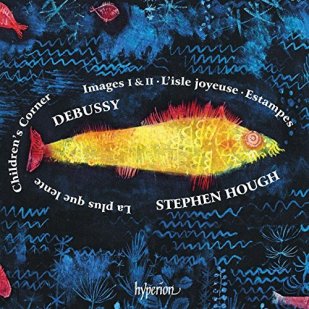
debussy-piano-music---stephen-hough-hyperion-1515405549…….make sure it’s Stephen Hough’s new disc of piano music by Debussy (Hyperion).

I read Stephen’s illuminating article about Claude Debussy (New York Times, 2 March 2018) and then listened to his new disc of Debussy’s piano music (Estampes, Images, Children’s Corner, La plus que lente and L’isle joyeuse). Here is Stephen writing on Pagodes, the first piece on his new disc:

[Debussy’s] use of its tonal color………is not so much a translation of a foreign text as it is a poem written in a newly learned, fully absorbed language

Stephen could be describing his own playing here (though he is far too modest to do so!). For those more used to hearing him play Liszt with cool yet colourful virtuosity, his Debussy playing is deliciously liquid, lucid, perfumed, sensuous and elegant. The phrasing and pacing is so natural and supple, fermatas and pauses so sensitively judged, touch, articulation and pedalling so clear and carefully nuanced, one has the sense that Stephen has also “fully absorbed” the composer’s language.

Take Pagodes, for example, the piece which opens this disc. Textures and lines emerge, blur and recede with all the ethereal delicacy of watercolour painting (and the suite Estampes is a reminder that Debussy loved art), but there is clarity too, so that every note sounds like a crystalline droplet. Reflets dans l’eau is similarly coloured, glistening and shimmering with subtlety and elegance. There’s nothing fussy or contrived in Stephen’s account of this music, and his assertion in the NYT article that Debussy was a “modern” composer is more than confirmed in his highlighting of the composer’s fondness for piquant or erotic harmonies, surprising melodic fragments (often using the pentatonic scale) and rhythmic quirks.

Children’s Corner proves as much a delight for adults as the young ones: snow dances with feathery delicacy, while The Little Shepherd a study in tender simplicity, tinged with poignancy. Strictly for adults, La plus que lente is wonderfully louche and languorous, with its late-night cocktail bar swagger. L’isle joyeuse closes this fine recording with a sparkling clarity, wit and sunlit joie de vivre

Highly recommended

Claude Debussy (1862-1918) / Piano Music / Stephen Hough (piano) / Hyperion CDA68139


Meet the Artist – Stephen Hough

Robert Schumann died in a lunatic asylum on 29th July 1856. On 29th July 2017, at Prom 20, British pianist Stephen Hough gave a performance of a work suffused with melancholy and darkness, the composer Johannes Brahms’ response to the tragedy of Schumann’s mental illness.

According to Brahms’ friend and colleague Joseph Joachim, who conducted the première of the First Piano Concerto in Hanover in 1856, the work reflects Brahms’ emotions on hearing Schumann, his artistic patron and musical father figure, had attempted suicide in the Rhine. The concerto opens with a ferociously portentous drum roll and darkly-hued, angst-ridden orchestral tutti, and the entire first movement charts a terrain of pain and instability, in which orchestra and piano seem at odds, engaged in a battle of drama and rhetoric. Given that this is the work of a young composer “without his beard” (Stephen Hough), the darkness and profundity of the First Concerto is shocking, its message visceral and emotionally charged. It flames with intensity and rhetoric.

Read the full review here

Stephen Hough, composer and pianist with The Prince Consort at Wigmore Hall, Friday 28th October 2016

An evening of music for piano and voice by pianist and polymath Stephen Hough, performed by The Prince Consort, with Hough himself playing in the second half, promised to be something intriguing and special, especially as the programme included the world premiere of Hough’s song cycle Dappled Things, dedicated to John Gilhooly, director of Wigmore Hall.

In setting poetry to music, Hough is working within a fine English song tradition that includes composers such as Purcell, Elgar, Delius, Vaughan Williams, Butterworth and Britten, and indeed there were fleeting musical glimpses of these composers within Hough’s works

Read my full review here

20160806_bkp001_0
(picture: The Economist)

Stephen Hough’s recent comments about changing the length and format of classical music concerts by ditching the interval and perhaps starting concerts earlier or later in the evening has generated a lively discussion. And rightly so, because those of us who care about classical music should be concerned about keeping this wonderfully and incredibly varied art form alive and kicking. In his article for the Radio Times, Hough expresses his concerns about attracting a younger audience to classical music and notes that there is no one simple solution to attract more people to concerts.

It strikes me that whenever young people are mentioned in the context of classical music, a whole host of commentators immediately respond by saying that “it’s all about education“. They cite the woeful provision for music education in our state primary and secondary schools (true), the fact that music lessons are often the preserve of the better off (also generally true, sadly) and that our children need to be educated to understand and appreciate classical music.

As I’ve mentioned several times before on this site, I was fortunate in that I had a very good musical education as a child, initiated first by my parents, who were keen concert-goers and music lovers, and subsequently through excellent music provision and teachers at both primary and secondary school (both state schools). My enjoyment and interest in classical music was inculcated at a young age and has stayed with me: I have not, as one friend suggested, grown to love classical music as I’ve got older, only that my tastes change as I explore more repertoire. I was very very lucky – privileged, in fact – in my musical education.

The debate about music provision in our state schools is ongoing and no one seems to have the solution. Various musical celebrities such as Nicola Benedetti and James Rhodes have initiated projects to try and right this terrible wrong, and I applaud anyone who cares enough to encourage our children to enjoy classical music, in and out of school. And Stephen Hough’s ideas should not be dismissed out of hand, just because they might run counter to established ways of doing things in classical music.

But we need to be careful how we frame “educating young people to like/enjoy/appreciate classical music”. As a Twitter colleague of mine said in response to Stephen Hough’s article:

Too often, whenever people start saying “Education” is the important factor, it sounds coercive

We should not seek to “programme” people, whatever their age, to like classical music. Let us not forget that the word “teach” comes from the Old English tæcan which means to “show”, “present” or “point out”. As a music teacher, I agree with my colleague and fellow blogger Andrew Eales, who suggests in his post in response to Stephen Hough’s comments, “When it comes to generating enthusiasm for classical music (and any other genre for that matter) the responsibility truly lies with those who perform and teach it.”. Andrew then goes on to offer some simple and creative ways in which to engage young people with classical music and which do not involve sitting a bunch of 6 year olds in a classroom and force-feeding them Beethoven and Bach.

It’s very easy – and lazy – to blame the young for all the ills in our society, and debates such as music education are too often, in my experience, loaded with a sense of entitlement or superiority – that the role of educators is to produce people who think and do things our way, rather than exploring ways to engage young people. Maybe one of the first things we need to do is shift the vocabulary from “tell” to “show”, “present” or “point out”……

I don’t have all the answers either. But in my very small way as a private music teacher, and via this blog and my other musical activities, I hope I am making a contribution, albeit a tiny one…..

Further reading

No More Loo Breaks – Stephen Hough’s original article in the Radio Times magazine (PDF file)

Stephen Hough: no more loo breaks? – Article by Andrew Eales/Piano Dao

Nicola Benedetti: Every young person in Britain should be made to study classical music


