‘The World of Yesterday’ – written & performed by Sir Stephen Hough with the Bournemouth Syphony Orchestra, conducted by Mark Wigglesworth. Wednesday 26th February, Lighthouse, Poole

British pianist Sir Stephen Hough hadn’t intended to write a piano concerto. But during the dark days of the COVID pandemic, he was approached to write a score for a film about a concert pianist writing a piano concerto… With little to do but take Zoom calls, “it seemed like a wonderful way to keep me busy”, and, intrigued by the film’s plot, he began jotting down ideas.

As the world emerged from the pandemic, the film project stalled and Stephen’s concert diary began to fill up again, but he still had the sketches for the film score and, with the support of four orchestras (the Utah, Singapore and Adelaide symphonies, and the Hallé) he wrote his piano concerto ‘The World of Yesterday’. It received its world premiere with the Utah Symphony Orchestra in January 2024 and a recording made with the Hallé and Sir Mark Elder is available on the Hyperion label.

I had the pleasure of hearing Hough perform his concerto with the Bournemouth Symphony Orchestra in a well-conceived programme called Notes of Nostalgia. Given its theme, the concerto sat perfectly between Brahms’ Third Symphony and Elgar’s Enigma Variations – all three works infused with a certain wistfulness interposed with personal reflection, warmth and wit.

Hough’s concerto takes its inspiration, in part, from Austrian author Stefan Zweig’s atmospheric memoir of the same name, which depicts Vienna and Viennese culture in the last golden days of the Habsburg Empire before Europe was torn apart by war. You can almost smell the aroma of Viennese coffee and taste the Sacher-Torte in the quieter passages of the piece.

The music is rich in nostalgia, but without the heart-tugging poignancy of Chopin, for instance: it’s a more reflective yet positive reminiscence of another time. Scored in a single movement but with distinct sections, ‘The World of Yesterday’ has a filmic quality (“something from the 1940s”, my husband commented as we left the concert hall) – you certainly hear nods to Korngold’s film scores, and it shares Korngold’s romantic sweep, but there are also references to Rachmaninov (particularly in the very glittery virtuosic solo sections), Copland, the Warsaw Concerto…but at no point do these references feel like pastiche. And if you’re familiar with Hough’s wonderful transcriptions of Rodgers and Hammerstein, you’ll find similar idioms here (I half-expected Hough to segue into the Carousel Waltz at one point). And yes, there is a waltz too – not so much a Viennese waltz but something more sultry, redolent of Bill Evans and a smoky, late-night jazz club.

Hearing the composer play his own work was like a bridge across time to another world of yesterday, a time when composers wrote piano concertos which they performed themselves: Mozart, Beethoven, Mendelssohn, Chopin, Liszt, Rachmaninov and Prokofiev all performed their own concertos. Showcasing their prowess and personality as both performer and composer, these works becoming their “calling cards” as they toured to give concerts.

The music has an almost “vintage” quality: surprisingly traditional in its direct communication with orchestra and audience, and its idioms, motifs and references to other composers (there’s not a hint of that “squeaky gate” atonality one often associates with contemporary classical music). The piano enjoys Brahmsian interactions with the orchestra and Rachmaninov-esque cadenzas, but Hough’s does break with tradition in a few significant ways. First, the concerto has a narrative title, rather than just an opus number or key, which undoubtedly guides the audience, even without a programme note. Additionally, the cadenza, traditionally heard at the end of a movement, comes very early, after an orchestral ‘prelude’. Here the piano is solo, notes and motifs sparkling in the upper register (later mirrored by the piccolo).

Above all, The World of Yesterday is a richly textured, virtuosic and joyful celebration of past influences, rather than a poignant glance back to a better time. It’s full of warmth and wit, affection and humour: it made me smile, it thoroughly uplifted.

After all, isn’t that what music should do?

The World of Yesterday’ is released on 28 February on the Hyperion label

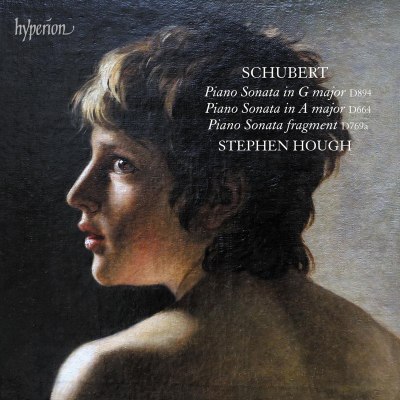
Piano Sonatas D664, 769a & 894 – Stephen Hough (piano). Hyperion, 2022

In his memoir ‘Every Good Boy Does Fine’, American pianist Jeremy Denk says of Schubert, “He likes to let his ideas spread out, like pets that hog the bed.” He’s referring specifically to Schubert’s penchant for length or expansiveness, most evident in his late piano sonatas. This is not a criticism from Denk; later in the same paragraph he goes on to explain how Schubert uses his “heavenly length” to accumulate meaning.

In the first movement of Schubert’s G major piano sonata, D894, which opens this new recording from recently-knighted Stephen Hough, the ideas are certainly spread out, each clearly delineated, from the chordal, prayer-like first subject to the delicately dancing second subject (where the cantabile clarity of the upper registers of the piano is utterly beguiling in Hough’s hands), yet without the longueurs of Richter’s interpretation (and such a slow tempo really only works in Richter’s hands!). Hough favours a molto moderato which moves forward with vigour and colour when required but also allows time to savour all the details and nuances of this wondrous first movement.

The second movement is genial and intimate, a simple aria elegantly sculpted by Hough, reminding us that this is music for the salon rather than the concert hall. Hough really appreciates this, creating intimacy and introspection through supple phrasing and rubato, pauses (so important in Schubert’s music to create drama and breathing space) and tasteful pedalling.

The third movement scherzo revisits the chords of the first movement, this time in B minor, its robustness quickly offset by another dance figure. The trio, almost entirely in ppp, weaves a pretty melody around a handful of notes, with an offbeat bassline, like the memory of a forgotten Viennese waltz. And when the music shifts into the major key, it is almost more tender and poignant than when Schubert is writing in the minor key. The rondo finale is also a dance, graceful yet playful, occasionally insistent, played with an elegant clarity and some delicious bass details.

A curious interlude between two complete sonatas comes with the unfinished sonata fragment in E minor, D769a, a mere 1 minute of music yet profound and inventive in its expression. It finishes on a repeated figure, pianist and listener suspended, wondering where Schubert might have gone next with this music.

The Sonata in A, D664, is wholly delightful, Schubert at his most good-humoured. The affable first movement sings in Hough’s hands, while the second movement is thoughtful, poignant and tender, marked by gently sighing phrases. The sunny mood is soon restored in the finale, to which Hough brings a joyful light-heartedness with its tumbling scales and dance-like passages.

The recording was made on a C Bechstein Model D piano and there’s an intimacy and warmth to the piano sound which perfectly suits Schubert’s introspection, while a bright but sweet treble brings a lovely clarity to the melody lines and highlights Hough’s deftness of touch.

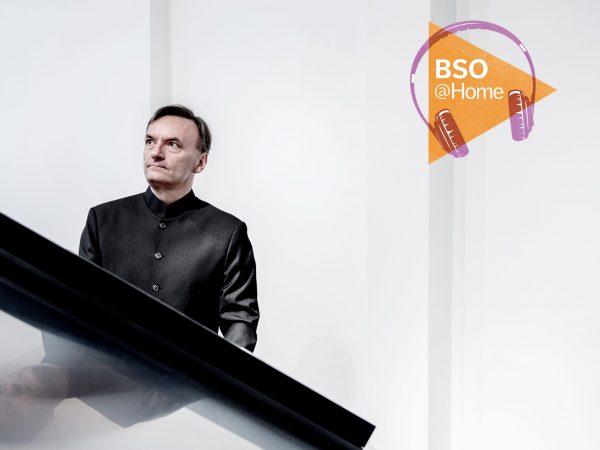
The applause, from the orchestra, at the end of Stephen Hough’s performance of Brahms’ expansive, turbulent first piano concerto was unexpected and also very welcome in a concert devoid of an actual, live audience.

I admit I have not always warmed to livestream performances and have watched very few over the past year. But I applaud any artist or organisation which has made every effort to keep the music playing and musicians employed and, importantly, paid during what has been an incredibly difficult year for an already precarious profession. Chapeau to the Bournemouth Symphony Orchestra (my “local” orchestra, since I moved to Dorset in 2018) for keeping us engaged and entertained with a wonderfully varied weekly programme of music and soloists (Paul Lewis, Gabriella Montero, Benjamin Grosvenor and Sunwook Kim, amongst others), presented via livestream and available for 30 days post-concert via the BSO website. They have also found a way to successfully monetise livestream concerts.

Livestream concerts are all we keen music lovers and concert-goers have at present, until the government deems it safe to reopen music venues and opera houses (probably in mid- to late May). I actually watched the BSO/Hough livestream two days after the live broadcast (one of the benefits of livestream is that one can watch it at one’s convenience, and on multiple occasions if desired!), on the first anniversary of my last visit to central London for a concert at Wigmore Hall (of course, at the time I didn’t realise it would be my last visit to a major London concert venue, in the company of a good friend, for a year; the coronavirus was only just beginning to be something of a concern back in February 2020…..).

Stephen Hough has a knack of selecting programmes which seem to perfectly chime with our curious, troubled times – for example, his latest release Vida Breve) – and the Brahms concerto is another good example. A work of restlessness and turbulence, seraphic serenity, and an energetic Hungarian dance as a finale, it seems to reflect the anxiety and hope which colour these strange days of lockdown.

Of course, Brahms didn’t know his music would resonate in this way when he wrote his first piano concerto. It’s the work of a young man, full of passion, intense in its emotional landscape and symphonic in scale and organisation. From the opening with its thunderous, ominous timpani and driving strings, its no-holds-barred orchestral writing, one has the sense of the young Brahms setting out his compositional stall with authority and maturity.

The piano is not always a soloist here, but also an obbligato instrument which takes over material from the orchestra and comments or expands on it. Between the BSO, conducted by John Eliot Gardiner, and Stephen Hough there was a constant sense of sympathetic cooperation (sometimes these big romantic piano concertos can feel like an immense tussle between soloist and orchestra). Phrases were sensitively shaped and tempi allowed a certain suppleness. Hough has a remarkable instinct for natural rubato, to highlight certain phrases or harmonies, emphasise certain emotions or perfectly time the delayed gratification which we crave in music such as this; it was especially apparent in the seraphic slow movement, its hymn-like tranquillity and introspection redolent of the slow movement of Beethoven’s ‘Emperor’ concerto. This was complemented by some particularly fine bassoon playing.

The Hungarian dance finale was a release of pressure from the adagio, alternately thunderously energetic and graceful, Hough switching between sparkling, fleet-fingered passages and sections of tender intimacy (and a certain intimacy imbues the entire concerto, despite its expansive scale – when Brahms is intimate, he is really really intimate!). Perhaps the greatest benefit of a filmed concert for the ‘piano nerd’, is that one is treated to close ups of the pianist’s hands and fingers in a way one could never see them in a live concert, and Hough has a remarkable economy in his playing, free of gestures which only serves to highlight the intensity of the music he is performing.

Overall, the AV quality of this livestream was impressive. Clever camera angles disguised the fact that the players were socially-distanced, and the camera did not linger long on the empty auditorium, instead offering viewers some excellent close-ups of individual players, conductor and of course soloist.

This concert is available on demand at bsolive.com until March 26

The ‘BSO At Home’ livestream performances from its home at The Lighthouse, Poole, continue on 3 March. Further information here

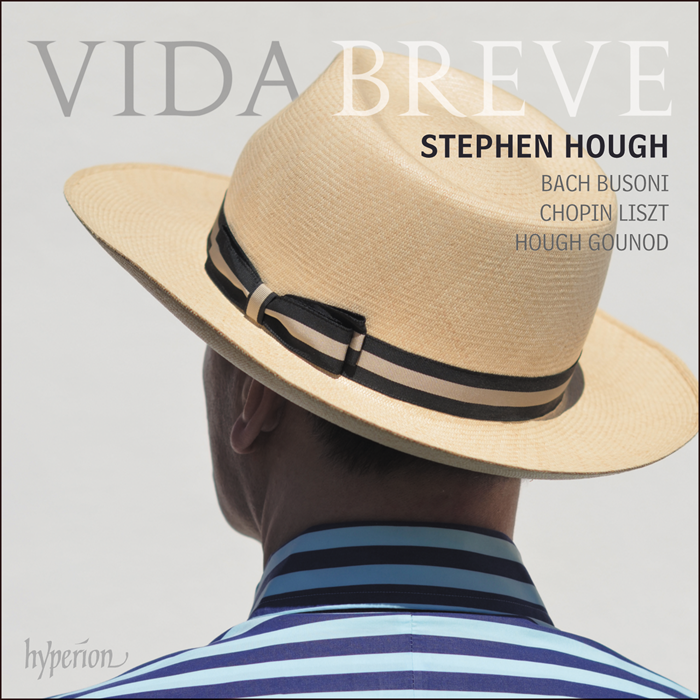
034571282602‘Vida Breve’ (Short Life) – Stephen Hough, piano (Hyperion CDA68260)


It seems fitting that Stephen Hough’s new album ‘Vida Breve’, featuring music on the theme of death, should be released while we are still in the thrall of the coronavirus. But this album is not a response to the pandemic and was in fact conceived and recorded long before any of us had heard of coronavirus or COVID-19.

Yet its theme is highly relevant to our Corona times when death dominates the news, from the daily tally of COVID deaths and grim predictions from scientific and medical experts. Despite this, as Stephen Hough says in the CD’s liner notes, we are still reluctant to talk about death, a reluctance which has increased over the past 50-odd years during which medical science has made it possible for people survive better and for longer and has led to a greater disassociation from and hyper-sensitivity to discussions about death.

For artists, writers and composers death has always been a central preoccupation, resulting in some of the most extraordinary, exultant and emotionally profound expression in painting, literature and music – amply demonstrated in the works on Hough’s new album. In the nineteenth century people were far closer to death than we are today, and for Chopin (whose short life was dogged by ill-health), Liszt and Busoni, composers whose music is included on this CD, death was understood and accepted as part of the natural course of life.

As a Catholic, I suspect Stephen Hough has a fairly robust attitude towards death, perhaps more closely aligned to that of the composers featured on his new disc (and remember Liszt was a devout Catholic). Hough’s faith teaches us not to fear death but to accept it as the only certainty in life, and his own piano sonata ‘Vida Breve’, the work which lends its title to the disc, explores the brevity of life, a reminder that our allocated time is short. An abstract, introspective work constructed of five tiny motivic cells, which interact contrapuntally and include a quotation from the French chanson En Avril à Paris, made famous by Charles Trenet, ‘Vida Breve’ lasts a mere 10 minutes, a comment on the transient, fleeting nature of life, its passions and turmoil.

Bach’s mighty Chaconne from the D minor violin Partita opens this recording, in Busoni’s glorious, romantic transcription for solo piano. This epic cathedral of sound is an awe-inspiring, emphatic opener (Hough played it at his Wigmore Hall livestream concert in June 2020), and here Hough gives it an authoritative, multi-layered, orchestral monumentalism. It’s opening is dark and sombre, yet the processional nature of this piece, with its sense of building, dying back, then increasing again, brings a remarkably uplifting atmosphere to this music, and of course its final cadence, a Picardy Third, ensures that it closes with a clear sense of positivity.

After the towering majesty of the Chaconne, Chopin’s Piano Sonata No. 2 is fleet and turbulent, its anxious intensity tempered when Hough lingers over the more lyrical Nocturne-like passages in the opening movement and the Scherzo, or when he allows the essential nobility of the music to shine through over disruptive bass motifs. Like the Chaconne, the famous Marche funèbre is magisterial rather than simply funereal, while the tender, dreamy middle section lends an other-worldliness to the music’s atmosphere before the tolling bass and mournful theme return.

In addition to the thematic associations between the pieces, there are musical connections too: the dark rumbling bass octaves in the Bach/Busoni Chaconne are reiterated in the Marche funèbre – a plangent left hand accompaniment which, in the reprise of the famous theme dominates, with a dark tolling grandeur. And this figure is later heard again in the opening of Liszt’s Funerailles, to which Hough brings an ominous darkness, its slow-march meter suggesting the dead weight of a bier on the shoulders who carry it, before a more reflective, wistful section. The other piece by Liszt, the Bagatelle Sans Tonalité, is a musical gargoyle with its wayward harmonic language and grimacing, dancing rhythms.

The remaining works on the disc are encores of a sort – a reminder that this final recital is not quite over….. Busoni’s Kammer-Fantasie über Carmen uses familiar melodies and motifs from Bizet’s opera and transforms them into a witty concert piece, to which Hough brings a warm romanticism. His own transcription of Arirang, a traditional Korean folksong, is gentle and contemplative, its lyrical melody singing out over a flowing accompaniment. It leads naturally into Gounod’s recasting of Bach’s Prelude in C into Ave Maria (also transcribed by Hough), a popular work at funerals, perhaps because it is both perfect music for the transit to the afterlife and for reflections on life and the inevitability of its end. Death, now where is thy sting?

This album is masterly is its programming; stimulating and provocative, it’s a superb recital disc and, being Hough, the music is thoughtfully chosen and impeccably played.

Highly recommended

FW


‘Vida Breve’ is released by Hyperion on 29 January 2021. 

This review first appeared on The Cross-Eyed Pianist site