On 20 June 2016 St John’s Smith Square announced its 2016/17 Season. With over 300 concerts and many individual series, workshops and strands, this season further strengthens St John’s Smith Square’s core mission: to be a centre of excellence for chamber orchestras, choral and vocal music and period instrument groups. St John’s Smith Square also plays a vital function in presenting new work (with over 30 world premieres already announced for 16/17) and supporting emerging artists (including an own-promoted Young Artists’ Series).

There is plenty to interest and excite lovers of piano music: the popular and excellent International Piano Series will continue at SJSS, its temporary home while the Southbank Centre undergoes refurbishment. IPS highlights include the outstanding young British pianist Benjamin Grosvenor (4 October 2016), runner-up at the 2010 International Chopin Competition Ingolf Wunder (19 November 2016) and winner of the same competition Yulianna Avdeeva (29 March 2016). Pierre-Laurent Aimard and Tamara Stefanovich perform music for 2 pianos as part of Southbank Centre’s year-long festival Belief and Beyond Belief in partnership with the London Philharmonic Orchestra (24 January 2017). This concert also forms part of Southbank Centre’s International Chamber Music Series.

In addition there will be performances by other pianists, including SJSS Young Artist Christina McMaster, Zubin Kanga, Geoffrey Saba, Rolf Hind, Howard Shelley and Martino Tirimo.

Richard Heason, Director of St John’s Smith Square said: 

“I am thrilled to be able to launch another season packed with exciting and stimulating concerts. It is particularly exciting to see international partnerships, with groups like Les Talens Lyriques and Stradivaria, starting to come to fruition. I am very keen to ensure that St John’s Smith Square presents a dynamic and individual programme and that we devote our energy to ensuring we present top quality artists. Alongside the distinctive baroque programme we offer it is also very rewarding to welcome artists presenting contemporary music and commissions. My sincere thanks go out to all those partners who have collaborated to make this programme possible. St John’s Smith Square receives no public subsidy and so we are reliant on the friendship and support of those who believe in our mission to be one of the UK’s leading concert halls.”

Ever since its reinvention as a concert hall, St John’s Smith Square has played a pivotal role in supporting the most promising young musicians. Simon Rattle, Steven Isserlis, Nigel Kennedy and Jacqueline du Pré are just a few of the musicians who performed at St John’s Smith Square before going on to begin internationally renowned careers.

St John’s Smith Square Young Artists’ Scheme 2016/17

“The Young Artists’ Scheme at St John’s Smith Square is a vital part of our mission as one of the UK’s leading concert halls. By investing in the development and nurturing of exceptional talent we are helping to ensure that music making and creative opportunity is refreshed and renewed for future generations. It is also, of course, incredibly exciting simply to observe the young performers as they develop across the course of their involvement with the scheme and a real reward for our audiences to be able to share this process of development.” – Richard Heason: Director, St John’s Smith Square

Pianist Christina McMaster is amongst the line up of the 2016/17 Young Artists’ Scheme (which also includes the Minerva Piano Trio, harpist Oliver Wass and the Ferio Saxophone Quartet). A champion of contemporary repertoire, Christina has been praised for her innovative programming, and her collaborations with a diverse mix of genres and arts, recently working with the Brodowski Quartet, violinist Lizzie Ball, rapper Tor Cesay, director Richard Williams, actors from Central Saint Martin’s and a number of designers for London Fashion week. She also commissions and performs a wide range of new music, and has worked with established composers including Sir Harrison Birtwistle, Sir Peter Maxwell Davies, Tansy Davies and Stephen Montague as well as emerging composers – collaborating most recently with Freya Waley-Cohen and Richard Bullen.

christina2bmcmaster

Christina launched her debut album ‘Pinks & Blues’ in October 2015 on her own label to a sell-out audience at St James’ Theatre, the album is a fusion of jazz and blues influenced classical and contemporary music with two new commissions.

“Thanks to the St John’s Smith Square Young Artists’ Scheme I am able to design and deliver my ambitious vision of an exciting ‘mini-festival’ across 2016/17 season with an array of concerts from solo piano music by Bartók, Scarlatti, Ligeti, Debussy, to a concert where 120 school children take over the galleries of SJSS! Responding to the building’s rich history I’ll perform music by Dowland, Shostakovich, Britten and Birtwistle with the Ligeti Quartet; and the brilliant sisters Kristine and Margarita Balanas will join me for piano trios by Schumann and Arvo Pärt. The scheme has also provided the wonderful opportunity to commission new music by Richard Bullen and Ayanna Witter-Johnson; Ayanna will pay homage to one of her heroines in celebration of International Women’s Day alongside some of my musical heroes including Ruth Crawford-Seeger, Charles Ives and Meredith Monk.”  –

Christina McMaster

Meet the Artist……Christina McMaster

Review of Pinks & Blues

St John’s Smith Square Young Artists’ Scheme

The Françoise-Green Duo at St John’s Smith Square, Thursday 31st March 2016
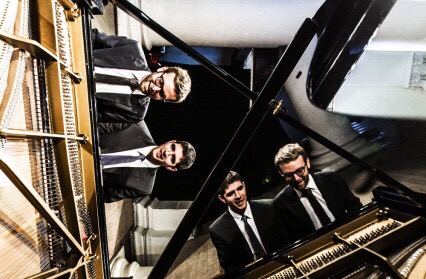
  

The five-concert residency at St John’s Smith Square by the Françoise-Green piano duo is exploring the music of Vienna’s musical landscape through its salon culture, from Mozart and Schubert to Schoenberg and the Second Viennese School. Vienna’s unique system of private and public patronage allowed composers such as Mozart to present their music to a select audience via the salon. For Schubert, who did not have the kind of patronage and support Mozart enjoyed, nor publishers eagerly clamouring for his music, performances within the privacy of his own circle of friends was the only way his audacious music found a truly receptive audience. This salon culture became even more pronounced at the turn of the twentieth century, when Schoenberg and his cohort broke away from the Vienna Tonkunstlerverein and built their own community for the performance of their music outside of the mainstream where much of their music was premiered through private performance societies. The Françoise-Green Duo pay a special hommage to this by performing new works which they have commissioned especially for their residency.

Music for piano duo is often, and mistakenly, regarded as “light” – music to be enjoyed at home amongst friends, and the enduring popularity of music for piano duo is testament to its appeal, variety and inventiveness. Both Mozart and Schubert wrote fine works for piano 4-hands, including the latter’s Fantasie in f minor, D940, arguably the most profound work ever written for this genre.

This particular concert, the third in the series, revealed the contrasting characters of Vienna, from the elegance and wit of Mozart through Schubert’s bittersweet Allegro in A minor ‘Lebenssturme’, D947, to the decadence and eroticism of fin de siecle Vienna of Alban Berg, reimagined by British composer Kenneth Hesketh in his Die letzten Augenblicken der Lulu, and the world premiere of ‘Fable’, a new work by Colin Alexander which was dedicated to the duo.

The Françoise-Green Duo are notable for their confident and convincing handling of contemporary repertoire – one has the sense of two musicians who actively relish the challenges, both technical and artistic, that this music presents – yet their opening piece, the Sonata in F K497, written at the end of Mozart’s life, proved them at home in more traditionally “classical” repertoire. In this sonata, the two pianists are equal players, sparking off one another, and creating witty dialogues interspersed with rich orchestral textures. In the softer dynamic range, the pianists brought a tenderness which immediately shrank the large space of St John’s Smith Square to an intimate salon.

Kenneth Hesketh’s work is both a redaction of Berg’s ‘Lulu Suite’ focusing on the main material in the suite, but also providing a flashback of Lulu’s life in the immediate moments before her death. Soprano Sarah Gabriel’s performance in this work was dramatic and vulnerable, and the combination of spoken word and vocal line, culminating in a full-throated scream signifying Lulu’s death at the hand of Jack the Ripper, was searing. The piano part created an unsettling undercurrent, increasing in urgency towards the tragic denouement.
After the interval came the world premiere of Colin Alexander’s ‘Fable’, a work which fully utilised the fine acoustic of St John’s Smith Square, the resonance of the Steinway D, and the duo’s technical assuredness. At times, the sounds emanating from the piano recalled bells, bassoons, horns and chanting, which built in intensity to create a hypnotic whole. It put me in mind of Somei Satoh’s mesmeric Incarnation II, which uses the resonance of the piano to similar effect.
It’s all too easy to ascribe a certain mindset or state of health to Schubert’s music: his illness, syphilis, and its disturbing and debilitating treatment and side effects are well-documented. Whatever the composer’s mental state in the final year of his life, there is no doubt that this was a period of fervent, boundary-breaking creativity. The ‘Lebenssturme’ (Life’s Storm – a title assigned by the publisher after Schubert’s death) opens with a dramatic motif of forte (check) chords which gives way to an ethereal second subject, which Antoine Françoise seemed to float across the upper register of the piano. It’s a substantial work whose structure hints that Schubert might have had something longer in mind and which demonstrates fully the breadth and daring of his creativity in the year of his life. 

For an encore, the duo played the opening movement of Mozart’s Sonata in C major, K19d (dropped from the original programme better to accommodate the new works) Written when the composer was still a boy, yet already bright with promise, witty, colourful, and elegantly turned by Robin Green and Antoine Françoise.

‘The Viennese Salon’ continues at St John’s Smith Square on 7 April with a rare opportunity to hear Mahler’s Symphony No. 6 arranged for piano four-hands by Alexander von Zemlinsky together with works by Mozart and the world premiere of a new piece by Alissa Firsova. Further information here

Recommended.

250px-johannespassion
First page of the autograph manuscript of St John Passion
Hearing J S Bach’s St John Passion in a Baroque church, as I did on Good Friday, connected this powerful and stirring work more closely to its original conception and performance. This was the annual Good Friday performance at St John’s Smith Square, a Baroque church in the heart of Westminster, given by Polyphony with the Orchestra of the Age of Enlightenment, conducted by Stephen Layton.

Bach composed his Johannes Passion (St John Passion) in 1724, the composer’s first year as director of church music in Leipzig. The work received its first performance on 7 April 1724, at Good Friday Vespers, at the St Nicholas Church. The work is in two sections, intended to flank a sermon, and the text, which retells the events of Good Friday leading up to Christ’s crucifixion, death and deposition from the Cross, is drawn from chapters 18 and 19 of the Gospel of John in the Luther Bible. To the modern audience, the text may seem arcane, and the unfolding narrative feels almost operatic, but to the congregation in Bach’s church, it would have been entirely familiar, as were the chorales which used well-known hymn tunes and texts. The work comprises choruses, chorales, arias and recitatives, with some highly effective and arresting “word painting” to reflect the meaning of certain words or passages.

In this performance, the role of St John the Evangelist was sung by Stuart Jackson whose tenor voice was eloquent, pure and mellifluous. Jackson was joined by Neal Davies, a sombre Christus, whose interplay with Roderick Williams’ Pilate was gripping and intense. Julia Doyle, Iestyn Davies, and Gwilym Bowen all responded with sensitivity to the spiritual substance of the text and the profound drama of the narrative. Julia Doyle’s soprano arias were especially luminous, while Iestyn Davies’ counter-tenor was clear and ethereal.

Polyphony sang with a full, rounded sound with impressively crisp diction which brought a dramatic immediacy to the text, for example in the chorus when Christ is brought before Pilate and the choir become the baying crowd. Stephen Layton drew a rich, colourful sound from the OAE with some particularly fine contributions from the woodwind and an elegant cello continuo. The pacing of the drama was also expertly judged by Layton with impactful and moving pauses and longer silences to allow the audience time to digest and reflect upon the highly charged and emotional narrative.


