Who or what inspired you to take up the piano, and make it your career?
One of my early piano teachers, Christopher Vale. He is one of those amazingly enthusiastic musicians and teachers who couldn’t fail to inspire anyone. His passion for music was contagious at a very crucial time in my life.
Who or what were the most important influences on your musical life and career?
My conservatoire teachers: Richard Ormrod, Alexandre Léger, and Rolf Hind. And Nelly Ben-Or and Chris Cullen for an inspiring and timely introduction to both the Alexander Technique and to mindfulness. And I really appreciate the time I spent away studying in France.
What have been the greatest challenges of your career so far?
The realisation that what I’ve decided to do with my life will be hard and likely not bring much certainty or security, but that somehow I have to do it regardless.
Which particular works do you think you play best?
Messiaen Cantéyodjayâ, Bartók Out of Doors, Ives ‘Concord’ Sonata
How do you make your repertoire choices from season to season?
I pick things that I like – that excite me – and that I want people to hear. And I play new works, which is exciting in itself as I don’t always know what I’m going to get.
Favourite pieces to perform? Listen to?
Listen to: Bartók Piano Concerto no. 2. Watch: Globokar Corporel. Play: Reich Sextet.
Who are your favourite musicians?
Bartók, Ligeti, Kate Bush.
What is your most memorable concert experience?
Playing Feldman’s For Philip Guston (a four-and-a-half-hour-long trio) during which the venue’s heating stopped working (in February). Both musicians and (most) audience members powered through the cold to the end.
What do you consider to be the most important ideas and concepts to impart to aspiring musicians?
Keep at it – something is bound to happen.
What do you enjoy doing most?
Watching birds and doing a jigsaw.
Siwan Rhys is a Welsh pianist based in London. She currently holds the position of Artist Fellow at the Guildhall School of Music and Drama, specialising in contemporary piano music, and also teaches piano at City University, London. Recent concert engagements include performances of Stockhausen’s Kontakte and of Feldman’s four-hour work For Philip Guston
Paul Badura-Skoda (Photo @ DR)Saturday 10th May, 2014 – St John’s, Smith Square, London
Chopin
Waltzes – A minor, Op.34/2, C sharp minor, Op.64/2, D flat, Op.64/1; Nocturne, op. posth., Four Mazurkas, op. 30, Barcarolle, op. 60
Schubert
Impromptu in B-flat D935 No. 3 ‘Rosamunde Variations’
Sonata in B-flat D960
The words “great” and “world class” are all too frequently bandied about in reviews and articles about musicians (and artists and writers too). But how does one truly define these over-used descriptions? If “greatness” comes from a life spent living with, and performing and writing about, some of the finest music ever written, forming a profound relationship with it and its composers, understanding with intimate detail its structures and nuances, then Paul Badura-Skoda is a living example of this.
Paul Badura-Skoda is a pianist I have long wanted to hear live. I was aware of him more as a respected pedagogue, writer on music and editor of works by Mozart, Beethoven and Chopin and others. My teacher frequently refers to him, I have met pianists who have studied with him, and I have listened to some of his recordings (including his latest in which he plays Schubert’s final sonata on three different pianos) with interest and curiosity.
His concert at St John’s Smith Square was an opportunity for me and my companion for the evening (a fellow pianist) to share a unique musical experience – and one which will resonate with us for a long time to come. To attempt to “review” the playing, the pianism, the musical understanding and insight of such a master would be churlish.
Badura-Skoda created a special and intimate soundworld and atmosphere from the opening notes of the bittersweet A minor Waltz to the life-affirming closing cadence of Schubert’s final Piano Sonata, a place where generosity of spirit and good humour ruled, a place of great intimacy, as if we had been invited into his own musical salon for the evening. Of course, Paul Badura-Skoda is steeped in that particular European tradition of music-making, and his teacher, Edwin Fischer, connects him to an earlier golden age of music making and culture.
Despite his age (86), Badura-Skoda cuts a sprightly figure (compare his twinkling eyes and brisk gait with the frailer Maurizio Pollini at the Queen Elizabeth Hall in April, who is more than 10 years Badura-Skoda’s junior) and displayed an obvious pleasure in being at St John’s Smith Square. And if there were some smeared notes and uncertain rhythms, the overall effect was of a musician who has lived with this music for many years and whose knowledge and understanding allowed the music to speak for itself, free of ego and unnecessary gestures.
Before the Sonata in B flat, D960, Paul Badura-Skoda said a few words about the piece, how he regarded it as Schubert’s “farewell” (it was completed less than two months before the composer’s death in 1828), and how the sublime opening theme suggests the words of a hymn or prayer. The first movement had a spacious serenity in the main theme, and the range of colours and nuances which Badura-Skoda brought to the music shone a new light on a familiar work for me: for example, the bass trills were voiced differently each time which gave them a greater resonance and sense of foreboding, and the exposition repeat was observed. The slow movement’s ominous tread was relieved by a middle section of great warmth. The third movement bubbled with all the exuberance of a mountain stream, the darker Trio hardly interrupting the mood, while the finale had drive and energy coupled with wit and humour, despite one or two uneven moments. This was an engaging and entirely satisfying performance, which was met, deservedly, in my opinion, with a standing ovation.
Who or what inspired you to take up the piano and make it your career?
Originally, my Mum inspired me to play. She was a keen amateur pianist and there was always music in the house. One of my earliest memories is of her practising for her diplomas and strains of beautiful Chopin and Beethoven sending me off to sleep at night.
I always wanted to be a musician, or, more to the point, I could never have imagined not having music in my life. When I was 18 I was the Piano Winner of the BBC Young Musician of the Year and things just progressed gradually from there. I was at the Guildhall but I began to do a lot of professional engagements.
Who or what were the most important influences on your playing?
Since I was a child I had a profound love for the music of Robert Schumann. Looking back, he seems an unlikely candidate for an eight year old but I felt something spoke to me. As if it was a voice I understood. And I still feel that – although who knows whether my instincts are right, of course! It’s not just the piano music – it is his entire output. I only have to hear the opening of the 4th Symphony and I’m off! Brahms has a pretty similar effect on me.
Pianistically, I have always been inspired by Richard Goode and Mitsuko Uchida. I heard Richard Goode at the Wigmore Hall in June playing the last three Beethoven sonatas. It was a revelatory concert and something I shall always remember.
What have been the greatest challenges of your career so far?
I think everything is a challenge. Performing in itself is the greatest challenge. But all the organising of concerts, learning repertoire, writing scripts, practising, travelling. It all takes it out of you, emotionally.
Which performances/compositions/recordings are you most proud of?
My recent performance of Rêverie (with actor Henry Goodman) at the Wigmore Hall was a very happy occasion, as was touring the USA with the Schumann Concerto, conductor Barry Wordsworth and the BBC Concert Orchestra. And last year, playing the Clara Schumann Concerto at the RFH with Jane Glover was rather special evening for me. Generally though, I’m pretty self critical and rarely feel that happy with myself. It’s the same with CDs, I think. All my recordings were the best I could do on that day. I don’t like listening back to them – I think they are snapshots of how you were in a particular moment. You always want to re-record them a year later!
Do you have a favourite concert venue to perform in?
London’s Wigmore Hall
Favourite pieces to perform? Listen to?
Brahms’ First Piano Concerto is a particular favourite to perform. But I think these things chop and change depending on your mood and what is happening in your life. There are far too many favourites to name. And I have obsessions about Jerome Kern, all Tchaikovsky’s ballet music and about many jazz musicians like Stacey Kent, Jim Tomlinson and Miles Davis. The John Wilson Orchestra is extraordinary. I have been to all their Proms, which are my idea of heaven. John and I have worked together too (with the Philharmonia) and he is a really exceptional musician.
Who are your favourite musicians?
Where to start..?!
Dinu Lipatti, Daniel Barenboim, Richard Goode, Andras Schiff, Bryn Terfel, Yo Yo Ma, Itzak Perlman, Mitsuko Uchida, Sarah Connolly, Paul Lewis, Natalie Clein, Sir Colin Davis. I could go on and on, but…..
What is your most memorable concert experience?
There are too many to list – but playing the Ravel Concerto in Moscow with the Moscow State Symphony Orchestra, with a formidable female conductor called Veronica Dudarova, must rank among them! Being on stage with the most extraordinary actors in my words and music evenings makes my feel very lucky, too. Performing “Nocturne” at the Almeida with Juliet Stevenson and Henry Goodman on the very same stage I had seen them perform “Duet For One” was memorable for me. I learn a lot from them too and it has opened up a whole new world for me.
What do you consider to be the most important ideas and concepts to impart to aspiring musicians?
My own highly inspirational teacher was Joan Havill. She was (and is) quite extraordinary in so many ways and I owe so much of what I do now to her original belief in me and her dedication. I try to pass that on to my pupils but whether I succeed with that who knows?!
I feel that humility as a performer, and as a teacher, is crucial. We really are just the servant of the music. Trying to get to the heart of what the composer wanted and not about you as the performer should always come first.
What are you working on at the moment?
I am learning the Schumann Humoreske Op.20. It has taken me a long time to tackle this piece – and I’m not sure why I never learnt it before. It is a masterpiece and hugely underrated. I am also learning Brahms’ Op.116 which is pure heaven for me.
What is your idea of perfect happiness?
Perfect happiness is being at peace with yourself and being good and kind to those around you. It would also be owning my own private swimming pool – but sadly that isn’t ever going to happen!
Launched in December 2013, Lucy Parham’s King’s Place Sunday Coffee Concerts (Word/Play) continues throughout 2014. All details can be found here:
2014 sees the launch of her new Sheaffer Sunday Matinee Series at St John’s Smith Square, featuring all four of her words and music concerts. Actors will be: Henry Goodman, Martin Jarvis, Joanna David, Alex Jennings, Juliet Stevenson, Harriet Walter and Simon Russell Beale. There will be a Q and A session after each performance. The first concert ‘Beloved Clara’ is on Sunday 19th January 2014. Further details can be found here:
Lucy Parham first came to public attention as the Piano Winner of the 1984 BBC TV Young Musician of the Year. Having made her Royal Festival Hall concerto debut at 16, she has since appeared regularly at all the major concert venues in London and around the UK. Conductors with whom she collaborated include Barry Wordsworth, Sir Charles Groves, Bryden Thompson, Jane Glover, En Shao, Richard Hickox, Antoni Wit, Owain Arwel Hughes, Yoav Talmi, Veronika Dudarova, Martyn Brabbins, Sian Edwards, John Wilson and Jean-Claude Cassadesus. Festival appearances include, in the UK, Brighton, City of London, Perth, Leeds Castle, Rye, Bury St Edmunds, Three Choirs, Newbury, Victor Hugo, Guernsey, Canterbury, Cambridge, Winchester, Harrogate, BBC Proms, Welsh and Scottish Proms, Chelsea, Cardiff, North Norfolk and Oxford, and abroad, Bergen, Istanbul and Mexico City.
Who or what inspired you to take up the piano and make it your career?
My father, who is a cellist and studied with Rostropovich. He wanted me and my sister to become musicians and pianists in particular – he always loved piano even more than cello, and declared: “I want my children to play the “Royal” instrument (in Russian grand piano is “Royal”)
Who or what are the most important influences on your playing?
Without any doubt, the representatives of the old Russian piano school: Rachmaninoff, Horowitz, Sofronitsky. It is very different from the “Soviet” school – it’s very vocal in its nature and its main characteristics are a deep, singing tone, exquisite phrasing, huge range of colour and the sense of perspective – well differentiated layers of sound. When the true masters like Rachmaninoff or Horowitz played, they operated not only on the level of volume, but also in space: the sounds can be placed near and far away, as in a good painting.
What have been the greatest challenges of your career so far?
Overcoming the lack of imagination, snobbery, commercialism and often incompetence of the gate-keepers in classical music industry. It is very narrow-minded, and I am convinced that if any other business were run like this, it would go bankrupt within months.
What are the particular challenges/excitements of working with an orchestra/ensemble?
The excitement is obviously making chamber music with the richest instrument of them all; the challenge is seeing eye to eye with a conductor and at times having to deal with certain dictatorial trends on his part. Also, having to come to terms with the idea that your concerto is not really what matters most to a conductor in that programme and will inevitably be under-rehearsed.
Which recordings are you most proud of?
I am only proud of some parts of my recordings. On a whole, I understand very well the film director Federico Fellini, who never watched his films once they were edited and released. When I listen, I am always painfully aware of what could have been done better. At times, the recording conditions are not at all conducive to creative music-making. The economic considerations prevail over the musical ones.
Do you have a favourite concert venue?
Not really – those are probably the ones I haven’t performed in yet.
Who are your favourite musicians?
There are many, but they are mostly in the past – not because there aren’t any talented artists out there right now, but because I enjoy hearing something that is lost nowadays, something unique. Here are just some of them: Feodor Chaliapin, Kathleen Ferrier, Maria Callas, Sergey Rachmaninoff, Vladimir Horowitz, Vladimir Sofronitsky, Ignaz Friedman, Gregor Piatigorsky, Glenn Gould; jazz musicians Ella Fitzgerald, Art Tatum, Oscar Peterson, Niels-Henning Ørsted Pedersen, Stephan Grapelli, Django Reinhardt, Michel Petrucciani, Michael Brecker, Keith Jarrett, Chick Corea, Dave Weckl; crooners Frank Sinatra, Sammy Davis Jnr, Charles Aznavour; not so many among rock musicians, but most certainly Beatles and Led Zeppelin; in fusion: bassist Jaco Pastorius; in pop music: Bee Gees, Earth Wind & Fire, George Benson, Michael Jackson, Sting, Jamiroquai, etc.
I don’t love absolutely everything these artists ever did without reservation, but they all achieved something truly unique and great in their field. And I don’t mention here the great composers, of course (apart from Rachmaninoff who is mentioned as a great pianist), as those are in a totally different league altogether.
What is your most memorable concert experience?
When I played Rachmaninoff’s 3rd Concerto for my dad’s 80th birthday – I knew I made at least one person really happy.
What is your favourite music to play?
Whatever I am working on at the moment – if it hadn’t excited me, I wouldn’t have picked it up in the first place. To listen to? See above re Favourite Musicians
What do you consider to be the most important ideas and concepts to impart to aspiring musicians/students?
That music is a language and so it’s not enough just to be able to speak it – you have to use it to say something that matters. Otherwise, it is similar to a verbal incontinence.
What are you working on at the moment?
JS Bach’s English Suite No. 3, Partita No. 2 and French Overture, Liszt’s Petrarca Sonnet No. 123, Mephisto Waltz and some Etudes, Rachmaninoff’s 1st Sonata and Patrick Jonathan’s Preludes dedicated to me.
What is your idea of perfect happiness?
Being in a happy, loving relationship; staying healthy; having enough time to live a balanced life, i.e. not only working non-stop, but also taking time to see a bigger picture, going out, travelling, reading, seeing friends, etc; keeping in good shape physically; and being able to earn my living doing what I love doing best – playing the piano.
Rustem Hayroudinoff performs at St John’s Smith Square, London on Saturday 13th April in a programme including works by Bach, Liszt and Rachmaninoff. Further details here
Described by London’s Classic FM Magazine as a “sensationally gifted” musician of “stunning artistry”, Rustem Hayroudinoff graduated from the Moscow Conservatory, where he studied with Lev Naumov, and received his postgraduate degree (DipRAM) at the Royal Academy of Music in London with Christopher Elton.
On hearing his performance, Lazar Berman praised him as “a serious artist and master, whose emergence in today’s atmosphere of pseudo-artistic and shallow music-making is specially valuable and welcome”.
His performances have been broadcast on most major classical radio stations around the world and he has appeared in the documentary “The Unknown Shostakovich” alongside Vladimir Ashkenazy, Valery Gergiev and Maxim Shostakovich.
The Cross-Eyed Pianist is free to access and ad-free, and takes many hours every month to research, write, and maintain.
If you find joy and value in what I do, please consider making a donation to support the continuance of the site


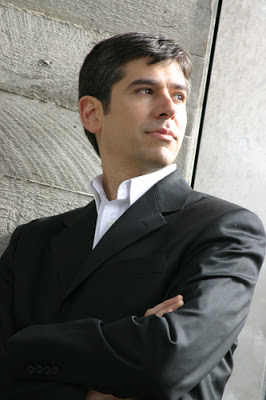 Who or what inspired you to take up the piano and make it your career?



 The Cross-Eyed Pianist