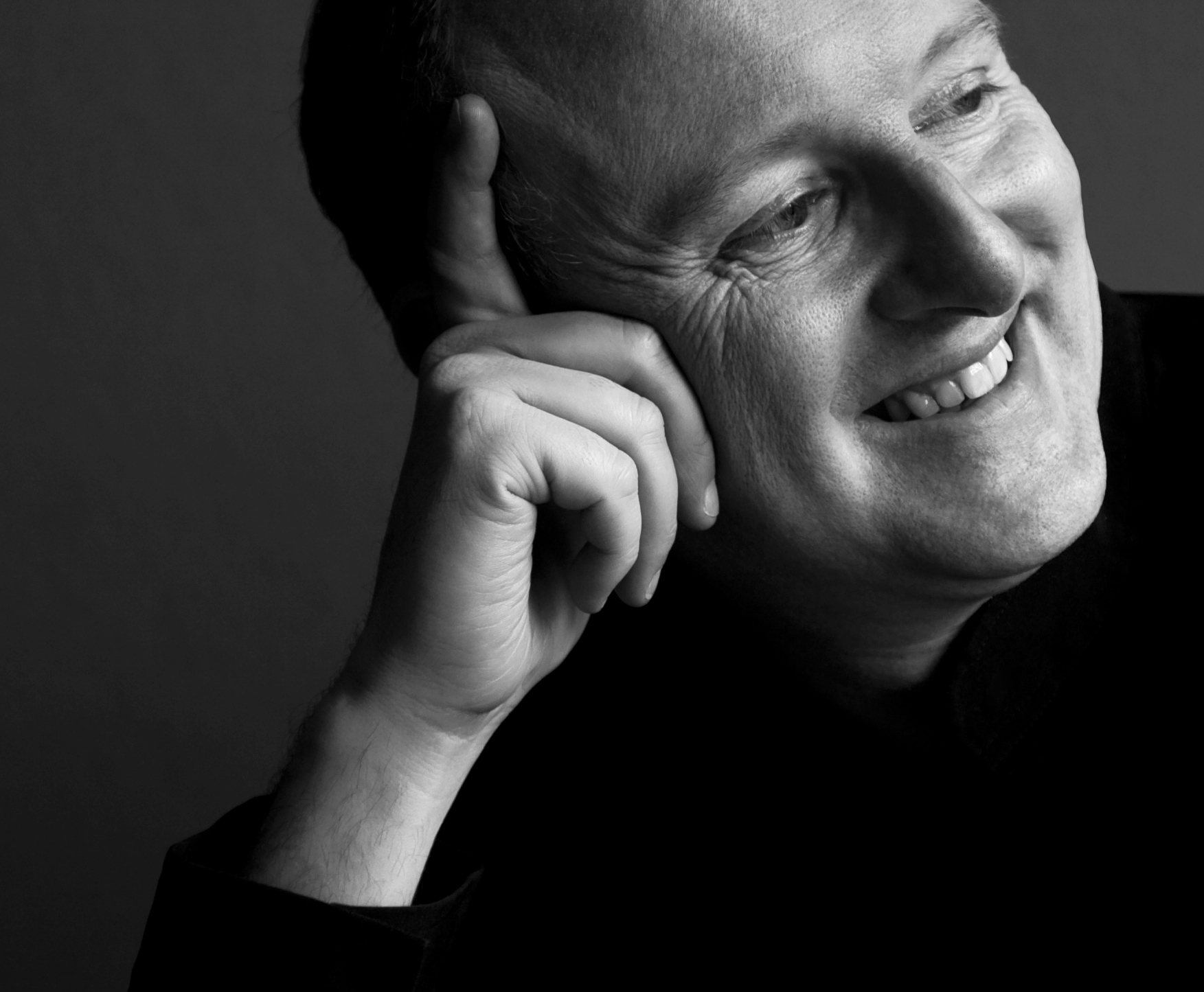
For his autumn concert tour, which begins on Sunday 9 November, British pianist James Lisney places Beethoven’s late sonatas at the centre of this rich programme of masterpieces, not the least of which is the ricercar that Bach performed for Frederick the Great in Potsdam in 1747. “Old Bach of Leipzig” improvised on the King’s theme while using a newly developed fortepiano; the finished composition can thus lay claim to be the first major piano work.
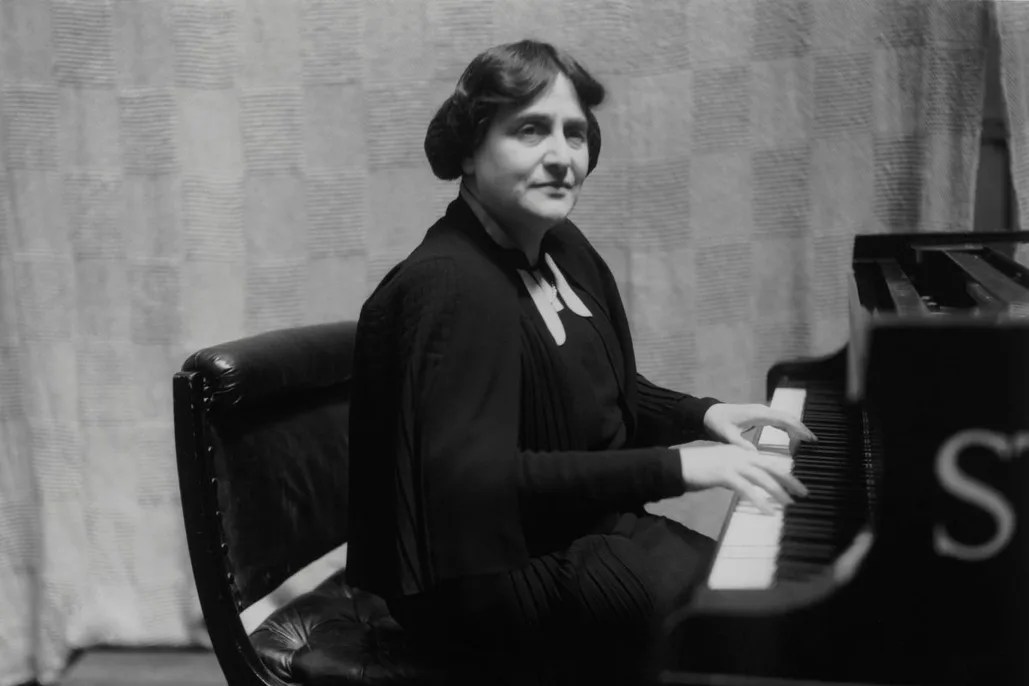
The preludes by Chopin and Shostakovich are similarly written out versions of improvisatory pieces, whilst Myra Hess’ beloved chorale prelude, “Jesu, Joy of Man’s Desiring”, is a reminder of her close association with Beethoven’s final triptych of piano sonatas, and is included in this programme to honour the anniversary of her death on 25th November 1965.
James Lisney says, ‘I have returned to Beethoven’s late sonatas on many occasions over the past forty years. Each study period is a time of intense contentment that reveals new insights, greater pianistic authority, and a reflection of personal growth in terms of musical and extra-musical experience. The great Chilean pianist Claudio Arrau stated that passion deepens with age, and Beethoven’s late works are certainly ‘appassionato’, communicating ideas that stretch human experience.
There is a lifetime in this music, an inexhaustible well of ideas that defeat our perceptions of time during performance. I have long wanted to add preludes to this music, easing the listener into a new universe and refreshing the palate. The death of Shostakovich fifty years ago provided inspiration; Dame Myra Hess (d. November 1965), a peerless interpreter of these sonatas and the music of Bach, provided further items for the programme, not least her enduring transcription of the chorale prelude ‘Jesu Joy of Man’s Desiring’.
Johann Sebastian Bach’s Ricercar à 3 is a further example of a composition that represents a preludial improvisation, one executed by a master of the increasingly archaic art of counterpoint who was not above adding galant flourishes to a theme provided by Frederick II of Prussia. An example of an artist “speaking truth to power?”’
Myra HessJames Lisney
CONCERT DATES & VENUES
9 November, Bradshaw Hall, Royal Birmingham Conservatoire
18 November, St George’s Bristol
21 November 1901 Arts Club, London
22 November, The Red Hedgehog, London
28 November, The Quay Theatre, Sudbury, Suffolk
4 December, The Stoller Hall, Manchester
5 December, Stamford Arts Centre, Stamford, Lincolnshire
An initial approach via this blog in March 2017 led me this week to St George’s Bristol for a lunchtime concert by the sparkling Piano 4 Hands duo (Waka Hasegawa and Joseph Tong).
Last year Josie Dixon emailed me to ask if I might feature her mother, the composer Ailsa Dixon, in my Meet the Artist series. One of Ailsa’s choral works was receiving its premiere as part of the Oriana Choir’s Five15 project. This was rather special because, as Josie explained, her mother had rather “hidden her light under a bushel for the majority of her lifetime”. Ailsa’s interview was published on my Meet the Artist site in July 2017, to coincide with the premiere of her anthem These things shall be, a setting of verses by John Addington Symonds. Around the same time, Josie contacted me again to ask if I knew a piano duo who might be interested in giving Ailsa’s piano sonata ‘Airs of the Seasons’ its first performance. Knowing their fondness for contemporary repertoire for piano duo, I immediately suggested Waka Hasegawa and Joseph Tong (Piano 4 Hands), and was delighted to hear from Josie that they had enthusiastically taken up the piano sonata.
Sadly, Ailsa died in August 2017, just short of her 85th birthday.
In April this year, as I was in the throes of preparing to move from London to the West Country, Josie contacted me again to tell me that Waka and Joseph would be premiering Ailsa’s piano sonata in Bristol on 8 November. As I’d never visited St George’s (considered by many of my musician friends and colleagues to possess the UK’s finest acoustic), nor heard Waka and Joseph together as a duo, I was delighted to join Josie and her family and friends to celebrate the premiere of her mother’s piano sonata.
St George’s, a former church in the graceful, well-proportioned Greek Revival style of the early 1820s, is a really fine venue, and a handsome new extension has added a contemporary bar and social area which perfectly complements the building’s clean neo-classical lines. The concert hall itself retains the columns and balcony of the original church, together with a fine altarpiece. A small illuminated star in the ceiling indicates where a bomb fell through the roof during the Second World War but did not explode. At just shy of 600 seats, St George’s is about the same size as London’s Wigmore Hall.
St George’s Bristol with its new extension
The purity of St George’s acoustic combined with Waka and Joseph’s split-second precision, supreme technical assuredness and musical sensitivity brought wonderful clarity and contrasting shading to Mozart’s Andante with Variations KV 501, which opened the concert. This linked neatly to David Matthews’ Variations on a theme by Haydn, which was written for Waka and Joseph. The unsually chromatic theme from the opening of Haydn’s last string quartet is the starting point for this set of 12 variations which initially remain close to the originally theme before moving into wider musical territory, including a tango (Var. 5), a blues variation (Var. 7) and a moto perpetuo (Var. 10). The work has a delightful sense of fantasy suffused with romanticism and musical wit, and ends with a humorous exchange between the two players which Haydn would surely have appreciated. It was evident from the performance that Waka and Joseph really relish this kind of repertoire, which proves that the piano duet is not confined to small-scale salon works.
Ailsa Dixon’s Airs of the Seasons was composed in the early 1990s and is her only substantial work for piano. Its four brief movements are each prefaced by a short poem, evoking in turn the magical stillness after a winter snowfall, the first stirrings of spring, a dragonfly darting over the water in summer, and finally amid the turning leaves of autumn, a retrospective mood which recalls the earlier seasons and ends with the hope of transcendence in ‘Man’s yearning to see beyond death’. The opening chords of the first movement are reminiscent of Debussy and Britten in their timbres, and the entire work has a distinctly impressionistic flavour. Ailsa’s admiration of Fauré for his “harmonic suppleness” is also evident in her harmonic language, while the idioms of English folksong and hymns, and melodic motifs redolent of John Ireland and the English Romantics remind us that this is most definitely a work by a British composer with an original musical vision. The entire work, although quite short, is really delightful and inventive. Rich in imagination, moods and expression, the musical evocation of each season is distinct and characterful – Summer, for example, is not all sunshine as a brief but dramatic storm interrupts the warmth and serenity, while Autumn contains flashes of music from earlier movements to underline its reflective, retrospective mood. From a pianistic point of view, the textures of the music are carefully conceived to bring a range of colours and voicings imaginatively shared between the two players.
Mme Debussy deemed her husband’s La Mer unplayable in its piano four-hands version, but Waka and Joseph made impressively light work of this masterful evocation of water, light and wind (and reminded me of my coastal home in Dorset, currently in the grip of gale force autumnal winds!). Their brilliant pianism complemented by total synergy at the keyboard brought this work to life with vivid drama and passion, and was a thrilling close to an absorbing and varied programme.
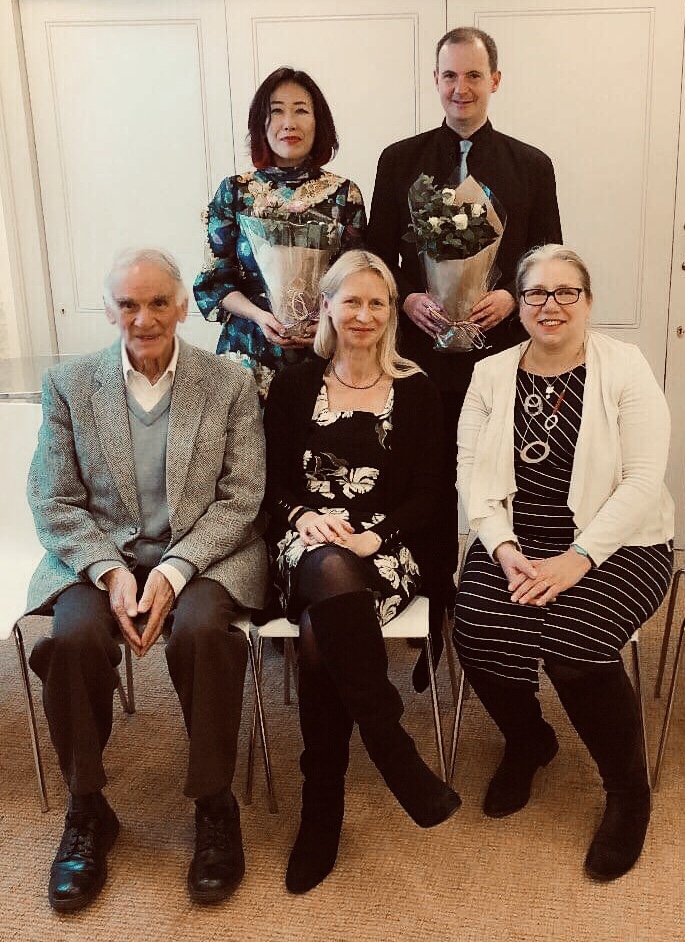
back row: pianists Waka Hasegawa & Joseph Tong; front row from L to R – Brian Dixon (Ailsa’s husband), Josie Dixon (Ailsa’s daughter) and Frances Wilson (The Cross-Eyed Pianist)
The Cross-Eyed Pianist is free to access and ad-free, and takes many hours every month to research, write, and maintain.
If you find joy and value in what I do, please consider making a donation to support the continuance of the site






 The Cross-Eyed Pianist