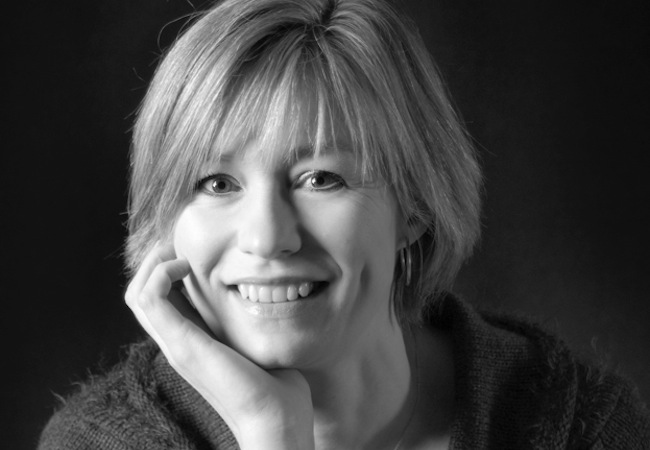
susie_allan_c-_simon_denison_bw_main

Who or what inspired you to take up the piano and pursue a career in music?

We had an upright piano in the corner of the dining room, which one of my older sisters was learning on. Aged about 6 I used to sit at it, crashing about on the keys and flailing my arms around as I imagined concert pianists did –  maybe I saw one on the TV. I think my parents realised my enthusiasm needed channelling and took me to a teacher who reminded me of Cruela de Vil – brown hair on one side and blonde on the other! I had a wonderful teacher at secondary school, Elaine Hugh-Jones, who was very inspiring and supportive. For a long while I toyed with becoming a solo pianist, but turned down the opportunity to study piano at the RNCM in preference to taking up an instrumental scholarship at Oxford. Over time I began to realise that my musical temperament did not lean towards life as a soloist, and there were many other ways to pursue a performing career. The Guildhall School of Music and Drama (GSMD) held those answers for me.

Who or what have been the most important influences on your musical life and career?

A chance conversation with Roger Vignoles prevented me from giving up altogether…I needed a teacher who knew about accompanying-he suggested some lessons with Paul Hamburger, and, as well as with him, at the GSMD I had the chance to work intensively with Graham Johnson, Martin Isepp and Iain Burnside, who were all hugely inspirational to me in their different ways. Playing for masterclasses at Snape for wonderful singers/teachers such as Elly Ameling, Anthony Rolfe Johnson and Elizabeth Soderstrom were also fantastic learning opportunities. In latter years, especially after moving to Shropshire, I have Roddy (Roderick Williams) to thank for continuing to take me with him on his musical journey, whilst it may have seemed I disappeared off the musical world’s radar; and for his natural, intelligent, sublime interpretations. Oh, and his irrepressible sense of humour.

What have been the greatest challenges of your career so far?

Trying to keep it going!! The move to Shropshire, having three children in close succession, and getting divorced made it particularly challenging to carry on playing at all.

Musically, I think some of the contemporary works I’ve performed have challenged me greatly, such as the four Songs by Torsten Rasch, commissioned for Gloucester Three Choirs Festival; and more recently getting out of my comfort zone and having to use an elbow in a new work called “The Rain is Coming” by Emily Levy.

Which performance/recordings are you most proud of?

Going way back, one which comes to mind is playing for Nathan Berg in the Gold Medal final at GSMD. He was singing Mahler’s Ruckert Lieder – trying to do these incredible songs justice for Nathan meant so much to me I was sick beforehand! Luckily it paid off – and he won. A recent performance of Die Schöne Mullerin with Roddy had a feeling of musical and emotional synchronicity – I was so glad to be part of that performance too. And I’m really proud to have been given the opportunity to record the new SOMM CD, songs that I have performed with Roddy many, many times over the years, all of which I adore.

Which particular works do you think you play best?

You may have to ask others about that!

Accompanists have to be like chameleons. It’s important to be able to feel comfortable in as many styles as possible. I like to think I can play best whatever I happen to be working on. Having said that, I have a particular penchant for the serious and intense, for example I think I can put across a pretty convincing “Ich bin der welt abhanden gekommen” (Mahler)… I also feel I now have a more confident approach to playing Schubert – Die Schöne Mullerin is a personal favourite; although tomorrow it may be Schwanengesang, and the day after, Winterreise.

How do you make your repertoire choices from season to season?

As an accompanist with many other demands made on my time, these choices are frequently not mine. Quite often my job is to fall in love with whatever repertoire I am tasked with – I enjoy that challenge.

Do you have a favourite concert venue to perform in and why?

Roddy and I did a tour of Schwanengesang in 2016. One of the venues was the Sam Wanamaker Theatre at the Globe in London. It was a very special place to play. It is an utterly beautiful bijou Jacobean-style space for starters, and as the performers, we were cocooned by the audience above us and around us, all of us bathed in the most atmospheric candlelight – a truly memorable experience.

What is your most memorable concert experience?

A festival in 2013 – memorable for the wrong reasons! I was attempting to give my all in an exceptionally beautiful postlude of Richard Sisson’s “So Heavy Hangs the Sky”, when the city council rudely began to empty the huge glass-recycling bins outside the venue – the sound continued for a good ten seconds… The second half of the concert was accompanied by reversing vehicle noises, pretty much matching the pulse, but not the atmosphere of Britten’s “The Sunflower”. The audience were not happy!

As a musician, what is your definition of success?

The ability to be able to move an audience through musical communication.

What do you consider to be the most important ideas and concepts to impart to aspiring musicians?

Respect the composer’s intentions, whatever you perceive them to be; try to communicate the spirit of the piece; enjoy the practice journey; have fun. Respect and support your colleagues.

Where would you like to be in 10 years’ time?

Back at the Wigmore Hall

What is your idea of perfect happiness?

The Beach House Goa Retreat

What is your most treasured possession?

My Steinway piano, given to me when I was 14

What do you enjoy doing most?

Walking the dog in the Shropshire hills with my kids

What is your present state of mind?

Busy!


Roderick Williams’ new CD, with Susie Allan, piano, ‘Celebrating English Song’ is available now on the SOMM label. Further information here

Susie Allan studied Music at Worcester College, Oxford, as a Hadow Instrumental Scholar, and Piano Accompaniment at the Guildhall School of Music and Drama. She won the GSMD Accompaniment Prize, the Gerald Moore Award, and a Geoffrey Parsons Memorial Award. Her teachers included Paul Hamburger, Graham Johnson and Iain Burnside. She has accompanied many masterclasses at the Britten-Pears School at Snape Maltings, Suffolk and elsewhere, and has been a Professor of Accompaniment at the RCM and the RWCMD.


sommcd0162Whenever I hear Haydn’s piano music played well, I want to rush to my piano to play it myself. Such was the effect of listening to Leon McCawley‘s new ‘Sonatas and Variations’ disc on the Somm label. Haydn’s piano music is not performed enough, in my humble opinion, so it is a pleasure to have a recording of such quality to enjoy.
A brace each of sonatas in major and minor keys, these works have long been part of McCawley’s concert repertoire, and this shows in his deft and insightful handling of articulation, dynamics and Haydn’s rapid changes of mood. Nothing feels forced nor contrived, and there’s wit and humour aplenty, especially in the C major Sonata (No. 60, Hob. XVI/50) which shows Haydn (and McCawley) thoroughly enjoying his mastery of the instrument and its capabilities. McCawley brings elegance and spaciousness to the slow movements, revealing fine details of inner voices. Haydn’s final piano sonata, No. 62 in E flat Hob. XVI/52, which unlike the last sonatas of Beethoven and Schubert was composed some 15 years before Haydn died, rather than at the end of his life, combines grandeur and exuberance in its opening movement, while the slow movement has a stately nobility. The finale is a lively romp, but despite the rapid tempo, there is never any loss of detail or precision.

The F minor Variations are a delight, at once melancholy and wistful in the minor variations, and gracious, playful and warm in the major ones. Interior details are highlighted and a sense of the overall architecture and narrative of the work is clear. And I am pleased to note that McCawley observes all the repeats, which turns this work into something enjoyably substantial. Throughout there is tasteful pedalling and the piano has a lovely clarity, perfect for this music.

Recommended.

Haydn
Piano Sonatas
No. 53 in E minor
No. 60 in C major,
No. 33 in C minor
No. 62 in E flat major
Variations in F minor Hob. HVII/6
Leon McCawley, Piano

SOMMCD 0162


50fb9b63faf24b079dabd5a6bbbcf0c2Piano Sonata No. 6 in A, Op. 82 (1940)
Piano Sonata No. 7 in B flat, Op. 83 (1942)
Piano Sonata No. 8 in B flat, Op. 84 (1944)

Peter Donohoe, piano

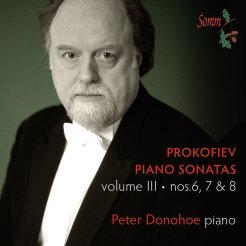
Peter Donohoe’s third volume of Piano Sonatas by Sergei Prokofiev completes the cycle with Nos. 6, 7 and 8. Peter has a long association with the piano music of Prokofiev – the Sonata No 6 was part of his silver medal-winning programme at the 1982 Tchaikovsky Competition – and indeed the composer’s homeland, as a regular visitor to Russia throughout his career (his diary from his stay in then Soviet Moscow during the 1982 Tchaikovsky Competition is a fascinating read).

Prokofiev composed piano sonatas throughout his life and the final three belong together in the same way as the final three piano sonatas of Beethoven and Schubert. Though the works were not intended to be performed consecutively, they do exhibit “familiar” attributes which connect them. For Peter Donohoe, these sonatas form one of the great cycles in piano literature, written by a composer who was also a magnificent pianist (surviving recordings of Prokofiev playing his own works are testament to this). This final instalment of Donohoe’s recording for Somm includes what are called the “war trilogy” piano sonatas, written during World War II, and reflecting on and reacting to the horrors of Soviet Russia’s titanic struggle against Hitler.

The sixth sonata opens with a clangorous motif which rings out before the music retreats into darker passage work and a second subject with folksong qualities. Donohoe’s pacing, acute rhythmic vitality and colourful dynamic palette combined with a glorious sound (evident throughout the recording) allows the music to build gradually to a climactic reprise of the open motif. Donohoe brings a wry humour to the second movement, a rather jaunty march, interrupted by a tense and sinuous middle section, but the ominous tread is never far away. The third movement is an elegant and rather poignant waltz, and like the preceding movement the middle section contains more unsettling material. There is a lovely clarity of line here which brings an expansive romantic sweep to the movement. The finale, all frenetic scurryings and mocking themes, is a fine example of Donohoe’s effortless fluency and technical control.

The Sonata No. 7 is the most popular of the three, and its menacing, militaristic tread is evident from the opening. Donohoe’s restraint in the quieter, middle section hints at impending drama as the frenetic energy builds. Although scored in a major key, there is nothing joyous about this music. The middle movement, marked Andante caloroso, contains a consoling cantabile melody as beautiful as any nineteenth-century salon piece, but once again the mood is disturbed by plangent bass chords and an overriding sense of melancholy. There is power here, in Donohoe’s rich fortes, but his sense of restraint creates an extraordinary tension despite the hushed conclusion. The perpetuum mobile finale crackles with energy, subtly phrased and crisply articulated, it is both triumphant and unsettling.

Like the previous sonata, No. 8 is also scored in B flat. Composed in 1944, it is the longest of Prokofiev’s nine piano sonatas and is a work of great breadth and emotional tension. Again, it is Donohoe’s ability to hold back rather than push the dynamics which creates a greater sense of drama, tension and impending tragedy. The middle movement opens with a lyrical Schubertian melody over an accompaniment which grows more florid. This feels like the calm before the final tempest and Donohoe’s sensitive line and delicate touch creates passages of great charm and beauty. The finale begins with a hectic motif which is both playful and heroic.

There is a wonderful immediacy to Donohoe’s playing combined with vibrant pianistic colour, sprightly articulation, technical assuredness and musical authority which runs through every note. An impressive conclusion to the cycle.

Available on the Somm label

SOMM JUNE RELEASE: SOMMCD 259 

Release date: 29 April 2016

PROKOFIEV PIANO SONATAS VOL. 3, The “War Sonatas”, Nos, 6, 7 & 8

Peter Donohoe – piano

“Donohoe’s authoritative playing shines through in every work — he has lived with these pieces for a long time… In his hands every sonata makes a memorable impression, and the Fifth receives one of the finest performances I have encountered on disc. A wonderful anthology. Next instalment, please!”   Classical Ear (of Vol. I).

The recording is exemplary, fully projecting Donohoe’s massive dynamic range. The finale of the Second Sonata epitomises all that is Prokofiev, and, in Donohoe, all that is great Prokofiev playing… The helter-skelter character of No. 3 is perfectly conveyed through Donohoe’s impressive technique. There are performances of both No. 2 and No. 3 by Gilels in existence, and Donohoe loses little in that exalted company. It is No. 4 that is the highlight, though, a performance of magisterial intensity. No. 5 receives a performance of the utmost integrity. Magnificent” . International Piano (of Vol. I).

This intelligently planned programme is played by musicians fully attuned to Prokofiev’s expressive lyricism and humour… Raphael Wallfisch and Peter Donohoe give the music’s opening narrative a compelling sense of direction, making the gentle, inward quality of the exposition’s end all the more captivating.” *****  BBC Music Magazine (of Vol. II).

peterdonohoe

This is the third and final volume in Peter Donohoe’s highly-praised recordings of the complete Piano Sonatas of Sergei Prokofiev and SOMM are proud to have been able to capture his mature interpretative thoughts on the composer’s War Trilogy. Prokofiev was a magnificent pianist and, like so many of his predecessors and contemporaries, he would often reserve his most personal and intimate thoughts to the music he wrote for his own instrument. Sonatas Nos. 6, 7 and 8, written consecutively during World War II, reflecting on and reacting to the horrors of what was referred to in Soviet Russia during their titanic struggle against Hitler as the ‘Great Patriotic War’, drew from Prokofiev some of his greatest music, expressed through his own instrument, the piano, producing in the central sonata of the trilogy, No. 7, his most famous and brilliant piano music, with the exciting finale marked Precipitato (impetuous, headlong) depicting the ferocity and grit of the Russian attacks on the Nazi army. The beautiful Sixth Sonata is more personal and inward-looking, contemplative and moving, and the Eighth looks forward to a post-war world in which all conflict on Russian soil will have ceased.

Peter Donohoe has always been closely attuned to Russian music and particularly that of Prokofiev and his recordings of the War Trilogy go back more than 30 years. He first recorded the 7th Sonata in 1982 for HMV then again in 1991 together with the two other “War Sonatas”, 6 and 8 for EMI. He believes that Prokofiev’s Sonatas form one of the greatest piano solo cycles in the repertoire. ‘Prokofiev was creating these major works throughout his career — all of them are major and some are still underrated and I am delighted to have had the chance of recording, on SOMM, the complete cycle at last.’

Tracklisting:

Piano Sonata No. 6 in A, Op. 82 (1940)

[1[ 1. Allegro moderato

[2] 2. Allegretto

[3] 3. Tempo di valzer , lentissimo

[4] 4. Vivace

Piano Sonata No. 7 in B flat, Op. 83 (1942)

[5] 1. Allegro inquieto — Poco meno — Andantino

[6] 2. Andante caloroso – Poco più animato – Più largamente – Un poco agitato

[7] 3. Precipitato

Piano Sonata No. 8 in B flat, Op. 84 (1944)

[8]  1. Andante dolce – Allegro moderato – Andante dolce come prima – Allegro

[9]  2. Andante sognando

[10]3. Vivace – Allegro ben marcato – Andantino – Vivace come prima


Peter Donohoe  – biography

Peter Donohoe was born in Manchester in 1953. He studied at Chetham’s School of Music, gratuated in music at Leeds University and went on to study at the Royal Northern College of Music with Derek Wyndham and then in Paris with Olivier Messiaen and Yvonne Loriod. He is acclaimed as one of the foremost pianists of our time, for his musicianship, stylistic versatility and commanding technique.

Recent and forthcoming engagements include appearances with the Dresden Philharmonic, the BBC Concert Orchestra, RTE National Orchestra and CBSO (under Sir Simon Rattle), a UK tour with the Russian State Philharmonic Orchestra as well as concerts in South America, Europe, Hong Kong, South Korea, Russia and the USA. Other engagements include performances of all three MacMillan piano concertos with the BBC Scottish Symphony Orchestra, a series of concerts for the Ravel and Rachmaninov Festival at Bridgewater Hall alongside Noriko Ogawa, and performances with The Orchestra of the Swan. Donohoe is also in high demand as an adjudicator at piano competitions around the world, including the International Tchaikovsky Piano Competition, Moscow, the Queen Elisabeth Competition, Belgium, and the Hong Kong International Piano Competition. Recent recordings include two discs of Prokofiev pianos sonatas for SOMM, the first of which Gramophone described as “devastatingly effective”, declaring Donohoe to be ” in his element”.  Other recordings include Cyril Scott’s Piano Concerto with the BBC Concert Orchestra under Martin Yates for Dutton and Malcolm Arnold’s Fantasy on a Theme of John Field with the Royal Scottish National Orchestra and Martin Yates, also for Dutton.

Donohoe has worked with many of the world’s greatest conductors including Christoph Eschenbach, Neeme Järvi, Lorin Maazel, Kurt Masur, Andrew Davis and Yevgeny Svetlanov. More recently he has appeared as soloist with the next generation of excellent conductors such as Gustavo Dudamel, Robin Ticciati and Daniel Harding.

Peter Donohoe is an honorary doctor of music at seven UK universities and was awarded a CBE for services to classical music in the 2010 New Year’s Honours List.

[Source: press release]

Meet the Artist……Peter Donohoe

