
Moderato (It.)
‘Moderate’, ‘restrained’, e.g. allegro moderato (‘a little slower than allegro ’).
adv. & adj. Music (Abbr. mod.)
In moderate tempo……. Used chiefly as a direction.
‘Moderato’ is one of those rather nebulous musical terms, like andante (“at a walking pace”). If I ask one of my students what it means, they say “moderately”. But what does it really mean? At the most basic level, it is a tempo marking, slower than allegretto, but faster than andante. The modern metronome gives a marking of 96 to 100, a very narrow range – and I would always guard against assigning a specific metronome mark to a piece marked moderato, or allegro moderato, or molto moderato. Like so much else in music, moderato is not just a tempo marking; it also suggests mood and character. It is personal feeling and sense of music, and one person’s moderato might be rather different from another’s, both in terms of tempo and character.
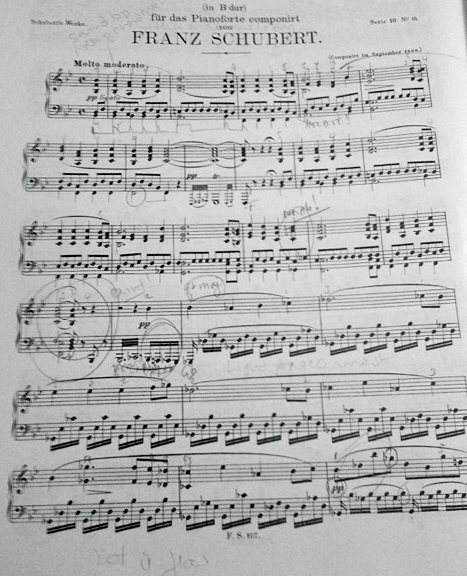 The opening movement of Schubert’s last sonata is marked molto moderato, literally “very moderately”. And taken literally, that could result in a very slow tempo, virtually alla breve (two beats in a bar), which can make the music appear to drag. Schubert also used the German term mässig, implying the calm flow of a considered allegro. But the word “allegro” suggests a certain character as well as a certain speed, and so the moderato marking is more appropriate, Schubert suggesting in it a graceful strolling tempo. There are many, many different interpretations of Schubert’s marking, resulting in some wildly varying lengths of the first movement. Richter’s is an almost self-indulgent 25 minutes – listening to it, you get the feeling he is thinking about every single note and where to place it; while Maria Joao Pires brings it in at 20 minutes, which feels both fluid and eloquent, and Imogen Cooper at 16 minutes, which is thoughtful and serene. In another recording I have, one which I listen to most often, and used as a benchmark when I was learning the piece, the movement lasts just over 21 minutes, yet at no point is there a sense of the music stagnating, even in the most poignant sections; it moves forward with grace.
Of course, at the end of the day, all these timings are rather meaningless: one would not notice the time passing at a good performance unless one was pedantic enough to sit there with a stopwatch – and if one was doing that, one would not be concentrating on the music! Creating a sense of the music and conveying mood, colour and shading is more important. One pianist, who shall remain nameless, did take it far too fast for my liking at a lunchtime concert at the Wigmore, and the music just felt rushed, as if he couldn’t wait to finish it. (He also omitted the repeat of the exposition, which is inexcusable, in my view. Without the repeat and the absolutely transcendental bridging figure, one does not achieve a full appreciation of the composer’s intentions in the development section.)
When I was learning the sonata a couple of years ago, I had a tendency to play the opening movement “molto molto moderato”! This was partly to enable me to cope with some of the more tricky measures in the development section, but whenever I played it, I had a terrible sense of the music plodding. When I listen to the piece, I always feel the opening movement suggests a great river broadening into its final course before reaching the sea: unhurried but with continual forward motion. There are moments of “other-wordliness” in this movement as well, which demand sensitive rubato playing and some very fine pianissimos. There are storms too, but these are short-lived, and do not disturb the overall, almost hymn-like, serenity of the movement. But no matter how often I practised the wretched movement, it always sounded chunky, and “notey”, as if the river was made of treacle through which one was wading painful step after painful step!
Discussing my difficulty with my friend Michael was more a discussion of the meaning of moderato in a literal sense rather than in relation to Schubert. In the end, Michael suggested I tried playing the movement quicker: the difference was instant. Never mind that some passages were still very rough in my hands, the overall sense of the music was of a relaxed serenity and spaciousness. There was still time to hear every note and to enjoy each one, but there was also a much greater forward propulsion, especially in the climactic passages of the development section, which highlight Schubert’s long lines of melody and the overall evolution of the movement. Armed with Michael’s helpful advice and my renewed interest in the work, it was one of the first pieces I presented to my teacher when I started having lessons again, nearly two year’s ago.
In Chopin’s Ballade in G minor, a piece of fluctuating tempos and ever-changing moods and textures, the first theme is also marked moderato. Here, I would read this marking as a much slower tempo than in the Schubert sonata. The mood is very different too: the key is darker, and the off-beat quaver figures and the rather uncertain harmonies, with the prominent use of diminished and dominant seventh chords to add moments of tension which are not always resolved immediately, create a sense of hesitancy in the music, as if it is not quite sure where it is going. After the fioritura, the opening theme returns, slightly elaborated with a sighing quaver figure, but rather than increase the sense of forward motion, I feel the music becomes more suspended; thus when one reaches the direction agitato, there is a far greater sense of climax. This continues right through to the arpeggiated figures and onwards, in a section marked sempre piu mosso. After the great, memorable second theme is heard, the first theme returns, this time in A minor, and the music returns to the moderato tempo and mood of the opening. Here once again, uncertain harmonies are used to contrive a feeling of suspense, while the insistent repeated low E’s in the bass tether the music even more firmly in one place. This is a useful device for introducing another climax, which seems to suddenly free itself from the restraints of the moderato marking; the restatement of the second theme on a far grander scale than its first appearance. So, one could argue here that the use of moderato at the opening of the piece, and its reappearance later on, is a very deliberate device which serves to create moments of great tension, suspense and climax.
An interesting discussion of tempo came up during the piano course I attended in the spring. One of the students played some Bach, one of the French suites, I believe, the opening movement of which he took at such a lick, we could hardly hear the notes. When asked to put the brakes on, the result was charming: measured and elegant. This led to a discussion about “comfortable tempos”: just as one person’s moderato may be different from another’s, it is also true for presto or allegro. Nimbleness of brain and fingers can result in very lively, speedy, clean playing: if you feel comfortable playing at that speed, good for you. But speed at the expense of accuracy or musicality can wreck a piece.
The opening movement of Poulenc’s Suite in C, which I am currently learning, is marked Presto, and on my recording Pascal Rogé takes it at an alarming presto, far quicker than my 44 year old brain and fingers can manage – at the moment. Thus, I am practising it at a “comfortable” tempo; eventually, I hope that comfortable tempo will be quicker – the music needs to sound light yet sophisticated (its C Major key gives it an innocence which should shine through all the time) – but for the time being I am concentrating on accuracy, with a beautiful sound. It ain’t easy: sometimes just learning the notes is hard enough, without all the other attendant directions and markings one has to take note of and execute!




 The Cross-Eyed Pianist