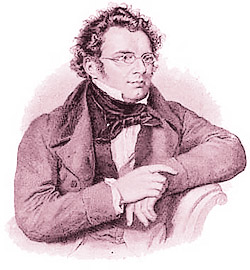
To the Wigmore Hall last night for an evening of late Schubert piano music, performed by Paul Lewis. A few years ago, Lewis stamped his mark emphatically upon the international piano world with his concert cycle and recordings of Beethoven’s complete piano sonatas, thus elevating him to the rank of one of the top flight pianists of his generation. Now, in another epic world tour, he is exploring the late music of Schubert.

Lewis was taught and mentored by Alfred Brendel – and it shows. Brendel famously does not teach – except for the chosen few (Imogen Cooper, Till Fellner). He performed (he retired in 2008), choosing to concentrate on the Viennese school, he writes and he gives lectures on music. His on-stage persona is austere, didactic, intellectual, highly disciplined.

Watching Paul Lewis play music composed in the last six years of Schubert’s short life, I felt the shadow of Brendel at his shoulder throughout the evening. The opening Waltzes, D145, written in response to the seemingly unending desire for dance music in Vienna, were largely serious, grand and solemn. Only occasionally was the music allowed to “let go”, offering brief glimpses of the private life of a composer who enjoyed evenings of music, song, women (and men, it is said) and wine with his friends, students and writers, radicals and intellectuals. As opening pieces, I would have liked more lightness, more spirit, more playfulness. And maybe a touch less darkness.

In the D899 Impromptus there was a greater sense of the music being thought out in advance, each signpost along the journey of these pieces clearly highlighted, lest we miss it. In the opening C minor Impromptu, there was less coldness in those early measures, less of a sense of the tyranny of the bare G which marks the opening, reminding us that this is a work which falls post-Winterreise. There was warmth in the major key measures and lyricism, but towards the end, from bar 160, the repeated Gs in the treble and bass were too mechanical, too obvious, robbing the music of its portentous chill.

The E flat Impromptu was rapid and polished, and, as a consequence, lost some of its agitation and hysteria. At times, during the Trio, the touch was too heavy and occasionally muddy. Though many measures in this section are marked fortissimo, at times there was not a proper sense or attack, or if there was, it was quickly reined in, cheating the music of its startling contrasts and harmonic and emotional shifts. This was even more evident in the final Impromptu of the set, the A flat. The opening semiquavers never really took flight, and some smeared or inaccurate notes suggested a tiredness on the part of the performer, possibly the result of having played this programme several times already.

The Hungarian Melody D817 was a pleasing opener for the second half, settling us in before the expansive G major sonata. It was enjoyable if overly dark, its folksy elements muted in favour of a grander delivery. (For a really wonderful performance of this piece, I would flag up Imogen Cooper’s from her ‘Schubert Live Vol 3’ album.)

The G Major sonata, D894, was the favourite of Russian pianist Sviatoslav Richter, and, in his hands, the spacious opening movement, marked Molto Moderato e Cantabile, comes in at 26 minutes, roughly the same length as an entire Beethoven piano sonata. It is graceful and meditative, Richter achieving an amazing stillness in the first motif. Paul Lewis opted for a brisker tempo, which suited the second subject elements better, but rather robbed the first subject of its grace and philosophy. In the middle movements, my attention began to wander: I craved more life, more bounce and vivacity. Throughout, the very cerebral reading of the score was evident (witness the powerful influence of Brendel!). The final movement was more questioning, charming and humourous, but overall I felt the sonata was played with too much gloss and a curious ‘intellectual complacency’ that diluted the music’s spontaneity and tempered the ever-shifting soundscape and emotional landscape of Schubert’s writing.

Paul Lewis repeats the programme at the Wigmore on Thursday night, and then in Oxford and Schwarzenberg, Austria, before returning to London next week for performances of Die Schëne Mullerin with tenor Mark Padmore.

As a postcript to this review, I must also mention Paul Lewis’s annoying habit of snuffling and “chuffing” as he plays. I have been aware of this “tic” before, and it seems to be getting worse. It was particularly noticeable during the quieter or more profound measures, and was obvious from the earliest bars of the first Waltz.

Sviatoslav Richter – Schubert: Piano Sonata No.18 in G, D.894 – 1. Molto moderato e cantabile

Monday 24th January, Wigmore Hall

Schubert – German Dances, Ländler, Valses Sentimentales; Brahms – 4 Klavierstücke, Op 119; Beethoven – Piano Sonata Opus 110; Chopin – Four Ballades

Encores: Chopin – Nocturne Op 9, No. 2; Dudley Moore Parody on a Beethoven Sonata

There is a mysterious fulfilling pleasure in watching any manual task being performed with infinite skill and grace, the agility and accuracy required, the finesse of touch and judgement. Thus, we admired Piers Lane’s superior technical prowess in the four Ballades of Chopin, and the applause that came spontaneously after he had completed the first one was, in part, an appreciation of the monumental technical effort involved in playing some of the most challenging music of the piano repertoire. After the fourth was safely delivered, the applause was even more rapturous, and perhaps tinged with relief, that the performance had been completed safely, accurately, and without mishap. Indeed, the playing was utterly pristine, and if it was lacking in depth or emotion at times, at least the performer’s technical assuredness could be admired.

This was my first concert of the new year, a varied programme which contained two great edifices of the standard repertoire: Beethoven’s penultimate piano sonata, and Chopin’s Four Ballades.

The concert opened with a selection of Schubert’s D783 German Dances, Ländler (D790, No. 3), and Valses Sentimentales (D779). It is easy to forget, when hearing works like this in a formal concert setting, that these are salon pieces, written for the regular Schubertiades, which often took place in Schubert’s home, or the homes of his friends, and where assembled guests would take to the floor and dance. There is a light-heartedness in these pieces – indeed, some are positively rollicking – yet many of them are shot through with Schubert’s distinctive harmonic shifts, and the melancholy is never far away. They were a pleasing, inoffensive opener, and one had the sense of Piers Lane clearing the way for the big warhorses to come.

I was not, until this evening, familiar with the Brahms 4 Klavierstücke, Op 119, though I had listened to extracts of them on iTunes earlier in the day. The first, a meditation on descending thirds, was utterly sublime, “teeming with dissonances”, as Brahms warned Clara Schumann, and freighted with sadness, as each note of every bar was sounded so carefully. The second was breathless and agitated, with a contrastingly tender middle section, whose melody returned at the end, allowing the music to fade away nostalgically. The third was playful and graceful, while the fourth, a rhapsody marked Allegro risoluto, was confident and full-blooded, full of pent-up energy, and generous in its thematic content.

And so to the Beethoven Sonata….. Here, I must admit to a love affair with this piece which borders on an obsession. It is my Desert Island Disc (a choice I share with tenor Ian Bostridge, clearly a man of taste), but I would not take any old recording with me to my Desert Island. No, it has to be the right one. For me, Arrau is hard to match (as he is with all of Beethoven’s Piano Sonatas); equally, Glenn Gould, for all his eccentricities (and on the recording I have, one can ‘enjoy’ his humming and muttering accompaniments in the Arioso), brings a Quasi una Fantasia feel to the piece, segueing effortlessly from one movement to another, in a continuous stream of Beethovenian consciousness, while, in his hands, the final fugue is a peon of praise, as glorious as a peel of celebratory bells, life-affirming and uplifting. Another favourite performance, or rather performances, given by a friend in unusual and intimate venues, is remarkable for its meditative qualities, and its ability to remind us that this is music that goes to the very heart of what it is to be a sentient, thinking human being. This is music which speaks of the meaning of life, shared values, what it means to be alive, and which debates the basic philosophical questions of Beethoven’s time which still have relevance to us today. Written towards the end of the composer’s life, at the same time as the Missa Solemnis, Beethoven’s last three sonatas (the Opus 110 is the last but one) prove that a whole universe can be contained in a single piece of music. This is not just music; this is philosophy.

Of course, Piers Lane had no idea that I was placing such a huge responsibility upon him as he played the opening measures of the Opus 110, and, while I enjoyed his playing, it was no Desert Island choice. In the Arioso, particularly the section where the music literally dies back, and comes back to life little by little (and this is Beethoven’s actual instruction in the score – poi a poi di nuovo vivente), I did not feel that Piers Lane truly “breathed life” into the music, and the final fugue, which should sound triumphant, exultant with a sense of the music groping its way to daylight from some darker, outer firmament, started to unravel slightly, with uneven tempos. His playing was pristine (as it was throughout the entire performance), but it did not move me.

Chopin’s Four Ballades are considered to be some of the most challenging works in the piano repertoire, a fact from which I draw a certain amount of smug satisfaction, for I am learning the First Ballade, at the suggestion of my teacher. It is rare to hear them performed back to back, since they are technically and physically demanding. They are each sufficiently different to be performed as stand-alone works, but it was wonderful to hear all four in a one siting.

Chopin ‘invented’ the Ballade, deriving it from its poetic and vocal cousins, and was the first composer to apply the term to a purely instrumental piece. It was later taken up by composers such as Liszt and Brahms. The Ballades are innovative in form in that they cannot be placed in any other form, for example, Sonata form. Despite sharing the same title, each is highly distinct, with its own character, though all share certain attributes, such as the clever use of “lost” or “ambiguous” keys, exquisite delayed gratification through unresolved harmonies, contrasting, climactic passages, and moments of pure romanticism. The structure of the pieces does not suggest a firm narrative; rather, the listener is able to form his or her own narrative as the music unfolds. (The Third, for example, has a “ticking clock” motif which brings to mind a lovely image of Chopin working at Nohant, while an elegant carriage clock chimes on the mantelpiece, perhaps reminding him, poignantly, of the passing of time.)

Once again, I felt Piers Lane’s rendition of these monumental works lacked real depth, and it was only at the Fourth where he really seemed to settle into the music and finally get into his stride. The piano was too loud at times, so loud that it hurt, and occasionally the tone was marred by some very dodgy harmonics, a problem I noticed when I heard Leonskaja at the Wigmore last autumn (suggesting it’s the piano rather than the performer at fault). I do think it is important to remember the kind of sound Chopin was said to produce when he performed, or which he encouraged his students to strive for, and to bear in mind that the kind of piano he preferred (a French Pleyel) had a smaller voice than a modern concert Steinway. A little tempering of the fortes and fortissimos here and there would have brought more of Chopin’s famous “souplesse” to the music. (Interestingly, Piers Lane has talked very elegantly on the subject of Chopin’s music, as part of Radio 3’s bicentenary celebrations last year.) Nevertheless, it was an impressive performance, and the applause and curtain calls were absolutely deserved.

The Nocturne, played as a first encore, was relaxed and elegant, the fiorituras tripping off his fingers, as if he had just improvised them there and then. Perhaps this is because it is easier to play an encore like this when the main job of the night is done? But the evening was not yet over. Returning to the stage once again, Piers Lane announced that he would play “a very naughty piece” – Dudley Moore’s hilariously clever parody of a Beethoven sonata.

Wigmore Hall

Dudley Moore playing his Beethoven Parody

Russian pianist Elisabeth Leonskaja is not one for extravagant or flamboyant gestures: she strides across the Wigmore stage in the manner of a collective farm worker who has recently descended from her chugging tractor, her meaty, potato-pulling arms disguised in a soft brown velvet jacket. Seated at the piano, she is self-contained and workmanlike. There is barely a moment’s silence after the applause which greets her has died down before she begins, as if she is impatient to get on with the evening’s work. But from the sweeping opening measures of Schumann’s suite Papillons, there is no doubting her commitment, both to the music and the performance.

Papillons is a young man’s composition, written when Schumann was just 20. A suite of miniature dance pieces, it draws its inspiration from Schubert’s waltzes and four-handed polonaises, and the novels of 19th century writer, Jean Paul (whose pseudonym was Johann Paul Richter), and can be considered an early example of “programme music”. It looks forward to later  suites such as Carnaval, Waldszenen and Blumenstuck, while the influence of Schubert is obvious in the colourful and inventive harmonies, and the rapid changes of mood, dynamic and tempo.

This suite may be written by a student, but it is definitely not ‘student music’. After an introductory figure, not unlike the opening motif of Chopin’s First Ballade, the first piece is 16 bars of fast right-hand octaves, and many of the following movements employ similar devices, while others are lyrical and songlike. Elisabeth Leonskaja gave each movement the appropriate measure of weight, strength, delicacy, warmth and colour, highlighting the full range of Schumann’s moods, and his twin personas Eusebius (passionate, flamboyant, impulsive) and Florestan (dreamy, poetic, controlled)

The Etudes Symphoniques Op 13 are even more ‘bi-polar’. Written in the form of a theme and variations, these are Etudes in the manner of Chopin – i.e. intended as concert pieces which investigate the possibilities of technique and intonation. These are not variations in the sense of Mozart’s, but rather draw influences from Beethoven’s monumental Diabelli’s Variations in their arrangement and construction: aspects of the theme are used in subsequent variations, amplified and transformed, as opposed to a straightforward variant on the opening theme. There are moments in this work where, even if one knew nothing about Robert Schumann’s mental state (he suffered from what we now call “bipolar disorder”, one has the sense of a troubled mind at work. Some movements are simply manic, or thrillingly virtuosic (the 9th Etude is marked “Presto Possibile“, literally, “as fast as possible”!) Others are light and airy, or dark and sombre. An Allegro Brillante Etude brings the suite to its exciting, noisy conclusion.

This is “big” music, both physically in the demands it makes on the pianist’s hands with its rapid octave passages and wide hand-stretches, and, at times, in sound. Leonskaja harnessed the full force of her powerful, tractor-driver’s arms for the loud passages, while bringing delicacy, lightness and sweetness to the quieter sections. It is no accident that the Etudes Symphoniques are considered some of the most difficult music in the repertoire: Leonskaja made them look alarmingly easy. Added to that is her technical assuredness: there was not a smeared nor split note that I could detect in the entire performance, despite some unpleasant harmonics from the piano which at times displayed an alarming “twang”.

After such a grand, dramatic, and varied first half, we had a drink in the front bar, and looked forward to the second half, which was Schubert’s Sonata in G, D894.

I have heard Leonskaja play Schubert on several previous occasions, the first time being a fine performance of the last three sonatas. She has been criticised in the past for bringing a “Beethovenian” feel to her Schubert-playing, but I like the robustness. It also reminds us that Schubert admired Beethoven’s music, while striking out on his own after the Old Radical died in 1827. The G major sonata has an unusually expansive first movement, which contains a mixture of contrasting material, from the calm, hand-filling chords of the first subject, to the pretty and lyrical second theme. Marked “Molto moderato e cantabile”, it looks forward to Schubert’s last, great sonata in B-flat, the D960, in both its tempo and its deeply serene atmosphere, only briefly interrupted by a fff moment of violence in the development section. The subsequent movements are gentle, melodic, and largely untroubled, while the finale has the feel of a string quartet in the organisation of its textures and styles.

As in the first half, Leonskaja gave the full range of emotions and colours, highlighting Schubert’s extraordinary and unexpected harmonic shifts, and his innate lyricism. She is mistress of the velvet touch, perfectly judging exactly how much weight should be brought from finger to key to create exactly the desired sound, and despite more unpleasant twangs from the Wigmore Steinway, the Schubert sonata was memorable, moving and completely wonderful.

In true old-school Russian pianist tradition, she gave two encores, the first Debussy’s final Prelude, the other the second impromptu from Schubert’s D935 set. She played with the bouquet she had been presented at the end of the main performance on the lid of the piano, the pink and white flowers in their crisp cellophane wrapper reflected in the gleaming inside lid of the Steinway.

Elisabeth Leonskaja returns to the Wigmore Hall in 2011, for a concert with the Artemis Quartet on 17th May and a solo Schubert recital on 27th May, to include the Allegretto in C Minor D900, the Sonata in A D664, and the Wanderer Fantasy.

Click on this link to read a review of this concert on Classical Source.


