Daniel Barenboim, musical polymath, is in town for a four-concert Schubert Project residency in which he will traverse all 11 of Schubert’s completed piano sonatas. Prior to the first concert, he unveiled a brand new piano – one with his name on it. The Barenboim piano was conceived and developed in a collaboration between Barenboim and Belgian piano maker Chris Maene, with the cooperation of Steinway. What makes this piano different from the modern concert grand is that it is straight strung, and Barenboim used a Liszt piano as the inspiration for his eponymous instrument. It is said to offer a greater variety of colour, transparency and clarity across its range. Audiences at Barenboim’s Schubert recitals will have the opportunity to hear for themselves this new piano in action.
Unsurprisingly, it was a full house at the Royal Festival Hall and there was a distinct buzz of anticipation and reverence ahead of the start of the concert. Sitting in the rear stalls didn’t really offer myself and my concert companions a chance to examine the piano in detail. The piano remained firmly closed, lid down, until a few moments before Barenboim took to the stage, and was closed up again during the interval.
The jury is still out on whether the Barenboim piano was noticeably different to a modern Steinway, and any clarity and crispness of articulation, or nuanced dynamics are surely the result of the pianist’s technique, not the piano: one would expect an artist of Barenboim’s calibre to make even the most beat-up church hall piano sound lovely.
The theme of the first of Barenboim’s Schubert concerts was the key of A, as he presented three sonatas from different periods in the composer’s life. The D537, in A minor, was composed by Schubert when he was 20 and is the earliest surviving completed piano sonata, though it was not published until 1852 as the Op. post. 164. It begins with a dotted motif followed by filigree semiquaver broken chords. It’s emotionally charged and already demonstrates Schubert’s skill in unexpected harmonic shifts which colour the music. The middle movement, in warm E major, is genial and nostalgic, with a theme that would be heard later in the concert (Schubert “exported” it as the Rondo theme of the final movement of the D959). Yet, typically of Schubert, the mood shifts during the trio, a chilly march in A minor. The finale has a Beethovenian cast, with a dash of Haydn’s wit, yet already full of Schubert’s trademark unexpected harmonic shifts and emotional volte-faces.
I think many of us were trying to hear whether the piano really sounded that different instead of concentrating on the music, but the opening Sonata was presented with energy, though not always entirely convincingly, and keen sense of Schubert’s tonal palette, especially in the final movement. The middle movement, whose theme was reprised later in the D959, began genially enough, but the middle section had an ominous tread, for which the bass notes of the piano were suitably rich and dark.
The first A major Sonata of the evening is known as “the little A major” and was the most genial of the three sonatas presented in the concert. Barenboim created a sense of intimacy in the first movement, but again one had the sense he wasn’t entirely convinced by it himself. It continued into the ethereal slow movement, whose pianissimos were, at times, barely a whisper. The finale was lyrical and good-natured, the opening theme played with a songful elegance, though I felt he pushed the tempo a little too much for my taste so that some of the lyricism was lost.
After the interval was “my’ Sonata, the penultimate of Schubert’s piano sonatas, the D959 in A major, which I have (perhaps recklessly) set myself the task of learning. I was extremely curious to hear Barenboim’s take on this big work, not least whether he could carry the narrative of the first movement right through to the closing sentence of the finale. My difficulty with hearing other people’s versions of this sonata is that they often conflict with my own, which can make me the most pedantic of listeners. I spend a lot of time with this Sonata. To say I eat, drink and breathe it might be excessive, but I often find myself waking in the night and playing it through it my head. The opening statement, a chorale-like sentence, lacked real nobility and drive and the propulsion towards the suspension at the end of the passage was lost in some curious pulling about of the tempo. There were one or two rocky moments as some of the triplet figures were lost – and this issue reappeared in the finale, where perhaps Barenboim was tiring (this is a big work – lasting around 40 minutes, even without the exposition repeat in the first movement), and overall I felt the movement lacked power and drive.
The slow movement, about much has been said, written and surmised, a melancholy folksong with a storm at its centre, lacked cohesion and there were some serious memory issues towards the end. The movement seemed relentless rather than revelatory. However, the scherzo was bright and crisp, with some sensitive highlighting of the melodic line in the trio section. The finale seemed rushed, the triplets often losing clarity, but the sections in the coda where the music stalls, as if to take a long breath, to reflect on what has gone before, were perfectly paced and the closing statement, a recapitulation of the opening sentence from the first movement, was emphatic. The standing ovation which followed was as much for Barenboim the man, the demigod, as for the performance and the new piano.
Imogen Cooper concluded her own survey of Schubert’s piano sonatas with a performance of the last three sonatas to a packed, attentive and highly appreciative Wigmore Hall audience.
Whether or not to meticulously observe the exposition repeat in Schubert’s final sonata, the D960 in B-flat major, is a question which continues to trouble pianists, musicologists and listeners alike. The debate concerns aspects such as authenticity, personal taste, prevailing musical fashion, and timing. It has cropped up the press this autumn as British pianist Paul Lewis completes his cycle of Schubert’s sonatas, and has exercised myself, colleagues and other musical friends in discussion.
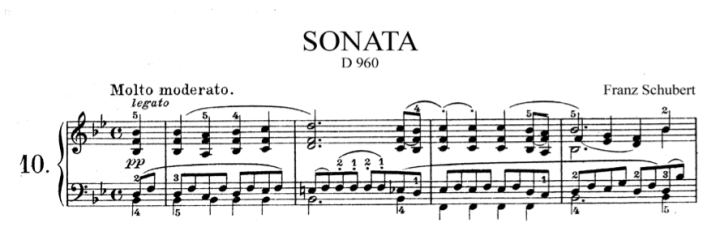
The opening bars of the first movement of Schubert’s Sonata in B-flat Major D960
When I first started learning the D960, the day my new piano arrived from Chappells in January 2007, I did not doubt the correctness of adhering to the score and repeating the exposition. Throughout my musical studies, I had been taught to trust the composer’s intentions, that composers know what they are doing, and that repeats are there for a reason.
In Baroque repertoire, sectional repeats are commonplace, often used to reinforce material and to offer soloist and/or ensemble the opportunity for some interesting extemporisation or ornamentation in the repeated material. At a recent harpsichord masterclass I attended at Handel’s House with some of my students and those of a teaching colleague, the harpsichordist, Claire Williams, encouraged students to experiment with different effects in repeats, such as using the upper manual of the harpsichord, or employing a lighter touch. Bach and his contemporaries would have expected and encouraged it.
In the piano sonatas of Mozart, for example, a repeat of the exposition in the first movement is often a reinforcing device, a reminder that this is a sonata, in Sonata Form (Exposition, Development, Recapitulation). And Mozart would have expected his keyboard player to offer some extemporisation – changes in dynamics, ornamentation and so forth – in a repeat. As musicologist, pianist and noted Mozart expert Robert Levin states:
“If you take a repeat, for instance, heaven forefend you should play exactly the same way you did before. It’s like telling somebody, ‘Look, if you could go back five years and relive your life would you change anything?’
Some people might say, ‘Nah, I think I basically did what I wanted to do,’ but a lot of people would say, ‘Oh boy. I can name you a dozen things that I would done differently.’ A piece of music is an almost cinematic opportunity to revisit a situation and reinterpret it.”
In a repeat of the exposition, the musical experience does not stay the same – there can never be a “straight repeat” because we are human and do not seek to replicate MIDI recordings – but the repeat of the same material helps the listener to assimilate the musical ideas expressed in the composition, and makes it easier to comprehend the structure of the piece.
In Schubert’s last sonatas, the repeat sign is written for an exceedingly long exposition, while the material of the exposition is repeated a third time in the recapitulation with little alteration. This has led some pianists to omit the exposition repeat in performance. But in the last Sonata (and, indeed in the penultimate Sonata, D959 in A), the first ending of the exposition contains unique material, leading the music back to the movement’s opening. If the music is performed without the repeat, this material is missed out completely as it does not appear in the second ending of the exposition (if one does not observe the repeat, one goes straight to the second time bar and thence to the development section). These bars contain striking material, which does not appear anywhere else in the piece, and is significantly different from the second ending. When the exposition ends a second time, Schubert introduces an extraordinary bridging section, three ethereal chords a single bar, which seem to come from somewhere else completely, and lead the music into darker, minor-key territory.
The first and second time bars at the end of the exposition
British-Hungarian pianist Andras Schiff feels that the omission of the exposition repeat is as “the amputation of a limb” (Schiff, “Schubert’s Piano Sonatas”), while Alfred Brendel declares the exposition repeats in the final two sonatas to be “unimportant”, that the transitional bars in the D960 are too unconnected to the rest of the movement, and that their omission actually contributes to the coherence of the piece. Brendel also states that “repeat marks must not be taken as orders to be automatically obeyed, as if the repeatable section were written out by the composer.” (“Schubert’s Last Sonatas: An Exchange”; Frisch and Brendel). But the last two sonatas have more than mere “repeat marks”: the bars of music specifically written out by the composer suggest that Schubert requires the repeat to be observed.
Personally, I have never doubted the inclusion of the exposition repeat, and it irritates me when I hear performances, either live or on disc, which omit it.
In reading reviews of live performances of Schubert’s last three sonatas, it strikes me that many pianists omit the exposition repeat/s simply to save time. Most concerts last around 90 minutes (plus interval); any longer and the audience starts to get restless, worrying about last trains etc. Critics, who praise the omission of the exposition repeat, are similarly impatient, presumably keen to get out of the Wigmore and into the pub before last orders! Played in its entirety, with all repeats intact (including in the third movement Scherzo), the D960 comes in at around 40 minutes.
Another issue which relates to this is the tempo of the first movement. It is marked Molto Moderato, and in some pianists’ hands (Richter), this can verge on Adagio! Moderato means “not rushing or dragging”, and Schubert also used the German term mässig, implying the calm flow of a measured allegro. A quick glance through Spotify of recordings of this work reveals that most versions which include the repeat come in at around 20 minutes; Richter’s is 25 minutes, which is verging on self-indulgent, while Pollini’s is 18 minutes. At this length, the opening movement of the D960 is as long as an entire sonata by Haydn or Beethoven.
It is customary to programme Schubert’s last three sonatas together, just as Beethoven’s last three are, to stress the interrelations between the three. The D958 and D959 are played in the first half of a concert, and the D960 after the interval. It can feel like a long haul for the audience, and one of the solutions to this problem is to shorten the programme by omitting repeats, mainly those of the opening movements’ expositions. However, it irks me when I read reviews of pianists such as Paul Lewis (a protégé of Brendel), who is completing his survey of Schubert’s piano and lieder music with performances of the final three sonatas, in which critics praise the omission of the repeat without outlining at least a little of the background to this ongoing debate. I feel that without the exposition repeat the audience is cheated of the opportunity to experience Schubert’s compositional intent, and the drama, which comes from the tension between the contrasting harmonies in the exposition, and the transition between exposition and development, is lost.
To my mind, a well-played opening movement of the D960, with repeat, need not feel unnecessarily long. The music has an spaciousness (its key and scale always calls to mind, for me, a great river charting its final course towards the sea) which is offset by a considered interpretation of the Molto Moderato marking. I particularly like Pires and Uchida in this work. I have enjoyed all three sonatas in a single concert, or the D960 on its own, preceded by one of the D899 Impromptus in a lunchtime recital at the Wigmore (Andreas Haefliger – repeat omitted!). Both programmes work equally well.
The Cross-Eyed Pianist is free to access and ad-free, and takes many hours every month to research, write, and maintain.
If you find joy and value in what I do, please consider making a donation to support the continuance of the site







 The Cross-Eyed Pianist