With my Diploma behind me, it’s high time I set to work on learning new repertoire, in particular in preparation for my teacher’s spring weekend course.
The day after my diploma recital I woke with aching limbs, and a feeling of extreme tiredness akin to ‘flu, the effect of coming down after a big adrenaline/anxiety induced high (nervousness is surprisingly energy draining). I expect these symptoms are familiar to regular performers, but I was surprised by just how exhausted I felt. Instead of rising early and going straight to the piano as I normally do, I drifted through the day, listening to the radio and “pottering” in a way I hadn’t for months. I felt a little bereft without my diploma pieces to practice, but I’d vowed immediately after the exam that I would not “post mortem” the event. In the words of Doris Day “Que Sera, Sera”.
In his excellent book With Your Own Two Hands, Seymour Bernstein offers a sensible “cure” for post-performance ennui:
At this low point, we have only to let music itself take charge. For every challenge we can possibly want lies before us in the vast and inexhaustible repertory that cannot but replenish our spirit. For true musicians, depression is temporary because their music is permanent.
Two days after my exam, I went on holiday for week, but I did read some scores on my iPad, listen to music and think about the repertoire I wanted to look at on my return.
Chopin – Nocturne in E major, Opus 62 No. 2. The second of the Opus 62 and the last set of Nocturnes published in Chopin’s lifetime, charming and mature works of great expressiveness. The second of the set opens with a stately yet lyrical theme before a more restless middle section. The opening melody is then restated and the piece ends with one of the most exquisite cadences in all of Chopin’s music. Here is Pollini:
Schubert – Impromptu in F minor, Opus 142 No. 1. I first learnt this a few years ago, and then lost interest in it. It is my second favourite of all of Schubert’s Impromptus, the A flat from the first set being my absolute favourite. I love the grand, classical, almost “Beethovenian” gestures of the opening measures, before the music gives way to a plaintive duetting figure. Schumann suggested that this Impromptu could form the opening movement of a Sonata – it certainly has the feel of a Sonata in its varied gestures and textures, yet it stands alone perfectly too. Here is Perahia:
Bach, trans. Liszt – Prelude & Fugue in A minor, BWV 543. I heard this in concert recently, performed by Khatia Buniatishvili, who brought delicacy, clarity and grandeur to this work which Bach originally conceived for organ. Liszt demonstrates his deep reverence for Bach in his treatment of the material: he takes no liberties with the music, but rather simply enhances what is already there, capitalising organ sonorities, and some bravura chromatic figuration. Here is Khatia herself:
I’ve been playing and listening to Schubert’s Opus 90 Impromptus since I was about 14, when my mother fell in love with Brendel playing the fourth of the set, in A flat, and insisted that I learn it. So, armed with a Peters edition of the score, I set off to my teacher’s house on my bicycle and made a fair attempt at wrecking Schubert’s sublime, ethereal semiquavers. In retrospective, Schubert’s late piano works are perhaps not best tackled by a precocious teenager. These are works born out of the tumult of Winterreise, and, in my humble opinion, are best tackled by a musician who has lived with the music, and the composer (albeit deceased), for a long time. Sure, one can process the notes, but these works are imbued with profound, complex and mixed emotions, and only a hefty degree of ‘life experience’ can truly inform one’s playing and interpretation of this music.
Schubert famously and tragically died young, at 31, possibly from complications arising from syphilis, yet in his short life he, like Mozart, and Chopin, and Mendelssohn, produced a phenomenal amount of work, not all of it complete, much of it sublimely beautiful, absorbing and endlessly fascinating. And so, one can say that the music which came post-Winterreise – the late piano sonatas, the two sets of Impromptus, the D946 Klavierstucke – are most certainly “mature” works.
I learnt the E flat Impromptu (no.2) properly for my ATCL Diploma. My teacher cautioned me against learning, or rather re-learning something I had learnt in my teens, as despite the distance of many years, old mistakes would surely remain. So, my strategy for studying this piece some 30 years since I first encountered it, was to treat it as a completely new venture. I threw out my dog-eared Edition Peters score and purchased a new Henle edition. Of course, the fingers do remember what they learnt before, and in one or two places, I felt them straying into the forbidden territory of bad habits and sloppy or clumsy passage work, but, on the whole, I managed to avoid such errors, mainly by practising the less certain measures very slowly, in the manner of a Chopin Nocturne. This technique was been particularly helpful for the trio section, which, in the past, I had a tendency to gallop through, over-emphasising the fortissimos and sforzandos, and not paying enough close attention to the melodic line which is still evident, despite the anger and torment. This ‘Chopinesque’ treatment has revealed some really beautiful moments – I always knew they were there, but allowing myself time to hear and consider them has enabled me to shape the music in a different way.
The Opus 90 Impromptus are often performed as a set, though sometimes a single one will be offered in a programme, or as an encore (Schubert himself told his publishers that the works could be issued singly or in a set), and the four pieces do present a kind of journey (‘Reise’), both musical and metaphorical, when considered together. Much has been written on the connections between the works, and it is easy to drown in a sea of complex musical analysis and confusing hypothetical debate as to whether the pieces share connections and organised structures. Indeed, Schumann made the somewhat muddled assertion that the second set, the Opus 142, is a sonata “in disguise”.
The first of the Opus 90, in C minor, opens with a bare, arresting G octave, and the ensuing lonely dotted melody sets the tone of the whole piece. In one recording I have, the work freezes, calling to mind the exiled fremdling (traveller) of songs such as ‘Gute Nacht’, from Winterreise. The chill never really thaws as the music continually struggles to break free of that portentous, restraining G: it never truly succeeds, despite the lyrical and nostalgic A-flat sections. The warm, major key offers little real solace, as the harmonic progressions constantly drag the ear away from the resolution it craves, and any pleasant recollections are quickly forgotten by the return of the chilling tread of the opening motif, the tyranny of the G, and a horrifying attempt to finally break free.
The E-flat Impromptu suggests an etude, with its swirling, tumbling triplets, which need careful articulation to sound dancing, fluid and limpid. The opening scalic melody, repeated not once but twice, reflects the composer’s ongoing crisis, the fremdling’s agonised progress, and despite its serpentine coiling, its attempts to slip away, remains firmly tethered by an insistent, repetitive bass line.
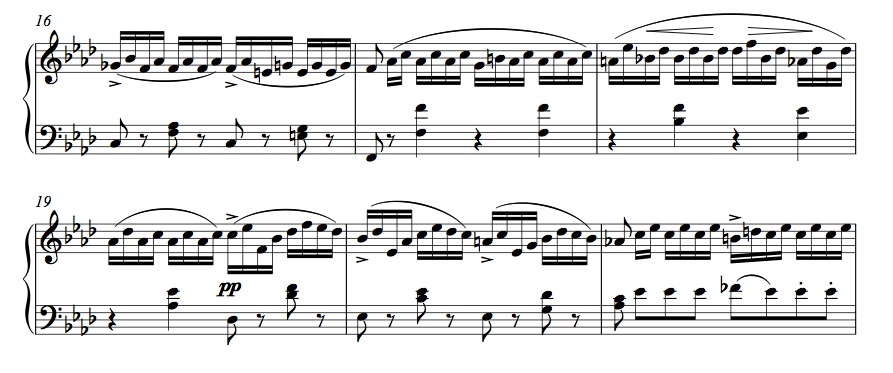
The streaming, scalic figures of the opening require wrist flexibility and suppleness, the wrist acting as a shock absorber to help shape the phrasing here. While the music is marked ‘Allegro’, there needs to be some give-and-take within the phrases, signaling shifts in mood and tone. There are measures of great charm and true Schubertian “prettiness”, but these are quickly offset by the darker, minor sections. The longer melodic lines must be shaped and preserved at all times: despite the tempo, this is not a moto perpetuo exercise in the manner of Czerny! It is an Impromptu, and by its very name it suggests romanticism rather than rigour.
As the RH ascends high into the upper registers, marked forte, the tone grows more hysterical and desperate, before the music descends to an angry, accented section, preparation for the drama and anguish of the Trio. Here, the 3/4 time signature suggests a rough, bohemian waltz, with a figure of widely-spaced bare octaves, and stamping off-beat accented triplets, alternating with a division of the beat into quavers, a stark contrast to the flowing triplets of the earlier sections. There are some moments of great melodic beauty and poignancy here, but the roughness and tension is never really smoothed, while a sobbing, repeated triplet figure acts as a bridge, leading us back to the opening material. The pieces ends, emphatically, in the minor key, signalling once again the confusion of Schubert’s lonely traveller.
The third Impromptu, in G-flat major, is probably the best-loved of the set, with its serene, nocturne-like melody, redolent of Schubert’s Ave Maria, and its fluttering harp-like broken chords, which soothe after the torment of the previous piece. There are storms – bass trills, and a shadowy, frequently-modulating middle section – before the music returns to the same flowing calmness of the opening.
And so to my favourite, the No. 4, in A-flat, and here at last all the uncertain tonalities of the preceding movements find a home. This is not prefigured at the outset, rather the protagonist, the meandering fremdling of these four pieces, must strive for eventual and gradual disclosure: the piece opens in A-flat minor, though it is written in the major, with accidentals, and the harmonic ambiguity lingers until bar 31, when the graceful, cascading semiquaver figure is at last heard in A-flat major, beneath which the left hand has a fragile, ‘cello-like melody. At the centre of the piece is a lyrical trio reminscent of Schubert’s ‘Wanderer’ fantasy, after which the sense of alienation and tension from the earlier pieces is swept aside by the gradual acceleration of all the elements and the home key, A flat, becomes fully dominant, while a life-affirming dance-like figure takes over in the bass. The final cadence is an emphatic A-flat major descent and two forceful closing chords. Home at last.
It may be fanciful to assign such complex musical and thematic considerations to these pieces, but play them, or hear them, as a set, and I think the sense of a journey, and its eventual completion is evident, if only in the progressive tonalities of each piece. In any event, these are poetic, timeless, and very personal works, which display a gravity and intensity far beyond the typical nineteenth-century drawing room Albumblatt or klavierstück.
Further reading:
Fisk, Charles – Returning Cycles: Contexts for the Intepretation of Schubert’s Impromptus and Last Sonatas. University of California Press. 2001
Daverio, John – Crossing Paths: Schubert, Schumann and Brahms. Oxford University Press, USA. 2008
Ian Bostridge with Julius Drake (piano) – from the film of Winterreise by David Alden
The Cross-Eyed Pianist is free to access and ad-free, and takes many hours every month to research, write, and maintain.
If you find joy and value in what I do, please consider making a donation to support the continuance of the site