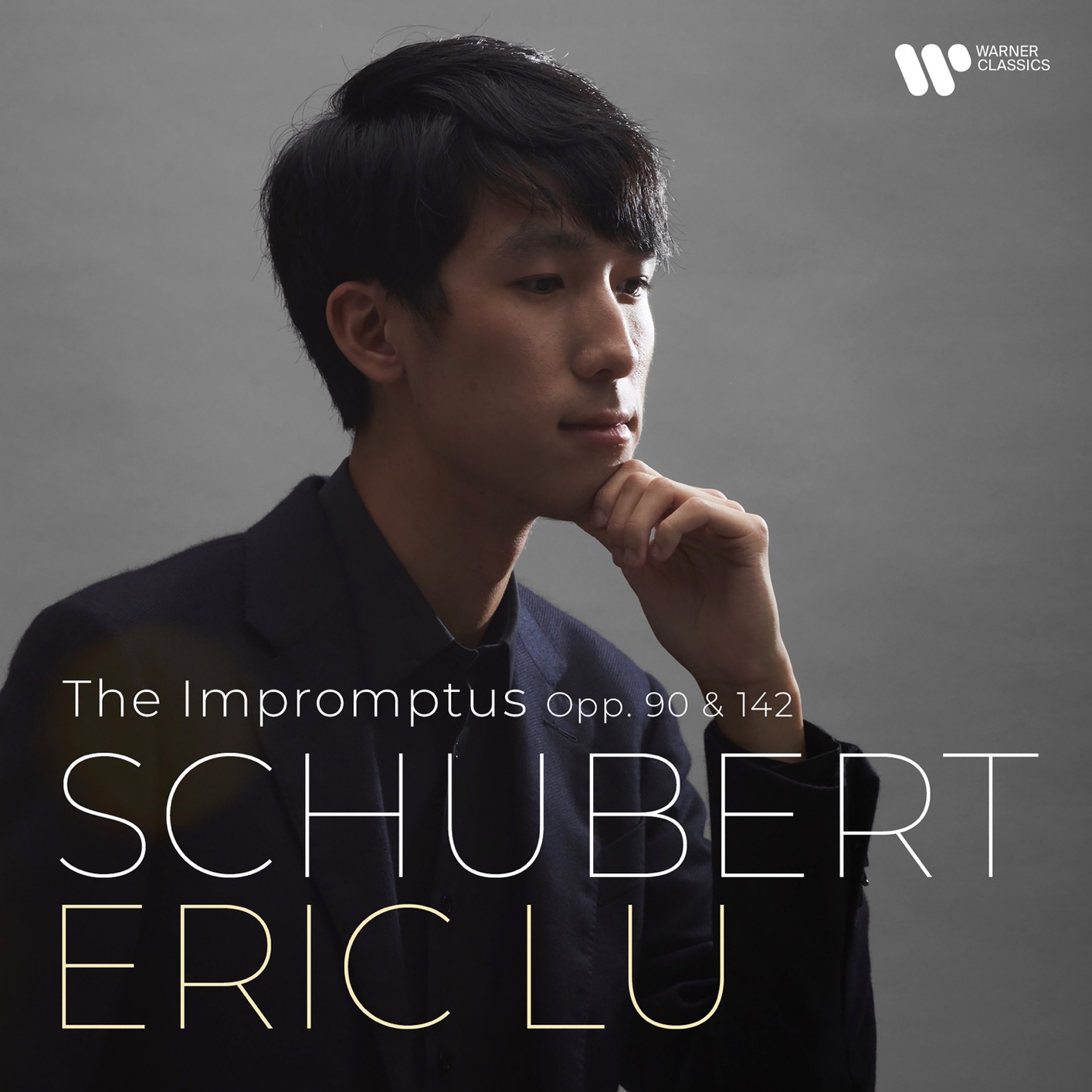
Schubert: Impromptus Opp.90 and 142 – Eric Lu, piano (Warner Classics)

The two sets of Impromptus are my favourite piano pieces by Franz Schubert, music which I’ve explored as both player and listener since my teens. As a consequence, I’m very fussy about performances and interpretations of this music

In his second recording of Schubert’s piano music, Eric Lu, winner of both the Leeds and Chopin competitions, presents both sets of Impromptus. In interviews, Lu has expressed his affinity with and affection for Schubert’s music, stating that, “It is difficult to describe how meaningful his music is to me….he is the composer who moves me most intensely.

A shame then, that Lu doesn’t seem to translate these statements when he actually plays the music. Ponderous tempos, lingering rubato and over-emphasised agogic accents, all presumblay intended to suggest “emotional depth” abound, particularly in the D898/1, D935/1 and D935/2. Here, I feel Lu mistakes slowness for profound emotion. This is most evident in the very first impromptu. That bare G that opens the piece is sustained far too long, to the point where one wonders if the pianist has perhaps forgotten what comes next. The opening theme is sluggish (the overall tempo is too slow here) and detracts from the drama and contrasting moods (portrayed in Schubert’s characteristic volte-faces between minor and major keys). I felt this performance was contrived, somewhat egocentric – and find myself repeating some of what I said about Lu’s previous Schubert release. Oh dear! (https://crosseyedpianist.com/2022/12/30/leeds-winners-release-albums/)

He’s better in the more lively impromptus. The D899/2 ripples along in its outer sections, with a clear dance pulse in the bass which adds to the sense of forward propulsion. The final impromptu, a fiery Hungarian dance, has rhythmic bite which contrasts with sparkling scalic passages.

Lu is often described as “a poet of the piano” (a moniker attributed to many a young competition winner these days!) and there’s no doubting his ability to make a beautiful sound, perhaps most evident on this recording in the G-flat major impromptu where Lu achieves a singing melodic line, sensitively phrased, over a subtly shifting bass of almost continuous movement.

The thing about this music is that Schubert gives plenty of directions and a rather more “literal” interpretation, free of wandering rubato and unnecessary accents, actually feels more in keeping with the composer’s emotional landscape.
And for that I would recommend recordings by more mature, experienced Schubert players such as Maria Joao Pires, Mitsuko Uchida or Murray Perahia.

But Lu is not yet 30 and there’s plenty of time for him to absorb all the subtleties and details of Schubert’s writing. So maybe I’ll find more to love in his next release, when it comes….

Guest review by Adrian Ainsworth


Edna Stern’s latest release is a fascinating find. Beautifully performed, for sure, but those performances are led by an intriguing, impeccably realised idea.

The pieces on this disc are well-loved and oft-recorded: the first four ‘Impromptus’ (D899) and the ‘Moments Musicaux’ (D780). But Stern, following the courage of her convictions, has arrived at a new way of hearing them. Or perhaps, more accurately, a very old one.

The artist’s sleeve-notes explain the background at length, and if you buy this album, you’ll find they are an excellent read. So I will just try to summarise here. Broadly, Stern became disenchanted with modern digital recording – in particular, the facility to edit performances into ‘perfection’. To the non-expert listener, what can sound like a seamlessly executed rendition of a work is sometimes a painstakingly finessed collage from multiple takes. Flashes of divine inspiration that don’t conveniently occur within the same run-through are made to do so, after the fact.

This came to a head, Stern tells us, when working with a sound engineer who produced an edit that was stitched together to the point where she could barely recognise her own interpretation. For this project, then, each of the ten pieces is represented by a single, intact take. Of course, Stern recorded them several times in order to choose her favourite, but no artificial mix-and-match took place. She picked the versions she found the most interesting or appealing, if not necessarily the most accurate: the integrity and spirit of the performance outweighed the occasional stray note or tempo.

One of the reasons I enjoyed Stern’s booklet essay so much is the extremity of her position. While she acknowledges the value and skills of everyone involved, she calls that game-changing edit a ‘monster’, and likens the studio correction of mistakes to offering a performance from a robot over a human. It’s forcefully argued stuff.

And thought-provoking. Schubert-lovers who are tripping over Impromptu recordings – anyone with shelves (or hard-drives) full of versions of their favourite works: what are we looking for? I realise there’s an element for many of seeking an ideal version that matches the one in their head, of looking for the ‘best’… and I don’t envy critics who have to make these sorts of comparisons all the time. But what it’s really about, surely, is hearing the works you love ‘renewed’, enjoying the surprise and delight of seemingly infinite reinterpretations of the same music.

You could argue that, most of the time, these differences survive modern recording techniques. What must be Stern’s worst nightmare – correcting every error or deviation from the score so that every pianist’s Schubert CD comes out identical to all the others – hasn’t come to pass. But by removing the safety net, Stern has thrown down a gauntlet of sorts – will other classical musicians follow suit and subject their unvarnished playing to scrutiny?

I use the word ‘classical’ here deliberately. Pristine clarity may be the common goal in this genre, but over on the rock side of the fence, many acts have often wanted to go back to the source, in their search for authenticity. There’s the huge number of bands who went through the ‘Unplugged’ rite of passage in the 90s. There are producers like Steve Albini, who seems to carry out the intensive labour upfront, listening to his clients and finding exactly the right place for the microphones in the room – then documenting the resulting live sound, with staggering results. There’s the formidable roster of groups – perhaps most famously, the White Stripes – who have made records at London’s Toe Rag Studios, renowned for their totally analogue set-up.

There is a rock-snob trap here, of course: “when it’s me, it’s authenticity – when it’s you, it’s nostalgia”. But Stern is totally alive to this, seeking to recapture the sound of the recordings she loved most during her early development. Has she succeeded?

When you start ‘Schubert on tape’, you could be forgiven for thinking you’d just lowered the stylus on to vinyl, or pressed the clunky play button on a cassette player. You hear the room before the piano. Instead of a CD’s usual dead silence, you hear an ambient noise that I instantly want to describe as ‘warmth’: it’s not disruptive, there’s no hiss or clicking, just a hushed presence that replaces any potential dryness or sterility.

There’s no doubt about it. I was hit by two waves of entirely pleasurable nostalgia. One, true: my youth, playing records and tapes in my room. Two, false: the feeling evoked by Stern of being at a Schubertiade, hearing the composer perform his work in intimate, informal surroundings.

Because once the music starts, you are there in the room (especially if using a decent pair of headphones). You can hear some of the pedal work – towards the end of Impromptu No. 4, for example, there’s a passage where this almost becomes a percussion feature – and the rise and fall of the keys, even (I think) accompanied once or twice by the click of a fingernail. This sustained, audible ‘physicality’ really brings home the effort involved in a good performance and, in the salon of the imagination, makes you feel genuinely close to the player.

I think there is also a pleasing effect on the dynamics. I was reminded of something the rock writer David Hepworth said on a podcast, when discussing the merits of vinyl over CD – almost his instant response was: “The drums don’t hurt.” Analogue recording as evidenced here has a generosity of scope – I can hear that Stern is across every pp and ff, and all points between, but the sound never becomes a bang or a whimper – it’s all accommodated in the bandwidth.

We hear chiming, keening top notes and a gorgeous bass rumble – particularly in, say, Impromptu No. 2 or Moments Musicaux No. 2 – reminiscent of a fortepiano (I was interested to read that Stern also plays this instrument). The dexterity and sensitivity of Stern’s playing is still immaculately conveyed, shining through – while benefiting from – the tape’s ambience.

As a result, I think Stern’s particular strengths and this style of recording are perfectly aligned. A successful experiment, then – I look forward to seeing the research continue, and hearing which composer becomes its next subject.

Schubert on Tape is available on the Orchid Classics label

This review first appeared on sister site ArtMuseLondon.com


105491206_266430451442172_334752493078903436_nAdrian Ainsworth is, by day, a copywriter specialising in plain language communications about finance and benefits. However, he spends the rest of the time consuming as much music, live or recorded, as possible – then writing about it, often on Specs, his slightly erratic ‘cultural diary’ containing thought pieces, performance and exhibition write-ups, playlists, and even a spot of light photography. He has a particular interest in art song and opera… and a general interest in everything else.

Twitter @Adrian_Specs

Schubert…..makes tears catch at the edge of my eyes; such fragile hope, such powerful emotions.

Ian McMillan, poet (via Twitter)

I was reminded of Ian McMillan’s quote while listening to the final lunchtime lockdown concert from London’s Wigmore Hall, a devastatingly beautiful, austerely unsentimental yet profoundly poignant rendering of Schubert’s late great song cycle Winterreise, performed by tenor Mark Padmore with pianist Mitsuko Uchida. Music so fitting for these strange days, with its narrative of loss, longing and separation.

Schubert is the composer for our corona times. Listening in isolation to performers playing to an empty hall, this acccount of isolation, its chill frequently tinged with the tenderest poignancy, seemed particularly appropriate. We are at home, but we are separate, living in our “bubbles”, unable to hug our family and friends, yet finding a sense of closeness, warmth and solace through music.

That same sense of isolation is evident in the Andantino from Schubert’s penultimate piano sonata, or the bare “horn call” first subject of the F minor Fantasie, D940, the fearful tread of the second movement of the Trio, D929, or the haunting opening measures of the unfinished sonata D 571. There are numerous other examples, of course….

In both the Andantino of D959 and the D929, it is those unexpected modulations into the major key, when the sun comes out to warm one’s skin and the chill of winter momentarily recedes, that make this music so magical, so breathtakingly extraordinary in its harmonic and emotional volte-faces. And then, only a few bars later, the melancholy and the sorrow flood back…. Often even more tragic in the major key, it is as if Schubert recognises the darkness visible, acknowledges and accepts it.

No one does chiaroscuro quite like Schubert: he mixes light and dark more subtly than any other composer and colours his musical palette with an elusive hue of mystery. Light and dark, levity and depth all reside in close proximity in Schubert’s music, perhaps even more so than in Mozart’s (and Mozart too is a master of light and shade).

I’ve loved Schubert’s music, and, more specifically, his later piano music since I was a child. I grew up listening to my parents’ recordings on LP of the ‘Trout’ Quintet, the Unfinished and ‘Great’ Symphonies, the string quartets, and The Shepherd on the Rock, which my father would play on the clarinet – and, when I became a more competent pianist, I would accompany him. When I was about 12, still a fairly novice pianist, my mother gave me an Edition Peters score of the Moments Musicaux and both sets of Impromptus – works which portray in perfect microcosm the breadth and variety of Schubert’s artistic vision and emotional landscape. I stumbled my way through these works, mostly too advanced for me at the time, though there were fragments of each which I could actually play. I took the A-flat Impromptu to my then teacher and instead of ticking me off for trying to learn music which was far in advance of my capabilities, she helped me find my way through the score. At this time, in the late 1970s, Schubert was regarded as the poor relation to Beethoven, his melodies sweet as sachertorte, his structures incoherent, and his emotions too introverted. Then I had little knowledge about Franz Schubert beyond the notes on the page, but there was definitely something that drew me to his unique soundworld….

Much as I love Beethoven, his gruffness and uncompromising spirit, as I’ve grown older I turn more and more to Schubert’s introspection, his tenderness and his intimacy. He speaks more softly, more personally than Beethoven for me. His unmatched gift for melody enables him to spin the agony of desire, melancholy and sorrow, and the joy of living  – and a whole gamut of emotions in between. He has a remarkable ability to switch rapidly between terror and lyricism, from the darkly tragic and melancholic to golden transcendence or joyous other-worldliness, all rendered in music of incredible, almost revolutionary inventiveness. Often this is achieved through the most miraculous modulations, an unexpected sonic shift and, for me, as a synaesthete who sees the musical keys in colour, a completely new luminosity.

His other great skill is in managing rests and pauses. Silences abound, freighted with poetic imagination and who knows what, suspending time and offering pause for reflection, while also clarifying the structural expansiveness of the music, his “heavenly length”. In addition, Schubert’s use of dynamics is often ‘psychological’ rather than purely physical, suggesting an intensity of feeling rather than volume of sound. As pianists, we shouldn’t play Schubert as if you would Beethoven (though some do!). Even in his grandest gestures, for example the fff passages in the first movement of the Sonata in G, D894, there’s a restraint. His generous use of pianissimo in particular creates an ethereality in his music as if hovering between different states of mind.

In those moments, his music makes you feel as if you are the last person in the universe…..

How does one explain Schubert? The simple answer is – one can’t.

Steven Isserlis, cellist


CDA68213Piano Sonata in B flat major D960

Four Impromptus D935 Op 142

Marc-André Hamelin, piano

(Hyperion CDA68213)


Canadian pianist Marc-Andre Hamelin, more used to scaling the most vertiginous peaks of the piano literature or revealing the more esoteric nuggets and rarities of repertoire, has released a recording of Schubert’s final piano sonata and the second set of Impromptus.

The evergreen Sonata in B flat, D960, is perennially popular with pianists and audiences alike, and regularly graces concert programmes and recordings. Not only is it a beautiful and absorbing piece of music, it also holds a curious fascination for pianists and listeners. Completed just a few months before the composer’s death in November 1828, this sonata (and to a lesser extent its companions D958 and D959) is regarded by many as a valediction or a premature message from beyond the grave – the composer’s final farewell at the end of a life cut tragically short by syphilis. As a consequence, this sonata has acquired a certain “otherworldiness” which can influence the way pianists approach it. It is, in my opinion, unhelpful to apply too sentimental an interpretation to this striking work, or to approach Schubert’s life and work in Vienna in the first part of the nineteenth century with 21st-century sensibilities:  it is worth noting that the average life expectancy for a man in Vienna in the 1820s was 38 years, and at the time when Schubert lived in that great city it was dangerous, dirty, disease-ridden, and rife with crime. All lives were lived on the edge of sorrow, not just Franz Schubert’s. And so while there is pathos, sombre melancholy and a sense of acceptance (but never resignation) in this Sonata, there is also serenity, exuberance and a tangible joie de vivre, particularly in the third and fourth movements. Indeed, by the close of the work, one has the sense of a composer who lived a full life and still had plenty more to say.

When so many performances and recordings of this great sonata exist, including some notable “benchmark” recordings which stand the test of time (and we each have our personal favourites), why would a pianist of Marc-André Hamelin’s standing and facility, with an already impressive discography, turn to Schubert? Well, in a way, late Schubert – like late Beethoven – sits up there alongside Shakespeare, and like Shakespeare’s writing, there’s always more to find in this music, and each performance (as a player or listener) is a different experience. The D960 has the richness of a journey willingly undertaken and plots a course through the whole gamut of the composer’s personality, his emotions and ideals. He’s introspective, yet his message has a universal truth – and tenderness too.

For a pianist who seems able to handle anything the repertoire can throw at him, from the craggy edifice of Charles Ives’ ‘Concord’ Sonata, Stockhausen’s enigmatic Klavierstück IX, to Villa-Lobos’ savage Rudepoema, or the mannered witty classicism of Haydn, late Schubert seems an unusual choice. Yet I know from a conversation with Marc-André that this is a hugely significant undertaking for him personally, and I feel this recording perhaps says more about the pianist than the work itself.

This is not virtuosic music, in the traditional sense of the word. It has no grand gestures nor intricately glittering passages; it is introspective and often deeply intimate. But there are certainly connections between Schubert’s last sonata and Ives’ Concord – both are large-scale works, expansive and wide-ranging, and require the pianist to create a clear narrative for the entire work, rather than “sleepwalking” through it. Schubert combines beauty and a structure so vast that it seems it may never end, and the work requires special reserves of concentration and artistic vision to be convincing. Pairing this large sonata with the four Impromptus D935 gives the listener a chance to appreciate Schubert’s intense artistic maturity and skill in handling structure in smaller works too.

Fortunately, Hamelin eschews the valedictory or overly sentimental approach for the D960 and opts for a leisurely Andante moderato in the opening movement, highlighting the graceful hymn-like melody of first subject, and despite a couple of rhythmic anomalies, the music moves forward with a serene sense of purpose, occasionally tinged with hesitancy. Agogic accents (a slight hesitation before arriving at a note) are used to emphasise the long notes which begin the phrases in the first subject. This can feel a little self-conscious at times, although I appreciate why Hamelin does it – it lends a dramatic poignancy to the melody. The infamous bass trill, first heard in bar 8, is a distant rumble, nothing more ominous, though later iterations feel more unsettling, quickly dispelled by the poetic melody, which is tastefully balanced against the accompaniment. The bridge to the development section (the exposition repeat is, thankfully, intact!) – those two extraordinary chords at bar 117 – is suitably ethereal, though the pause before embarking on the development is just on the uncomfortable side of dramatic for me. Overall, Hamelin’s take on this movement is not “Schubert as Beethoven on a quiet day”, but rather Schubert the genial spinner of songs: Hamelin gives this movement the intimacy of a lieder while also appreciating its regal expansiveness. Schubert’s good nature is never far away in the transitions between major and minor passages, to which Hamelin responds with a nuanced warming up or cooling of the sound, and the overall mood is positive – imperturbability and joyfulness are only occasionally disturbed by darkness.

The temperature drops somewhat in the slow movement (famously given a desolate, almost funereal air by Sviatoslav Richter’s choice of tempo), though the atmosphere is restrained and meditative rather than cold and melancholy. The bass line, whose rhythmic ostinato figure maintains the underlying sense of forward motion in the outer sections, is well delineated and never obscured by too much pedal. And it is that rising bass figure, over which the melody is simply yet elegantly shaped, which also saves the music from becoming too sombre. The middle section, in warm A major, is rather passive. I would have liked a greater sense of exaltation: it feels a little held back and occasionally ponderous. The coda however is sensitively managed, ending on a rising arpeggio in radiant C-sharp major.

If the opening movement unfolds like a great river plotting its final course, the third movement is as bright and playful as a mountain stream. Hamelin captures its bubbling, quixotic character, responding neatly to the harmonic sidesteps and shifting registers. A change of mood is signalled in the minor key Trio, whose fzp bass accents and syncopations in the right hand suggest an exotic and rather menacing dance or ländler, but the former ebullience is quickly restored in the return to the Scherzo, preparing the way for the finale.

It is in the finale that Hamelin has the greatest opportunities for virtuosity, yet there is restraint and sensitivity here, just as in the opening movement: supple responses to the shifting moods and harmonies, the second subject melody lyrically shaped, the dotted rhythms dance gracefully, and some colourful voicings give this movement playfulness and vigour. The occasional places where the tempo presses forward somewhat unexpectedly lend a slightly breathless sense of urgency, while the coda is bright, robust and positive.

Coming after the expansive D960 (other programmes may place these works the other way round), the Impromptus D935 also have the sense of a sonata in four contrasting movements. The fourth of the set has a toe-tapping vigour and wit, a darkly lit Hungarian dance (remember these pieces were written the year before the final sonatas in the aftermath of Winterreise), the third is graceful and mercurial, occasionally tongue-in-cheek, and the second tender and intimate.

The F minor Impromptu, the first of the set, has an orchestral grandeur offset by the tender duetting passages. Purists will balk at the addition of a “new” coda, written by Hamelin himself, who regards the score “a frozen moment in time“. His justification for adding a coda in this instance is that the work “basically finishes without a coda“, and while he believes that one should not stray too far from what the score says, it is sometimes “permissible to go a little bit away from it“. Certainly, it’s an interesting addition, perhaps more akin to Schumann than Schubert in its romantic textures, and it picks up the duetting fragments from the main body of the work. For me it just feels too unexpected.

But perhaps the most unexpected aspect is Hamelin’s decision to record late Schubert, given his predilection for more virtuosic/unusual repertoire. It’s a bold move, because the Sonata D960 holds such an important place in the repertoire and the hearts and minds of pianists, listeners and commentators. Do we need another recording of the D960? Does it matter that many others have also recorded it and others are waiting to record it in the future? I don’t think so, because the music is there to be played and this recording will enter the great catalogue of Schubert recordings to give pleasure to listeners. It may not be to everyone’s taste –  no recording ever could be – but there’s an eloquence and sensitivity in Hamelin’s approach to this music which is satisfying and committed.


Recording details: May 2017
Concert Hall, Wyastone Estate, Monmouth, United Kingdom
Produced by Andrew Keener
Engineered by Simon Eadon
Release date: 27 April 2018
Total duration: 81 minutes 48 seconds

Informative and readable liner notes by Richard Wigmore