Guest post by Michael Johnson

It’s funny how some random experiences can teach us important lessons in life. On an Air France flight across the Atlantic recently, I clapped on a new set of Bose wireless headphones and within minutes a stewardess was squeezing my shoulder. I looked up and saw her mouth flapping – but she made no sound. All I could hear was Rachmaninoff’s Concerto No. 3 that I was playing through my headphones. It took me a few seconds to regain my composure.  No, I didn’t need any more café, I told her. Back to the music, I was  experiencing the true meaning of “active listening”.

The sharp trebles and thunderous basses of quality headphones create a private world of pure music. Was I listening? Of course. One can hardly avoid listening to the Arkady Volodos performance of this brilliant concerto.

Best of all, on headphones nobody yells at me, ”Turn it down, for God’s sake!”

And yet ironically, the advent of listening through high-tech recording systems has in some ways been harmful, not helpful, to the modern world of serious music. We have removed much of  music from the intimacy of live salon style performances and created the sterile experience of playing a CD or downloading tracks from the Internet. Just 60 or 70 years ago it was only the live performance that brought audiences to the music and the player. Everybody got involved, everybody listened. Now that is largely gone, as concert venues sell us the super-stars such as Volodos, Yevgeny Kissin, Yuja Wang,  and possibly Khatia Buniatishvili. The second tier players attract mainly aging retirees, some of them asleep by the end of the first movement.

“We seem to have mastered the art of hearing without listening.” Christy Thomas, Yale Center for Teaching and Learning. “Active learning is a frequent topic of discussion in pedagogical circles today, but the notion of active listening is rarely addressed—if at all.

But now, waking up and learning to listen may turn out to be the saving grace of the classical tradition. The salon style in various forms can help, and it seems to be in vogue again. Both solo and ensemble players are happy to play in private homes with only 50 or so seats.

Natasha Cherny, New York-based artist manager and producer, tells me her salons in past years “were infinitely more satisfying from every perspective”. Her recital-goers were encouraged to mingle before and after the program “always including protracted conversations with the artist”. And former Juilliard professor David Dubal, pianist, pedagogue and accomplished painter, has been running his series of ‘Piano Evenings’ in New York for 30 years. His aim is to bring “the glories of the piano repertoire, in an intimate setting, dedicated to the art of listening”. He calls it “a site for collective learning through the exchange between teacher and student, performer and listener”.

Indeed, recorded music, no matter how perfect, misses the point. “We kind of caused the problem,” admits Andrew Scheps, an American recording engineer, by making it too easy to hear the notes while missing the intimate experience that players, especially solo pianists, want and need.

Pianists in this overcrowded field find that much of their recorded music ends up in background. An Italian pianist friend tells me the world of recordings has never been such a waste. “There are too many CDs. We can never get noticed.” Too often, a fine piano talent merely exists for his or her  background noise. In Bordeaux, for example, the main underground car park offers Chopin Nocturnes murmuring along with  honking horns and shouts from angry French drivers, hardly a perfect venue. The artist remains mercifully anonymous. Worse, nobody is listening to Chopin.

A comprehensive treatment of regaining that connection is explored in the book Music: The Art of Listening by Jean Ferris, a former music history and appreciation professor at Arizona State University.  “Listening to classical music is itself an art,” she writes,  “and good listening is an active, creative experience.”

The personal experience is further investigated in a recent documentary of a similar name, “The Art of Listening”, available free on YouTube:

There are perhaps two kinds of pianist, those that just hammer the clavier louder and faster and those like Volodos who listen intently to themselves as they brush the keyboard with their fingertips. In this recording, Volodos playing Rachmaninoff was all ears, and so was I:

Working as a critic, I am pleased to find more and more  attention to listening skills, a mini-movement on an international scale. Indeed, learning to listen is perhaps the best hope for rescuing classical music from the dustbin of history. Statistics are at an all-time low, ranking rock and hip-hop, rap, electronic dance music (EDM), country and jazz comfortably ahead. Classical occupies only about 4 percent of this world.  Could it be true that there is nowhere to go but up?

Many others in the realm of classical music have joined the movement. Julian Blackmore, a British composer and sound designer, takes a professional interest in absorbing and processing music in the brain. He calls it “active listening” and says it leads to a far deeper understanding and appreciation of complex compositions.

Being prepared makes all the difference. “As woo-woo as this sounds, it’s a unique and priceless kind of satisfaction that money can’t buy,” he adds.

The online ‘Piano Encyclopedia’ promises that as you immerse yourself, “an ordinary auditory experience becomes  a profound connection – a kind of bond. Each note played has purpose and intention. By being fully engaging with the music, it speaks to your very soul.”

Learning to listen can provide this profound satisfaction, for example, in impressionist music. Creating color rather than line might seem elusive but through “active listening” this rich artistry can be appreciated.

Help is increasingly available. A wide choice of advice, courses and instructional videos from experts flood the internet  today. My favorite for beginners is a talk about how to take in what you are hearing: “How to Listen to Classical Music: Sonata Form”, accessible through this link:

And French musicologist Jean-Jacques Griot has marketed his “Ecoute Classique” (Listen to Classical) Zoom sessions effectively to internet users throughout the francophone world. He tells me he now has some 3,500 paying customers eager to follow his lessons for learning.  He does not try to make it easy. “”It takes time because learning classical music is a progressive process of assimilation,” he writes in his book Ecoute la musique classique – it can be learned”.

The late philosopher Rudolf Steiner wrote that music is the only art form that flows from the spiritual world, not from the material world as in architecture, painting, ballet, sculpture. If you step back and listen a great player such as Volodos, Yevgeny Kissin or the late Glenn Gould, you might agree with Steiner that music plays to your inner sense of well-being, as he wrote in his essays, compiled and published as The Inner Nature of Music: The Experience of Tone.

To take listening to classical music seriously is to find solace, reduce stress in your life and even improve your memory. Personally and for all these reasons, my life is filled with classical music, live and recorded. The sad opposite is also true: the latest fad fades away in seconds. When you listen to Rachmaninoff in the hands of Volodos you carry it in your head forever.


Michael Johnson is a music critic and writer with a particular interest in piano. He has worked as a reporter and editor in New York, Moscow, Paris and London over his journalism career. He covered European technology for Business Week for five years, and served nine years as chief editor of International Management magazine and was chief editor of the French technology weekly 01 Informatique. He also spent four years as Moscow correspondent of The Associated Press. He has been a regular contributor to International Piano magazine, and is the author of five books. Michael Johnson is based in Bordeaux, France. Besides English and French he is also fluent in Russian. He is co-editor with Frances Wilson of Lifting the Lid: Interviews with Concert Pianists.

The words “salon concert” conjure up an image of a beautiful setting in nineteenth-century Paris, London or Vienna where a select few intellectuals and dilettantes gather to enjoy music, poetry, art and conversation – an exclusive event for like-minded individuals.

Today the spirit of the salon concert lives on in venues like the 1901 Arts Club (whose furnishings could have come straight from nineteenth-century Paris), the spacious Marylebone drawing room concerts of the highest order regularly hosted by Bob and Elizabeth Boas, or the more modern vibe of Fidelio Café on Clerkenwell Road, and in series such as …Petits Concerts or 7 Star Arts’ concerts at a convivial little Japanese café in Kew. But whatever the venue, the modern salon concert is about creating a special intimacy and connection between audience and musicians, and an ambiance of shared experience, and venues such as the 1901 Arts Club and Fidelio Arts Café have succeeded in reimagining the salon concert for the 21st century audience. Not only is it a wonderful way to experience live music, the modern salon concert breaks down the barriers normally associated with classical music in a formal concert hall and brings music-lovers together in a convivial, relaxed setting. The experience of enjoying music amongst friends is uplifting and inspiring.

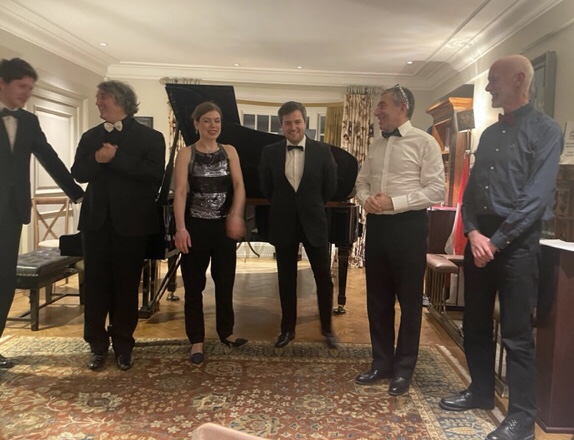
Down in a pretty part of West Sussex, not far from Petworth, another salon concert series takes place, organised and generously hosted by Neil and Debbie Franks. Neil is chairman of The Petworth Festival, a keen amateur pianist, passionate music lover, and supporter of other musicians.

An elegant music room-cum-library, which boasts two fine grand pianos, (including possibly the best Steinway B I’ve ever played!) and seats around 70 people, is the setting for Neil Franks’ salon concerts. Initially, these house concerts were very much “music for friends, with friends” – he’d gather together a few talented piano friends and we’d play solos, duos, 6-hands, 8-hands and more – and mingle with audience during the interval and afterwards. Lately, his house concerts have transformed into a modern salon where young talent is showcased and celebrated. For Neil it is also an opportunity to support musicians in their careers and to recognise the “great value derived by the musicians in performing their own very personalised and precious repertoire to small audiences in intimate settings, and the huge enjoyment realised by audiences. In the right settings, the combination generates some absolutely wonderful and passionate performances. The same was true in the British and European salons of the 19th and early 20th centuries and much was written by composers and musicians at the time about the tremendously important and inspirational value they took from those evenings” (Neil Franks)

For the January concerts, he assembled a group of very talented musical friends, including established as well as up-and-coming, talented young pianists, namely Anthony Hewitt, Emanuil Ivanov, Florian Mitrea, Olga Stezhko and Julian Davis, Neil’s regular piano-duo partner. The jointly-held ambition of the concerts was to promote and re-invigorate the whole idea of salon concerts, to invite friends including local concert series organisers, with the objective of showcasing the talents of these musicians which would hopefully lead to further engagements at other regional concerts (this objective has already been successfully realised as some of the pianists will perform again in West Sussex venues later this year).

Between us, we very much enjoyed putting the programme together that I think I can say came together quite naturally as each pianist had something special to offer that led to a perfect combination of solos, duets, 2-piano duos, and even 8-hands pieces. The solos were almost mini, individually-curated recitals, and the multi-handed pieces offered contrast to the solos in which the individuals were in the spotlight.

Each pianist also gave short but informally presented introductions to their pieces – a far more welcoming practice than the paper-consuming lengthy, and usually rather dry and inaccessible essays of programme notes. The result was 2 hours of absolutely absorbing music: not just absorbing the notes, but really feeling the very vibrations of the music in the salon environment, something that is a rarity in a concert hall however magnificent the pianos might be. One of the notable advantages of the salon is the total elimination of any physical barrier between performer and audience.” (Neil Franks)

Of course, one of the added attractions of the salon concert is the opportunity to mingle with friends and other music lovers, and also the musicians, and enjoy drinks and canapés. Debbie and Neil are warm, generous hosts and, as an expert networker, Neil has a knack of bringing people together which encourages new connections and friendships. And at these concerts, there was also a good age range represented amongst the guests – a mix of the “usual” classical music concert-goer and younger people who would have little interest in sitting in a formal concert hall, church or town hall for 2 hours, but who were delighted to be welcomed into Neil and Debbie’s lovely home.

It is abundantly clear that classical music is in need of a lot of tender loving care, just like so many forms of cultural activities where consumption patterns have changed in recent years – and would have changed even if Covid didn’t happen, but Covid concentrated the disruption in a very short period. We are all very aware of the options available now, very much including the opportunity to “consume” our music online. We are equally aware that the majority of classical music takes place in formal settings of concert halls in major cities, town halls and churches in smaller towns. I think it’s reasonably safe to say that there will always be a hardcore audience of passionate music-lovers who will look for what they want to hear and travel to the concerts of their choice, but music needs to attract new and younger audiences, many of whom are not so likely to be attracted to these formal settings, especially as they may not be fully familiar with what’s on offer. So I think the key is to make music in interesting venues that already go some way to removing the formality barrier. The venues themselves can generate interest in attendance. So let’s all think outside the box and bring new ideas, new and interesting venues to make concert-going an experience for many more. Include art exhibitions, gardens, lovely food and drink and anything else you can imagine! ” (Neil Franks)

A busy week of enjoyable and varied concerts in Brighton and London. Here’s my round up:

Sunday 4th May – Helen Burford, piano, Brighton

Helen has a particular interest in contemporary British and American music, and an unerring ability to create imaginative and eclectic concert programmes which combine her interests with more mainstream repertoire. For her afternoon recital as part of the Brighton Fringe Festival, she opened with Somei Satoh’s haunting Incarnation II, a work which allows one to fully appreciate the full range of sounds and resonance possible on the piano. An extraordinarily absorbing and unusual work. The Japanese connection continued with Debussy’s evocative Pagodes, followed by Haydn’s C major Piano Sonata Hob. XVI No. 50 with two witty and sprightly outer movements enclosing a slow movement played with expression and warmth. In typical style, Helen cleverly paired Hush-A-bye, a work by contemporary American composer Julie Harris, with Debussy’s much-loved Clair de Lune. Both pieces recall nighttime – the first has night sounds combined with fragments from the lullabies, “All the Pretty Little Horses” and “Hush Little Baby Don’t Say a Word”, while the veiled harmonies and rippling semiquavers of Debussy evoke moonlight. Helen closed her programme with a lively and foot-tapping Rumba Machine by Martin Butler.

Monday 5th May – Jonathan Biss at Wigmore Hall

Biss is a musician I was curious to hear live, having enjoyed interviews with him, and his insightful and intelligent writing about Beethoven. His recital opened with an early Beethoven Sonata, Op 10, No. 2, and there was much to enjoy in his nimble and witty rendition of the first movement. However, the second movement lacked shape and the final movement was too rushed. The second Beethoven of the concert was the ‘Waldstein’ which lacked structure and a clear sense of the underlying “four-square” nature of Beethoven’s writing. The end result felt rather superficial. Sandwiched between the two Sonatas were selections from Janacek’s On An Overgrown Path. These were enjoyable but lacked a certain sensitivity to the emotional depth inherent in these miniatures.

Wednesday 7th May – Behind the Lines: Music from the First War, MOOT, Brighton

Another lunchtime concert, hosted by Music Of Our Time, a wonderful music collective organised by the indefatigable Norman Jacobs. This year’s focus is on music and composers from the First World War, and the concert, duets and solo works performed by Helen Burford and Norman Jacobs, was a touching, tender and occasionally humorous tribute to composers such as Cecil Coles (who was killed in April 1918) and Frank Bridge, a committed pacifist who was profoundly affected by the war. There were also works by Debussy and Stravinsky, and the concert ended with a four hands version of ‘Mars’ from Holst’s Planets suite. The concert took place on the 99th anniversary of the sinking of the Lusitania, which gave the concert an added poignancy.

Friday 9th May – David Braid, guitar & Sergei Pobdobedov, piano

The end of the week and a concert at the delightful 1901 Arts Club, a converted schoolmaster’s house not five minutes from the bustle and noise of Waterloo Station. One of London’s hidden gems, the venue seeks to recreate the ambiance and ethos of the European musical salon, with its gold and crimson decor and friendly, convivial atmosphere. It is the perfect place for intimate chamber music, and this evening’s concert was no exception.

I interviewed David Braid earlier this year and I was curious to meet him and hear him in performance, for his musical landscape and influences accorded, in part, with my own interests. He plays an electric archtop guitar, more usually associated with jazz or rock/pop musicians. He makes transcriptions for this instrument, with piano accompaniment (his duo partner Sergei Podobedov), of works by Renaissance and early Baroque composers such as Byrd and Sweelinck. The concert included music by these composers and Bach, together with piano solos of works by Chopin (two Scherzi, handled with stylish aplomb and energy by Sergei) and Schubert/Liszt, and some of David’s own compositions. Taken as a whole, this was a most intriguing and unusual concert, beautifully presented. It is hard to describe the sound of the archtop guitar with the piano: at times it recalls the Renaissance lute (which David also plays) while also sounding entirely contemporary, thus making the music sound both ancient and modern. David’s own compositions were haunting, delicate, fleeting – the Waltzes in particular had great poignancy and tenderness – and his contrapuntal writing connects his music to the Baroque masters whom he also plays. One of the nicest aspects of the evening, apart from the high-quality music, was that during the interval instead of disappearing upstairs, the musicians stayed in the salon to talk to the audience, further enhancing the sense that this was very much an evening of music amongst friends.