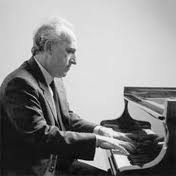
 “Maestro Pollini”, as the interviewer in the programme rather sycophantically calls him, is presenting a five-concert series at the Royal Festival Hall entitled ‘The Pollini Project’, intended, as the Italian pianist says in the interview, to offer “an overall flavour of the keyboard repertoire, from the Baroque to that great master of the 20th century, Stockhausen” to a London audience he describes as “almost unique………so enthusiastic, attentive……..with lots of young people”. The five concerts offer a fairly broad brush of piano music from the first book of the Well-Tempered Clavier of Bach, to Pierre Boulez’s Piano Sonata No. 2 (a composer with whom Pollini claims a particular affinity), Chopin’s Op 28 Preludes, Debussy’s Etudes, and the last sonatas of both Beethoven and Schubert. The final concert in the series features music by Stockhausen, Schumann and Chopin.
Pollini is a fairly regular visitor to the RFH, and I was very sorry to miss his Chopin birthday recital last year, as I have heard he is good with Chopin. I have not heard him before, neither live nor on disc. Last night, the second concert of the series, he played the last three sonatas of Beethoven, which are a somewhat different kettle of pianistic fish from Chopin, being profoundly emotional, with universal values, and in possession of “philosophy in music”, if you will (that is not to say that Chopin does not posses these attributes in his music, because he does, in different ways….). The last sonatas combine sublimity and a certain roughness, and a skilled performer, who understands these pieces intimately, both metaphorically and physically, should be able to combine both elements convincingly.
The Opus 109 begins with that memorable, lyrical opening melody. It was pleasantly played, if a little choppy in places (what my teacher calls “notey” playing). The second movement variations did not grab me, but I have no criticism of his playing per se which was pristine and technically flawless. There was a sense of Pollini settling in to his programme.
Readers of this blog and my musical friends will know already that I am very devoted to the middle sonata of the three, the Opus 110. It is my Desert Island Disc, and I am very fussy about it. Piers Lane failed to move with it a couple of weeks ago at Wigmore Hall in a rather workmanlike performance. To me, Pollini hurried through it, not allowing us enough time to enjoy the beautiful, serene first movement, while the final fugue, in its second incarnation, was rushed and muddy in places so that its wonderful “paean of praise” was lost. There were some nice parts in the Arioso, but his fortissimos were sometimes too much and verged on Hammer Horror soundtrack in places. Some of the quieter passages were also marred by an unidentifiable buzzing in the auditorium (someone trying to tweet by Morse code, perhaps?), a good deal of coughing in the audience (well, I suppose it is the time of year for coughs and colds), and the pianist’s own huffing and snuffling.
Pollini’s playing style is quite uncomfortable to watch too, though it is unlikely that anyone will ever replicate Glenn Gould’s bizarre, crouched posture. He sits close up to the keyboard, almost hunched over it (though he’s not tall – I know this because he walked right past us when we were having a post-concert drink), with his elbows jammed to his sides. He looked awkward, and it was often a surprise to see his arms go out to the highest or lowest registers of the keyboard.
Having said all that, the Opus 111 was fantastic. He brought an appropriate roughness and “bump and grind” to the opening movement, while the second movement variations were full of lyricism, sublime and meditative, while in the more up-tempo variations, Pollini demonstrated he could more than cope with Beethoven’s sheer weirdness and nuttiness (a feature common to the late works in general). Some of the trills in the highest registers fluttered as if carried on a fragile breath, and in other places we heard bells ringing, and repeated notes which seemed to nod forward to the minimalist music of John Adams and Philip Glass (and I’ve never felt that about Beethoven before!).
He received five curtain calls at the end, and many members of the audience were on their feet by the third call. Behind us, a group of Pollini tifosi whooped and cheered, much to the irritation of my companion who grumbled “I can’t stand that stuff!”. Since he played the three sonatas straight through without an interval, there was still time after the concert to enjoy a leisurely drink in the bar. Maestro Pollini came down to the foyer of the RFH to receive plaudits and sign copies of his Beethoven CD.
The next concert is in the series, Schubert’s last three sonatas, is on Saturday 26th February.
The Pollini Project







 The Cross-Eyed Pianist