Who or what inspired you to take up conducting and pursue a career in music?

I was born into a family of a conductors, so it was my father.

Who or what are the most significant influences on your musical life?

There have been many influential musicians along the way who have been important influences for me – my father, my teacher Max Rudolf at the Curtis Institute of Music and Leonard Bernstein as far as conductors go. But there have been also influential instrumentalists and composers who have been important in my life, for example Radu Lupu and Arvo Pärt.

What, for you, is the most challenging part of being a conductor? And the most fulfilling aspect?

Every part of conductor’s life is challenging. From the enormity of the repertoire to the geography and travel.

The most fulfilling aspect is that a conductor can spend his or her life with talented human beings and explore music of geniuses like Mahler and Beethoven, for example  

As a conductor, how do you communicate your ideas about a work to the orchestra?

One communicates ideas through various methods – with the eyes, verbally, with gestures and body language.

How exactly do you see your role? Inspiring the players/singers? Conveying the vision of the composer?

I see my role as a medium between the composer and the musicians. The role is to formulate a point of view about the piece through study of the score and to convey this to the musicians. 

Is there one work which you would love to conduct?

There are many works I would love to conduct but one lifetime is not enough to get close to all the masterpieces in the repertoire.

Do you have a favourite concert venue in which to perform?

The Zürich Tonhalle, Suntory Hall in Tokyo, the Musikverein in Vienna, just to name a few.

Who are your favourite musicians/composers?

Hard to name a favourite composer but I do have a soft spot for music of Sibelius and Bruckner.

As a musician, what is your definition of success?

Success is when you can make music on the highest possible level with like-minded musicians.

What do you consider to be the most important ideas and concepts to impart to aspiring musicians?

Make sure you love music enough to make it your profession and then be prepared to work very hard.

Where would you like to be in 10 years’ time?

On the planet Earth.

What is your idea of perfect happiness?

I think it would be the balance between personal and professional life.

(Artist photo: Julia Baier)
Guest article by Wendy Skeen

A friend of mine attended András Schiff’s two concerts with the Orchestra of the Age of Englightenment earlier this week in which he performed and directed Brahms’ two piano concertos. Here she shares her thoughts on the concerts – less a review, more a report informed by Wendy’s own experiences as a pianist, piano teacher and performance coach.

These two concerts were unusual in three key respects…

First, Sir András Schiff was both conductor and pianist. It’s not unusual these days to find concerts where the pianist directs the orchestra from the piano, but it’s rare to see that with Romantic repertoire such as these Brahms piano concertos. You might wonder whether it’s possible for a pianist to successfully direct an orchestra whilst also playing such fiendishly difficult repertoire. Well… it is possible… but it takes a pianist with colossal technique, musicianship and presence of mind (Schiff) and an orchestra comprising musicians of such high calibre and bravery (the OAE).

Secondly, these concerts involved much smaller orchestral forces than we’re used to hearing in Romantic repertoire. In a modern symphony orchestra, aside from the regular complement of wind and brass, there’s usually 16 first violins, 14 seconds, 12 violas, 10 cellos and 8 double basses. For these two concerts the string department had just 10 first violins, 9 seconds, 6 violas, 7 cellos and 4 double basses. One might have thought this would detract from the overall effect yet it engendered a much more intimate, personal and transparent ambience, even within such a large concert space. This allowed us to hear so much more in the music than we’re used to hearing. In fact, at the start of Monday night’s concert, Schiff gave a short speech where he told us that “we think we know this music, but we don’t know it well enough!” I think that everyone who was there knows exactly what he meant by that!

Thirdly, the use of period instruments, the most notable of which being the Blüthner grand piano which Schiff had selected for these ‘historically accurate’ performances. This instrument, which was built in Leipzig around 1867 and restored in 2013 by Edwin Beunk, had been transported from Berlin especially for these concerts. In a short introduction before Tuesday night’s concert, Schiff explained that the instrument was contemporary with when Brahms’ piano concertos were being written and performed. He also explained that it was straight-strung rather than having the bass strings running diagonally in the middle and upper register strings, as with a modern grand piano. As such, it offers pianist and listener “distinct registral differences”, rather like a choir, from bass, tenor and alto through to soprano. In the hands of a master like Schiff, this resulted in a beautifully broad palette of tonal shades and colours, allowing many more distinct lines to peak through the texture as a result of Schiff’s masterful voicing and phrasing. It felt like the musical equivalent of seeing a work of art after it’s been restored… the craftsman’s work revealing the beauty that lies beneath hundreds of years of time and history!

This is not to knock the modern-day concert Steinway. It’s just an entirely different experience hearing music played on period instruments. I confess it did take my ears a few minutes on Monday night to adjust and attune to that different kind of sound and balance. But oh my goodness… what a joy to just let go of past experiences of these pieces and allow the ears to open up to a different, equally valid approach.


Wendy-Skeen-200x300.jpgWendy Skeen is an enthusiastic amateur pianist. She is also an experienced piano teacher, performance coach, workshop facilitator and fully qualified Cognitive Hypnotherapist with a particular interest in the topic of performance anxiety. She studied piano at the Guildhall School of Music & Drama and holds a diploma in Cognitive Hypnotherapy and Master Practitioner in NLP qualification from the Quest Institute. She also holds a CIPD Certificate in Training Practice and TAP Certificate in Learning Management. During the early part of her career Wendy worked in arts administration. After that she spent a short while working in sports management and PR. She then spent over twenty years working in adult education in a variety of learning & development and coaching roles before setting up her own piano teaching studio and hypnotherapy practice. Wendy regularly participates in performance workshops, performs in meet-up groups and accompanies instrumentalists and singers whenever she can. She also develops and performs music for her village’s theatre club productions. She is particularly interested in the topic of performance anxiety, especially as it applies to musicians, actors and athletes as well as business people who have to ‘perform’ (e.g. when giving presentations). Her focus is on helping people to find practical strategies that will work for them based on a tailored approach that takes account of each person’s specific ‘way of doing their performance anxiety’. Her one-day and weekend ‘Panic to Poise’ workshops are particularly popular with instrumentalists and singers.
Contact Wendy Skeen


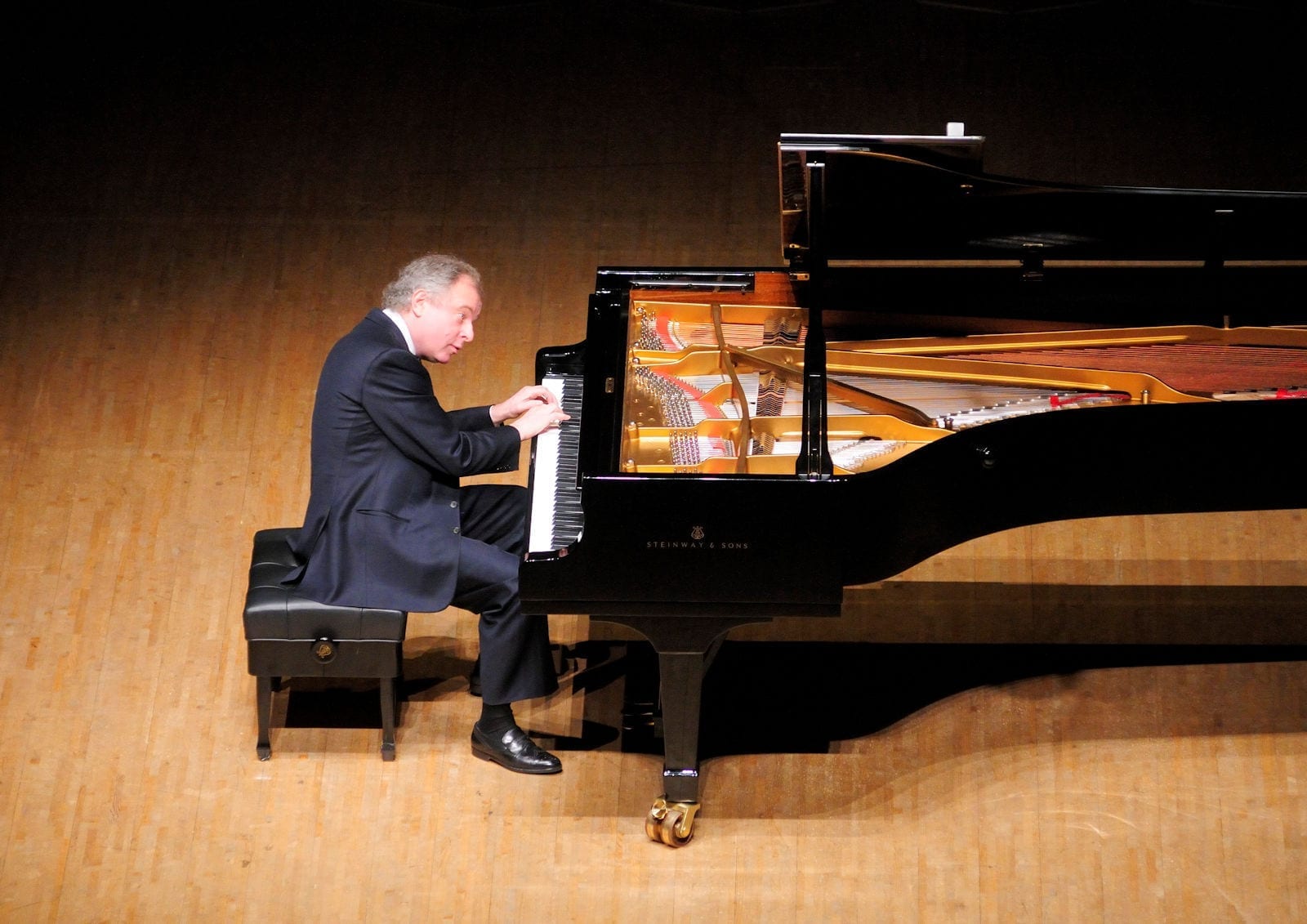
One of the world’s best pianists, Sir András Schiff, joins the Orchestra of the Age of Enlightenment to perform some of world’s best piano music.

Andras-DSC3357-c-Yutaka-Suzuki

Written 22 years apart, Brahms’ only piano concertos are snapshots of his life. The first is youthful, raw and expressive; the second is mature, structured and wiser. Both embody radical ideas of the 19th century, when revolution was in the air and artists joined political movements to overturn the old order.

The OAE performs these blockbuster piano concertos over two nights with Sir András Schiff, an extraordinary pianist and one of the world’s finest musicians. To complement the piano concertos, they also delve into music by Brahm’s mentor and inspiration, Robert Schumann exploring the complex interplay between political turmoil and personal anguish in composer’s life.

Pre-concert talks, Level 5 Function Room, Royal Festival Hall 6pm

New to Brahms? Enjoy an introduction to Brahms’ Piano Concertos at a free pre-concert talk by presenter Katy Hamilton.

On the second night, Dr Robert Samuels of the Open University will explore Brahms’ relationship with Schumann in a pre-concert talk

Brahms Piano Concertos with Sir András Schiff

Monday 18 and Tuesday 19 March 2019, Royal Festival Hall, 7pm

Further information and tickets


source: OAE press

(Photo: Yutaka Suzuki/Askonas Holt)

03HOUGH1_SPAN-jumbo-v2What can I write about Stephen Hough’s startling, stunning concert at the Festival Hall last night?



During the second half, between the miniatures by Debussy and Beethoven’s elemental Appassionata Sonata (Op 57), I leaned across to my concert companion and muttered that this concert seemed to be all about spontaneity and improvisation, the short works by Debussy which opened both halves of the concert, in themselves, and in Hough’s skillful hands, improvisatory in character, revealing the same qualities in the works by Schumann and Beethoven. One had the sense of meticulous preparation – and Stephen has talked before in interviews and articles about practising of the need to be “a perfectionist in the practise room” so that one can be “a bohemian” on stage – which enabled him to step back from the music and set it free.

It was an unusual programme. Other pianists may not have been able to pull it off so convincingly, and certainly opening with Debussy’s much-loved Claire de Lune from the Suite Bergamasque was potentially risky. The piece is so well-known, so prone to clichéd readings – yet Hough’s sensitive, unfussy shaping of this work saved it from saccharine sentimentality, and the delicacy of his sound and touch encouraged concentrated listening while also creating a wonderful sense of intimacy in the vastness of the RFH. It was as if we were in Debussy’s drawing room, gathered around his upright piano. And as Stephen said in the pre-concert talk, in the moments of the concert, we can “all be friends”, forgetting our differences of opinion or politics, joined in the shared pleasure of music.

In the programme notes, Stephen Hough explained that his choice of repertoire highlighted the very different approaches the three composers took to writing for the piano. While Debussy’s works (Clair de Lune, the two books of Images and the Prelude La terrasse des audiences du clair de lune) are “sensual paintings with mystical suggestions” [SH] (and even without the titles, their distinctive soundworld immediately conjures up potent, perfumed images in the listener’s mind), the two works by German composers are abstract and tightly structured with clear musical architecture.

And so while Debussy was light (feathery, but never fluffy) and delicately hued, the textures of Schumann’s Fantasie in C seemed all the richer in comparison, the composer’s passion for Clara all there in every note and phrase (Schumann often wears his heart on his sleeve), balanced by lyricism and tenderness, particularly in the glorious closing movement which seemed to evolve and expand there and then.

Similarly, the Beethoven felt wrought before our very eyes and ears, the opening measures creeping out of the mysterious darkness of the lower registers into something resembling light, if only briefly, the work fantasy-like in its range of ideas and striking contrasts. The outer movements were fraught with emotion, urgent and agitated, the middle movement providing a calm respite before the finale was unleashed upon us with, its feverish intensity all the more terrifying for the restrained tempo: this was music on the edge of chaos.

Stephen returned to Schumann for the first encore, one of the Symphonic Etudes which was rejected by the composer – a brief few moments of meltingly beautiful filigree traceries. And a Chopin nocturne to close this exceptional evening.