Guest post by Eva Doroszkowska

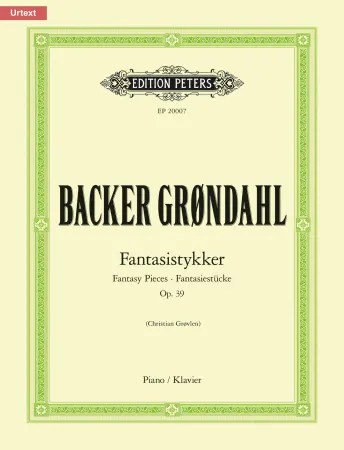
If patience is a virtue, then it could be coined a female trait. Hildegard von Bingen waited 900 years for a resurgence of interest in her music. Fortunately for Agathe Backer Grøndahl, it was only a century before she was honoured with a republica-tion and urtext edition of 2 of her piano cycles. The albums, Fantasistykker (Fantasy Pieces) Op. 39 and I Blaafjellet (In the Blue Mountains) Op. 44 have been re-issued, thanks to the work of pianist and editor Christian Grøvlen and Faber Music for Edition Peters.

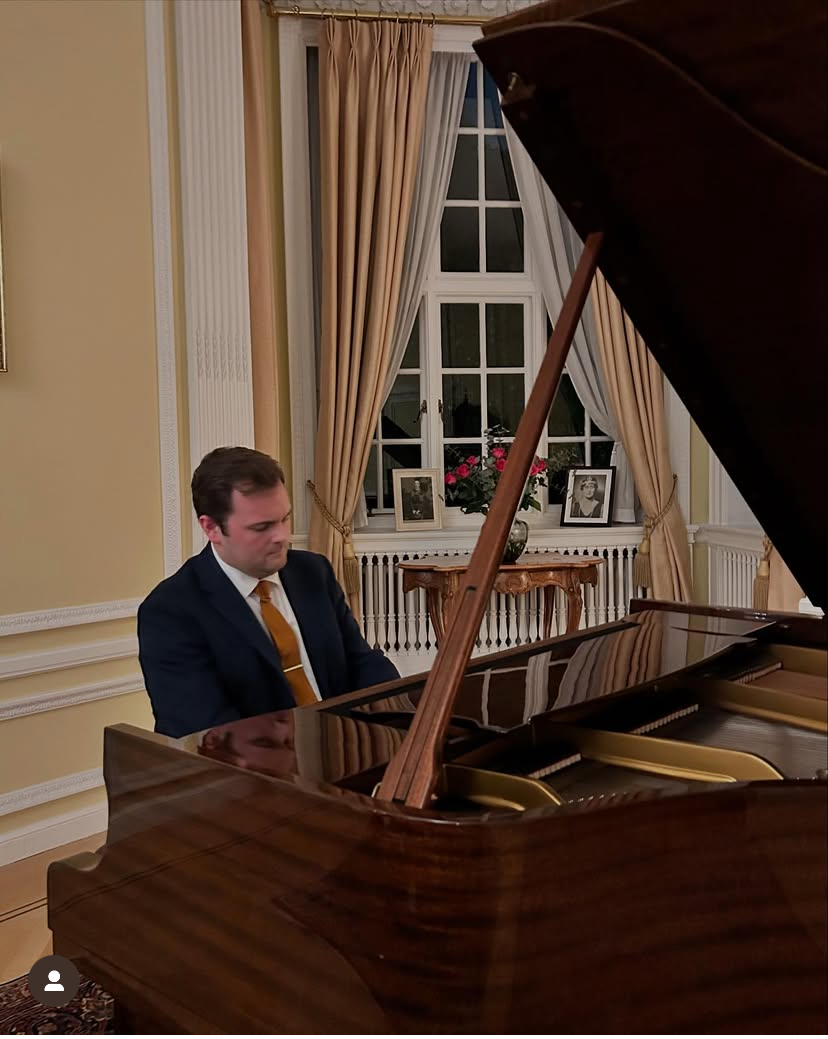
Grøvlen, Director of Music at the Composer’s Homes for Kode, has been promoting the works with a flurry of concerts showcasing these sparkling bright new albums whilst championing one of Norway’s greatest pianists and folklorist composers. So it was on a cold February night, that I was fortunate to attend an event at the beautiful home of the Norwegian Ambassador’s residence in Kensington, London. Outside the velvet winter sky contrasted with the pale luminosity glowing from drawing room windows, as musicians, publishers and journalists alike, were welcomed into the warmth.

The audience were transported to a world of Nordic magic in a setting that provided the perfect backdrop for the poetry of Norwegian landscapes encap-sulated by the visual reminder of paintings of fjords that hung on the walls. Grøvlen elicited both curiosity and laughter from the audience as he regaled with insightful anecdotes from the composer’s life and performed with a lyrical intensity.

Of special interest was his comparison of Grøndahl’s style to her colleague and passionate advocate and supporter, Edvard Grieg. Grøvlen deftly demonstrated similarities and differences between the two composers with musical cadences summarising their respective characters. Grøndahl’s music hinted at a subtler darker enigmatic underworld, more mysterious in harmonic complexity.

Grøvlen traced a link between Grøndhal, her envrironment and relations to her sis-ter Harriet Backer’s paintings which include many intimate scenes of music making often featuring Grøndahl at the piano. The exhibition last year at the Musee d’ Orsay of Harriet’s work was entitled “Music of Colour”. This evening could have been entitled an exhibition, “Sounds of Light and Shade” as tone painting and hints of impressionism within Grondahl’s music were displayed. Also explained was the influence of the poetry of Vilhelm Krag (1871-1933), noted for his symbolism, melancholy and connections to nature. This resonated with what I knew of Grøndahl’s own life. Krag explored the melancholic side of the human mind and within Grondahl’s music there is this Nordic melancholy – her music often filled with an inexplicable darkness, despite the light that shines from within. An artist who struggled with depression and ill health, music was her refuge. Music, she wrote, helped her forget slush and rain, encouraging her to daydream instead. “There are no feelings or passions which it cannot create, arouse to the highest degree of randomness, you can cry or rage, be gripped by the most excited enthusiasm and feel more wretched and humble than the felon in chains.”

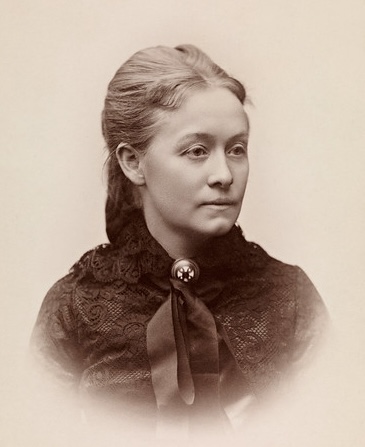
Yet whilst I was filled with pride to see the music about which I had written and talked celebrated in brand new print, the beautiful cream pages bound by a cover surrounded by the distinctive spring green border of Edition Peters, I left feeling frustrated. Yes, it is time her music is made approachable with worthy inclusions of smart title pages, credits and contents, academic preface and full scale portaits of Grøndahl in modest flowing dress, and cap. Yet despite all this, I couldn’t stem the mild irritation that here again sympathy was portrayed for a woman and what more she might have achieved were she a man?
Here a woman was glimpsed through the 21st-century lens of expectations of what was missing, rather than seeing what was remarkably there burning bright in her own time. Presented by Grøvlen was an artist described as restrained, yet look deeper and a new picture emerges. Here after all is a woman who, as I wanted to yell from my seat, wrote a dawn chorus for the suffragette movement, who did indeed write and perform with and for orchestras and promoted herself despite the required modesty of the time. Why was that not mentioned? Here is a human who showed inconceivable will power pushing through boundaries to a life that was hard won for a woman of her era. Agathe Backer Grøndahl may have been “aggravatingly modest” as her era demanded, but she was also a woman whose bravery and courage took her to Europe as a young lady with a black jack truncheon in her pocket to protect herself from any angry or rowdy soldiers as pianist and recording artist of Grøndahl’s works, Sara Aimee Smiseth has pointed out. Look hard enough and what emerges is not the picture of a retiring wallflower chained unwillingly to a kitchen sink, but that of an exceptional artist fighting to follow her own creative path whilst fulfilling a role as mother and wife.

If you adjust the lens in the other direction another perspective emerges. Our gen-eration may be frustrated by the ideals of 19th-century decorum, but it was precisely the women’s salons of history where arts, celebrated in domestic settings, played an essential role in the flourishing of cultural traditions through the centuries. It was often in salon settings that the latest ideas were carried on chatter through windows out to the larger world. By virtue of Grøndahl’s career as a mother, musician and teacher firmly rooted to Nordic soil, she also had first hand access to her beloved folk music. Grøndahl more than Grieg transcribed these melodies, preserving them for future generations of male and female artists.

It is her work at home as a much-loved teacher and pianist that helped keep her name alive whilst raising standards of music in Norway.

Grøndahl may not have had the compositional career benefits of male gender, but in her own words to Bernard Shaw it is this “experience as a wife and mother that makes her an artist.”

Perhaps Grøndahl with all of her 400 songs and piano pieces wisely understood that it is by composing “salon miniatures” – the music of everyday inner details – and by experiencing the intricacies of life that her art will travel more feasibly than an epic sonata of grandiose ideas played by the few. Just as valuable as the giant sweeping brush strokes are the small yet miraculous details to be shared amongst generations of musicians at home as well as in the concert hall.

Whilst we celebrate the wonderful work of Edition Peters for replacing overcrowded print of antiquated editions and marching them into the clarity of the elegantly printed realm, let us also celebrate the achievements of a remarkable woman. Let us hope her story will not slip through the cracks of history.

Grøndahl brought to life the inner landscape of the soul. Perhaps this scattering of musical seeds will in the long run bear more fruit? I hope at least these informative editions will do much to contribute to hearing Grøndhal’s music, in the words of Vilhelm Krag, “grow beyond the frost of iron”.

Eva Maria Doroszkowska is an international pianist and teacher
evamaria.co.uk

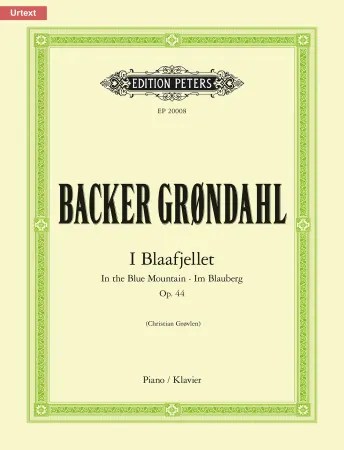
Last week I attended a reception and recital hosted by H.E. Tore Hattrem, Ambassador of Norway, and Mrs Marit Gjelten, together with Faber Music and Kode Art Museums & Composers Homes to celebrate the first ever Urtext edition of Fantasistykker (Fantasy Pieces) Op. 39 and I Blaafjellet (In the Blue Mountain) Op. 44 by Norwegian composer Agathe Backer Grøndahl. The exclusive event for leading music professionals took place at the Ambassador’s residence in London, an elegant mansion close to Kensington Palace.

Agathe Backer Grøndahl (1847-1901) was a Norwegian pianist, composer and music teacher. She studied with Franz Liszt and Hans von Bulow, amongst others, and was a contemporary and close friend of Edvard Grieg. She wrote over 400 works, mainly for piano and voice, and, like Grieg’s, her music blends Norwegian folk elements with Romantic influences. The English writer and music critic George Bernard Shaw described her as one of the foremost pianists in Europe, and at the time of her death in 1907, she was hailed as one of the great names of Norway’s musical heritage. Yet, over the following years her music was overshadowed by her famous compatriot and has remained relatively unknown, until now.

The music was performed by Christian Grøvlen, who gave some fascinating insights into Backer Grøndahl’s life and her compositional output. Although these works can be defined as “salon pieces” , they display an intriguing range of styles, textures and musical colours – at times impressionistic or nodding towards Bartokian folk idioms and dance rhythms; at other times, energetic, virtuosic and sweepingly Romantic, with a depth of emotion that goes beyond far beyond the salon miniature.  

The Fantasy pieces resemble Grieg’s Lyric Pieces yet they can also be seen as tone paintings with their programmatic titles (Summer Night, In the Boat, Bird’s Winter Song, for example). And while beauty and charm may lie on the surface of these pieces with their elegance and decorativeness, there is smouldering darkness beneath – and this is the core of Agathe Backer Grøndahl’s music.

This darkness is more evident in the suite I Blaafjellet (In the Blue Mountain), one of Grøndahl’s major works, dedicated to her sister, the painter Harriet Backer. It owes something to the programmatic music of Liszt in that the suite takes the listener on a journey, not unlike the first year of Liszt’s Annees de Pelerinage. The ‘fairytale’ suite evokes the different moods of the magical mountains of Norway, replete with trolls and wood nymphs, and from the outset, despite the relatively calm opening piece ‘Night”, there is an unsettling sense that something is afoot…. The suite builds in intensity, as the troll emerges from the mountain, heralded by portentous, almost aggressive chords, and unnerving jazz-like rhythms.

This was a splendid introduction to Backer Grøndahl’s piano music, characterfully performed by Christian Grøvlen, whose affection for and appreciation of it shone through every note.

The first-ever Urtext editions of two of Backer Grøndahl’s greatest piano works are published by the distinguished music publisher Edition Peters. Edited by Christian Grøvlen, they are based on the original manuscript and the first edition of 1898, which was out of print for many years. Now, in these new critical editions, the beauty and inventiveness of Backer Grøndahl’s writing for piano can be brought to a wider audience and enjoyed by pianists professional and amateur alike.

“I hope these new editions will make more people play, explore, understand and love Backer Grøndahl’s music” – Christian Grøvlen, pianist

 Find out more


Support The Cross-Eyed Pianist

This site is free to access and ad-free, and takes many hours to research, write, and maintain. If you find joy and value in what I do, why not

BUY ME A COFFEE

Sergei Rachmaninov (1873-1943) is surely one of the greatest – if not the greatest – composers for the piano in the history of the instrument.

It probably helped that Rachmaninov was an extraordinarily talented pianist himself and the instrument dominated his creative thinking from the outset. He began playing the piano at a young age and by his early teens he was already performing in public. He went on to study at the Moscow Conservatory, where he received a rigorous musical education that included extensive training in piano performance. This background gave him a deep understanding of the instrument, both technically and artistically, which is clearly reflected in his piano music.

As a master of the piano, who fully understood its capabilities, one of the hallmarks of Rachmaninov’s piano music is its virtuosity. His music is technically demanding and requires exceptional skill and dexterity to perform. But he was also careful to ensure that his virtuosity always served the music, rather than being an end in itself, and his works for piano – from the miniatures and salon pieces to the great piano concertos – are not just impressive displays of technical prowess, but also deeply expressive and emotionally evocative, full of brooding passion that remained a powerful force in his music throughout his compositional life. His music is often intimate and personal. He wrote many of his pieces as a way of processing his own emotions and life experiences. His pieces are full of passion, nostalgia, and a sense of yearning; they plumb the depths and scale the heights of emotion, and they speak of and to the human experience in a way that is both universal and also highly intimate.

Another important aspect of Rachmaninov’s music is his use of harmony. Reacting against the trend towards modernism and the avant-garde, which dominated classical music at the turn of the 20th century, Rachmaninov remained true to the late Romantic style of which he was a master. His music is replete with lush harmonies and emotional expressiveness, and he used a wide range of complex chords and sweeping arpeggios to create a sense of richness, vivid colours, depth and emotional power.

He also had a wonderful gift for melody, and his piano pieces are full of beautiful, memorable themes which are often developed over the course of the piece, becoming more complex and intricate as the music unfolds to create a sense of narrative and emotional progression.

For the advanced amateur, and even the professional, his music can be daunting. Many pianists believe they cannot play Rachmaninov’s music because of the physical demands it places on the player – a misconception to which I subscribed for a long time, until I decided to include two of the Op. 33 Etudes-Tableaux in one of my performance diploma programmes.

I believed my hands were too small for Rachmaninov, that I didn’t have a big enough hand stretch (a ninth, at a stretch; Rachmaninov could famously stretch an octave plus 4) or the necessary power and stamina to manage the big, hand-filling chords or the tempi. So what did I do? I selected a piece (op. 33, No. 7) which included both of these challenges – and I rose to them, with the help of my then teacher who showed me that one needs neither hands like shovels nor a specially-adapted piano keyboard to play this magnificent music.

Yes, technique is crucial in mastering Rachmaninov’s music, but perhaps the harder aspect is interpretation – and for that one can hear the master himself playing his own music. Recordings of Rachmaninov playing Rachmaninov offer some remarkable insights into his approach to tempo, phrasing, dynamics, interpretation, a gift for counterpoint, and so much more. There is much expressive freedom in his performances coupled with a profound emotionality (as opposed to sentimentality), rendered with great clarity and drama. He offers us the best interpretation possible of his own music. It is therefore surprising to learn that Rachmaninov declared, “I can’t play my own compositions.”

His most famous works for piano are surely the second and third piano concertos, the Rhapsody on a theme of Paganini, and the Preludes in C-sharp minor and G minor. But his oeuvre for piano is extensive and varied – the opp. 23 and 32 Preludes, two sets of Études-Tableaux (opp. 33 and 39), transcriptions, salon pieces like the Morceaux de fantaisie and Moments musicaux, the Symphonic Dances, works for four and six hands piano, variations (on themes by Chopin and Corelli), two piano sonatas, and many other miniatures and shorter works.

Which pianists should we turn to for inspiration in this remarkable repertoire? Of today’s pianists, Evgeny Kissin is, for me, one of the finest Rachmaninov players – an opinion which was fully reconfirmed when I heard Kissin in concert at the Barbican in March; the second half was all Rachmaninov (to mark the composer’s 150th anniversary). Kissin’s technical virtuosity and musical understanding allow him to reveal the full range of Rachmaninov’s music, from hauntingly beautiful, intimate melodies to thunderous climaxes.

This Etude-Tableaux, from the Op. 39 set, is one of my favourites:

When preparing for my diploma, John Lill’s recording of the Etudes-Tableaux was one to which I returned many times, but I also very much like Nikolai Lugansky in this repertoire. His performances of Rachmaninov’s music in general are marked by a rare combination of technical mastery, emotional breadth, and interpretive insight which showcase the full range of the composer’s vision. Steven Osborne is another pianist whose recording of the Etudes-Tableaux I much admire for its clarity, multi-hued dynamic palette and beautiful quality of sound, coupled with a thrilling “in the moment” spontaneity.

Pianists from an earlier era must surely include Vladimir Horowitz, who was greatly admired by the composer himself, and who helped bring the third piano concerto to prominence in the USA. His recordings of the Prelude in C-sharp minor and the Vocalise in particular are also widely admired for their emotional intensity and technical brilliance.

And no collection of favourite Rachmaninov recordings should be without Sviatoslav Richter. Renowned for his technical command and expressive power, and his ability to create a sense of “controlled risk”, Richter’s performances of Rachmaninov’s music are considered some of the finest ever recorded.

Other pianists to seek out in this repertoire include Emil Gilels, Cyril Smith, Vladimir Ashkenazy, Yefim Bronfman, Byron Janis, Martha Argerich, Arcadi Volodos, Daniil Trifonov, Yuja Wang, Peter Donohoe, Khatia Buniatishvili, Valentina Lisitsa….. Each of these pianists brings their own distinct interpretive style to Rachmaninov’s music, resulting in memorable performances that are technically fluent and emotionally rich.

En Pleine Lumière – Sandra Mogensen, piano

A multi-volume recording and concert project

Women such as Clara Schumann, Amy Beach and Cécile Chaminade are now recognised as a significant pianist-composers, who also enjoyed international performing careers, but in the course of her research, pianist Sandra Mogensen discovered many other women composer-pianists who were well-regarded, but whose names and music are hardly known today. These include Mélanie Bonis, Helen Hopekirk, Agathe Backer-Grøndahl, Luise Aldopha Le Beau, and Laura Netzel. The piano music of these composers was widely known and played during their lifetimes, but for much of the 20th century, their works were rarely played. Now, in the changing climate of classical music, with a greater emphasis on diversity, these once-forgotten composers are being given the recognition they deserve.

The music I have found is again incredibly beautiful….and all of it is new to me

Sandra Mogensen

Released in December 2019, the bicentenary year of Clara Schumann’s birth, the first volume of pianist Sandra Mogensen’s multi-CD and concert project, En Pleine Lumière (“in full light”), focuses on piano music by women composers born in the middle part of the nineteenth century (c.1840-1870). Each composer is represented by two short works and the entire project will have an international reach. Volume one includes composers from France (Chaminade and Bonis), the USA (Beach), Scotland (Hopekirk), Norway (Backer-Grøndahl and Lærum-Liebig), Sweden (Netzel and Aulin), and Germany (Le Beau and Menter). The subsequent two volumes will include music by women composers from Canada, Russia, Australia, Austria, Croatia, Germany, Latvia, Estonia and the Netherlands.

En Pleine Lumière will eventually comprise six albums, each focusing on a 30-year period – rather like a recital disc. En Pleine Lumière Volume 1 was recorded at Immanuelskirche in Wuppertal, Germany in June 2019, produced by an all-female team, and crowdfunded via Indiegogo. The subsequent volumes will be recorded with the same team and also supported by crowdfunding.

En Pleine Lumière is available on CD or digital download.


Canadian pianist Sandra Mogensen is equally at home in two worlds: performing as a solo pianist and co-performing with singers in recital. She has played in concert in both capacities in Canada, the United States, Denmark, Latvia, Iceland, Norway, Sweden, the Netherlands, and Austria. Sandra is also well-known as a vocal coach and piano pedagogue

Meet the Artist interview with Sandra Mogensen