Classical music is swathed in tradition and culturally conditioned thinking. The traditions of concert-going, for example, are well-known and show little sign of relaxing, despite the best efforts of more forward-thinking musicians, ensembles, concert managers and venues. Likewise, the score is regarded as the ‘sacred text’ of classical music wherein lies the composer’s ‘intentions’, and as such should be followed slavishly.

The musician’s training is still largely about preserving tradition and the reverential “canonization” of repertoire: for the pianist, the “greats” of our repertoire are of course Bach, Mozart, Beethoven and Chopin, and the teaching of this music is littered with “shoulds” and “musts” and curious, long-held notions of what is deemed “authentic” or “correct” in our interpretation and performance of this music. Classical musicians are taught that there is, in general, one ‘proper’ performance of the score which honours the composer’s ‘intentions’. Anyone who steps outside what is considered to be the “norm” may be castigated for going against tradition, a maverick lacking respect, or simply “wrong”. (Paradoxically, musicians are also encouraged to be creative and individual, to offer audiences something different or unique.)

But where do these notions of tradition come from?

In fact, many of the attitudes and practices of classical music as we know them today were established not that long ago, during the Romantic period, when musicologists, teachers and some musicians and composers decided it was time to formalise the artform to ensure it was treated with due respect, alongside some serious, quasi-religious composer-worship. It is no accident that the setting down of these “rules” about how music should be interpreted and performed coincided with the advent of recording which allowed audiences and musicians to hear the music in a definitive performance multiple times. Today, recordings have a highly significant role in the upholding of tradition in the interpretation and performance of classical music.

The weight of tradition can be stifling as musicians strive to conform to it. Enshrined in teaching and performance practice, and policed by teachers, critics, academics and even listeners, tradition can exert extraordinary pressure on musicians. It’s often safer to follow tradition, to do things as they have always been done, because stepping outside the norm, defying tradition, may not always be well received by audiences, critics or concert promoters, and may lead to loss of work.

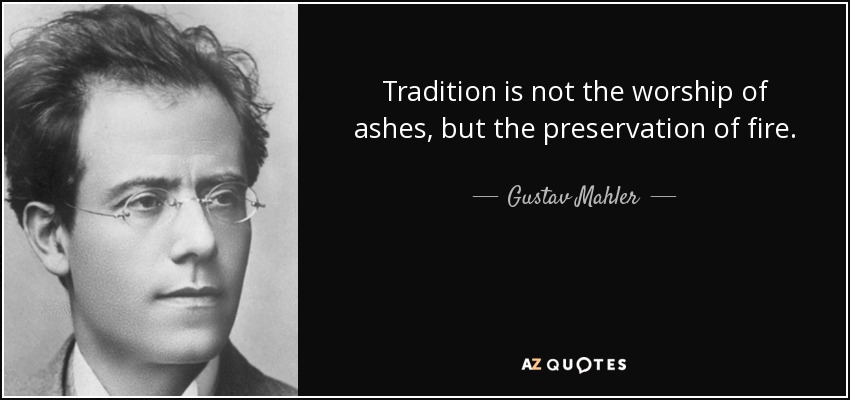
But there’s the counter argument to this, that tradition can inspire and motivate, that it is, to quote Gustav Mahler, “not the worship of ashes, but the preservation of fire”, and that by honouring or respecting traditions we keep the artform alive. Thus, the musician is like a conservator or gardener, nurturing the wisdom of the ages while also building upon it to create our own wisdom and knowledge for those who come next. Teachers in particular can have a significant role in this, passing down the wisdom from an earlier generation of pedagogues to the next generation.

Tradition can be a learning and research tool too, exactly because it is born out of an accumulation of wisdom. Musicians can refer back to earlier performance practice, for example, and use this to inform their own playing. In fact, in the traditions of performance practice, for example, each generation brings a slight shift in attitude and approach: exploring early recordings demonstrates this very clearly where familiar works are often played with a far greater flexibility of interpretation than we are used to now. The danger comes from regarding tradition as an absolute, without the imagination or creativity to explore alternatives.

Every performance today is a translation; a reconstruction of the original sound is the most misleading translation because it pretends to be the original, while the significance of the old sounds has irrevocably changed – Charles Rosen

The sounds and after sounds of great music never cease evolving – Michael Davidson (Mozart and the Pianist)


Shameless begging bit:

This site is free to access and ad-free, and takes many hours to research, write, and maintain. If you find joy and value in what I do, why not


Tradition is not the worship of ashes, but the preservation of fire
― Gustav Mahler

A sense of reverence seems to pervade every corner of Classical Music. The artform is presented as the very pinnacle of man’s artistic, intellectual and spiritual achievement, rather than one art amongst many, and certain composers, works and artists enjoy such an elevated position that mere mortals often fear to approach or reproach them.

Such an attitude can alienate potential concert goers, who fear that they may not “know enough” or are not sufficiently “educated”, to appreciate or enjoy classical music. At concerts, I regularly meet people, clearly intelligent and culturally aware, who enthuse about the music they have just heard and then apologise for “not really knowing enough about it” (the fact that these people can explain the things they liked about the music – details of melody and structure, its emotional impact and the way it transported them to another place – demonstrate to me that they fully appreciate the art form!). And at least those people actually went to the concert; sadly, many are too intimidated by the reverence surrounding classical music to even step inside a concert hall for fear of doing something wrong or appearing ignorant.

After a concert, I want to grab people by the lapels and tell them how lucky we are as a species that, out of all the hundreds of billions of us who ever lived, one of us managed to come up with the Goldberg Variations. But I don’t, because that’s not the done thing. So instead I mention that the café downstairs does some fabulous chocolate éclairs.

Armando Iannucci:Classical music, the love of my life

In concerts, reverence can limit programming: with a preponderance towards the “great works”, lesser-known composers and music, young composers or new music may be overlooked or excluded, thus denying audiences the opportunity to experience the wilder shores of the repertoire.

Classical music has a gatekeeping problem, and much of that can be traced through the word “great.”…..if the major selling point of classical music is how objectively Great it is or how Great the composers are, Greatness becomes insidious: effectively meaningless, but unchangeable, almost impossible to fight. Being sold Greatness is now what audiences expect. 

– Zoë Madonna, NPR

The ingrained rituals of the classical concert, which are themselves an aspect of reverence and are used by some to maintain the aura of specialness, exclusivity and gravitas, often preclude people from sampling classical music because they are nervous about how to behave, what to wear, and when to applaud. I remember once attending a Catholic wedding and it was so far removed from the Anglican ceremony that I spent most of the proceedings wondering what on earth was going on, while others around me seemed totally at home with it all: I imagine newcomers to classical music often feel like this (in fact I know they do because I shared a box with some classical music ingenues at the Proms in 2015 and they expressed all the anxieties noted above).

Reverence also breeds prejudice, almost as pervasive and polarised as the general problem in society today: mention Wagner, and you are adored by one group; mention Schoenberg, and you’re disdained by another; mention minimalism, and another group rolls their eyes. Certain composers are untouchable, beyond criticism, fetishized even – Bach, Mozart, Beethoven, Wagner and Mahler being examples which immediately spring to my mind. With such firmly-held beliefs about the greatness of certain composers, it becomes impossible to have reasoned conversations with other music-lovers. A friend of mine (also a pianist) really doesn’t like the music of Bach, nor Mozart. Mention this in one of the online piano forums to which we both belong, and he is greeted with shouts of horror and even abuse, suggesting that there is something “wrong” with him. It seems that one is just not permitted to dislike certain composers. Of these, Bach in particular enjoys especial veneration: cycles of Bach’s works are not “performances”, they are “journeys”, “voyages” or “pilgrimages”, suggesting that hearing and playing his music is a quasi-religious experience.

The elevation of certain performers to almost God-like status is another aspect reverence. I’ve felt it at concerts by Barenboim and Schiff, the veneration often created not by the performers (who strike me as fairly modest men) but by the audience and the pre-concert hype. Sadly, the idolised, almost cultish admiration of certain conductors, in particular, can lead to inappropriate behaviour and dangerous abuses of power, such as were revealed in the closing months of 2017.

***

The classical musician’s training is largely still about preserving tradition and the reverential “canonization” of repertoire: we’re taught from a young age that Bach, Mozart, Beethoven, Brahms, Tchaikovsky, Wagner, Mahler…. are the “great” composers. Revering the music in this way can create problems when learning and playing it: for pianists, as for other musicians, certain works – the Goldberg Variations, Beethoven’s last piano sonatas, Chopin’s Etudes, the great piano concertos, for example – have an elevated status on a par with the works of Aristotle, Shakespeare or Dickens. We hold the music in such awe, carrying with us the weight of its history, its heritage, the long line of great musicians who have played it, and feel such a tremendous responsibility to these “great works” that our creativity, artistry and personal interpretation may be stifled. The music is imbued with notions of ‘greatness’ even though the player might not actually be feeling it intuitively nor actually believe in it.

This also encourages in some musicians an obsessive attitude to the music which leads them to sacrifice normal life in order to practice for eight or ten hours a day. Such behaviour is mentally and physically unhealthy, causing anxiety and tension, and, as a result, is often counter-productive.

I’ve experienced it myself, with works by Beethoven and Chopin, and I’ve observed people on piano courses whose reverence towards the music gets in the way of their enjoyment of it.

Respect the music, for sure, but don’t revere it: that prevents us from getting right to the heart of the music and experiencing – and, importantly, enjoying it – in all its myriad variety.

The trouble with music appreciation in general is that people are taught to have too much respect for music. They should be taught to love it instead”

 – Stravinsky
