Sergei Rachmaninov (1873-1943) is surely one of the greatest – if not the greatest – composers for the piano in the history of the instrument.

It probably helped that Rachmaninov was an extraordinarily talented pianist himself and the instrument dominated his creative thinking from the outset. He began playing the piano at a young age and by his early teens he was already performing in public. He went on to study at the Moscow Conservatory, where he received a rigorous musical education that included extensive training in piano performance. This background gave him a deep understanding of the instrument, both technically and artistically, which is clearly reflected in his piano music.

As a master of the piano, who fully understood its capabilities, one of the hallmarks of Rachmaninov’s piano music is its virtuosity. His music is technically demanding and requires exceptional skill and dexterity to perform. But he was also careful to ensure that his virtuosity always served the music, rather than being an end in itself, and his works for piano – from the miniatures and salon pieces to the great piano concertos – are not just impressive displays of technical prowess, but also deeply expressive and emotionally evocative, full of brooding passion that remained a powerful force in his music throughout his compositional life. His music is often intimate and personal. He wrote many of his pieces as a way of processing his own emotions and life experiences. His pieces are full of passion, nostalgia, and a sense of yearning; they plumb the depths and scale the heights of emotion, and they speak of and to the human experience in a way that is both universal and also highly intimate.

Another important aspect of Rachmaninov’s music is his use of harmony. Reacting against the trend towards modernism and the avant-garde, which dominated classical music at the turn of the 20th century, Rachmaninov remained true to the late Romantic style of which he was a master. His music is replete with lush harmonies and emotional expressiveness, and he used a wide range of complex chords and sweeping arpeggios to create a sense of richness, vivid colours, depth and emotional power.

He also had a wonderful gift for melody, and his piano pieces are full of beautiful, memorable themes which are often developed over the course of the piece, becoming more complex and intricate as the music unfolds to create a sense of narrative and emotional progression.

For the advanced amateur, and even the professional, his music can be daunting. Many pianists believe they cannot play Rachmaninov’s music because of the physical demands it places on the player – a misconception to which I subscribed for a long time, until I decided to include two of the Op. 33 Etudes-Tableaux in one of my performance diploma programmes.

I believed my hands were too small for Rachmaninov, that I didn’t have a big enough hand stretch (a ninth, at a stretch; Rachmaninov could famously stretch an octave plus 4) or the necessary power and stamina to manage the big, hand-filling chords or the tempi. So what did I do? I selected a piece (op. 33, No. 7) which included both of these challenges – and I rose to them, with the help of my then teacher who showed me that one needs neither hands like shovels nor a specially-adapted piano keyboard to play this magnificent music.

Yes, technique is crucial in mastering Rachmaninov’s music, but perhaps the harder aspect is interpretation – and for that one can hear the master himself playing his own music. Recordings of Rachmaninov playing Rachmaninov offer some remarkable insights into his approach to tempo, phrasing, dynamics, interpretation, a gift for counterpoint, and so much more. There is much expressive freedom in his performances coupled with a profound emotionality (as opposed to sentimentality), rendered with great clarity and drama. He offers us the best interpretation possible of his own music. It is therefore surprising to learn that Rachmaninov declared, “I can’t play my own compositions.”

His most famous works for piano are surely the second and third piano concertos, the Rhapsody on a theme of Paganini, and the Preludes in C-sharp minor and G minor. But his oeuvre for piano is extensive and varied – the opp. 23 and 32 Preludes, two sets of Études-Tableaux (opp. 33 and 39), transcriptions, salon pieces like the Morceaux de fantaisie and Moments musicaux, the Symphonic Dances, works for four and six hands piano, variations (on themes by Chopin and Corelli), two piano sonatas, and many other miniatures and shorter works.

Which pianists should we turn to for inspiration in this remarkable repertoire? Of today’s pianists, Evgeny Kissin is, for me, one of the finest Rachmaninov players – an opinion which was fully reconfirmed when I heard Kissin in concert at the Barbican in March; the second half was all Rachmaninov (to mark the composer’s 150th anniversary). Kissin’s technical virtuosity and musical understanding allow him to reveal the full range of Rachmaninov’s music, from hauntingly beautiful, intimate melodies to thunderous climaxes.

This Etude-Tableaux, from the Op. 39 set, is one of my favourites:

When preparing for my diploma, John Lill’s recording of the Etudes-Tableaux was one to which I returned many times, but I also very much like Nikolai Lugansky in this repertoire. His performances of Rachmaninov’s music in general are marked by a rare combination of technical mastery, emotional breadth, and interpretive insight which showcase the full range of the composer’s vision. Steven Osborne is another pianist whose recording of the Etudes-Tableaux I much admire for its clarity, multi-hued dynamic palette and beautiful quality of sound, coupled with a thrilling “in the moment” spontaneity.

Pianists from an earlier era must surely include Vladimir Horowitz, who was greatly admired by the composer himself, and who helped bring the third piano concerto to prominence in the USA. His recordings of the Prelude in C-sharp minor and the Vocalise in particular are also widely admired for their emotional intensity and technical brilliance.

And no collection of favourite Rachmaninov recordings should be without Sviatoslav Richter. Renowned for his technical command and expressive power, and his ability to create a sense of “controlled risk”, Richter’s performances of Rachmaninov’s music are considered some of the finest ever recorded.

Other pianists to seek out in this repertoire include Emil Gilels, Cyril Smith, Vladimir Ashkenazy, Yefim Bronfman, Byron Janis, Martha Argerich, Arcadi Volodos, Daniil Trifonov, Yuja Wang, Peter Donohoe, Khatia Buniatishvili, Valentina Lisitsa….. Each of these pianists brings their own distinct interpretive style to Rachmaninov’s music, resulting in memorable performances that are technically fluent and emotionally rich.
If there’s any excuse at all for making a record, it’s to do it differently, to approach the work from a totally recreative point of view… to perform this particular work as it has never been heard before. And if one can’t do that, I would say, abandon it, forget about it, move on to something else.
– Glenn Gould

R is for “robbed”. R is also for “rhubarb”. And, aged four, sat on a plump cushion, on top of my teacher’s piano stool, having just played the Minuet in G from the Associated Board’s edition of Eighteen Selected Pieces from ‘A Little Notebook for Anna Magdalena Bach with about as much feeling as the Honda production line in Swindon,  I first came across what I initially thought was a portmanteau of the two. (By the way, I wouldn’t have known, then, what a “portmanteau” was, either. And I still have the very same music perched on my piano, today: such is the rustiness of the current state of what I laughingly refer to as my “technique”.)

“Technically, that’s excellent,” said Mr Bury (or words to that effect); “but it could do with some rubato…” – and then, of course, he went on to explain and demonstrate, beautifully, what that was.  And, although I have hunted it ever since, Snark-like:  at such a tender age, my emotional range was narrowly-focused. All I could see were Boojums.

My personal definition of the word Rubato is aural; rather than written or visual. Listen to the two (fantabulous) recordings of Bach’s Goldberg Variations which (the fantabulous) Glenn Gould made at each end of his career. The first, from 1955, <https://itun.eslasts 38:34, and is a demonstration of pure technical genius. The second, from 1981 – at 51:18 – lasts exactly one-third longer – and transforms each variation from what could easily be a mechanical Baroque exercise (see above) to something of a romantic, yet contrapuntal, serenade: particularly the opening (and closing) Aria. The difference, I believe, is not in the time taken – although there is a definite contributory effect from the time taken between making the two recordings. Subtract the first from the second – although I have to admit, given my word limit (and being, ahem, robbed of time), this is a little simplistic (and may be over-egging the pudding a little): there are a few more repeats, as well… – and what you are left with (IMHO) is the very essence of rubato.

The tempi are not so much “robbed”; as generously donated. Or, as Michael Kennedy so wisely states in the 1980 edition of The Concise Oxford Dictionary of Music (which also sits atop my piano), rubato is…

A feature of performance in which strict time is for a while disregarded – what is ‘robbed’ from some notes being ‘paid back’ later. When this is done with genuine artistry and instinctive musical sensibility, the effect is to impart an admirable sense of freedom and spontaneity. Done badly, rubato merely becomes mechanical.

…and I’m sure you can easily evoke your own guilty parties with regards to that last comment. In fact, I wouldn’t be too surprised if you disagreed with my exemplar, above. (I’m sure Chopin would.) But, surely that’s what rubato is really all about – the individual, “instinctive” subjectivity (hopefully dredged up from your very soul, and bypassing most of your mind) that you can bring to any piece of music: whether it be from your emotions; or even from a desire to stress a melody hidden deep within a morass of complex notes (see, for instance, Prokofiev’s Second Piano Concerto).

In other words, rubato – whether applied to one note, or a thousand – is simply a symptom, an expression, of one’s own interpretation.

Stephen Ward AKA The Bard of Tysoe


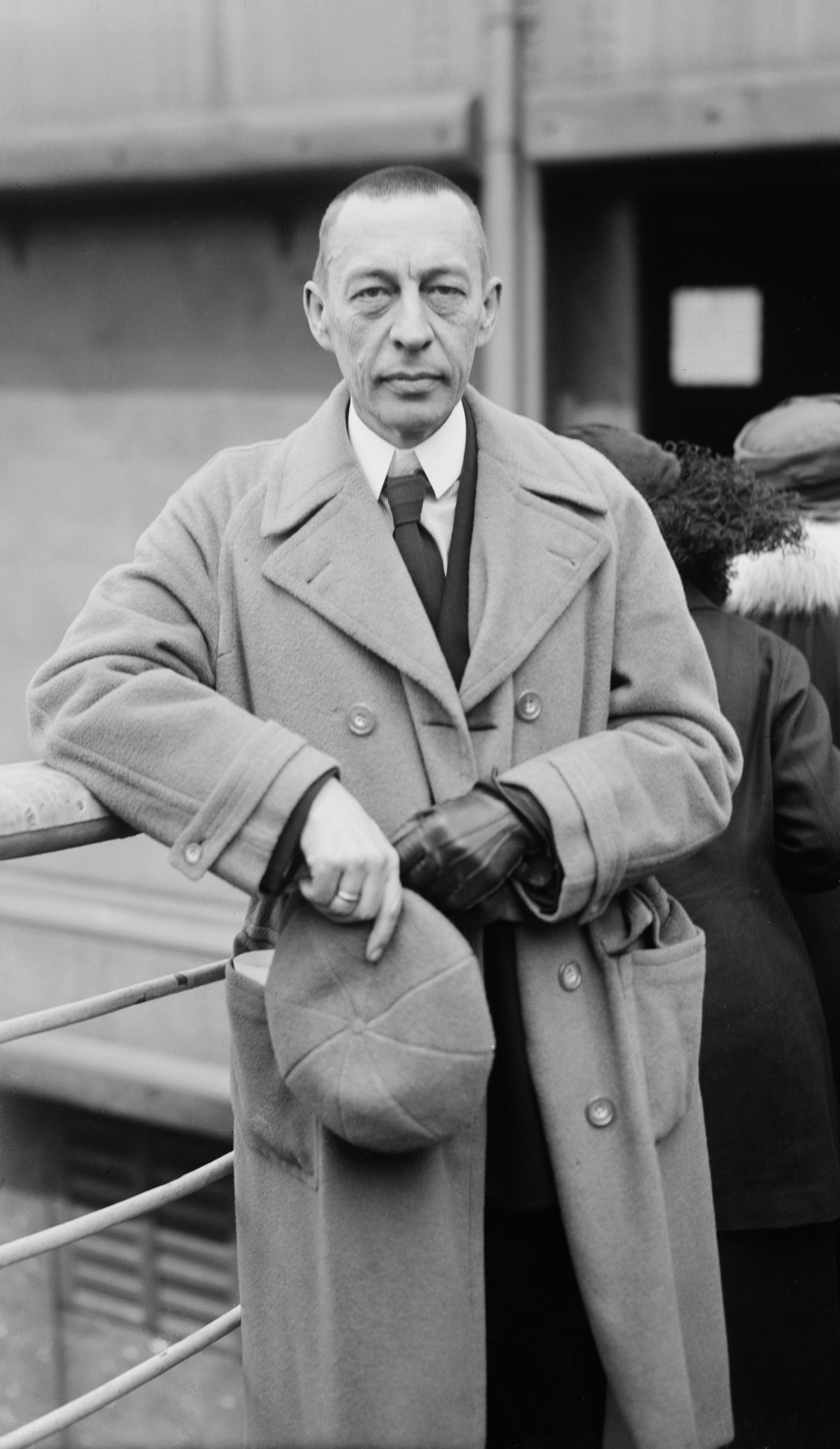
sergei_rachmaninoff_loc_33969uUp, up in the highest echelons of the pianistic pantheon sits Sergei Rachmaninov….
Regarded as one of the greatest pianists of the twentieth century, Rachmaninov had legendary technical facilities and rhythmic drive, and his large hands were able to cover the interval of a thirteenth on the keyboard. Today, his piano music remains amongst the most well-loved and widely-performed in the standard repertoire, yet in the 1950s the Grove Dictionary of Music and Musicians dismissed it as “monotonous in texture….. consist[ing] of mainly of artificial and gushing tunes….”. He was composing at a time when music was undergoing huge sea-changes (atonality and the development of the 12-note tone row, for example), yet he remained true to his own compositional vision and his music is unashamedly Romantic, full of sweeping melodies and rich textures. Even in his miniatures (for example, the Preludes, Moments Musicaux, Études-Tableaux) his music seems to express the vastness of the Russian landscape. It has a visceral and deeply honest quality.

“A composer’s music should express the country of his birth, his love affairs, his religion, the books which have influenced him, the pictures he loves…My music is the product of my temperament, and so it is Russian music”

Sergei Rachmaninov

Here is Sviatoslav Richter in the Prelude in G-sharp minor, Op 32, no. 12

Many of his piano works enjoy legendary status, and are performed around the world by the famous and the lesser known, such is their beauty, appeal and scale of challenges. Take the Third Piano Concerto, by his own admission his “favourite” of all his piano concerti – “I much prefer the Third, because my Second is so uncomfortable to play”. Due to time constraints, Rachmaninoff could not practise the piece while in Russia, and instead he practised and memorised it using a silent cardboard keyboard that he brought with him while sailing to the United States. It was premiered in New York on 28th November 1909 by Rachmaninov himself, and was dedicated to the pianist Josef Hofman, whom Rachmaninoff regarded as the greatest pianist of his generation, though Hofman never actually performed the Third Concerto.

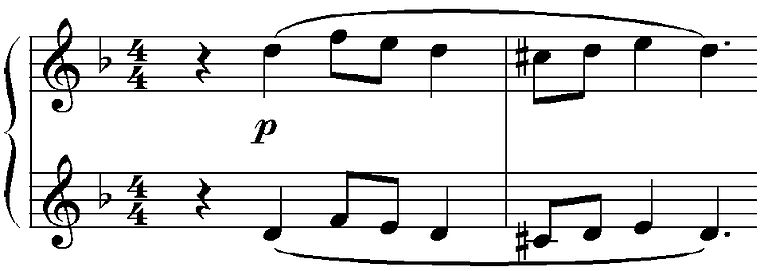
760px-rach3_beginning
The opening theme of the Third Piano Concerto

Monumental, treacherous, gorgeous, its fearsome technical difficulties reflect the composer’s own transcendent prowess at the keyboard. For the pianist it is forty-five minutes of almost continuous playing, the equivalent in energy expended to shovelling three tons of coal just to move the keys – and this excludes the emotional and intellectual energy used. For the audience, when played well it, it encompasses the full range of human emotions in its towering virtuosity.


Guest post by Georgina Imberger

My German teacher at school came from Prague. Frau, we called her. I shrink a little now, on first instinct, when I think that we did that. On second instinct, I think that she probably liked it.  It was a simplistic, naïve affectation and we were predictably naughty little people whose views were yet to expand. I like to think that she had a rueful smile for our cheek. Frau was different from anyone else I had met, and I thought that she and her world were fascinating. I can’t remember any of the words she used to talk about Prague, but I do remember, and still have, the picture of Frau’s Europe that ended up in my teenage head.

In a scene that well dates me to a pre-millennial high school education, we spent much of German class listening to audiotapes. The content on those things was appalling, boring and irrelevant to us, and we had no grace in tolerating it. But the tapes had a piano soundtrack, and while we were raucous, Frau would lose herself a little and sail away in the musical bridges. In those moments, I fancied I saw something that was more real than our suburban lives and more interesting than I yet understood. These memories are where I place the birth of my own love of a sideways turn and where I learnt that a true human story often plays slightly below the script.

Many years later, I finally went to Prague. I was well into my thirties by then, my life was still messy at every turn and my questions spilling out in disruptive mayhem. I went to Frau’s city hoping to meet the Europe that she had packaged for me. I walked the rambling outer suburbs for days, loving every minute. I scoffed at the tourism-gone-mad. I found gigs in dodgy venues, jumping train tracks and drinking booze too cheap to be decent. And on the word of a Czech friend made on one such night, I found myself with a ticket to a local piano recital.

As with most experiences in that chapter of my life, I was slightly hungover and a little wrought when I went. As the audience started coming in, however, my mind sharpened. We were in a community building, in a northern suburb of Prague, beautiful in its scale and simple in its set-up.  There was a chunky great grand in the front and mis-matched chairs. Here it was, Frau’s Prague. And it was filling with warm, searching faces. In an instant, it all felt like an over-due pause in my busy, busy conversation and I sensed a million noisy questions being quietly answered. The young man who came out to play that piano had a smile that knew thirteen-year-old-me. His hair was out of control and his hands were everywhere, even before they hit the keys. It was Rachmaninoff that he started with, the Prelude in C sharp minor, Op. 3, No. 2. And it was unspeakably beautiful.  I had never before, and never since, been in the presence of hands and space that could shift the landscape like they did that night.

So here is my Rachmaninoff Dreaming. A tribute to the stories told with 88 keys that drift us away and tell truths like no words can. And a toast to Frau, who had the wisdom to let us see her dream.


Georgina Imberger runs Piano Project, a Melbourne-based venture that sponsors piano lessons for children who are new immigrants to Australia. There is a fundraising concert at the Meat Market in North Melbourne on May 29 at 5.30pm, presenting the New Palm Court Orchestra, lead by pianist/composer Gemma Turvey and featuring flugelhornist Gianni Marinucci. Tickets are $20 and proceeds go to lessons for the kids. Details and tickets are on the website – www.pianoproject.org.au

meat-market-piano-106kb


