
ROCHESTER CHORAL SOCIETY 150th ANNIVERSARY COMMISSION

Founded in 1873, Rochester Choral Society is celebrating its 150th anniversary in March 2023 with a newly-commissioned choral work, Regards from Rochester, by award-winning British composer, and Rochester resident, Thomas Hewitt-Jones. The work received its world premiere on 18 March 2023 in Rochester Cathedral, and the choir will be taking it on tour to Wells and Glastonbury on 21 and 22 April respectively (details here).

Rochester itself is drenched in history. Regards from Rochester celebrates the rich history of the Medway Towns, exploring themes and valuable human stories while relating them to contemporary society. From the first Saxon settlement through to historic stronghold, from pillar of British naval history through to industrial centre and inspiration for Charles Dickens, composer Thomas Hewitt Jones hopes that this “postcard from Rochester” will celebrate and exude compassion for our planet, social conscience, humanity and kindness – values that are incredibly important to our world in 2023.

Director of Music, John Mountford, says: “Rochester Choral Society has passed some significant milestones recently, with 2022 marking the 100th anniversary of our first performance in Rochester Cathedral. We wanted to commission a piece which reflected the diversity of this area’s rich and turbulent history, with a historically accurate, humorous and engaging new piece. We wanted to find somebody with a connection and passion for the Medway Towns and who wanted to help raise awareness of the cultural and social heritage of the area.”

Composer Thomas Hewitt Jones says: “I was delighted when John Mountford approached me to commission this work for Rochester Choral Society’s very exciting 150th anniversary. Quite early on in our discussions, we decided that the richness of Medway’s history was conducive to a new text, so the result is a 10-movement oratorio which we hope tells the story of the area with sweeping melody and angularity where appropriate. I have written it to be as both engaging and as musically interesting as possible. The final movement of the work brings us to the present day, with the audience joining together to sing with one voice.” 

 John Mountford believes that choral societies are an essential part of national music-making after the COVID era. “Music is central to the lives of so many people; it binds community and enhances wellbeing for singers and audiences alike.

For Thomas Hewitt Jones, writing Regards from Rochester has been an extremely fulfilling and wholesome commission, not only given the richness of local history, but also due to the strength of the musical heritage of Rochester Choral Society dating all the way back to 1873.

“It was a privilege and a pleasure to discover many historic riches of the Medway area, which is often referred to in relation to Charles Dickens, the former Dockyard and as a stronghold to and from London, but in fact contains numerous other riches. Spending extensive time in Rochester library and reading around the history in detail, it became swiftly apparent that the area’s rich social history made up for any perception Medway may have externally of lack of charm; as the text and music were forming, I was delighted to have conversations with local Medway Council operative John Lester, who is a X generation of the Lester family in Rochester and who offered personal anecdotes of life in Medway since the Victorian era, some of which I have incorporated into the work.

Above and beyond the history books and local connections, in this work I have aimed to reflect throughout the work on the nature of life in 2022, both beyond the recent pandemic (which let’s face it indelibly changed life as we know it) and also in the shadow of contemporary issues that affect our society, not least our collective sense of identity and perhaps most importantly, the current climate change crisis.”

REGARDS FROM ROCHESTER – movements

Introduction & Rochester

The River Medway

Early History

The Cathedral

Seven Weeks (The Siege of Rochester)

Down to the Docks (Chatham Dockyard)

That House, 1857 (Charles Dickens)  Baritone soloist playing Dickens

The Victorian High Street

Our Changing World (Contemporary themes incl. Social Conscience and Climate)

The Medway Hymn – rousing end with audience singing in unison

Tickets / info


Rochester Choral Society, one of Britain’s oldest-established choral societies, has always striven to achieve high standards of singing, from the great choral works to traditional folk songs. Since 1922, the choir, which comprises around 75 singers, aged 18-80+, has performed regularly in Rochester Cathedral.

Rochester Choral Society appeared on BBC One’s Antiques Road Trip in January 2023 in an episode featuring Samuel Coleridge-Taylor, who conducted the choir between 1902 and 1907. After the world-premiere of Thomas Hewitt Jones’ Regards from Rochester, the choral society looks forward to a summer performance of Mendelssohn’s St Paul, which was also performed at their very first concert in 1873.

rochesterchoral.co.uk

Thomas Hewitt Jones is an award-winning composer of contemporary classical and commercial music. Since winning the BBC Young Composer Competition in his teens, his music has been published by many of the major music publishers and is frequently heard in concert and on radio, TV and in the cinema. Thomas’s diverse catalogue includes small instrumental, orchestral, choral and ballet works, and his large number of choral titles includes seasonal carols. ‘What Child is This?’ (OUP) has become a choral classic of recent years, garnering large numbers of performances each season. In 2021, he released ‘Can you hear me?’, an acclaimed response to the COVID19 pandemic. His most recent projects include ‘In Our Service’, a special commission from the Royal School of Church Music to celebrate the late Queen’s Platinum Jubilee in 2022, and a ‘Divertimento for Strings’ commissioned by Lucy Melvin to celebrate the 10-year anniversary of her ‘Chamber Players’ courses.

He is also a composer of Library (Production) music for several commercial publishers, with a current catalogue of around a thousand tracks available for licensing which can be heard on a variety of media worldwide. He works from his own cutting-edge studio facility. He was selected to be a member of the BAFTA Crew x BFI Network for 2021-2.

thomashewittjones.com

(Illustration by Rosie Brooks)


For further press information / interviews, please contact Frances Wilson frances_wilson66@live.com
 

Who or what inspired you to pursue a career in music?

I started my musical life as a chorister at Ripon Cathedral in Yorkshire. Exposure to the greats of choral music was the basis for becoming a composer and conductor, and was a great introduction to the technical as well as the aesthetic aspects of music.

Who or what were the most significant influences on your musical life and career as a composer?

In my teens I corresponded quite a bit with Benjamin Britten in the later years of his life, and he gave me a lot of ideas and encouragement to become a composer. Studying music at Christ Church, Oxford as an undergraduate was also an important step on the road.

What have been the greatest challenges/frustrations of your career so far?

The greatest challenges revolve around presenting pieces to audiences which require active listening on their part. People are everywhere bombarded with noise, and commercial music of all kinds, which requires no active participation from the listener. This puts them off the idea of listening to something and being challenged to think about what the music is trying to say to them.

Of which works are you most proud?

The Sonata for Organ, which was premiered and recorded by Clive Driskill-Smith; Suite – King Richard III for Solo Violin, premiered and recorded by Rupert Marshall-Luck; the works I have written for Christ Church, Oxford (especially King Henry VIII’s Apologia); the setting of the Jubilate Deo (in Zulu) which I wrote for the 750th Anniversary of the foundation of Merton College, Oxford; and a number of choral pieces for choirs in Germany, especially the Frankfurt Canticles and Responses, and the Berlin Canticles and Responses. I have also had a number of commissions from the London Festival of Contemporary Church Music. My Sonata for Piano is just about to be premiered in London, and this is a major piece.

What are the special challenges/pleasures of working on a commissioned piece?

Making sure that we are all agreed at the outset as to what exactly is being requested, and the reason why the person is commissioning the piece. However, it is a very rewarding experience to deliver a new work to someone who has commissioned it. People are very generous in their appreciation of new works like that. It is very exciting to be writing for a distinguished performer or ensemble, in particular to write a work which fits their style of performance, their character, and their ethos. The challenge is to write something which is appropriate to the performer, and is a work that they will want to play frequently and be identified with. Of course, they can be very demanding (!), but that is also good, because it means they have thought a lot about what they are looking for and why.

What are the special challenges/pleasures of working with particular musicians, singers, ensembles and orchestras?

Mainly this is a great pleasure, because the reason they will want to play your music is because they choose to. This enables one to develop a longer-term relationship with performers who are looking to include this type of music in their repertoire. Then a very fruitful discussion about new pieces can ensue, and trying new things which enhance the appeal of the performer to the audience.

How would you characterise your compositional/musical language?

It varies from very simple tonal pieces (especially some of the pieces for church choirs), through to more complex works, like the larger Sonatas. Maybe it could be see as being a continuation of the English musical tradition, from VW, Howells, Finzi, Britten, Tippett, Leighton, Lutyens.

How do you work?

I do like things to be organised, because I really do not like missing deadlines! A lot of planning goes into each piece. They will have been forming in my mind for many months (sometimes even years) before the pencil even hits the paper. I tend to write things out long-hand, and then put them onto Sibelius. Then it’s off to the publishers.

As a musician, what is your definition of success?

That people are interested enough to listen to the music, and that if they studied it in detail, they would appreciate the logic, structure, and meaning of the pieces I have written. Where listeners have done this, they tell me the music appeals to the ear, the heart, and the brain. It’s lovely when you get feedback like that.

What do you consider to be the most important ideas and concepts to impart to aspiring musicians?

To work hard, listen to the great music, and enjoy what you are doing. You have an individual voice as a composer or performer, and you need to find ways to express yourself. Others will guide you, but your voice is your own.

Richard Pantcheff’s Piano Sonata is premiered by Duncan Honeybourne on 6 November 2019 at the 1901 Arts Club, London. Introduction by Richard Pantcheff. More information


Richard Pantcheff is internationally renowned as a composer in many genres, and has established a prominent reputation as a composer of Choral, Organ, Chamber and instrumental music of the highest quality. His musical career commenced as Head Chorister at Ripon Cathedral, in England. During his five years as a Music Scholar at senior school, he corresponded regularly with Benjamin Britten, who acted as occasional mentor to him in composition. Thereafter, he graduated with Honours in Music at Christ Church, Oxford University, under Simon Preston and Francis Grier.

Read more

You can see most of Richard’s music on his publisher’s website : www.musicaneo.com

An initial approach via this blog in March 2017  led me this week to St George’s Bristol for a lunchtime concert by the sparkling Piano 4 Hands duo (Waka Hasegawa and Joseph Tong).

Last year Josie Dixon emailed me to ask if I might feature her mother, the composer Ailsa Dixon, in my Meet the Artist series. One of Ailsa’s choral works was receiving its premiere as part of the Oriana Choir’s Five15 project. This was rather special because, as Josie explained, her mother had rather “hidden her light under a bushel for the majority of her lifetime”. Ailsa’s interview was published on my Meet the Artist site in July 2017, to coincide with the premiere of her anthem These things shall be, a setting of verses by John Addington Symonds. Around the same time, Josie contacted me again to ask if I knew a piano duo who might be interested in giving Ailsa’s piano sonata ‘Airs of the Seasons’ its first performance. Knowing their fondness for contemporary repertoire for piano duo, I immediately suggested Waka Hasegawa and Joseph Tong (Piano 4 Hands), and was delighted to hear from Josie that they had enthusiastically taken up the piano sonata.

Sadly, Ailsa died in August 2017, just short of her 85th birthday.

In April this year, as I was in the throes of preparing to move from London to the West Country, Josie contacted me again to tell me that Waka and Joseph would be premiering Ailsa’s piano sonata in Bristol on 8 November. As I’d never visited St George’s (considered by many of my musician friends and colleagues to possess the UK’s finest acoustic), nor heard Waka and Joseph together as a duo, I was delighted to join Josie and her family and friends to celebrate the premiere of her mother’s piano sonata.

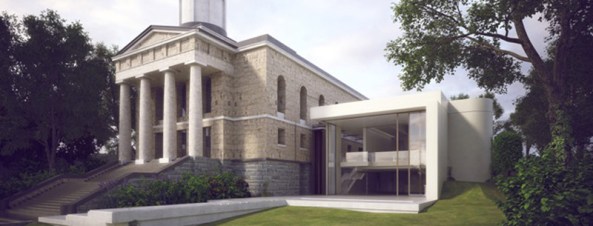
St George’s, a former church in the graceful, well-proportioned Greek Revival style of the early 1820s, is a really fine venue, and a handsome new extension has added a contemporary bar and social area which perfectly complements the building’s clean neo-classical lines. The concert hall itself retains the columns and balcony of the original church, together with a fine altarpiece. A small illuminated star in the ceiling indicates where a bomb fell through the roof during the Second World War but did not explode. At just shy of 600 seats, St George’s is about the same size as London’s Wigmore Hall.

view-from-great-george-street-for-webbanner
St George’s Bristol with its new extension

The purity of St George’s acoustic combined with Waka and Joseph’s split-second precision, supreme technical assuredness and musical sensitivity brought wonderful clarity and contrasting shading to Mozart’s Andante with Variations KV 501, which opened the concert. This linked neatly to David Matthews’ Variations on a theme by Haydn, which was written for Waka and Joseph. The unsually chromatic theme from the opening of Haydn’s last string quartet is the starting point for this set of 12 variations which initially remain close to the originally theme before moving into wider musical territory, including a tango (Var. 5), a blues variation (Var. 7) and a moto perpetuo (Var. 10). The work has a delightful sense of fantasy suffused with romanticism and musical wit, and ends with a humorous exchange between the two players which Haydn would surely have appreciated. It was evident from the performance that Waka and Joseph really relish this kind of repertoire, which proves that the piano duet is not confined to small-scale salon works.

Ailsa Dixon’s Airs of the Seasons was composed in the early 1990s and is her only substantial work for piano. Its four brief movements are each prefaced by a short poem, evoking in turn the magical stillness after a winter snowfall, the first stirrings of spring, a dragonfly darting over the water in summer, and finally amid the turning leaves of autumn, a retrospective mood which recalls the earlier seasons and ends with the hope of transcendence in ‘Man’s yearning to see beyond death’. The opening chords of the first movement are reminiscent of Debussy and Britten in their timbres, and the entire work has a distinctly impressionistic flavour. Ailsa’s admiration of Fauré for his “harmonic suppleness” is also evident in her harmonic language, while the idioms of English folksong and hymns, and melodic motifs redolent of John Ireland and the English Romantics remind us that this is most definitely a work by a British composer with an original musical vision. The entire work, although quite short, is really delightful and inventive. Rich in imagination, moods and expression, the musical evocation of each season is distinct and characterful – Summer, for example, is not all sunshine as a brief but dramatic storm interrupts the warmth and serenity, while Autumn contains flashes of music from earlier movements to underline its reflective, retrospective mood. From a pianistic point of view, the textures of the music are carefully conceived to bring a range of colours and voicings imaginatively shared between the two players.

Mme Debussy deemed her husband’s La Mer unplayable in its piano four-hands version, but Waka and Joseph made impressively light work of this masterful evocation of water, light and wind (and reminded me of my coastal home in Dorset, currently in the grip of gale force autumnal winds!). Their brilliant pianism complemented by total synergy at the keyboard brought this work to life with vivid drama and passion, and was a thrilling close to an absorbing and varied programme.

img_2202
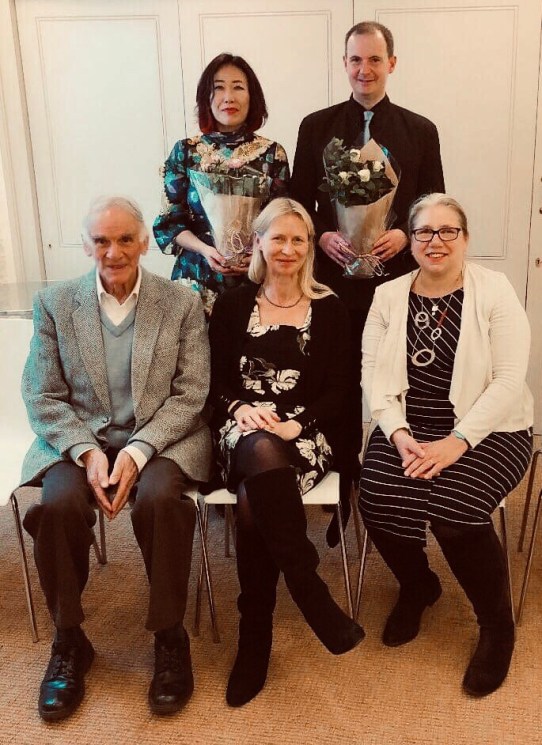
back row: pianists Waka Hasegawa & Joseph Tong; front row from L to R – Brian Dixon (Ailsa’s husband), Josie Dixon (Ailsa’s daughter) and Frances Wilson (The Cross-Eyed Pianist)

Meet the Artist interview with Ailsa Dixon

More about Ailsa Dixon

The genteel Wigmore Hall audience was startled by the abrupt slamming of the lid of the piano, heralding the start of a brand new work by a composer celebrating a significant birthday on the day of the concert. The pianist was Igor Levit, always very popular with Wigmore audiences, and the composer was Frederic Rzewski. As a student Levit was captivated by Rzewski’s music and asked the composer to write a new piece. The work premiered at this concert was commissioned by Wigmore Hall for Levit to play.

Read my full review here


