

What inspired you to take up the piano, and make it your career?
I loved the sound of the cembalo (harpsichord) very much when I was a child. Having no musical background whatsoever, my parents sent me to a local music school, where I was told that I would need to learn some piano before I could learn the cembalo. I fell in love with the piano immediately and quickly forgot about Bach’s harpsichord concertos!
In my teenage years, playing the piano was the activity I loved most. Nobody had to tell me that I should practice. As soon as I came home from school, I ran to my piano and played for hours. My time at the piano was quite evenly split between playing classical music and improvising or composing my own music. When I was discovered by a manager at age fifteen, I knew already that music would always be my main career, although my role as an interpreter of classical music – mainly of the romantic repertoire – was outweighing my activities as a composer at that time.
After two intensive years of touring and recording, I felt burned out. The growing success as a concert pianist had no positive impact on my happiness at all, quite to the contrary: I felt more and more isolated, and it became clear to me that I could not ignore my need to compose any longer. My manager considered my compositions as some kind of private hobby, but to me it was much more. As much as I love the music by the great masters, and as much as I enjoy playing it, composing (and performing) my own music had to come first. It was a difficult decision, since my possibilities as a soloist seemed to be endless and so many promising opportunities were at my fingertips. But I did what I had to do as an artist: I withdrew from the traditional career as concert pianist and immersed myself into the development of my musical language.
Who or what were the most important influences on your composing?
Being so well acquainted with the romantic repertoire, the music of Chopin, Liszt, Rachmaninov and Scriabin definitely had a strong influence on my early style. But since I am a child of the 20th century, I have also drawn inspiration from pop and rock music, maybe also a little bit from jazz music. When I discovered Keith Jarrett’s solo concerts and Arvo Pärt’s music in the late nineties, I was deeply moved by the sheer beauty that was still “allowed” in our time. My educational background had suggested to me that contemporary music had to be disharmonic, to put it politely, and I never cared for serialism and all the cacophony that followed. So, essentially, I am in constant search for truth and beauty in my music. My love for Gregorian chant, religious choral music and my Catholic faith have a great influence not only on my compositional style, but also on my understanding of music as a whole.
What have been the greatest challenges of your career so far?
When the Cistercian Monks of Stift Heiligenkreuz asked me to compose piano accompaniments for the follow-up of their hugely successful album ‘Chant – Music for Paradise’, I did not want to mess up. They were putting “their” sacred chants into my hands and let me interpret them! In plainchant you have so much freedom and detachment from clearly definable emotions in the sense that have become so accustomed to over the last centuries. It is indeed the most universal and pure musical language on our planet. Putting a piano part underneath it would naturally interpret the chants in some direction. Through hard work and constant rewriting of many passages I found a very personal, yet worthy and unsentimental style for these pieces. The monks liked them so much that they commissioned another four chants for their latest album ‘Chant – Stabat Mater’, which was released recently.
Which compositions are you most proud of?
Many of my choir pieces are very special to me. Unfortunately, not many of them have been performed so far, which makes me all the more excited that the wonderful Platinum Consort under the direction of Scott Inglis-Kidger will sing the world premiere of my ‘Consecration Prayer’ on 16th November, which is a very personal composition of mine. I am also very happy with my piano piece ‘Obsculta’ and the really beautiful video that my friend Vitùc created for it.
Who are your favorite musicians?
At the moment I am very fond of so many magnificent British choirs: Tenebrae, The Sixteen, Polyphony, Platinum Consort, to name a few. You really are blessed with a unique choral tradition in England!
There are countless pianists that I admire and love, but if I had to pick one, it would be Dinu Lipatti. I love his unpretentious and pure musicianship. I try to follow this role model, and I have never liked musicians who take themselves too seriously and want to be more important than the music. It is the musician’s duty to serve the music, not the opposite.
What is your most memorable concert experience?
I was crying from beginning to the end when I attended my first live performance of Bach’s B minor Mass in Luxembourg ten years ago. I have never been so moved by a piece of music. It was then that I realised that there is no such thing as old or new music. If music is true, it is timeless and will always reveal a glimpse of eternity to us mortal beings.
What do you consider to be the most important ideas and concepts to impart to aspiring musicians?
For the interpreter:
- Never take yourself too seriously.
- Always play with open ears and an open heart.
- Look for the essence behind the notes and remain faithful to the text.
- Find your personal sound by pursuing meaning rather than virtuosity.
- Practice hard and value technical exercises and scales. They help you to become better servants of the music you love.
If you’re a composer:
- Compose with open ears and an open heart.
- Look for the essence inside your musical ideas and omit what can be left.
- Let the music write itself by listening as deep as you can.
- Always question your work. If it can still be improved, don’t shy away from the work.
- Study the masters, again and again, but be yourself when you compose.
What are you working on at the moment?
I practice Brahms’ Cello Sonata in E minor for a performance with a very special young talent next week. After that I will orchestrate my children’s opera ‘The Little Gnome’ which will be premiered on 19th January in Luxembourg. And I expect the master CD of my new solo album ‘Prayers of Silence’ (which I recorded in August) to be ready any day soon, so I will definitely spend some time with listening and preparing the publication of my most important album so far. In December I will play Beethoven’s Choral Fantasy, a piece that is not in my repertoire yet, so I’ll have to practice a lot in November.
What is your idea of perfect happiness?
Perfect happiness is a gift of the moment and it wouldn’t be special if it were a constant state of being. That being said, I can say that I suffer from failures and bad moments like everyone else, but I am also regularly blessed with happiness when I compose or when I play the piano. But the most blissful moments are those that I spend with my family and especially with my three little children. I should also mention that I find peace in prayer, and it is the hidden driving force of my life.
David Ianni’s ‘Consecration Prayer’ receives its world premiere in a concert by Platinum Consort, under the direction of Scott Inglis-Kidger, on Friday 16th November. Further information and booking here
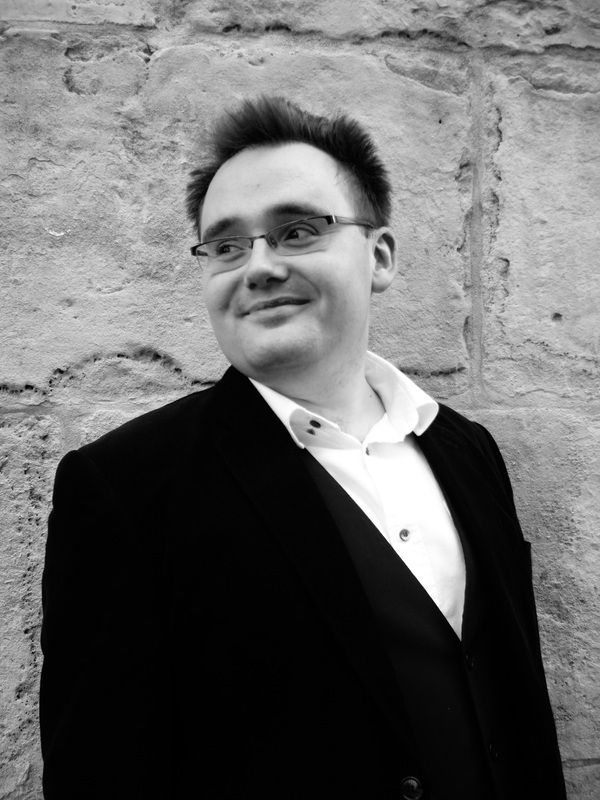
David Ianni was born in Luxembourg in 1979. He was accepted in the piano class of Daniel Feis in the Conservatoire d’Esch-sur-Alzette at the age of nine. At fifteen, he completed his piano diploma in Luxembourg with a “Premier Prix avec grande distinction”. He continued his studies in London at the Purcell School and later with Tatiana Sarkissova, teacher at the Royal Academy of Music. He also studied with Dimitri Bashkirov, Anatol Ugorski, Radu Lupu and Dirk Joeres. In 2005, he completed his studies with Tonie Ehlen at the Maastricht Conservatory.
After winning a number of prizes in national and international competitions, the sixteen-year-old musician began a career as a concert pianist, performing solo recitals as well as with orchestras in many European countries, India and Japan. His debut CD, with works by Beethoven, Rachmaninoff and Scriabin, was released in 1997. In 1999, the recording ‘Theodor Kirchner: Piano Music’ followed.
Since 1998, David Ianni has increasingly dedicated himself to composing his own works. He has written about 100 works, including the oratorio ‘Abraham’s Children’, ‘Pater Noster’ for piano and orchestra, a children’s opera, a string quartet, chamber music as well as numerous choral and piano compositions, which have been performed in Luxembourg, Germany, Austria, France, Italy, India and Japan.
David Ianni’s album Night Prayers with his own piano compositions was published in 2011.
That same year he composed and recorded the piano accompaniments for the album Chant – Amor et Passio by the Cistercian Monks of Stift Heiligenkreuz, which was awarded a Platinum award in Austria. In 2012 the monks commissioned David to compose and play four chant accompaniments for their album Chant – Stabat Mater.
His new solo album ‘Prayers of Silence’ will be released by Obsculta Music.





 The Cross-Eyed Pianist