“Brouillards swathed the Wigmore audience in mist, yet the sound was never foggy”
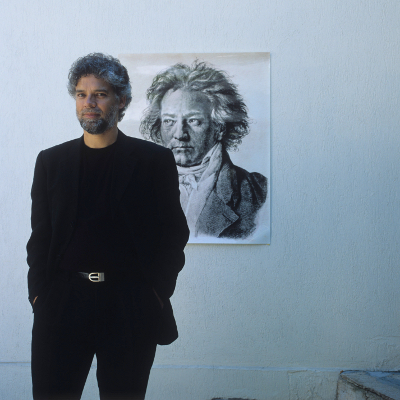
Photo credit: Guy Vivien
Occasionally one comes across an artist who seems so at one with the music, that one can almost hear the composer at the artist’s shoulder saying ”yes, that is what I meant”. Such was the effect of French pianist François-Frédéric Guy’s performance of Beethoven’s final Piano Sonata, the Op.111, at London’s Wigmore hall on Friday night: a performance replete in insight and an emotional intensity which comes from a long association with and admiration for this composer and his music.
Who or what inspired you to take up the pianoand make it your career?
I don’t remember not playing the piano. As my parents were also musicians, it was probably a rather obvious thing to do. I never thought of music as a career per se, but it was clear to me rather early (certainly before my teens) that music would consume my life.
Who or what were the most important influences on your musical life and career?
So many people! Obviously my teachers, Sulamita Aronovsky and the late Susan Bradshaw, have both been crucial. I learnt very different things from each of them. In a way they were very contradictory, but I have never felt confused, rather enriched by having multiple views on so many issues. I am hugely grateful to them both. Beyond that, clearly the influences on a musician who is even slightly inquisitive will be very wide-ranging.
Several pianists have been personally very important to me, most obviously perhaps David Tudor – who helped me most generously in my early 20s, as I was preparing a major Cage project – and Maurizio Pollini, whose work was influential on me in many ways from an early age, and who in recent years I’ve come to know personally. He invited me to share a concert with him at Suntory Hall last season, which was a huge pleasure – I played a work of Manzoni in the first half, and he played Beethoven Sonatas in the second.
I have had the honour of working with many living composers over the years and have learnt many things from them. When that honour has been dubious, I have learnt what to avoid rather than what to embrace. But in the case of a composer like Birtwistle, whose “Variations from the Golden Mountain” I am premiering at the Wigmore Hall on Sunday 14th September, the relationship has been only fruitful and enjoyable (for me at least).
Conductors, studying works in other genres (string quartets, orchestral works), visual arts – everything goes into the artistic pot and influences the flavour like herbs in a stew.
What have been the greatest challenges of your career so far?
Challenge in what sense? Every concert, every confrontation with a work of music, is a challenge. And practical life is a challenge. And bad conductors are a challenge.
Yes, that’s it: bad conductors are definitely the greatest challenge.
Which performance/recordings are you most proud of?
A composer was once asked which piece he was most proud of, and said it’s always his most recent. I guess the same is true for me. I’m just seeing a disc of the concertos of Birtwistle through the press, and have also just finished a disc of the complete piano music of Brian Ferneyhough. So I guess they’re the ones I’m most proud of.
How do you make your repertoire choices from season to season?
There are many things I think about for ages but don’t programme for many years, and on the other hand sometimes I decide quite quickly that I want to do a particular work. One of the joys of my situation is collaborating, and bouncing ideas off a trusted promoter can be extremely stimulating.
You are performing a new commission by Sir Harrison Birtwistle at your Wigmore Hall concert on 14th September. What is especially exciting about working on new music such as this?
Working with great composers personally is something that can only happen with contemporary music. All the others are dead. I can’t work with Beethoven or Debussy, but I’m overjoyed to have the opportunity to work with Birtwistle, for example. So much is made clear in our personal meetings and discussions; at the same time one understands the freedom available with more precision.
Do you have a favourite concert venue to perform in and why? What is your most memorable concert experience?
Well there are many remarkable acoustics around the world, and many halls with intelligent and searching programming. But what makes a concert really memorable is the situation – the programme, the audience, my mood, my collaborators (dead or alive). When everything aligns the experience is unforgettable.
What do you consider to be the most important ideas and concepts to impart to aspiring musicians?
The most important starting point for young musicians is the score. Students sometimes seem to view it more as a hint, rather than as the least indirect link to the composers intentions, which is what it is. Understanding notation in the deepest manner is one of the most important things which can be taught.
What are you working on at the moment?
After the Wigmore, I have to prepare a new piano concerto by Simon Steen-Andersen, and will also be working on Brahms 2nd Concerto for a concert in Finland in November. And many other smaller things in between!
Where would you like to be in 10 years’ time?
No idea. I am sure though that I won’t be anywhere I could now guess.
What is your idea of perfect happiness?
I am still trying to work that out.
What is your most treasured possession?
My Steinway (which is beyond obvious).
What do you enjoy doing most?
Watching my children develop.
What is your present state of mind?
Expectant before the birth of a new work at the Wigmore tomorrow!
Nicolas Hodges performs music by Mozart/Busoni, Debussy and Sir Harrison Birtwistle in an 80th birthday tribute concert at London’s Wigmore Hall, Sunday 14th September. Further information here
Born and trained in London, and now based in Germany, where he is a professor at the Stuttgart Conservatory, Hodges approaches the works of Classical, Romantic, 20th century and contemporary composers with the same questing spirit, leading The Guardian to comment that: “Hodges’ recitals always boldly go where few other pianists dare … with an energy that sometimes defies belief.”
People assume that if you can read music, you can be a page turner for another pianist.
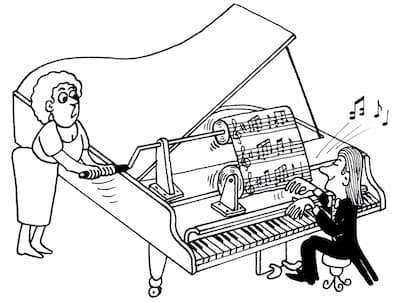
“You read music! You play the piano! You must be able to turn pages!” is the cry I frequently hear, and while all these statements are true, many people do not realise that page turning is an art in itself, a specialist skill which can help a performance go brilliantly, or turn a concert into a Feydeau farce.
These days at piano concerts it is still quite unusual to see a page-turner in attendance. The ongoing – and to my mind rather ridiculous – trend/burden of having to perform from memory (a habit which developed during the second half of the nineteenth-century, thanks in no small part to Franz Liszt and Clara Schumann) means that the turner is a fairly rare sight. It is more common if the pianist is playing as part of a chamber ensemble, though many pianists these days play from an iPad or similar device.
Page turning can be a nerve-wracking experience as the turner feels a great responsibility to “get it right” for the performer. Turns should be discreet and silent (turn from the left of the pianist, using the left hand to turn the top of the page). In effect the turner should be “invisible” – and the turner should be sure never to turn too early or too late.
In addition, the turner has to be able to understand and act correctly upon repeats, da capo and dal segno markings, and other quirks of the score. Turners also need to be alert to concert hall conditions: drafty halls can be stressful as stray gusts and breezes may blow the pages around. Page turners have to observe correct on-stage etiquette: they must follow the performer on to the stage and know not to rise from their chair nor fidget during pianissimo passages. They leave the stage after the performer has taken his or her applause and only step forward to receive plaudits if invited to by the performer.
Much of the turner’s role is about being able to “read” the performer’s body language and be acute enough to act upon sometimes highly discreet signals. Turners should not discuss their anxiety with the performer, nor expect the performer to give them tips or advice about their own playing or musical careers.
In fact, being able to read music is not necessarily a prerequisite of being a competent page turner as someone who gets too involved in reading the music may miss a crucial turn.
A quick poll around Facebook and X (Twitter) revealed some page-turning horror stories (turning the wrong pages, a severely damaged score with pages held together with sellotape, pages out of order) but also anecdotes celebrating page turning and page turners. One turner confessed that pianist Francesco Pietmontesi’s performance of the Liszt transcription of Beethoven’s ‘Pastoral’ Symphony had moved her to tears, and many people describe the privilege and pleasure of being able to turn for top international artists.
Modern times call for modern page-turning techniques and gagdets: scores stored on an iPad or other tablet device can be turned using a bluetooth foot pedal such as the AirTurn. Music publishers go to some lengths to engrave and print music in such a way as to facilitate easy page turns, but when this is not possible, one either ends up with photocopied sheets taped to the score, uses an automatic turner, or opts to have a page-turner, which can look more poised and professional.
Whatever route you choose, make sure your page turns are tidy, quiet and discreet – oh, and always thank your page-turner after the performance!
(Image credit: The Student Music Organizer on Facebook)
It has not always been like this. I was younger once and like all pupils would be given my notes on how to play the notes. I would each week be handed a few handwritten, barely legible lines marking out my teacher’s expectations for the coming week: a list of scales to perfect, contrary motion; the names of the pieces to work up.
I am older now. I no longer have to decipher any comments or reach any point by a particular time. I no longer have to worry that my lack of practice will show. I’m not working towards any exams. I’m not studying for a GCSE or A Level. I’m certainly not building up to my Grade 6, Grade 7 or Grade 8. I’ve not had to pick any pieces from List A; I’ve not even looked at List B. And I’m definitely not looking forward to any concert performance.
I am older now and I no longer practise the piano. It’s not practice because I’m not practising the piano for anything. I’m not practising a work in readiness for some point in the future when I’ll finally be asked to play it, when I’ll be asked to perform it, when I’ll be marked, given a merit or a distinction or not. I’m not setting aside time at the keyboard now against some prospective moment. I’m not preparing for anything. No, I’m not practising but just playing the piano.
The difference is one of quality. It is a difference that I can feel in every note, even the wrong ones. I’m not practising the piano, I’m just playing it and that playing belongs entirely to this present moment, this instant as I press down each key. This is it; it’s happening now and not in some future time of a potential recital. It belongs entirely to me, even and especially when I play not the right notes but the wrong ones.
It is an experience that as well as being more immediate in time is also now closer in space. It is nearer to me. The playing begins and ends with me at the piano. There is no inevitable audience. I’m not playing to the upper circle or to any icy examiner but for myself.
The difference between practice and play is also one of quantity. I play the piano far more now than I ever did when I was younger. I play every day when I’m at home. And when I’m not playing the instrument I’m listening to recordings of other people playing it. The piano is no longer a distraction but the thing from which I’m distracted.
And with this increased quantity of time at the keyboard has come an increased quantity – or at least variety – of music on the stand. The difference between practice and play has been for me a greater freedom to choose any piece I want, from any List, A or B, any piece by Liszt or otherwise, from the most simple to those that remain beyond me at the moment, and may well always stay out of reach. It is equally a greater freedom not to choose certain pieces and to abandon any work I want. If I find a work unrewarding (which is different to finding it difficult) I can simply take the music down and put it away without any sense of failure. There is no longer any merit or distinction in playing something that more than challenging me is making me unhappy.
This playing still does not come easy. I’m only moderately competent at the piano. I still have to work out which note is which when there are multiple leger lines. I still have to work hard to eliminate those wrong notes which multiply themselves across the keyboard. And I still patiently have to work my way through complex passages hands separately first and then hands together after, counting in my head as I go, one and two and… getting a feel for the cantabile melody line before adding the accompaniment.
And yet for all these difficulties it is still a joyful and intensely rewarding experience. And so I would recommend that everyone diligently practise the piano and then whenever possible also make time just to play it as well.
Dr James Holden was born in Ashford and educated at Loughborough University. He graduated with his PhD in 2007. He is the author of, amongst other things, In Search of Vinteuil: Music, Literature and a Self Regained (Sussex Academic Press, 2010). His website is www.culturalwriter.co.uk and he posts on Twitter as @CulturalWriter
The Cross-Eyed Pianist is free to access and ad-free, and takes many hours every month to research, write, and maintain.
If you find joy and value in what I do, please consider making a donation to support the continuance of the site






 The Cross-Eyed Pianist