
What is your first memory of the piano?
I was learning a piece called ‘Baby Bear’, and I was having difficulty with it. It was about the sixth piece in my grade one book, and I think you actually had to play hands together or something incredibly challenging like that. My mother sat down with me and patiently helped me through it. For some reason that always stuck in my mind – it’s one of the few memories I have of a warm and caring feeling between my mom and I.
Who or what inspired you to start teaching?
The lack of good piano teachers. I figured there has got to be some way of offering students better than what I received. But it was also just by chance – some neighbourhood kids needed lessons, so I taught them. I was 16 which means I’ve now been teaching over 40 years.
Who were your most memorable/significant teachers?
First off the bat is Richard Hunt, an Englishman who ended up in Montreal and later founded Quartango, one of the best tango groups around. He taught me for only two years when I was 8 and 9 years old, but he instilled a love of music in me that I carry to this day. He was very clever and he let me have fun! We even had some of our lessons on the church organ instead of the piano.
Then there was Phil Cohen who had been Yvonne Hubert’s assistant (she had been a student of Cortot and taught such Canadian greats as Janina Fialkowska, Marc-Andre Hamelin, Ronald Turini who later studied with Horowitz, Andre Laplante and Louis Lortie). Phil was fascinated with the psycho-physical aspects of performance and would do strange things with your hand that made you play way better but you weren’t sure what exactly was going on.
When I finished my studies with Phil I wanted to understand what had just happened to me, so I did a training in Feldenkrais Method, and I count Moshe Feldenkrais as my next most memorable and significant teacher.
I concluded that Phil had given me an amazing degree of refinement, but I had never acquired the firm foundation upon which such sophistication needs rest. So I went to study with Kemal Gekić in Yugoslavia. More or less a product of the Russian School, he rebuilt everything from the ground up and indeed gave my hand a strength and security it had never had before.
Finally, in the past few years I have again been having occasional sessions with Phil – getting some reminders about that sophisticated part and synthesizing what I’ve learned from both Phil and Kemal to develop what I call Craft of Piano Method, the approach presented in my three books on piano technique.
Who or what are the most important influences on your teaching?
All of the above. Also Richard Feynman, the physicist and author of ‘Surely You’re Joking, Mr. Feynman – Adventures of a Curious Character’, and Werner Erhard, whose work now goes by the name Landmark Education. Also G. I. Gurdjieff. And various psychological disciplines…… what they gave me is the idea always to make it a positive, creative experience. To respect the person. To try to discover the person. Never to fault the student for not understanding but to fault myself for failing to discover the language that would have him or her understand.
Most memorable/significant teaching experiences?
Hoo boy, there are hundreds of those… Recently I worked with a violinist in Pensacola, Florida, who had shoulder pain. I had him continue his up bow way past the violin, towards the ceiling, then around in a big circle. Then his down bow expanded into a big circle in the other direction. Then I had him play not moving his bow at all but moving his violin back and forth underneath the bow. Finally I explained to him where his arms are attached to his body: do you know? It is only at the central end of the collarbone where it attaches to the sternum. I put my bunched fingertips one on each of these collarbone-sternum joints and palpated them while he played, just kept physically in touch with them. His sound went through the roof. It had been improving steadily but this was a quantum leap, it had power, sonority, richness, expressivity – it gave us all goosebumps.
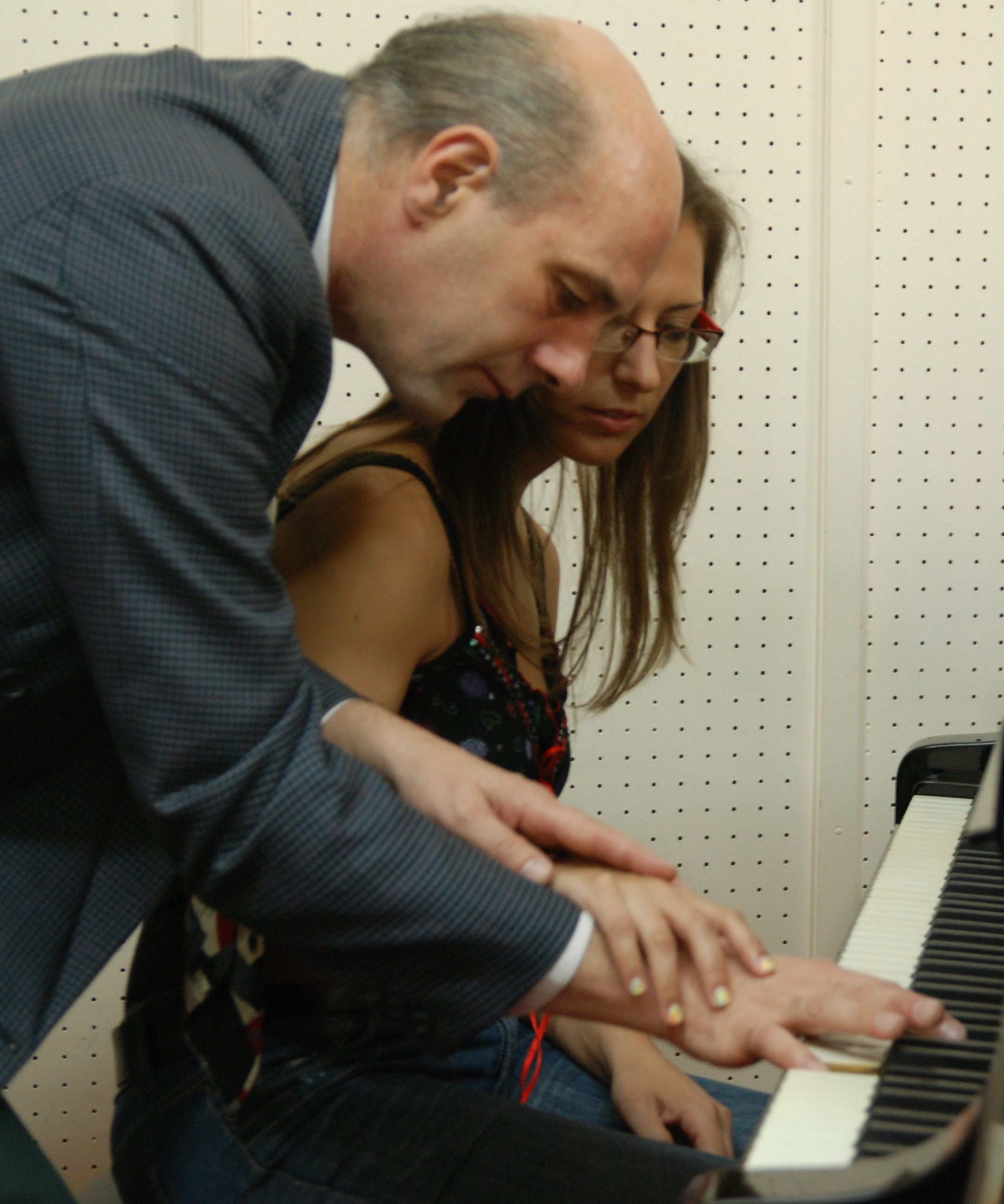
I recently worked with a young Italian pianist in Geneva. She had been given a steady diet of arm weight technique and told not to move her fingers too much. When I showed her a way of moving her fingers which gave them activity and tonus without stiffening them or causing any stiffness elsewhere, her playing became amazingly poetic. I was blown away because I didn’t have to tell her to be more expressive or poetic, we just worked to undo the physical block which had been preventing her natural expression from finding its voice.
I taught an American pianist in Trossingen, Germany many years ago. Her hand suffered (as so many do) from over-relaxation, and I worked to build up its structure, just to get it to stand nicely on the keyboard even before we tried to play anything. All of a sudden she says, “Gee, I feel so muscular!” We all laughed, because of course, it wasn’t her muscles at all that were giving her the sense of power, it was her skeletal structure.
I remember teaching a Chinese student during my year in Wuhan. She was playing Liszt’s Dante Sonata and couldn’t really get the special atmosphere of the second theme. I tried explaining to her how Liszt was pulled in two directions, towards divine love but also towards carnal love, and that we don’t really know which one this theme represents. I myself feel it as towards the divine, how about you? No result. I try another tack: “Imagine you are the Emperor of China and it is your yearly pilgrimage to the Sun Temple. You must pray to the Gods for rain, and if you fail, your people will die of famine. You enter the temple, you pray with all your heart, and suddenly, a sound of brass from the sky, a divine melody descends from the clouds – you know your prayers have been answered. Play this theme as if it was that heavenly melody.” She played and we were literally in tears. It was indeed heavenly. It was a prayer. I was fascinated because I had to go into her culture to access the universal quality of that theme. Trying to get her to understand Liszt’s culture met with no success, but her own culture proved an admirable path for her to understand that music, music which does indeed speak to us all. She needed her own culture to access the right side of her brain, which of course possesses a perfect understanding of the spiritual element in this theme.
What are the most exciting/challenging aspects of teaching adults?
Exciting: their intelligence, their sensitivity, their curiosity, their receptivity, and their willingness to be beginners. Challenging: 1) the slightly rusty nature of their brains, compared to the incredible flexibility and speed of their younger colleagues. 2) having to fix the sometimes vast amounts of garbage they have been taught over the years…
What do you expect from your students?
Curiosity, engagement, dedication….
What are your views on exams, festivals and competitions?
They are excellent, a stimulus to high level work. Competitions are the equivalent of a scientific congress where people go to meet their colleagues, share ideas and be stimulated. It’s a chance to feel like you are part of a community instead of this weirdo who mostly sits between four walls practicing on his or her own. Whenever I prepared a competition I played better, because I knew I had to. Perhaps theoretically I should play my best simply out of love for the composer, but I find the practical stimulus of a concrete goal a much more effective kick in the pants.
What do you consider to be the most important concepts to impart to beginning students, and to advanced students?
Beginning:
- Sing a simple song, sense your own voice. Let your fingers begin to find that song on the piano. Experience your fingers on the piano as an extension of your voice.
- Tap simple rhythms, one hand on your knee, the other on a piano key. Let rhythmic sense be as important as the sense of the notes from the very beginning.
- Play first, read second.
- Never let the task of reading distract you from the task of making music.
Advanced:
- Never let relaxation lead you into a state of emasculated collapse.
- “Don’t bang” does not mean “play like a wimp,” it means “find a way to play where you stand up into your hand’s structure instead of letting it collapse. Banging mostly comes from weakness not too much strength.
- Have your hands learn to stand, walk, run and jump well on the keyboard, then give them musical tasks that give them a reason for doing these things.
- Never let technique distract you from the sound you are making, the music you are making. They are intimately connected.
- Understand your hand’s structure and function, then find out where it is not working optimally for you. Find out how the body participates in supporting the hand in working well.
What are you thoughts on the link between performance and teaching?
They feed each other. I couldn’t really do one well without the other.
Who are your favourite pianists/pianist-teachers and why?
Passed on: Horowitz, Rubinstein, Rachmaninoff, Ignaz Friedman, de Pachamann. They all had supreme virtuosity, compared to which most of the best pianists today only move their fingers well. This virtuosity is way beyond digital dexterity – it’s creating orchestral sonorities and emotional characterizations that grow naturally and organically out of the soundscapes the composers created.
Living: Kemal Gekić. He is the one pianist today who is breaking new ground in this realm. He is using his transcendent mastery of the keyboard to explore new emotional and spiritual elements in the music he plays, and dealing with adjustments to the sonority at the micro- or even nano- level to evoke unbelievably huge changes in the expressive dimension.
Canadian pianist Alan Fraser is best known as the author of three major volumes on piano technique: The Craft of Piano Playing (also in DVD), Honing the Pianistic Self-Image, and All Thumbs: Well-Coordinated Piano Technique. Fraser’s new approach grows out of his many decades’ study with Phil Cohen and Kemal Gekić, synthesizing the best features of previous schools of piano technique in order to move beyond them. Analyzing piano technique in the light of the Feldenkrais Method of neuromotor reeducation (Fraser is a senior Feldenkrais practitioner) allows Fraser to unlock the hand’s innate potency at the keyboard by returning to its inherent structure and function. Instead of distracting from musical aspects of piano playing, Fraser’s focus on the physical brings the pianist, by improving his physical relationship to his instrument, back into contact with his essential artistic self. Thus Fraser’s students gain not only in technical mastery; but in their artistic expression which develops a whole new dimension of tonal breadth, emotional subtlety and spirituality.
In 2011 Fraser inaugurated the Alan Fraser Piano Institute, a week-long intensive course designed to create a breakthrough in one’s piano technique. Branches of the Institute have already sprung up at Smith College, Massachusetts; Salt Lake City, Utah; Concord New Hampshire; Stuttgart, Germany; Geneva, Switzerland; Nice, France; and Haarlem, the Netherlands. In addition to his Institutes, Alan Fraser gives recitals and master classes throughout Europe and North America, and continues to teach at the University of Novi Sad, Serbia. He has composed several vocal works including two masses and a Magnificat, and is a respected digital sound engineer who edited Kemal Gekić’s monumental recording of the 27 Chopin Etudes.




 The Cross-Eyed Pianist