Impostor syndrome (also spelled imposter syndrome, also known as impostor phenomenon or fraud syndrome) is a term coined in the 1970s by psychologists and researchers to informally describe people who are unable to internalize their accomplishments. Despite external evidence of their competence, those exhibiting the syndrome remain convinced that they are frauds and do not deserve the success they have achieved. Proof of success is dismissed as luck, timing, or as a result of deceiving others into thinking they are more intelligent and competent than they believe themselves to be. Notably, impostor syndrome is particularly common among high-achieving women, although some studies indicate that both genders may be affected in equal numbers. (Source: Wikipedia)

There’s a wealth of knowledge out there to be explored, absorbed, considered and acted upon. Sometimes it can fee like a whole lifetime would never be enough to take in a tiny fraction of the information which is flung at us every second of the day.

As our circle of knowledge expands, so does the circumference of darkness surrounding it.
Albert Einstein

I have days when I think I don’t know anything, or when I feel that I will soon be “found out”, revealed as a fraud and impostor, that I am not really a pianist or piano teacher, just someone acting out the role.

Such feelings of inadequacy are very common – and understandable,  given the way we are bombarded with messages about how we should develop, be smarter, be more attractive, have more and better sex, be slimmer, eat the right food, take more exercise, be confident, have self-belief. Is it any wonder that sometimes we feel totally overwhelmed by information? Sifting through all these conflicting messages to find the ones which are relevant to us can be a Sisyphean task. Then there are peers, friends and colleagues who urge us to do this, see that, try this, think that…. Some days I just want to withdraw and become a “piano hermit”, to shut out all the noise.

At every turn, there is some kind of resource which could be useful or beneficial to our development. These may be books and journals, websites or online groups and forums where people can meet to exchange ideas. I have enjoyed lively exchanges in such online groups (notably on Facebook) and I enjoy the fact that people are willing to share information and knowledge via this medium. But I have also found such groups detrimental: observing what others are doing, or comparing oneself to others is not the best way to assess one’s abilities, progress and development, especially if these groups become a vehicle for some else to parade students’ exam successes, or seek endorsement from group members for their own achievements. Such parading of egos or mutual appreciation can make others feel inadequate.

A healthy way to move on from such feelings of inadequacy is to accept that one is at the tip of the iceberg in terms of knowledge. This should not be regarded as something negative, but rather the spur to encourage one to be inquisitive, questioning and always open to new ideas. Learning requires and encourages humility: one should be willing to accept there are different ways of doing things, or alternative ways to develop the same skills. Many teachers, myself included, engage in continuing professional development (CPD) as a more formal way of enhancing and broadening our knowledge. This may involve attending courses or workshops, being mentored by another teacher, reading, studying and interacting with others in the profession. I don’t believe we should ever stand still as teachers, or rest on the laurels of students’ achievements such as exam successes, for this attitude can breed complacency. By all means look at what others are doing, consider suggestions and ideas which are put to us and choose to embrace or reject them as we see fit.

Fundamentally, I know I am good at what I do and that I deserve to be respected (and paid appropriately) for my knowledge and skill. I do not need to measure my own success against other people’s achievements because I have confidence and self-belief in my own abilities. My students return each week for lessons which they seem to enjoy. I see them progressing and I show them ways to measure their own success (and I don’t mean through exam results, which can be useful benchmarks, nothing more). Over the decade in which I have been teaching, I’ve realised that confidently carving one’s own course leads to a greater sense of personal fulfilment and job satisfaction. In recent years, I’ve made significant changes to my teaching studio, including reducing the number of students I teach (to allow me more time to pursue my own musical studies), being selective about which students I take (I do not teach beginners or very young children, for example), and setting my fees at a rate which I feel reflects my experience. Consequently, I enjoy my teaching a great deal more and I am sure that this benefits my students too. I also find I am treated with more respect by clients, prospective clients and colleagues. I do not believe we should shy away from this kind of “self care” to enable us to do our job well, with passion and commitment.

Here’s a comment on this subject from another teaching colleague:

Despite the fact that I’ve undertaken much professional development over the past few years, I feel more aware of my shortcomings as a teacher than ever before.  Rationally, I know that not to be true – my students enjoy their lessons, play well and do well in exams.  But the more I learn the more I really do realise how much I still have to learn and how vast the area of knowledge is in relation to piano teaching.  I find the internet a really double-edged world in all of this.  On one hand it is a fantastic source of support and inspiration and I have met many wonderful colleagues online and learnt loads from them.  On the other hand, scrolling through various piano teaching forums can lead me to a pit of despair as it seems as if everyone else is more experienced, knowledgeable and creative than me!   So I find it’s important to keep a balanced view, be specific and targetted about my use of online forums and continue to remind myself that I’m doing my best, learning all the time and – most importantly – my students are happy and keep coming back!!

****
As a practicing musician, feelings of inadequacy always lurk at the fringes of my consciousness – and my many conversations and interviews with other musicians confirm that I am absolutely not alone in feeling this. Despite the physical proof of my abilities (two performance diplomas in quick succession and positive endorsements from pianist colleagues and mentors), I often feel a fraud. In fact, I think this feeling is helpful, for it enables me to remain humble, an important attribute for a musician, in my opinion.
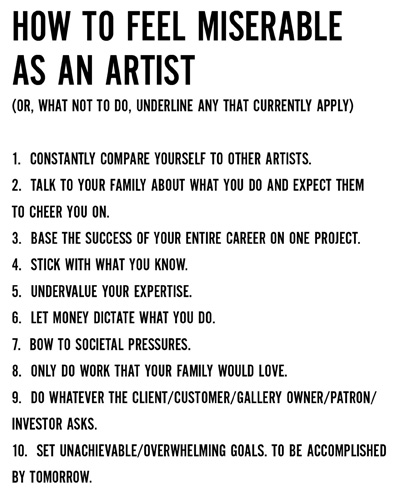
Awhile ago, I stumbled across this list, which seemed to me to encapsulate many of the things that can create and fuel feelings of inadequacy:
miserable
Turn each of these points around, and one has a manifesto by which to work and develop as a musician which is both realistic and achievable, and ensures the necessary self-compassion to allow us to flourish within our own comfort zone.
Of course whenever we open a new score, the sense of how little one knows, at that point (regardless of one’s knowledge of the composer or genre of the piece), is palpable, and when one truly cares about something, one’s standards are set very high.
The pianist Adele Marcus once said “The older I get the more I disdain the intellect.” As a colleague of mine stated, “I think that means that we become closer to the music instinctively, rather than by how we think it should sound based on knowledge of the music, the composers and history” (JB). Such a state of being can be hard won, and may take many years of study, hard graft and living with the music. Humility before the music and the composer is important; also a sense of continual striving, that one is on a journey. Sure, read the books, do the research, understand the social and historical context in which the music was created, but there must also come a point where we step away from the intellectual and the academic and liberate our personal creative impulse to “make music”
Further reading:

Two of my students, siblings as it happens, are working on pieces which include a continuously moving left hand, scored in triplets. One is a Rondo by Diabelli, the other a Sonatina by Clementi. I am also working on a movement of a Schubert sonata which includes the same figure. The other day, during a lesson with one of these students, I showed her the Rondo from Schubert’s D959 and said, “look, I’m working on something similar”. Her eyes opened very wide and she looked absolutely astonished, as if she couldn’t believe that there could be two pieces of music which were so similar. “I’ve encountered some similar technical issues with this,” I said to her, meaning that I too had had to work on forearm lateral movement (a “polishing” movement in the wrist and forearm) to achieve evenness in the notes, and to prevent my hand and arm becoming tired (also an issue for the student).

This episode highlights two important aspects for me: first, that students should never study music in a vacuum; and secondly, that I think it’s helpful for students to know that their teacher is also studying.

Dealing with my second point first, I firmly believe it is crucial for teachers to continue to study, whether this is independently of a teacher or mentor or by continuing to take formal lessons, and through attending seminars, workshops and courses for continuing professional development (CPD). Learning new repertoire, revising previously-learnt repertoire – no matter how easy or difficult it is – sharpens and informs our teaching skills and enables us to reference such music within the context of simpler repertoire when working with our students. And just because our repertoire may be “harder”, I do not see why we should not share it with our students, to demonstrate aspects as described above, to highlight scale and arpeggio patterns or other technical issues, or simply to share music with our students. Sadly, in my experience, many young people who learn a musical instrument have very little exposure to classical music outside of their lessons: they do not go to public concerts and have limited contact with music in school (and this is not going to improve with continual government attacks on the arts in the UK state education system). I believe one of the crucial roles of the music teacher is to broaden students’ cultural horizons by encouraging them to explore as much music as possible – whatever the genre. I also believe that by demonstrating to my students that I am also studying, there is the sense of a shared experience, that I understand how to practise properly, or prepare for a performance or exam. And for me as a teacher to be taught myself by a master teacher is incredibly useful as I draw on my own teacher’s vast knowledge and experience, and distil his wisdom into easily comprehensible nuggets for my students. And a good teacher will teach in such a way that seemingly complex concepts or technical issues can be simplified for students of any level.

Music should never be studied in a vacuum. And yet I come across students I have inherited from other teachers who have not been taught the context in which the music was created. They may be playing music from the Baroque period, but they have no idea what this means: for them, the music is simply a collection of dots on the page. Some students go right through to Grade 8 having learnt only exam repertoire (a total of 24 pieces) and come out of the process with a limited understanding of the very broad canon of classical music and its historical context. Giving students the opportunity to explore a broader range of repertoire outside the narrow confines of the exam syllabus allows them to experience different styles and genres but also to reference and put into practice technical and artistic aspects learned from their other pieces. Thus their learning – and mine – becomes a continuous process, a learning curve.

Pianist and teacher Andrew Eales introduces his new blog:

simple-banner1-e1437045607556

Pianodao is my new blog site launching Saturday 1st August 2015.

Built around the metaphor of piano playing as a lifetime journey, the site will focus on our musical and creative development as well as on our personal well-being: mind, body and spirit.

Pianists usually find that self-evaluation is crucial to their progress and musical development. When I started teaching piano I quickly also realised that one of the best ways I can improve is to continuously reflect on my teaching practice and student response. Pianodao takes this basic principle and places that process of reflection and evaluation within a much broader context – our journey through life.

When teaching I continue to observe that many of the problems and issues that I and my students grapple with have very little to do with our pianism and musical understanding, and far more to do with our physical limitations, tension, mental state and internal beliefs.

We all have a life outside of our piano playing, and it is clearly worthwhile considering the connections between our experience of life and our ongoing musical development. But where do we start? When it comes to considering those connections, I believe that the wisdom teachings of Dao (or “Taoism”) can offer a uniquely powerful and insightful approach.

Pianodao will have five main sections:

The Pianist’s Path focuses on specifics of how we learn, play, teach and help others develop as pianists. I hope to explore what it means to be a pianist in today’s world. There will also be articles about developing our creativity and performing with confidence and enjoyment.

The Pianist’s Well-being takes a broader look at our lives – our inner beliefs, physical health, and general lifestyle. This section will consider powerful quotes from great musicians past and present, as well as the teachings of wise thinkers ancient and modern.

Piano Qigong will offer suggestions for applying qigong practice to the needs of piano players, developing into a free resource offering simple breathing and stretching movements and exercises suitable for people of all ages and fitness levels. This part of the site will go live sometime before Christmas this year.

Interviews with pianists about their journey as players will focus on the obstacles they have faced and overcome in order to move forward on their path.

Music & Reviews complete the site, providing a space to share news and comment about resources that will hopefully be of interest to readers.

Pianodao is ultimately a record of my own journey, but I hope that in sharing I will encourage others. Making connections between my experiences as a pianist and teacher, my practice of qigong and interest in the wisdom of Dao, I hope to offer insights which will bring clarity to your own “Way of Piano”.

Please take a moment to visit www.pianodao.com and “follow” the blog. Thanks!

Following on from my earlier post about the notion of the “self-taught pianist”, I would like to explore further how teachers can – and should – enable their students to teach themselves.

The word “teach” comes from the Old English tǣcan which means “to show, present, point out”. This for me, (and having studied Old English at university), gives a big clue to how teachers should approach their teaching. We should not be telling our students how to learn, but showing and guiding them.

My personal stated aim as a piano teacher, in addition to encouraging a love of all things piano in my students, is to enable them to become independent learners – to show them how to teach themselves. Based on my own piano studies as a teenager and as an “adult returner”, there is nothing more satisfying than discovering that it is possible to explore, learn and enjoy music without constantly running back to teacher for support.

Sadly, it strikes me that due to the way children are taught in primary and secondary school in the UK, they are being robbed of the ability to think and work independently, instead relying on teachers to spoon-feed them information to enable them to pass tests and exams, and to meet targets set higher up the educational hierarchy. I have observed this unwillingness to think and act independently in a number of my students, and I try to encourage them to instead take a leap of faith and rely on their musical knowledge and experience gained during their lessons with me.

There is a lot of mystique surrounding music teachers, particularly those who teach at a high level in conservatoire and specialist music school. Students may compete to be assigned to a “top” or “famous” teacher, and there can be huge advantages, real or imagined, in studying with these teachers, for they have been taught by the great teacher-pianists of an earlier generation and can pass down “secrets” from these teachers to their own students. This heritage can be very important – I have studied with high-level teachers/concert pianists who in turn have studied with such pianistic luminaries as Peter Feuchtwanger, Maria Curcio, Guido Agosti, Phyllis Sellick, Peter Wallfisch, Nina Svetlanova and Andras Schiff – but I think it is also important for students not to be too much in awe of these teachers, and to learn how to take from their current teacher what they need to enable them to play and progress to their best of their ability.

To quote from Leon Whitesell, a US pianist and teacher, At best, we as teachers, must become like a wonderful cafeteria, where the pupil chooses and takes, as well as applies, whatever he/ she desires. We really can’t ” teach” anything, but pupils may take from our offerings that which they choose!”

In order for our students to select from our teacherly “cafeteria”, we first need to equip them with the necessary tools to learn independently. This may include:

  • notation
  • rhythm
  • sight-reading
  • technique and an understanding of how it serves the music
  • structure
  • an understanding of keys and key relationships
  • musical terms and signs
  • historical context
  • performance practice and stagecraft

In addition, the teacher’s role is to build self-esteem to enable the student to play with poise, expression and musicality. A good teacher supports the student to find their own musical voice and personality, will guide the student to find an appropriate and tasteful interpretation of their music, and encourages the student to be a musical explorer, to discover music outside of the repertoire under study for regular lessons. A sympathetic teacher tailors lessons to suit each student individually, is adaptable and flexible, and is able to identify what the student needs at that moment. In fact, the best teacher to teach students to teach themselves is one who is also engaged in ongoing study, who remains open and receptive to new ideas, and who is also willing to learn from their own students.

In contrast, an egotistical and/or possessive teacher wants to produce students in their own image whose sound reproduces that of the teacher, and whose students feel enthralled to their teacher. This approach does little more than boost the teacher’s ego, and makes students anxious

Adult students can present different challenges for the teacher as they often self-teach before seeking regular lessons, or enjoy exploring and studying outside of their lessons and may bite off more than they can chew and then become discouraged. I find that some adults, while being voracious learners, can lack confidence when it comes to trusting the musical instinct which enables them to work independently, and much of my work with adults, both as private students and via my piano group, is building self-esteem, encouraging them to let go of negative experiences with previous teachers (as both child and adult), learning to be wary of comparing themselves to others, and understanding how to practise effectively and intelligently in order to prepare music properly.

Adults also often like to seek feedback and advice from others aside from their regular teacher, through workshops, masterclasses and piano courses. I have met adult students who have attended so many courses and masterclasses they they have become confused by the myriad suggestions and signals given by different teachers. From my own experience attending courses and masterclasses, I would stress that it is important to take from these sessions only what you feel you need at the time (that notion of the “cafeteria” again!).

I encourage all my students to be questioning, to challenge me, and to set off on a path of musical self-discovery. I regard my teaching style as flexible, open-minded and sympathetic, and I tend to teach by asking questions of my students, or making suggestions, rather than saying “this is how to do it!” or “do it my way”. My own study currently involves two teachers/mentors who hold me to account for what I am attempting and who set the bar for my technical preparation through detailed study and knowledge of the score (Schubert Sonata D959). They do not impose their interpretation but allow the music-making to be my business, thus encouraging me to develop my own musical voice and to take ownership of the music.

One of the best aspects of my job is when a student arrives having resolved an issue which was proving problematic in an earlier lesson. Or the student who has selected a piece to learn on their own initiative and who simply needs some guidance from me to enable them to progress. Hearing my students perform in their end of term concert, as I did last weekend, was a wonderful indication of how much they are developing as young musicians, each with their own individual sound and style.