AndrewEales

What is your first memory of the piano?

I was seven years old. My older sister was taking lessons. I had double-pneumonia, and was recovering in bed. I remember hearing her playing and wishing I could learn too.

Who or what inspired you to start teaching?

A friend of mine was a classroom music teacher. He asked me to give lessons to one of his sixth form students, who had self-taught up to about grade six, but with major flaws in his playing. I was working for EMI Classics and commuting to London – which I hated. So I gave the student an evening lesson, and fairly instantly knew that I had found my vocation.

Who were your most memorable/significant teachers?

I was lucky to have several outstanding teachers. My first teacher was quite scary, and had a reputation for shouting at students, but having made a decision that I wanted to grow up to be a great musician I was happy to take my chances with her. In fact she was always tender and encouraging with me, although she did periodically wander off to another part of the house to shout at her husband! When I told her I liked Grieg, she said that when I grew up I would prefer Sibelius. When I said I had enjoyed hearing Bizet’s ‘Carmen’, she announced that in a few years time I would like Wagner. I think she recognised that I was musically inquisitive and deliberately goaded me, but she knew exactly what she was doing and before long my musical taste grew in many new directions. When I was eleven I won a music scholarship to boarding school, and as a parting gift she gave me a copy of ‘The Fitzwilliam Virginal Book’, an unusual present for sure. That seed lay dormant for many years, but remains one of my favourite possessions in terms of sentimental value.

Many years later I was studying for my music degree at Birmingham University. David Ponsford was assigned to teach me the harpsichord, and he had a very profound influence on me. Of all my teachers he is the one I feel most indebted to, and following on from those lessons I chose to specialise and study the Early Music course at the RCM, where I learnt with Robert Woolley.

My final piano teacher was Joseph Weingarten, the Hungarian concert pianist. He had studied with Dohnanyi at the Franz Liszt Academy in Budapest before coming to the UK in 1934. There was a clear sense that he was connected to this incredible heritage, that his teaching was authoritative, and yet he was so supportive and gently encouraging. He had a perfect balance there, which I can only attempt to emulate!

Who or what are the most important influences on your teaching?

The biggest influence is actually my love for the music itself, and all it communicates. And by that I include music from a wide range of traditions, not just classical. When I hear great music I am just inspired, and want to share it with others, so that informs my teaching from one day to the next. For me, music is an incredible journey of discovery – and my students are also on their own journey, so it’s a privilege to share that and play a part.

My wife Louise works in child and adolescent psychiatry, and it would be remiss of me to ignore the huge influence this also has on my teaching ethos. Her insight into the issues that affect the lives and mental wellbeing of children and families in contemporary society inevitably has a massive impact on my own approach to people.

Most memorable/significant teaching experiences?

Working for the local authority Music Service in schools in the 1990s was formative and very significant, forcing me to think carefully about my understanding of music education. Although a pianist, most of my work at that time was teaching electronic keyboards in a group context. The ensemble programme that I created took me down a very exciting creative route that I wouldn’t otherwise have experienced, and led to a lot of opportunities both here in the UK and in the USA.

What are the most exciting/challenging aspects of teaching adults?

Adults have more understanding of the journey they are on as musicians, and they know what music they like and what they don’t like. So that is a different type of challenge to teaching a child, who might be more open to new experiences. Because my teaching is driven by my own love for music, it’s important that the student’s interests and tastes coincide to some extent with mine. But often I have found that a student’s enthusiasm for a composer or style has fed back into my own interest, and that’s a real joy too – another discovery that feeds my enthusiasm as a teacher.

What do you expect from your students?

Respect. If a person doesn’t respect me – both as a musician and as a human being – then I can’t teach them.

What do you consider to be the most important concepts to impart to beginning students, and to advanced students?

There are the three essentials that underpin all playing: literacy, musicianship and technique. They need to be developed in tandem, and it’s the same whether a player is a beginner or more advanced. And again, the most important thing of all is to develop a proper LOVE for the music. We must be careful not to trivialise music or pretend it has to always be “fun”, but it must never be dull either.

The big enemy (as always!) is tension. I believe that the way to overcome that is to use physical movement away from the piano, and I have developed specific exercises based on Qigong forms and theory, which are proving very effective. Once a player is more relaxed, their musicality and creativity finds better freedom to be expressed.

What are your views on exams, festivals and competitions?

Exams can be great if used as a celebration of achievement, provided we don’t let them dictate the way we teach, or neglect creativity. Most of my students take selected ABRSM Grades, with positive experiences and fantastic results. I use ABRSM because I like the professionalism of their service, the positivism and consistency of the examiners, and the superb published resources.

My students do not compete in festivals. Growing up, I won virtually every competition I ever took part in, but I didn’t enjoy a single one of them. In fact they turned performing into something I dreaded, although I didn’t upset my teachers by admitting that to them at the time!

These days of course we have a much better understanding of the direct link between the public criticism of players and their performance anxiety. The welfare of our students is more important than upholding any tradition, however well intended, and as music teachers we can have a powerful role in remoulding and recasting our performance culture for the better.

What are your thoughts on the link between performance and teaching?

While we are all individuals with different strengths, I believe it is really important for performers to also teach, and for teachers to also perform.

I also believe that all musicians should try to compose and/or improvise. I see creating, performing and teaching as the three key areas of musical activity.

How do you approach the issue of performance anxiety/tension?

Performance anxiety primarily feeds off three things: the fear of failure, of looking silly, and of being compared critically with others. So we have to cut off this toxic food supply. Firstly, we minimise the fear of failure by ensuring students are well prepared, realistically confident, and focussed on enjoying the music they play. Secondly, we can ease their fear of looking silly by diminishing the formality and ritual associated with classical performance. And thirdly we can move away from the practice of having an adjudicator publicly evaluating and comparing performers, and in so doing establish a more positive context for both public performance and private, constructive feedback.

So long as we remember that music is an art form, not a competitive sport, performers and audience alike can all come away from concerts feeling entertained and enriched. Having performed in popular music settings as well as classical, I know the positive feelings that a good concert should engender, but sometimes it appears to me as if the classical world is deliberately trying to eschew enjoyment!

Once we have this basic understanding that performing music should be a celebration, we can start to look at how we approach a performance in terms of our preparation, how to deal with natural nerves and the effects of adrenalin in our system, breathing and stretching exercises, mental control, diet, and so on. This is again an area where I personally believe that Qigong can offer a genuine breakthrough.

ANDREW EALES is a pianist, teacher and educational consultant based in Milton Keynes UK.

His ‘Keyquest’ tuition books for electronic keyboard have sold many thousands of copies in the UK and overseas, and he has contributed to several other publications as composer and author.

To find out more please visit www.keyquestmusic.com

Andrew is also the founder of the online community The Piano Cloud, which brings together creative pianists from around the world. www.thepianocloud.com

Andrew’s next publication, ‘Piano Qigong’, is planned for Spring 2015.

What is your first memory of the piano?
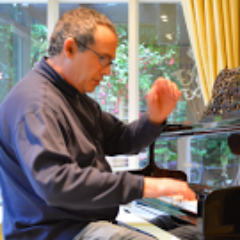
My parents moved from Hammersmith to Surrey when I was 3 years old, and the house they bought came with an old grand piano that was left behind! I remember being fascinated by the keyboard and what went on behind the lid. I had my first lesson when I was 5, and remember my response to my father asking me if I wanted lessons being “yes, but will I have to practise?” The rest is history.

Who or what inspired you to start teaching?

I studied with Judith Burton for a decade until I went to the Royal Northern College of Music in 2000. She was so dedicated, and her devotion to every one of her students filled me with admiration. She has certainly been my biggest influence with regards to teaching; I always used to think, “if I can spend my time doing what Judith does, I’ll be happy.”

My path hasn’t always been that clear. I struggled with my relationship to music in my later years at music college, and despite achieving an MMus degree, I left feeling convinced that I would convert to law! After speaking to many people about it, the woman who helped me to see the wood for the trees was my piano teacher at the time, Carole Presland, who said, “if you say you love to work with people, what more privileged position can you be in, than to teach students on a one-to-one basis, where you really get the chance to make a difference?”. That was enough to help me back onto my path and I’ve never looked back.

Who were your most memorable/significant teachers?

They are all memorable and significant!

Judith Burton I have already mentioned. We are still good friends, and she was my biggest influence and guide when I was young.

At the RNCM, I studied with Kathryn Stott for 2 years, then Carole Presland for 3 years.

After graduating, two teachers have really helped me in different ways:

Vera Müllerová is a Czech teacher and concert pianist who I met while teaching on a Summer residential course. She showed me some finger exercises that, in one session, solved technical problems I’d been having with trilling in 3rds for years! I now visit her in Plzen once or twice a year to take lessons.

On the same summer course, I met a jazz teacher, who persuaded me to join his student trio for 15 minutes one evening to learn a blues. I had never played by ear and was terrified! In 5 minutes, he had me playing “Sunny Moon for Two”, improvising round it, and taking solos with the band. I was elated, and it felt like the first time I’d really had fun while playing the piano. His name is Paul Cavaciuti, and he is now my husband!

Who or what are the most important influences on your teaching?

This is a difficult question to answer!

My own state of mind is my biggest influence on my teaching. As a professional musician, it is easy for our music-making to become something we MUST do, and this can become tiresome. Also, finding a good balance between teaching and playing is not easy and needs constant adjustment. I put a lot of time and energy into maintaining my own love of music, feeling inspired, and ensuring that what I pass on to my students, predominantly, is a love of music and playing the piano. My husband is wonderful and helps me a lot with this. His expertise is in helping people rediscover their love of music and also helping with stage fright. I’m so lucky to have him available to me 24/7!

Other influences, among my own teachers, are Horowitz, Dr. John Diamond (an educator in the US who has created his own system which involves using the arts therapeutically), and our record collection. We have thousands of LPs, most of which are jazz and classical, and every time I listen to one, I’m immediately drawn to the piano to play, or come up with ideas for my students! I’m sure it has something to do with the analogue sound production. I never feel the same when listening to digital.

Most memorable/significant teaching experiences?

Every teaching experience is significant, and sometimes we have to trust that what we show our students now, may not sink in until much later on in life. My most rewarding experiences are when I take on a student who has been traumatised by the grade exams, or is about to quit, and within weeks they have found a new approach to playing, and realised that they do, in fact, love music after all. It brings me such joy!

What are the most exciting/challenging aspects of teaching adults?

One of the most challenging aspects is that many adults have pre-conceived ideas of things, so often they want a detailed explanation of why I’m asking them to do something, rather than just rolling with it and seeing where it takes them. I don’t see it as a negative – it’s natural that adults want to understand first and experience afterwards – however it’s not always the best way to learn.

The most exciting thing is seeing adults enjoying themselves through music, and doing something meaningful with their time. In today’s society, many parents offer the opportunity to learn music to their children, but secretly long to play or sing for themselves. I feel so excited when a parent comes to me and says, “can I have a lesson?” Being an adult brings with it so many responsibilities of the “must” kind. It’s great therapy to commit to something (especially something creative) for the love of it. If I can assist with that, I am delighted to.

What do you expect from your students?

Application. That’s it.

I’m not concerned with achievement or standards. Nor do I mind if their attitude isn’t positive for a while. We all have our struggles, and if I can find a way to use music to help them through troubled times, then my work is done.

What are your views on exams, festivals and competitions?

Firstly, the term festival is misused. A festival is a celebration of something, and we use the term to describe competitions. Lose the competitive element, (but keep the constructive, positive adjudications) and I think they would be fantastic occasions!

I think exams and competitions are a disaster. I won’t blither on for too long about this (that’s for a future blog!), but developed societies are obsessed with assessment and quantifying ability. This has absolutely no place in the arts, especially in music, and the rise of grade exams and competitions has contributed to:

  • an increase in competitiveness among musicians and parents, (e.g. children in the playground saying “what grade are you on” instead of “fancy a play sometime?”)
  • an increase in performance anxiety and even stage fright.
  • a focus on skill acquisition without a true understanding of music being a language, and to the detriment of having something to say through playing or singing.
  • in the words of Horowitz, “standardisation”. Everything is now the same, instead of people playing as individuals. The idea of playing correctly and incorrectly shouldn’t be at the forefront of a musician’s mind, and it is only with note-reading that it’s an issue at all.
  • a feeling of self-worth being attributed to achievement. Musicians who receive distinctions in exams are often the ones who won’t play in restaurants, at parties or among friends. I think that’s tragic.

I could go on, but I should probably stop there. As a teacher, I want to spend my time convincing people that learning music for the sake of the music, and bringing people together, is enough. Benchmarks are not necessary to become a great musician!

What do you consider to be the most important concepts to impart to beginning students, and to advanced students?

To both beginner and advanced students, to love playing music. Another important concept is to realise is that the music comes from the person, not the instrument. The instrument is there to help release the music (though some instruments are more of a hindrance!)

What are your thoughts on the link between performance and teaching?

I think they are very complimentary; however I think the importance of their connection differs depending on whether the musician has been professionally trained or not.

A musician who has trained to perform professionally, should perform. There are too many teachers who have stopped playing in public, and project bitterness and envy onto their students. This is the most destructive thing a teacher can do, therefore maintaining a balance, in my eyes, is essential. (I’m not suggesting we should all be playing at Wigmore, but some kind of performance is important – like nourishment!)

The advantage of having performed is the advice that can be imparted from the experience of having done so. Performing does feel quite different to playing to the four walls and the dog.

An amateur musician who teaches because they love to teach, but has never really performed, or had the opportunity to perform publicly, is unlikely to pass any such negativity onto their students. Their relationship to music is probably quite different and unaffected by the rigours and strains of the profession. For this reason, it isn’t important that they perform.

How do you approach the issue of performance anxiety/tension?

I’ve been through the mill with performing-techniques. Been there, done that, bought the T-shirt. The one thing that has helped me more than anything, and that I do to this day, is sing along internally while I play. I do lots of singing aloud at home (and ask all my students to do the same), then on stage, whatever state I’m in, singing under my breath grounds me, helps me to concentrate without thinking too much, and regulates my breathing perfectly – consequently releasing tension. The ceiling could fall in or Jack Bauer could walk past, and I’d stay focused. It really is the best thing, and I learnt it from my husband!

Who are your favourite pianists/pianist-teachers and why?

My favourite classical pianist has to be Horowitz. Every time I listen to him or watch him on Youtube, I sit at the piano for ages afterwards. He’s so inspiring.

For years, my idol was Alfred Brendel. He has an incredible mind, and a wicked sense of humour. He’s a real artist – I’ve been to many of his concerts, and he played differently every time. On a bad day he was great, on a good day, he was sublime. (I went to his final retiring concert at the RFH, and shed tears on and off all the way home!)

In the jazz world, I adore Art Hodes. He was playing in the US in the 30s and 40s, and had the most incredible groove. The amazing thing about him is that his music is often in the spaces between the sounds. He isn’t flashy or a show-off, but boy does he make you want to tap your foot!

Lastly, (I suppose this counts as he was a pianist and a teacher), it has to be Beethoven. Whoever composes music and says, “Music is the mediator between the life of the senses and the life of the spirit” knows his purpose as a musician, and to elevate others to something higher, is a wonderful purpose.

Nadine’s biography

Nadine André’s website

For the Love of Playing – Nadine’s blog

Nadine on Facebook

Follow Nadine on Twitter

Nadine’s contemporary trio, Trifarious

And on Facebook and Twitter

Classical Babies

What is your first memory of the piano? 


A dark black shiny upright in my parents living-room that I couldn’t stay away from. Never mind dolls and toys…..this became the most irresistible, exciting, time-consuming and total love of my earliest years

Who or what inspired you to start teaching?

I’ve always loved people and helping/ sharing: even as a child if I learned something myself – my joy was to share it with others, in order to derive complete enjoyment and satisfaction from it.

Who were your most memorable/significant teachers? 

I was lucky with my teachers throughout: firstly, my earliest teacher (an unknown German lady called Else Schumann) inspired me, through her belief in my talent (I was 10 or 11 years old) and her encouragement of my natural gifts. Then, the wonderful Sidney Harrison who selected me (from those auditioning for the Junior Department at GSMD) to study with him, from the age of 11, and who continued to boost my confidence with his encouragement and delight in my abilities. Finally, the significance and importance of the legendary Greek pianist, Gina Bachauer, my mentor and “musical mother” and my beloved Ilona Kabos (the distinguished Hungarian teacher to so many of the great pianists) from the age of 15, who changed my way of thinking, attitude, and started me on the “road to artistry”. I also spent a wonderful six months in Paris, concentrating on French music with another legendary figure, Jacques Fevrier. Altogether the strongest and best influences one could ever hope for.

Who or what are the most important influences on your teaching? 

I think my work with Ilona Kabos planted the seeds from which my own “methods and ideas” grew: the importance of sound, understanding the depths and possibilities, the keyboard has to offer and how vital is stylistic awareness.

Most memorable/significant teaching experiences?

All my teaching experiences have brought their own memorable and significant moments……but, I think (in terms of working with great young talent) the years of teaching for the Horowitz Foundation, in Kiev, Ukraine have been the most exciting and rewarding.

What are the most exciting/challenging aspects of teaching adults?

If you mean, late beginners……. I have not much experience in this area but, would be fascinated by the challenge of dealing with the physical problems that may hamper the speed of learning to “make music”!

What do you expect from your students? 

A huge sense of responsibility to serve the music, at all times.

What are your views on exams, festivals and competitions? 

Wonderful experience, if dealt with correctly………from an emotional/psychological standpoint.

What do you consider to be the most important concepts to impart to beginning students, and to advanced students? 

I repeat, that all we do has to serve the music………i.e. that every technical problem, ceases to be that, if making sense of and finding the spirit of the music, is the goal. Obviously, with beginners an understanding of how the hands and keyboard connect, and the raison d’etre, is vital.

What are your thoughts on the link between performance and teaching? 

Again, vital! I do believe it is imperative to have an understanding of what it means to perform, at a certain level, before one can deal with the problems the would-be-performer has to face. Also, it is only when one has prepared oneself at the highest level can one understand how to help prepare another.

How do you approach the issue of performance anxiety/tension? 

Very difficult and requires much thought and understanding of the student’s mentality and personality. Everyone is different and these different problems have to be dealt with, accordingly.

Who are your favourite pianists/pianist-teachers and why? 

I adore Murray Perahia and, on the odd occasions, when I’ve heard him teach……..I adore his logic and humanity. I’m sure, my idol, Grigory Sokolov, would make a fantastic teacher (if he were to have the time and desire!) as his understanding of sound quality/ quantity, is second to none.


Norma Fisher will be teaching at London Master Classes 2014 Summer Master Course, July 8 -13 at the Royal Academy of Music and Purcell Room, Southbank Centre, July 8-13 www.londonmasterclasses.com, Accademia J.S.Bach, Sardinia, July 19-29 2014, and MusicFest Perugia, Italy, August 2014 

Norma Fisher is acclaimed internationally as one of the UK’s leading pianists and teachers.  As a child she was recognised as ‘a rare musical talent’ winning an exhibition, at the age of eleven, to study with Sidney Harrison at the Guildhall School of Music.  At the age of fourteen she came to the attention of the celebrated Greek pianist Gina Bachauer who became her mentor, introducing her to the distinguished Hungarian teacher IlonaKabos, with whom she subsequently studied. A period was also spent in Paris studying French music with Jacques Fevrier. 

Her many, highly acclaimed, early performances for the BBC led to an invitation by the German radio station RIAS, in Berlin, to make her debut with the Berlin Symphony Orchestra – which launched her career in Europe. Success in the Busoni International Piano Competition as a top prize-winner followed and in 1963, when she shared the much-coveted Piano Prize in the Harriet Cohen International Music Awards with Vladimir Ashkenazy, her international reputation was sealed.  That same year she made her debut at the Proms in the Royal Albert Hall and became a favourite soloist with leading British orchestras including the London Philharmonic, Philharmonia, London Symphony, Royal Philharmonic, BBC Symphony, Hallé, Bournemouth Symphony, and the City of Birmingham Symphony orchestras. 

Norma Fisher is known for her versatility as a performer, receiving recognition worldwide as one of Britain’s leading pianists. This versatility extends to chamber music, which she plays with leading musicians throughout the world.  Her early relationship with the Dartington, Allegri and Delme String Quartets led to a much sought-after partnership with the Stamic Quartet of Prague, both in the UK and the Czech Republic. She has also performed regularly with the International Chamber Ensemble of Rome, Carmina Quartet and Reykjavik Wind Quintet and partnered such well known soloists as Stephanie Gonley, Alan Hacker, Maurice Hasson, Emanuel Hurwitz, Ralph Kirshbaum, Steven Isserlis, Peter Lukas Graf, GyorgyPauk, Hu Kun, Sylvia Rosenberg, GrigoriZhislin, Yossi Zivoni and singers Benjamin Luxon, Sherrill Milnes, Nelly Miricioiu and Sir John Tomlinson. 

Her reputation as a teacher is widely established and many of her top prize-winning students are well known on the international concert circuit. She is aProfessor of Piano at the Royal College of Music and a Fellow of the Royal Northern College of Music.She is invited to give masterclasses throughout the world and has taught at the International Musician’s Seminar at Prussia Cove, UK, the International Summer Academy in Lenk, Switzerland and the Horowitz Foundation Summer Music Academy in Kiev, Ukraine, amongst many others. She is regularly invited on the Jury of leading international piano competitions including Gina Bachauer (USA), Horowitz (Kiev, Ukraine), Joanna Hodges (USA), Boston Grand Amateurs (USA), Newport (Wales), Sydney (Australia), Tbilisi (Georgia) and Virginia Waring (USA),  

She is the Artistic Director of London Master Classes (www.londonmasterclasses.com) whose courses attract major talent from around the world to work intensively with top performers/teachers in London. London Master Classes 2014 will celebrate 26 years of offering these prestigious events. 


What is your first memory of the piano?

My piano journey began more or less when I was 3 or 4 years old. Movers brought a 1932 5’3” Chickering baby grand to our house. It was a gift from my grandparents.

That piano eventually travelled with me from one coast to another in America, which is where I’m from. It came with me when I arrived in the UK 4 years ago.

Last summer I acquired a new Steingraeber Phoenix 205. It’s an amazing instrument. I looked at a lot of pianos in the UK and America  before I selected it. Some of them were very good but none of them had the special, personal “this is the one – this one is it” kind of feeling I was looking for. When I finally met the 205 at Hurstwood Farm Pianos in Surrey it did seem like the one. It’s definitely reaffirmed that to me since arriving in my house.

There are more than a few fascinating lessons I learned looking for a piano which I’ve written up on my blog. Meanwhile, the Chickering has moved to my neighbour’s house for new and more family adventures.

Who was your first teacher and what do you recall about your early days of learning about the piano?

My first teacher was a very nice woman in our town in New Jersey. But after not all that long I mostly taught myself. I wasn’t systematic or organised in what I learned. It was mostly the Chickering was in the house and I’d play by ear.

From the beginning I had an affinity for jazz. I don’t know why or from where or how because I remember hearing Liberace and Victor Borge but not jazz. I also recall trying to pick out bits of the ‘Rite of Spring’ after hearing a recording of it. But picking out tiny bits of the ‘Rite of Spring’ was about all I could do.

Do you remember what you liked to play?

The Joy of Boogie and Blues’ was the book that had my interest. When I played the pieces in it with the right spin they sounded like boogie and blues. But I hadn’t yet heard real boogie boogie such as Albert Ammons and Pete Johnson used to play. And I didn’t know about New-Orleans-style piano playing even though ‘The Joy of Boogie and Blues’ had pieces in that genre. And of course I didn’t know of the great jazz pianists like Art Tatum, Bud Powell, and Bill Evans.

My parents and neighbours used to say I had a “nice touch” when I played boogie-woogie-type things. That phrase resonated with me. I could feel what it meant in my hands. And I could hear how that feeling translated into sound.

Who or what inspired you to start teaching?

While working towards a PhD in composition at the University of Pittsburgh I taught courses in basic theory and musicianship, jazz history, class piano, and a seminar on Mozart. Teaching was part of what PhdD students did while working towards the degree. So that’s where I began with students and learning about teaching and how to do it – and finding that I really liked it.

Who were your most memorable/significant teachers?

The important teacher who fastened my wheels to the track was Floyd “Floogie” Williams. I met Floyd in the second semester of my first year at university which was mid-1970s. He had recently moved to the area from New York City where he had been a drummer and a percussionist in jazz and studio worlds.

Learning with Floyd was immersion all things musical. I couldn’t possibly have had a better teacher. He had experience in the world I wanted to enter. Essentially he put one on the path towards that world.

Lessons with Floyd always included stories and more stories, all them colourful, about how this or that musician practiced and learned. And there was always an important point that came out of it all. With the piano Floyd boiled it down to one essential: Practice and practice some more.

What he meant was put in time and effort. Serious time and effort – as a method it was brute-force “put-your-back-into-it.” I spent virtually every hour of the day playing Bach, and Chopin, Beethoven, and Oscar Peterson piano transcriptions or picking excerpts out of the Dover editions of scores.

Another big lesson from Floyd was to the importance of being around great pianists – to see and hear firsthand how the did what they did. So Floyd arranged for me to visit to New York City to meet John Lewis, who had who played with Charlie Parker and later formed the Modern Jazz Quartet. A few months later Floyd sent me to New York City again. This time for lessons with Jaki Byard.

Jaki is among the great pianists and teachers in jazz. He played like a one-man jazz repertory orchestra, always with allusions to different pianists and styles, all of which he juxtaposed with wit and great humour.

So for example Jaki’s left hand might play in a stride piano style. But his right hand would play over it in very free bebop style – and perhaps in a different key. But the thing was, no matter what Jaki played he sounded uniquely like Jaki and never like he imitating something. Jaki was postmodern long before postmodernism was a style.

Who or what are the most important influences on your teaching?

At New England Conservatory I continued studying with Jaki and then I switched over to William Thomas McKinley who’s a composer and a jazz pianist. Whereas Jaki’s approach to the piano was based on play, play, and play Tom’s way – because  he was a composer – was write, write, write. So I wrote excerpts and examples – I filled notebook after notebook – of what I wanted to improvise.

I also took lessons outside of NEC from Charlie Banacos who had his own fascinating teaching niche. Charlie was a great jazz pianist but he gave up performing to focus exclusively on teaching. And he was well-known as a teacher – as perhaps “the teacher. All his students first went through his two-year waiting list before lessons began. Many of Charlie’s students went on to play with fabulous jazz musicians. And Miles Davis said he wanted to study with Charlie!

Most of what Charlie taught was simple in concept – for example transcribe a McCoy Tyner solo. But to do that required a lot of focused work with a tape recorder. Once the solo was transcribed, the next step was to play it at speed.

With Charlie simplicity of concept definitely wasn’t the same as ease of execution. Some  of the “simple stuff” Charlie showed me a long time ago is still among what I practice now.

The big picture I synthesised from all of that which is right at the centre of how I teach is “Experiment: cast the net freely and widely.” In other words explore, explore, explore – as Robert Frost said very well:

Two roads diverged in a wood, and I—

I took the one less traveled by,

And that has made all the difference.

I moved to New York City in the early 1980s after New England Conservatory and Boston. New York was exhilarating because it was populated to beyond bursting with fabulously-skilled musicians. If there’s a genre or a style of music anywhere in the world someone in New York is exploring and playing it at some unbelievably high level. Probably along with an entire community of equally-skilled practitioners.

After several years of freelancing there and all sorts of gigs I completed a Masters’ degree in Jazz Piano at the Manhattan School of Music. One of the classes I took there was an introduction to composition. The solo piano piece I wrote for it – along with Tom McKinley’s prescriptions to write, write, write – launched me on to composing.

So I went from the Manhattan School of Music to the University of Pittsburgh for PhD studies in composition and theory. But at the time – mid-1980s – composition there was focused narrowly on serialism through the lens and teaching of Milton Babbitt. Which wasn’t uncommon at that time. But it wasn’t the direction the interested me so I moved on to the Hartt School of Music where there was more plurality of approach and style. That’s where I completed the doctorate.

Beginning in the 1990s I taught composition, music technology, and jazz piano at the University of Maine at Augusta. From there I went to Central Washington University where I directed the music composition and theory programs. During that period I had short and long-term residencies in the United States and Europe – at the Crakow Academy of Music, STEIM in Amsterdam, the Banff Centre in Canada, and the University of California Santa Barbara, among others. And I was always playing jazz.

How do you teach?

Everyone comes to the piano and improvisation with their own interests, strengths, and abilities. So how I teach depends on the interests and experiences my students bring with them. It’s very much based on what they want to learn.

I’d say what I do as a teacher is help students acquire a musical voice. That means on the one hand exploring what, why, and how we do music- and piano-related things. And being creative with whatever comes back from those questions. On the other hand it’s about building as much technique as we can to support creativity. Creativity and technique are the two sides on the same coin.

Most memorable/significant teaching experiences?

I’m keen on teaching improvisation through Skype to students around the world. What’s amazing to me about Skype is it works without getting in the way. So looking into my studio from a distance literally means looking through Skype.

For me, there’s magic and the miraculous in working with students who literally are all around the world. Because with Skype connections to distant places don’t feel distant.

From time to time I’ll think “Well we’re working together in realtime but there’s a 12-hour time difference between us.” Which to me is mind boggling. I’ve had some improvised, interesting two-piano duets with students on Skype.

I’d say what Skype brings out is it’s the creativity and enthusiasm we bring to the learning process that counts. Which is the same for everyone really – without or with Skype. Creativity and enthusiasm are essential.

The biggest challenge with Skype has been managing clock shifts and timezones around the world. So, for example, I’ve since learned some countries – Iran is one and I have a fantastic student there – set their clocks to the half-hour rather than to the hour.

What do you expect from your students?

The first thing I teach is relaxation helps improvisation and playing the piano enormously. Because when we’re relaxed it’s easier to play and make music.

But after that expectations can easily become “it-has-to-be-this-way” or “it-has-to-be-that-way.” If we can reduce “it-has-to-be-this” to as few instances as possible we’re that much closer to relaxation where music and everything can seem easy. So removing expectations is about learning to play and practice in the moment with the skills we have instead the skills we wish we had.

A different example of a removable expectation is the idea that knowledge of theory – scales and chords  – precedes meaningful improvisation. The reality is thinking about theory when improvising is about as helpful as applying theory to playing anything.

Of course later or sooner theory is among the great extra stuff that broadens and deepens how we play. But as a prerequisite to improvisation – and particularly for students who come to improvisation with technique already – it’s not the start point.

What are your views on exams, festivals and competitions?

I’m mostly interested in the quality of experience of the individual – instead of the quantity of quality competition judges have to quantify. The thing is, quality of experience doesn’t depend on prescribed skill levels. A different way to say that is I’m focused on processes of music-making – because experience is process.

On the other hand I competed in the Thelonious Monk International Jazz Piano Competition which is the huge international one of the jazz world. I was a finalist in the the Great American Jazz Piano Competition. My Robots-in-Residence installation which I built in Denmark was a prize-winner in a competition in France. I learned a lot by being in those events and I’m glad I had those experiences.

And many pianists know competitions and such to be exactly what they want to enter into. In that case of course I’m happy to assist and support. But to the question of “are competitions and such things fundamentally part of learning to play an instrument?” my opinion is, no, they’re not.

What do you consider to be the most important concepts to impart to beginning students, and to advanced students?

Being in the moment with the music we’re making. Focusing on right now. To do that we have to relax. Which isn’t a question of “Are we relaxed? Yes or no?” It’s that relaxation is a continuum. Which means we can always bring it to deeper and deeper levels.

Also important is listening to the sound that comes from the piano. Listening to how the piano resonates. How it projects. One way forward with this  play and listen to single, sustained notes – long tones at the piano.

It’s like magic but ears and mind usually then go right to the moment – because they’re listening to the attack, sustain, and decay of each note and then each note after that.

How do you approach the issue of performance anxiety/tension?

We all deal with it in one way or another. I wish I knew how to banish it once and forever. But the reality probably is that’s just part of music making and not really all that unusual.

My approach is to work with it in small increments – instead of looking to conquer or suppress it once and for all. Small increments could mean learning to use specific relaxation techniques of which breathing is one of them.

Breathing meaning focusing on and recognising the importance of breath while we’re at the piano. And of course listening to the sound of the piano. Focusing on sound as it floats out of the piano. The more we focus on breath and sound the more we go to those worlds and then on to relaxation and the moment of “right now.”

Differentiating between “practice” and “performance” mode can be helpful. Practice mode is about working out details and looking to improve “this thing” or “that thing” or both things or all things. It’s intentionally focused to things such as “play these notes” or “perform that passage softly.”

Performance mode on the other hand doesn’t require analytic thinking. It doesn’t require that we try to do something better today than yesterday. It’s sitting down at the piano and being in the moment: Comfortable, and relaxed with the music we make, the sound we hear, the ability we have. Then “letting” everything flow together into a performance. Instead of “making” it flow together into the performance.

Are there any books you’d recommend to pianists or musicians or anyone interested in improvising?

The book for the desert island, assuming the piano’s already been delivered, is The Listening Book: Discovering Your Own Music by W.A. Mathieu. It has listening exercises and philosophy for everyone at every level of ability and experience.

How can we contact you?

My Mark Polishook Studio website is a blog about improvising, jazz, and all things of interest to pianists. My email address is mark@polishookstudio.com.

Dr. Mark Polishook, a pianist, composer, and music technologist, teaches improvisation in his studio in Leicester and on the internet through Skype. Among his compositions is Seed of Sarah, an electronic chamber opera that was made into a film seen across North America, Europe, and Australia. As a jazz pianist Dr. Polishook has performed with many eminent artists. 

To the experimental side of sound art Dr. Polishook has worked with graphics tablets, robots, and open-source software. His Robots-in-Residence installation which he created in Denmark was a prize winner in the 2004 International Bourges Electro-acoustic Music Competition in France. 

Dr. Polishook directed the music composition and theory programs at Central Washington University. He’s been a professor of jazz piano at the University of Maine at Augusta and a Senior Fulbright Lecturer at the Crakow Academy of Music in Poland. Dr. Polishook has been a resident artist in the Aarhus Computer Science Department, at STEIM in Amsterdam and at CREATE at the University of California Santa Barbara. 

He has a DMA in Music Composition from the Hartt School of Music, a masters’ degrees from the University of Pittsburgh and the Manhattan School of Music. His undergraduate degree is from the New England Conservatory of Music.