
SOMM JUNE RELEASE: SOMMCD 259
Release date: 29 April 2016
PROKOFIEV PIANO SONATAS VOL. 3, The “War Sonatas”, Nos, 6, 7 & 8
Peter Donohoe – piano
“Donohoe’s authoritative playing shines through in every work — he has lived with these pieces for a long time… In his hands every sonata makes a memorable impression, and the Fifth receives one of the finest performances I have encountered on disc. A wonderful anthology. Next instalment, please!” Classical Ear (of Vol. I).
“The recording is exemplary, fully projecting Donohoe’s massive dynamic range. The finale of the Second Sonata epitomises all that is Prokofiev, and, in Donohoe, all that is great Prokofiev playing… The helter-skelter character of No. 3 is perfectly conveyed through Donohoe’s impressive technique. There are performances of both No. 2 and No. 3 by Gilels in existence, and Donohoe loses little in that exalted company. It is No. 4 that is the highlight, though, a performance of magisterial intensity. No. 5 receives a performance of the utmost integrity. Magnificent” . International Piano (of Vol. I).
“This intelligently planned programme is played by musicians fully attuned to Prokofiev’s expressive lyricism and humour… Raphael Wallfisch and Peter Donohoe give the music’s opening narrative a compelling sense of direction, making the gentle, inward quality of the exposition’s end all the more captivating.” ***** BBC Music Magazine (of Vol. II).

This is the third and final volume in Peter Donohoe’s highly-praised recordings of the complete Piano Sonatas of Sergei Prokofiev and SOMM are proud to have been able to capture his mature interpretative thoughts on the composer’s War Trilogy. Prokofiev was a magnificent pianist and, like so many of his predecessors and contemporaries, he would often reserve his most personal and intimate thoughts to the music he wrote for his own instrument. Sonatas Nos. 6, 7 and 8, written consecutively during World War II, reflecting on and reacting to the horrors of what was referred to in Soviet Russia during their titanic struggle against Hitler as the ‘Great Patriotic War’, drew from Prokofiev some of his greatest music, expressed through his own instrument, the piano, producing in the central sonata of the trilogy, No. 7, his most famous and brilliant piano music, with the exciting finale marked Precipitato (impetuous, headlong) depicting the ferocity and grit of the Russian attacks on the Nazi army. The beautiful Sixth Sonata is more personal and inward-looking, contemplative and moving, and the Eighth looks forward to a post-war world in which all conflict on Russian soil will have ceased.
Peter Donohoe has always been closely attuned to Russian music and particularly that of Prokofiev and his recordings of the War Trilogy go back more than 30 years. He first recorded the 7th Sonata in 1982 for HMV then again in 1991 together with the two other “War Sonatas”, 6 and 8 for EMI. He believes that Prokofiev’s Sonatas form one of the greatest piano solo cycles in the repertoire. ‘Prokofiev was creating these major works throughout his career — all of them are major and some are still underrated and I am delighted to have had the chance of recording, on SOMM, the complete cycle at last.’
Tracklisting:
Piano Sonata No. 6 in A, Op. 82 (1940)
[1[ 1. Allegro moderato
[2] 2. Allegretto
[3] 3. Tempo di valzer , lentissimo
[4] 4. Vivace
Piano Sonata No. 7 in B flat, Op. 83 (1942)
[5] 1. Allegro inquieto — Poco meno — Andantino
[6] 2. Andante caloroso – Poco più animato – Più largamente – Un poco agitato
[7] 3. Precipitato
Piano Sonata No. 8 in B flat, Op. 84 (1944)
[8] 1. Andante dolce – Allegro moderato – Andante dolce come prima – Allegro
[9] 2. Andante sognando
[10]3. Vivace – Allegro ben marcato – Andantino – Vivace come prima
Peter Donohoe – biography
Peter Donohoe was born in Manchester in 1953. He studied at Chetham’s School of Music, gratuated in music at Leeds University and went on to study at the Royal Northern College of Music with Derek Wyndham and then in Paris with Olivier Messiaen and Yvonne Loriod. He is acclaimed as one of the foremost pianists of our time, for his musicianship, stylistic versatility and commanding technique.
Recent and forthcoming engagements include appearances with the Dresden Philharmonic, the BBC Concert Orchestra, RTE National Orchestra and CBSO (under Sir Simon Rattle), a UK tour with the Russian State Philharmonic Orchestra as well as concerts in South America, Europe, Hong Kong, South Korea, Russia and the USA. Other engagements include performances of all three MacMillan piano concertos with the BBC Scottish Symphony Orchestra, a series of concerts for the Ravel and Rachmaninov Festival at Bridgewater Hall alongside Noriko Ogawa, and performances with The Orchestra of the Swan. Donohoe is also in high demand as an adjudicator at piano competitions around the world, including the International Tchaikovsky Piano Competition, Moscow, the Queen Elisabeth Competition, Belgium, and the Hong Kong International Piano Competition. Recent recordings include two discs of Prokofiev pianos sonatas for SOMM, the first of which Gramophone described as “devastatingly effective”, declaring Donohoe to be ” in his element”. Other recordings include Cyril Scott’s Piano Concerto with the BBC Concert Orchestra under Martin Yates for Dutton and Malcolm Arnold’s Fantasy on a Theme of John Field with the Royal Scottish National Orchestra and Martin Yates, also for Dutton.
Donohoe has worked with many of the world’s greatest conductors including Christoph Eschenbach, Neeme Järvi, Lorin Maazel, Kurt Masur, Andrew Davis and Yevgeny Svetlanov. More recently he has appeared as soloist with the next generation of excellent conductors such as Gustavo Dudamel, Robin Ticciati and Daniel Harding.
Peter Donohoe is an honorary doctor of music at seven UK universities and was awarded a CBE for services to classical music in the 2010 New Year’s Honours List.
[Source: press release]
 Liszt’s life and music have been the subject of numerous film adaptations. On one hand, Charles Vidor’s Song Without End (1960) won an Academy Award for Best Musical Score, as well as a Golden Globe for Best Motion Picture. On the other hand, Ken Russell’s Lisztomania (1975), based on the novel Nélida, written by Liszt’s first important mistress, the Countess Marie d’Agoult, was notorious for its re-imagining of Wagner as a vampire (yes you read that correctly…) and its use of giant phalluses, reminiscent of Japan’s Shinto Kanamara Matsuri. One of the 20th century’s greatest pianist, Sviatoslav Richter, played the role of Franz Liszt in the 1952 Russian film entitled The Composer Glinka, while Liszt’s Second Hungarian Rhapsody in C Sharp Minor was immortalised by the evergreen animated duo of Tom and Jerry.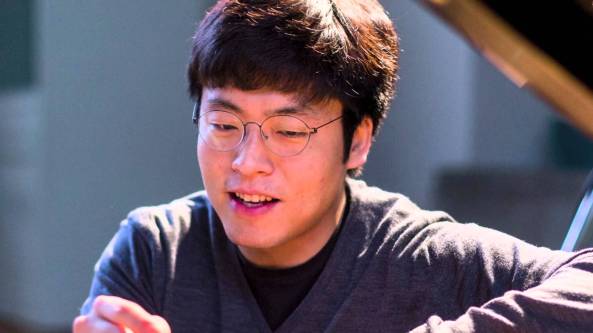




 The Cross-Eyed Pianist