Opus 109 – Vikingur Olafsson

A late masterpiece by Beethoven lies at the heart of this new release by Icelandic pianist Vikingur Olafsson to create a dialogue across the centuries.

The works of Beethoven’s third creative period feel both intimate and cosmic. It is the music of the future, yet it is fuelled by the music of the past – the music of Bach.

Vikingur Olafsson

Olafsson eschews the usual custom of presenting Beethoven’s final three sonatas together and instead places the transcendent Opus 109 alongside pieces by J S Bach and Franz Schubert as well as Beethoven’s Sonata Ppus 90 to create a ‘concept album’ where pieces connect and reflect.

For Olafsson, it was Bach’s Goldberg Variations (which he recorded in 2023) that drew him to Beethoven’s last three sonatas. He “felt the presence” of Bach in these late masterpieces, works where Bach’s influence is most strongly felt in their “wild polyphony”. The Sonata Opus 90, meanwhile, offers a prelude to the Opus 109 with its intimate, fleeting first movement and warm second movement, while also looking forward to Schubert’s early period sonata in E minor, D566, also scored in two movements. The other works on the album are Bach’s prelude in E major from the Well-Tempered Clavier and the imposing E minor Partita, perhaps the greatest of his keyboard suites.

Another unifying thread through the album is that all the pieces are in the key of E (major and minor modes) which for Ólafsson, who has a form of synaesthesia, represents lush and vibrant shades of green.

The album opens with the Prelude No. 9 in E from Book 1 of the Well-Tempered Clavier, played with Olafsson’s trademark luminous tone. It’s an intimate opener and contrasts with the drama of Beethoven’s Sonata No. 27, the first movement of which is imposing yet carries with it, especially in the second movement, the same airy elegance of the Bach Prelude.

The E minor Partita is serious, majestic, articulated with clean Baroque detachment and sensitive voicing. Olafsson finds the same intimacy in the middle movements of the Partita, in particular in the Allemande, which is almost tender in its counterpoint. The Sarabande, prayer-like and sombre, has an improvisatory quality. The closing Gigue, meanwhile, is energetic and crisply articulated.

We stay with E minor in Schubert’s two-movement Sonata D566. Olfasson’s transparent sound and subtle phrasing suit Schubert and he brings a warm cantabile to the music, in particular in the second movement.

With his characteristic clarity, poetic imagination and instinct for colour, Ólafsson approaches Beethoven’s late-period masterwork as a living, breathing meditation – fragile, searching, ultimately transcendent. The opening movement is natural, almost spontaneous, with a conversational quality in its phrasing.

The middle movement bursts forth with a controlled ferocity. Here, Ólafsson’s articulation is exceptionally clean, almost crystalline, but never merely virtuosic.

The emotional heart of this sonata is the third movement, with its tender, prayerful theme. Each variation has its own emotional landscape, shaped with meticulous attention to detail and rich in genuine feeling, yet Olafsson never loses sight of the overall narrative arc of this movement. His voicing allows inner lines to glow while the delicate filigree in the upper registers shimmers delicately. The music seems to unfold in a single, unbroken breath, time almost suspended in the later variations. Here is the music’s spiritual core and Olfasson invites us to bask in its radiance.

The album closes with the Sarabande from the E major French Suite, as Olafssons takes us back to the beginning, as it were, with J S Bach, the daddy of them all.

As with his previous releases, notably his recordings ‘Rameau and Debussy’ and ‘From Afar’, Olfasson brings a fresh perspective to well-known repertoire through thoughtful programming, finding intriguing connections and shining a new light on the familiar. And it’s all beautifully presented too.

Opus 109 is released on Deutsche Grammophon on CD and streaming

Kapustin: Between the Lines

Ophelia Gordon, piano

Nikolai Kapustin (1937–2020) occupies a distinctive place in 20th- and 21st-century music. A classically trained pianist and composer, Kapustin cleverly fused the formal, structural rigour of classical music with the rhythmic vitality and improvisational idioms of jazz. His works defy easy categorisation: though they sound spontaneously jazzy, they are entirely notated in classical form, leaving no space for actual improvisation. This paradox became the hallmark of his style.

Born in Horlivka, Ukraine, Kapustin studied piano at the Moscow Conservatory, under Alexander Goldenweiser, at a time when jazz was still viewed with suspicion by Soviet authorities. Kapustin’s fascination with American jazz pianists like Art Tatum, Oscar Peterson and Erroll Garner led him to explore the genre secretly and he absorbed its harmonic language, rhythmic energy, and phrasing to create his own compositional language. His music is vibrant, cerebral, witty, exuberant and alive.

British pianist Ophelia Gordon makes a striking recording debut with this album of works by Nikolai Kapustin, drawn to his music as it reflects her own background (she grew up in a household full of music, both jazz and classical), her musical versatility and her desire to challenge the barriers between different genres of music.

Ophelia says, “I dream of a world where classical and jazz musicians can perform side by side, with no gatekeeping or barriers. Kapustin’s music makes that dream feel possible. It sits beautifully in the space between genres. It speaks directly to jazz musicians through its harmony and rhythm, and to classical musicians through its texture and form.”

This album is a celebration of the space “between the lines” where Kapustin’s music sits. In preparation for the recording, Ophelia tracked down many long out-of-print vinyl recordings of the composer’s own performances to find the essence of Kapustin’s voice. The recording is also a milestone in that it’s the first full release of Kapustin’s music by a female British pianist.

The album opens with Big Band Sounds, Op. 46 (1986), a piece rich in swing and the textures and timbres of Big Band jazz. Ophelia sashays through it with panache, making a bold opening statement for the rest of her debut album.

Selections from the 24 Preludes follow. Based on Chopin’s model, most of the Preludes presented here are upbeat and foot-tapping, but No. 5 in D Major is more wistful, with hints of Bill Evans. Contemplation follows, a gentle, introspective piece which conjures up a late-night smoky jazz club. Ophelia gives this a wonderful spaciousness, so much so that it sounds improvised there and then.

The Paraphrase on “Aquarela do Brasil” is Kapustin’s take the famous Brazilian standard “Brazil,” composed by Ary Barroso in 1939. Ophelia played along with a samba beat “to lock into the groove” and the piece has a joyful, pacey mood, rich in colour and textures, with occasional moments of almost Lisztian bravura.

The eight Concert Etudes are probably Kapustin’s most well-known pieces and each has a distinct character – punchy, impressionistic, groovy, funky, the Etudes reflect the influences of jazz greats such as Erroll Garner, Art Tatum, Bill Evans, Chick Corea and Herbie Hancock. Ophelia really revels in this music, switching effortlessly between the different characters of each Etude – from the shimmering sixths (perhaps drawn from Chopin?) to the driving energy of Toccatina. There are sonorous bass sounds and hints of Rachmaninov in some of the chords, reminding us of Kapustin’s heritage. Performed here as the complete set, the Etudes are witty, poetic, fierce, relentless, and often beautiful too.

To close, the Paraphrase on Dizzy Gillespie’s “Manteca” for Two Pianos. With its nod to the virtuosic paraphrases of Franz Liszt, with its dramatic flourishes and sparkling fioriture, the piece has a wonderful vibrant energy. Unable to find another pianist with whom to record the piece, Ophelia learnt both parts herself:

“The process was lengthy and difficult but incredibly rewarding. I split the parts into “rhythm” and “melody.” Though both switch roles, it was essential to record the rhythm part first, then play the solo part alongside it. I now perform this live with the rhythm coming through a PA system!”

Recorded on a characterful 1961 Steinway, the piano sound is rich and warm, colourful and immediate, and engineered with a microphone setup designed to balance the immediacy of a jazz trio with the depth and clarity of the classical solo piano. Ophelia plays with a natural virtuosity which never feels contrived nor forced, completely at home with Kapustin’s rhythmic vitality, and myriad harmonies and textures. She clearly loves this music because, as she herself says in the notes, it allows her to “be all of myself at the piano”.

With detailed notes by Ophelia Gordon herself, lending a more personal take on traditional liner notes, this is an impressive debut recording that leaves one wanting to hear more from this bold and authentic artist.

Kapustin: Between the Lines is released on 14 November on the Divine Art label (CD and streaming).

(Artist image: Ben Cillard)

Mirrors & Echoes – Aïda Lahlou, piano

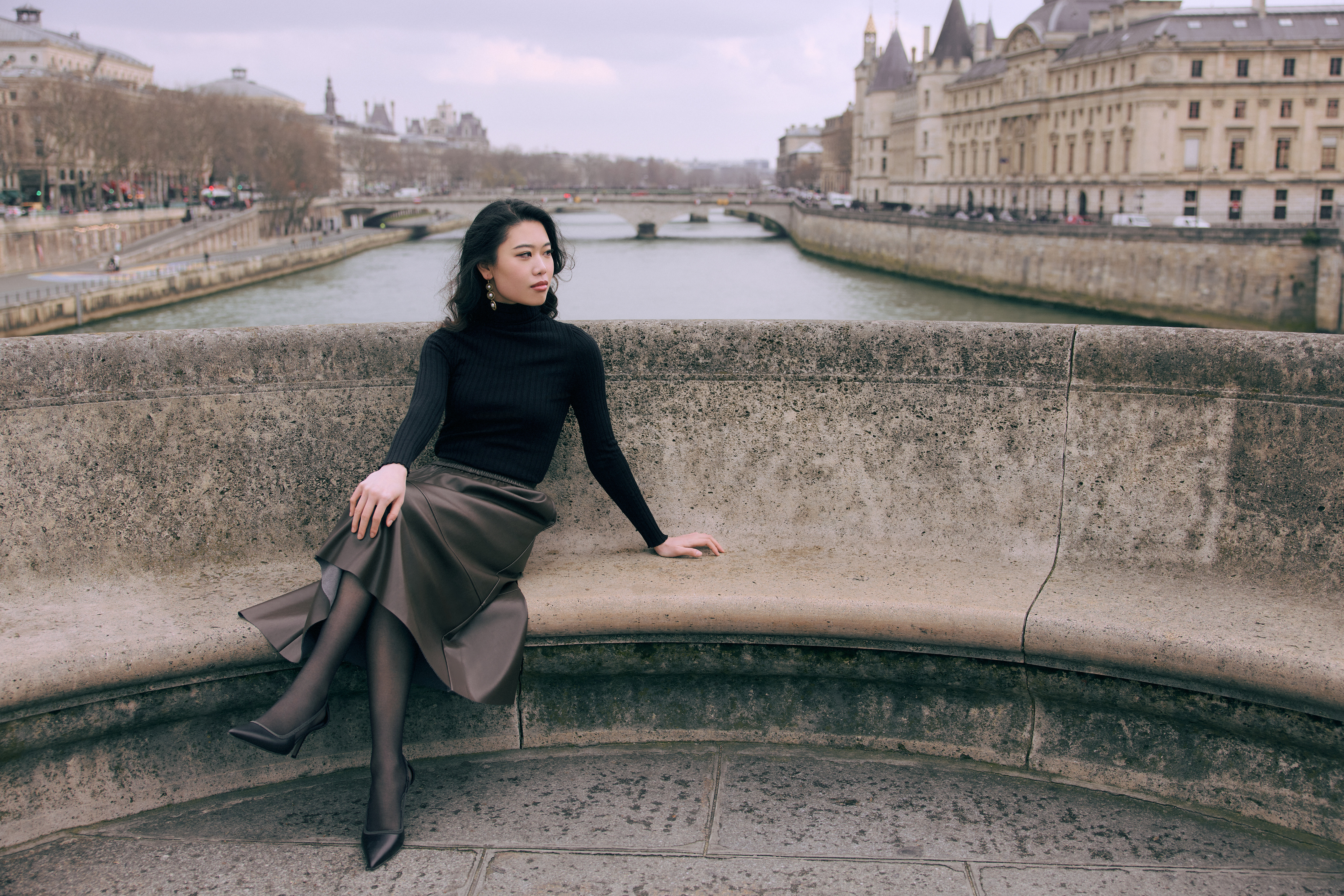
Moroccan pianist Aïda Lahlou makes an exciting and noteworthy recording début with Mirrors and Echoes, released by Resonus Classics on 19 September 2025.

Supported by Les Amis de Maurice Ravel, the album offers a vivid reimagining of Miroirs, placing it in dialogue with lesser-known piano miniatures from across the world to reveal surprising resonances and intertextual connections.

“Whether through spiritual texts, folkloric archetypes, or meditations on nature, each work in the album offers a moment of contemplation and self exploration.” Lahlou says. Drawing on Ravel’s own writing on Miroirs, she adds: “Ravel believed that music should act as a mirror, reflecting back the listener’s own interiority. This album seeks to transport the listener into that reflective space.”

Lahlou’s sensitive interpretation guides us through shifting sonic landscapes and themes of nature, spirituality, memory and transformation. The listening experience is not unlike a musical treasure hunt: Lahlou interweaves Ravel’s visionary five-movement cycle with rare piano miniatures from five continents—some rescued from obscurity, others newly arranged for this recording, like a Brahms motet or a 14th-century Andalucian song, each handpicked for its unexpected kinship with Ravel’s sonic world and its ability to evoke a sense of wonder.

My hope is that the album’s themes – nature, spirituality, and cross-cultural resonance – can inspire renewed awe for life and the richness of our world, especially at a time when it faces such urgent threats from war, pollution, and climate change.” (Aïda Lahlou)

Born in Casablanca and trained across Europe, Aïda Lahlou brings a multicultural lens to classical repertoire that feels both scholarly and deeply intuitive. The brilliant storytelling, weaving together works by Spendiaryan, Stevenson, Tansman, Garayev, Lecuona, and others, alongside arrangements of Brahms, Siloti and traditional melodies, culminates in a programme that is both exploratory and deeply personal. The result is a compelling artistic statement from a distinctive new voice in classical piano.

Mirrors & Echoes is released on CD and streaming on the Resonus Classics label.

Source: press release


About Aïda Lahlou

Born in Casablanca, pianist Aïda Lahlou began studying piano at the age of five with Yana Kaminska, and won her first international competition at eight. She later studied with Nicole Salmon-Boyer (École Normale Alfred Cortot) before receiving a scholarship to attend the prestigious Yehudi Menuhin School in Surrey. After reading Music at St John’s College, Cambridge, she continued her musical studies at the Guildhall School of Music and Drama, studying with Ronan O’Hora and Peter Bithell, and earning a Distinction in Piano Performance (MPerf).

Aïda has performed internationally from a young age, with appearances in venues including Wigmore Hall (London), BOZAR (Brussels), Théâtre National Mohamed V (Rabat), and the Hall of Organ and Chamber Music (Baku). She has performed as soloist with the Orchestre Symphonique Royal, becoming the youngest pianist to do so at the age of twenty, and has performed alongside artists such as Vadim Repin, Roby Lakatos, and Alina Ibragimova.

She has received over 20 national and international awards, most recently the Philip Crawshaw Prize at the Royal Overseas League Music Competition. A passionate educator and communicator, she also directs opera, volunteers with environmental groups, and created an award-winning one-woman show blending classical piano with stand-up comedy.

Praise for Aïda Lahlou

“Aïda Lahlou is a pianist of imagination and poetry, not shy of exploring sonority, colour, or inner voicings.” — The Classical Source

“Vivacious playing.” — Gramophone

“Aida…played with a poetic sensibility of refined beauty and a sense of style and musical intelligence of aristocratic authority.” — Christopher Axworthy

Website: aidalahlou.com