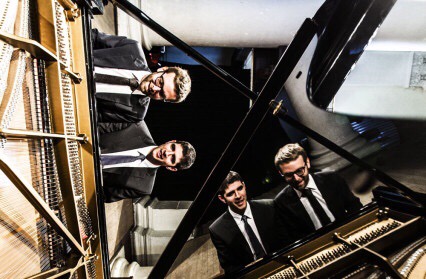
Worbey & Farrell are Steven Worbey and Kevin Farrell….

Who or what inspired you to take up piano, and pursue a career in music?

We’d both say it was really a natural ‘calling’. We’re both from musical families and had a piano in the house. We have similar stories of our parents having difficulty getting us away from the piano. At school neither of us ever went into the playground – we could always be found at a piano somewhere in the music department surrounded by fellow students. A career in music was a happy option. What could possibly be better than doing something you love and being paid for it?

Who or what have been the most important influences on your musical life and career?

We both come from families involved in many aspects of the arts. Kevin’s mother was at the Royal Ballet School and Steven’s grandfather was an accomplished Jazz pianist who toured with a famous dance band. We were both fortunate to be raised with wide a range of great music around us. Steven had inspiring teachers from an early age. Kevin’s college professor Peter Wallfisch was an excellent teacher and rather intimidating but looking back Kevin says he was the most inspiring of them all. Steven’s first Royal College professor was Phyllis Sellick who was wonderful teacher and enormously influential.  He then went on to study with Yonty Solomon and Peter Katin.

What have been the greatest challenges of your career so far?

We’re always challenging ourselves with new arrangements. When we first launched our duo, to stand out we included a fair amount of musical comedy. We soon realised that our strengths were really in the music and arrangements so had to make the changes subtly making the emphasis on the music. This lead to more concert engagements.

Which performance/recordings are you most proud of?

We recently recorded and filmed our arrangements of Bach’s famous Toccata and Fugue in D minor and Gershwin’s Rhapsody in Blue. There are a couple of versions of the Bach arranged for four hands on one piano but we thought them too embellished and heavy with not enough colour and contrasting textures that the piece requires being composed for organ. We were inspired to arrange the Gershwin for four hands on one piano as we feel the versions available don’t quite use the piano to it’s full orchestral potential which can mean crossing hands a lot.

Which particular works do you think you play best?

We like to take orchestral works and try and create orchestral sounds on the piano. You could say we like to think of the piano as our very own symphony orchestra. We wouldn’t take a well written sacrosanct piano piece (i.e. Chopin) and arrange it for four hands as it would simply spoil it. With the use of four hands and some clever trickery, it’s amazing that you can make a piano sound like a lush string section, a muted trumpet or like triangles and Glockenspiels.

How do you make your repertoire choices from season to season?

We’ve discovered that changing repertoire every season isn’t ideal as some of it can go to waste and not be heard by enough audiences. We now add and take away gradually throughout the year making sure that each work is performed to its best and also gets a good airing. We simply choose music that we love rather than trying to pander to our audiences. It wouldn’t be fun for us to play a work that we’ve chosen just because we think the audience may like it.

Do you have a favourite concert venue to perform in and why?

We tend to perform in concert venues and theatres. Concert venues often have wonderful acoustics for the piano but on the flipside they’re not ideal to talk to your audience as your voice gets lost. Conversely playing a piano in a theatre tends to sound very dry but is good for the voice. In those cases we sometimes add a little concert reverb to the piano. Our recent favourite venues were the Dora Soutzker Hall at the Royal Welsh College of Music and Drama, the Sejong Centre in Seoul, Korea and the Newbury Corn Exchange as part of the Newbury Spring Festival. This coming November we’ll be performing at Edinburgh’s Usher Hall which acoustically is wonderful.

What is your most memorable concert experience?

There are two – and we have to tell you about both! We were once performing our own Paganini Variations (which we called ‘Deviations on a Caprice’) and both had one of those wonderful and very rare moments of sheer bliss – where we completely lost ourselves in the music and nothing got in the mind’s way. It was what we all strive for. The other moment was when we were performing at the Grassington Festival and during a comedy moment a young boy on the front row burst into laughter and simply couldn’t stop. His father was holding his hand in front of his mouth and had to take him out. We later received an Email from the father thanking us for introducing his boy to music and fun. It was very moving for us.

As a musician, what is your definition of success?

There’s lots of talk of ‘making it’ and unfortunately musicians often compare their careers to others’ careers but as far as we’re concerned if you can make a career out of any aspect of music you’re definitely a success.

What do you consider to be the most important ideas and concepts to impart to aspiring musicians?

We’d say “be yourself”. If that means re-inventing the traditional recital do it. If you love to talk, be funny or tell stories then do it. When a performer enters the stage the audience doesn’t really know if they like you. Why not smile, say hello or chat first. Concerts don’t have to be so glum anymore. We’ve been to some amazing performances recently by world famous pianists that just look so unhappy. There’s no reason why they couldn’t enhance their stage technique a little.

Where would you like to be in 10 years’ time?

If we’re still doing what we do now we’d be most happy. Making a good living out of something we love. Sometimes we spend so much time striving for more we forget to enjoy what we’ve got. We’ve come to realise that a moderate amount of ambition is fine.

What do you enjoy doing most?

Aside from the obvious music we enjoy socialising and cooking. We rarely have a night at home and watch very little television. There’s so much going on in the real world such as theatre, concerts, parties, restaurants etc

Worbey & Farrell are internationally acclaimed concert pianists with a wicked sense of humour. They have played with the world’s leading symphony orchestras, achieved over a million hits on YouTube, and entertained in over 150 countries around the globe with their barnstorming blend of sparky comedy and utterly sensational piano playing.
www.worbeyandfarrell.com

There’s a unique intimacy in the piano duet and a special etiquette must be observed when playing. For this reason, you need to be on friendly terms with your duet partner! The players sit very close together at the keyboard, often their hands will touch or cross over (Debussy’s Petite Suite contains much hand-crossing between the players), and each must be alert to the other’s part, sensitive to details of tempo, dynamics and musical expression, while details of pedalling and page-turns need to be agreed in advance. While some works for piano duet are undoubtedly aimed at children or junior players, many are highly complex, technically and musically challenging, such as Poulenc’s Sonata for Piano Four Hands and works by Rachmaninoff and Messiaen. Some of the greatest pianists of the 20th century have enjoyed the very special relationship of the piano duet, including Martha Argerich and Daniel Barenboim, Radu Lupu and Murray Perahia, and Cyril Smith and Phyllis Sellick, the great British piano duo from an earlier era.

Listen to the playlist

(not available in the US and Canada)

The Françoise-Green Duo at St John’s Smith Square, Thursday 31st March 2016


The five-concert residency at St John’s Smith Square by the Françoise-Green piano duo is exploring the music of Vienna’s musical landscape through its salon culture, from Mozart and Schubert to Schoenberg and the Second Viennese School. Vienna’s unique system of private and public patronage allowed composers such as Mozart to present their music to a select audience via the salon. For Schubert, who did not have the kind of patronage and support Mozart enjoyed, nor publishers eagerly clamouring for his music, performances within the privacy of his own circle of friends was the only way his audacious music found a truly receptive audience. This salon culture became even more pronounced at the turn of the twentieth century, when Schoenberg and his cohort broke away from the Vienna Tonkunstlerverein and built their own community for the performance of their music outside of the mainstream where much of their music was premiered through private performance societies. The Françoise-Green Duo pay a special hommage to this by performing new works which they have commissioned especially for their residency.

Music for piano duo is often, and mistakenly, regarded as “light” – music to be enjoyed at home amongst friends, and the enduring popularity of music for piano duo is testament to its appeal, variety and inventiveness. Both Mozart and Schubert wrote fine works for piano 4-hands, including the latter’s Fantasie in f minor, D940, arguably the most profound work ever written for this genre.

This particular concert, the third in the series, revealed the contrasting characters of Vienna, from the elegance and wit of Mozart through Schubert’s bittersweet Allegro in A minor ‘Lebenssturme’, D947, to the decadence and eroticism of fin de siecle Vienna of Alban Berg, reimagined by British composer Kenneth Hesketh in his Die letzten Augenblicken der Lulu, and the world premiere of ‘Fable’, a new work by Colin Alexander which was dedicated to the duo.

The Françoise-Green Duo are notable for their confident and convincing handling of contemporary repertoire – one has the sense of two musicians who actively relish the challenges, both technical and artistic, that this music presents – yet their opening piece, the Sonata in F K497, written at the end of Mozart’s life, proved them at home in more traditionally “classical” repertoire. In this sonata, the two pianists are equal players, sparking off one another, and creating witty dialogues interspersed with rich orchestral textures. In the softer dynamic range, the pianists brought a tenderness which immediately shrank the large space of St John’s Smith Square to an intimate salon.

Kenneth Hesketh’s work is both a redaction of Berg’s ‘Lulu Suite’ focusing on the main material in the suite, but also providing a flashback of Lulu’s life in the immediate moments before her death. Soprano Sarah Gabriel’s performance in this work was dramatic and vulnerable, and the combination of spoken word and vocal line, culminating in a full-throated scream signifying Lulu’s death at the hand of Jack the Ripper, was searing. The piano part created an unsettling undercurrent, increasing in urgency towards the tragic denouement.
After the interval came the world premiere of Colin Alexander’s ‘Fable’, a work which fully utilised the fine acoustic of St John’s Smith Square, the resonance of the Steinway D, and the duo’s technical assuredness. At times, the sounds emanating from the piano recalled bells, bassoons, horns and chanting, which built in intensity to create a hypnotic whole. It put me in mind of Somei Satoh’s mesmeric Incarnation II, which uses the resonance of the piano to similar effect.
It’s all too easy to ascribe a certain mindset or state of health to Schubert’s music: his illness, syphilis, and its disturbing and debilitating treatment and side effects are well-documented. Whatever the composer’s mental state in the final year of his life, there is no doubt that this was a period of fervent, boundary-breaking creativity. The ‘Lebenssturme’ (Life’s Storm – a title assigned by the publisher after Schubert’s death) opens with a dramatic motif of forte (check) chords which gives way to an ethereal second subject, which Antoine Françoise seemed to float across the upper register of the piano. It’s a substantial work whose structure hints that Schubert might have had something longer in mind and which demonstrates fully the breadth and daring of his creativity in the year of his life. 

For an encore, the duo played the opening movement of Mozart’s Sonata in C major, K19d (dropped from the original programme better to accommodate the new works) Written when the composer was still a boy, yet already bright with promise, witty, colourful, and elegantly turned by Robin Green and Antoine Françoise.

‘The Viennese Salon’ continues at St John’s Smith Square on 7 April with a rare opportunity to hear Mahler’s Symphony No. 6 arranged for piano four-hands by Alexander von Zemlinsky together with works by Mozart and the world premiere of a new piece by Alissa Firsova. Further information here

Recommended.

Teacher and pupil took the stage at London’s Wigmore Hall on Friday 20th February in a joint concert by Maria João Pires and Pavel Kolesnikov featuring late works by Schubert and Beethoven, and Schumann’s love letter in music to Clara Wieck, the Fantasy in C, Opus 17.

Pavel Kolesnikov © Colin Way

Pavel Kolesnikov, the young Siberian pianist who has already garnered many prizes and much praise for his playing, is a soloist of the Music Chapel in Brussels, studying with Maria João Pires as part of her ‘Partitura Project’ which offers a benevolent relationship between artists of different generations and seeks to thwart the “star system” by offering an alternative approach in a world of classical music too often dominated by competitions and professional rivalry. In keeping with the spirit of the Partitura Project, the pianists shared the piano in two works for piano four-hands by Schubert and each remained on the stage while the other performed their solo. From the outset, this created a rather special ambience of support and encouragement.

Read my full review here


