Guest post by Rhonda Rizzo

Pianists are the luckiest of instrumentalists. We’re self-contained and unlike most other musicians, we can be a musical “island”. But while our ability to work without others is a gift during a pandemic, many of us yearn to return to the delight of making music with other people. I’ve had the privilege of performing with many musicians during my career as a pianist, but some of my favorite stage moments occurred when I was sharing the keyboard with another pianist. As half of the Rizzo/Wheeler Duo, my long running collaboration with pianist Molly Wheeler taught me that there is an intimacy to 4-hand playing that can’t be found in any other form of collaborative playing. Performers breathe together, arms are entwined, and egos are sacrificed to the good of the ensemble. There is no individual glory in duet playing, just a melding of two players and four hands into one musical organism.

We may not be able to share the bench with our favorite duo partners right now, but we can use this time of forced separation to explore new repertoire. Much of the standard duet music is lovely but can also feel limited and overplayed. These 5 gems are ones I know intimately. They’re pieces that don’t show up on every 4-hand concert program. And because I love music with a tune and a beat, all these pieces are audience-accessible crowd pleasers, sit comfortably in the hands, and are rewarding to practice and perform.

3-Day Mix

Composer: Eleanor Alberga (b. 1949)

Description: In this rousing 9 minute party on a piano, Alberga draws on her Jamaican background to create a whirling celebration of color and cross-rhythms. 3-Day Mix requires the pianists to have a strong rhythmic sense and a fearless sense of bravura, but Alberga is a pianist and she knows how to make difficult passages feel accessible. Of all the 4-hand music I’ve performed, this piece may be the most fun two pianists can have on one keyboard, and its dramatic ending pulls an audience to its feet.

Difficulty Level: Advanced

Where to purchase: Eleanor Alberga


Gazebo Dances

Composer: John Corigliano (b. 1938)

Description: This 16 minute 4-movement suite is, in Corigliano’s description, “ a musical depiction of the pavilions often seen on village greens throughout the countryside where public band concerts are given on summer evenings. It consists of a Rossini-like Overture, followed by a rather peg-legged Waltz, a long-lined Adagio and a bouncy Tarantella.” This suite is rhythmically challenging and (at times) melodically unpredictable but the humor, beauty, and exuberance make it a joy to play. The Tarantella is a rousing way to end a concert.

Difficulty Level: Advanced

Where to purchase: Musicroom


Legacies: Fantasy-Suite on American Folk Songs

Composer: Terry McQuilkin (b. 1955)

Description: American folk song favorites Wayfaring Stranger, Jack Went a-Sailing, Joshua fit the battle of Jericho, Shenandoah, and Cindy are featured in this 14-minute 5-movement suite. McQuilkin walks the line between classical and jazz, requiring performers to possess both strong technique and the ability to swing and play a decent walking bass line. No folk song is presented in a straightforward manner; instead, these familiar tunes dart in and out of the texture, teasing performers and listeners with fragments of the familiar embedded in an unfamiliar landscape. In this way McQuilkin saves the folk songs emotional power; in the moments that the melodies emerge intact, they’re so powerful they’re like sun breaking through dark clouds.

Difficulty Level: Advanced

Where to purchase: Terry McQuilkin


Pièces Romantiques, Opus 55

Composer: Cécile Chaminade (1857-1944)

Description: This jewel-box collection of 6 elegant, Romantic pieces is 19th century 4-hand French piano music at its finest. Similar in style to Gabriel Fauré’s Dolly Suite, these pieces by Chaminade contain lyrical melodies and elegant harmonies but are more accessible than Fauré to the late intermediate or early advanced player. These are pieces to be shared by and with friends—perfect jewel-box musical moments.

Difficulty level: Late intermediate/early advanced

Where to purchase: IMSLP / Sheet Music Plus


3 Modal Tangos

Composer: Alexander LaFollett (b. 1985)

Description: Mix a handful of unfamiliar modes and catchy melodies with traditional tango rhythms and you get 3 Modal Tangos. This 10 minute suite is technically and rhythmically accessible to the early advanced player, but has the benefit of sounding a lot more difficult than it is to play. The rhythms, melodies and solid structure make it feel familiar, but the modes keep the music fresh and unexpected. Satie-like performance notes give the tangos a theatrical feel, allowing the performers to explore unexpected ideas on how to approach the score.

Difficulty Level: Late intermediate/early advanced

Where to purchase: Alexander LaFollett


Rhonda Rizzo is a pianist, and author.  She has released four CDs: Made in America,Oregon Impressions: the Piano Music of Dave Deason,2 to Tango: Music for Piano Duet, and A Spin on It. She has also released numerous articles and a novel, The Waco Variations.  She’s devoted to playing (and writing about) the music of living composers on her blog, No Dead Guys, and she is a regular contributor to The Cross-Eyed Pianist

Guest post by Eleonor Bindman

Over the course of my work on arranging the Brandenburg Concertos many people would ask me: “Why not for 2 pianos?” Now that the project is completed and the recording has been released, I am still getting emails from fans of the new Brandenburg Duets CDs with the same question. Well, there are many reasons why and the teacher in me strives for thorough explanations, so here are a few paragraphs on the topic.

Of course, the question is perfectly legitimate, since two pianos would be much easier to work with when transcribing this piece, or any orchestral piece for that matter.  No need to decide which string parts to omit completely, no need to transpose up or down an octave, no need to worry about density of texture in the middle register or about dividing a harpsichord cadenza between two players. It would have been easier to have an entire keyboard for each pianist: no bumping elbows, no deciding whose hand goes into an awkwardly high or low position, no issues of balancing register volumes or exact sound and touch matching when sharing the same theme. The sheet music would have been easier to print as well, without having to fit the same measure numbers for each page of Primo and Secondo and to print the hard copies of music back to back.

The overriding reason for this being a piano-4-hands arrangement is elementary: two pianos are much harder to come by than one.  Think of how many times you have seen two pianos in the same room, unless you were in a concert hall or a music school. And now compare that to all the times you have seen one piano in a room, like in your own home, perhaps. You can play this music at home with a friend whenever you are both available, but imagine if you had to have two instruments? And for performances, bringing a second piano in for a concert always requires rental, extra tunings and (unless we’re talking about a major concert venue) moving/ transportation, ditto for a recording –all this means major expenses in a world were musicians barely get paid for anything. Incidentally, recording on 2 pianos is a lot more difficult than on one, as far as synchronicity goes.

My motivation for working on the Brandenburg Duets was to replace the old arrangement by Max Reger which was hastily done and has barely ever been performed. For the same practical reasons as above, his transcription was made for piano-4-hands, as were other transcriptions of Bach’s works, Beethoven’s symphonies, many opera overtures,etc.. There was a huge body of piano duet repertoire generated mostly in the 19th century when pianos were found in most bourgeois homes. Those duet transcriptions served the same function as the radios and records did in the 20th century: they made classical music accessible for the public’s enjoyment outside the concert hall.

All piano teachers know how important 4-hand playing is for one’s development as an ensemble player. Duets for beginners figure prominently in methods books, yet there isn’t much music for that medium written by great composers. Mozart’s Sonatas and Schubert’s works are the only extensive bodies of work that advanced students and adult amateurs can enjoy. I am hoping that Bach’s 6 Brandenburg Concertos – a total of 18 movements of the most wonderful and varied set of orchestral pieces ever transcribed for piano-4-hands – can give piano partners a new source of learning and enjoyment. The single-keyboard format dictates a thinner texture and therefore simpler parts for both pianists, suitable for intermediate/advanced levels.  Some slow movements are very easy to coordinate, some fast ones are quite difficult and there are many in between. Many faster movements sound equally good at a slower tempo and may be used for exercises in finger dexterity and coordination. And playing this in such close proximity, next to one another, has a unique sensation and feeling of partnership in music for pianists who normally don’t find themselves so close to others in chamber music.

Lastly, for me personally, meeting the challenge of adapting the music well to one keyboard and two players was the real purpose of this project.  The process exposed the complex polyphonic architecture of 6 very different pieces and somehow resulted in a version which seems to belong in our times as much as the original belonged in the 1700s. Bach’s music can be heard in a completely new way without losing its essence.

The Brandenburg Duets arranged by Eleonor Bindman and performed by Eleonor Bindman and Jenny Lin are available on the Grand Piano label, and also via streaming services. Further information here

Meet the Artist interview with Eleonor Bindman


Praised for “lively, clear textured and urbane” performances and “impressive clarity of purpose and a full grasp of the music’s spirit” (The New York Times), New York-based pianist, chamber musician, arranger, and teacher, Eleonor Bindman has appeared at Carnegie Hall, The 92 Street Y, Merkin Hall, Alice Tully Hall, and on solo concerto engagements with the National Music Week Orchestra, the Staten Island Symphony, the Hudson Valley Philharmonic, the New York Youth Symphony, and The Radio and Television Symphony Orchestra of Moscow, Russia. Ms. Bindman is a prizewinner of the New Orleans, F. Busoni and Jose Iturbi international piano competitions and a recipient of a National Foundation for the Advancement of the Arts award.

Born in Riga, Latvia, Ms. Bindman began studying the piano at the E. Darzins Special Music School at the age of five. Her first piano teacher, Rita Kroner, hailed from the studio of Heinrich Neuhaus, the venerable Russian piano pedagogue. After her family immigrated to the United States, she attended the High School of Performing Arts while studying piano as a full scholarship student at the Elaine Kaufmann Cultural Center. She received a B.A. in music from NYU and completed her M.A. in piano pedagogy at SUNY, New Paltz under the guidance of Vladimir Feltsman. The Poughkeepsie Journal describers Ms. Bindman as a strong pianist who attacks her work with great vitality and emotion…and mesmerizes her audiences with her flair and technique” (Barbara Hauptman).

More about Eleonor Bindman

An initial approach via this blog in March 2017  led me this week to St George’s Bristol for a lunchtime concert by the sparkling Piano 4 Hands duo (Waka Hasegawa and Joseph Tong).

Last year Josie Dixon emailed me to ask if I might feature her mother, the composer Ailsa Dixon, in my Meet the Artist series. One of Ailsa’s choral works was receiving its premiere as part of the Oriana Choir’s Five15 project. This was rather special because, as Josie explained, her mother had rather “hidden her light under a bushel for the majority of her lifetime”. Ailsa’s interview was published on my Meet the Artist site in July 2017, to coincide with the premiere of her anthem These things shall be, a setting of verses by John Addington Symonds. Around the same time, Josie contacted me again to ask if I knew a piano duo who might be interested in giving Ailsa’s piano sonata ‘Airs of the Seasons’ its first performance. Knowing their fondness for contemporary repertoire for piano duo, I immediately suggested Waka Hasegawa and Joseph Tong (Piano 4 Hands), and was delighted to hear from Josie that they had enthusiastically taken up the piano sonata.

Sadly, Ailsa died in August 2017, just short of her 85th birthday.

In April this year, as I was in the throes of preparing to move from London to the West Country, Josie contacted me again to tell me that Waka and Joseph would be premiering Ailsa’s piano sonata in Bristol on 8 November. As I’d never visited St George’s (considered by many of my musician friends and colleagues to possess the UK’s finest acoustic), nor heard Waka and Joseph together as a duo, I was delighted to join Josie and her family and friends to celebrate the premiere of her mother’s piano sonata.

St George’s, a former church in the graceful, well-proportioned Greek Revival style of the early 1820s, is a really fine venue, and a handsome new extension has added a contemporary bar and social area which perfectly complements the building’s clean neo-classical lines. The concert hall itself retains the columns and balcony of the original church, together with a fine altarpiece. A small illuminated star in the ceiling indicates where a bomb fell through the roof during the Second World War but did not explode. At just shy of 600 seats, St George’s is about the same size as London’s Wigmore Hall.

view-from-great-george-street-for-webbanner
St George’s Bristol with its new extension

The purity of St George’s acoustic combined with Waka and Joseph’s split-second precision, supreme technical assuredness and musical sensitivity brought wonderful clarity and contrasting shading to Mozart’s Andante with Variations KV 501, which opened the concert. This linked neatly to David Matthews’ Variations on a theme by Haydn, which was written for Waka and Joseph. The unsually chromatic theme from the opening of Haydn’s last string quartet is the starting point for this set of 12 variations which initially remain close to the originally theme before moving into wider musical territory, including a tango (Var. 5), a blues variation (Var. 7) and a moto perpetuo (Var. 10). The work has a delightful sense of fantasy suffused with romanticism and musical wit, and ends with a humorous exchange between the two players which Haydn would surely have appreciated. It was evident from the performance that Waka and Joseph really relish this kind of repertoire, which proves that the piano duet is not confined to small-scale salon works.

Ailsa Dixon’s Airs of the Seasons was composed in the early 1990s and is her only substantial work for piano. Its four brief movements are each prefaced by a short poem, evoking in turn the magical stillness after a winter snowfall, the first stirrings of spring, a dragonfly darting over the water in summer, and finally amid the turning leaves of autumn, a retrospective mood which recalls the earlier seasons and ends with the hope of transcendence in ‘Man’s yearning to see beyond death’. The opening chords of the first movement are reminiscent of Debussy and Britten in their timbres, and the entire work has a distinctly impressionistic flavour. Ailsa’s admiration of Fauré for his “harmonic suppleness” is also evident in her harmonic language, while the idioms of English folksong and hymns, and melodic motifs redolent of John Ireland and the English Romantics remind us that this is most definitely a work by a British composer with an original musical vision. The entire work, although quite short, is really delightful and inventive. Rich in imagination, moods and expression, the musical evocation of each season is distinct and characterful – Summer, for example, is not all sunshine as a brief but dramatic storm interrupts the warmth and serenity, while Autumn contains flashes of music from earlier movements to underline its reflective, retrospective mood. From a pianistic point of view, the textures of the music are carefully conceived to bring a range of colours and voicings imaginatively shared between the two players.

Mme Debussy deemed her husband’s La Mer unplayable in its piano four-hands version, but Waka and Joseph made impressively light work of this masterful evocation of water, light and wind (and reminded me of my coastal home in Dorset, currently in the grip of gale force autumnal winds!). Their brilliant pianism complemented by total synergy at the keyboard brought this work to life with vivid drama and passion, and was a thrilling close to an absorbing and varied programme.

img_2202
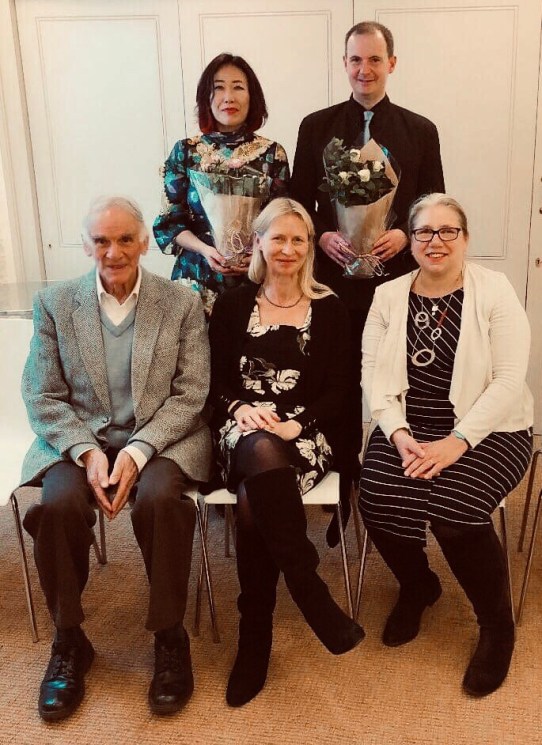
back row: pianists Waka Hasegawa & Joseph Tong; front row from L to R – Brian Dixon (Ailsa’s husband), Josie Dixon (Ailsa’s daughter) and Frances Wilson (The Cross-Eyed Pianist)

Meet the Artist interview with Ailsa Dixon

More about Ailsa Dixon

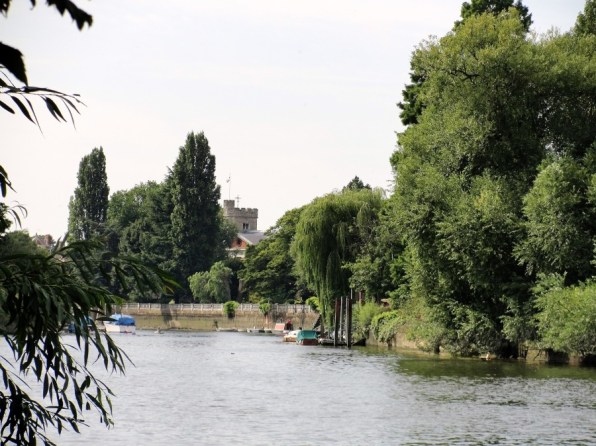
A mile or so along the river from where I live in Teddington, SW London, the attractive 18th-century church of St Mary’s in Twickenham sits on a grassy plinth overlooking the Thames. And for the weekend of 10-12 June 2016, it became the home of a new chamber music festival, directed by Emily Pailthorpe of the London Conchord Ensemble.

Regional and local classical music festivals are such a good idea. They take music out of formal metropolitan concert venues and into communities, forging important and lasting connections between musicians, local people and venues, and many attract world class performers, as well as encouraging young musicians. Conchord Festival boasted an impressive roster of performers, including actor Simon Callow and baritone Roderick Williams. I was delighted to attend the Saturday afternoon concert, music for piano duo performed by Alasdair Beatson and Julian Milford.

St-Marys-Church-Tower-in-Twickenham-by-e1456080701261

The theme of the concert was dance and the connecting thread was Sergei Diaghilev, ballet impresario and founder of the Ballets Russes, who collaborated most famously with Igor Stravinsky in the staging of The Rite of Spring, the piano 4-hands version of which concluded the concert. The afternoon opened with Debussy’s Prelude à l’Aprés Midi d’un Faun, a symphonic poem which formed the basis of the ballet Afternoon of a Faun, choreogaphed by Nijinsky and staged by the Ballets Russes in Paris in 1912. The piano duo version was transcribed by Ravel and loses nothing of its sinuous lines and erotic textures in the piano reduction. Beatson and Milford’s performance was languorous, nuanced and sensuous, perfect for a humid summer’s afternoon. This was followed by four of Dvorak’s Slavonic Dances, a reminder of the popularity of music for piano duo during the nineteenth-century and a foot-tapping musical palette-cleanser before the main event, The Rite of Spring, which followed the interval.

When The Rite of Spring opened in Paris in May 1913 the avant-garde nature of the music and the staging caused a near-riot in the audience. The piece still has the power to shock over 100 years later, with its narrative of savage rituals and human sacrifice. Stravinsky first performed his own four-handed version of The Rite of Spring with Debussy, the arrangement created to accompany rehearsals for the first performance of the ballet. This music was born on the piano, written in a tiny room, so Stravinsky tells us, on an upright piano, and it contains an exhilarating and precarious excitement. Forget the orchestral version: here is a work of raw energy, convulsive rhythms and pagan exoticism, aptly described by Debussy as “a beautiful nightmare”. It remains a vertiginously challenging work for piano duet, straining the medium to its limits. Beatson and Milford rose to the challenge with aplomb, managing pianistic gymnastics with ease and creating a riot of colour, texture, rhythmic drive and narrative. The famous stamped-out chords were percussive and metallic, redolent of heavy machinery, pistons and steam engines. (Let us not forget this piece received its first performances as Europe was preparing for the most mechanised and destructive war in its history.) This was truly an enthralling journey.

Next year’s Conchord Festival takes place from 9-11 June 2017.