People assume that if you can read music, you can be a page turner for another pianist. 

You read music! You play the piano! You must be able to turn pages!” is the cry I frequently hear, and while all these statements are true, many people do not realise that page turning is an art in itself, a specialist skill which can help a performance go brilliantly, or turn a concert into a Feydeau farce.

These days at piano concerts it is still quite unusual to see a page-turner in attendance. The ongoing – and to my mind rather ridiculous – trend/burden of having to perform from memory (a habit which developed during the second half of the nineteenth-century, thanks in no small part to Franz Liszt and Clara Schumann) means that the turner is a fairly rare sight. It is more common if the pianist is playing as part of a chamber ensemble, though many pianists these days play from an iPad or similar device.

Page turning can be a nerve-wracking experience as the turner feels a great responsibility to “get it right” for the performer. Turns should be discreet and silent (turn from the left of the pianist, using the left hand to turn the top of the page). In effect the turner should be “invisible” – and the turner should be sure never to turn too early or too late.

In addition, the turner has to be able to understand and act correctly upon repeats, da capo and dal segno markings, and other quirks of the score. Turners also need to be alert to concert hall conditions: drafty halls can be stressful as stray gusts and breezes may blow the pages around. Page turners have to observe correct on-stage etiquette: they must follow the performer on to the stage and know not to rise from their chair nor fidget during pianissimo passages. They leave the stage after the performer has taken his or her applause and only step forward to receive plaudits if invited to by the performer.

Much of the turner’s role is about being able to “read” the performer’s body language and be acute enough to act upon sometimes highly discreet signals. Turners should not discuss their anxiety with the performer, nor expect the performer to give them tips or advice about their own playing or musical careers.

In fact, being able to read music is not necessarily a prerequisite of being a competent page turner as someone who gets too involved in reading the music may miss a crucial turn.

A quick poll around Facebook and X (Twitter) revealed some page-turning horror stories (turning the wrong pages, a severely damaged score with pages held together with sellotape, pages out of order) but also anecdotes celebrating page turning and page turners. One turner confessed that pianist Francesco Pietmontesi’s performance of the Liszt transcription of Beethoven’s ‘Pastoral’ Symphony had moved her to tears, and many people describe the privilege and pleasure of being able to turn for top international artists. 

Modern times call for modern page-turning techniques and gagdets: scores stored on an iPad or other tablet device can be turned using a bluetooth foot pedal such as the AirTurn. Music publishers go to some lengths to engrave and print music in such a way as to facilitate easy page turns, but when this is not possible, one either ends up with photocopied sheets taped to the score, uses an automatic turner, or opts to have a page-turner, which can look more poised and professional.

Whatever route you choose, make sure your page turns are tidy, quiet and discreet – oh, and always thank your page-turner after the performance!
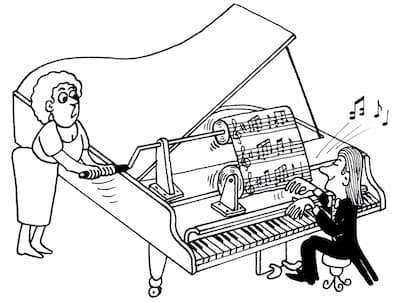
(Image credit: The Student Music Organizer on Facebook)


Lang Lang (photo © Philip Glaser)

Here’s an article from Bachtrack’s ‘Piano Month’ on pianists and their gestures. Whether you love or hate Lang Lang’s extreme facial expressions and flamboyant OTT gestures, or feel the perfomer’s gestures should only serve the music, this is an interesting and thoughtful read.

Every age has its own tastes, its own aesthetic lines drawn in the sand. Since the 19th century, with its seminal guardians of musical decorum (Clara Schumann chief among them), pianists and their critics have debated the role of stage persona. Most outspoken are those who believe that a quiet, undemonstrative approach to the instrument – à la Arthur Rubinstein – best reflects a serious commitment to earnest musicianship. The corollary is presumed true as well: that excessive body movement or facial expressions can cheapen an interpretation or betray a lack of real understanding. Pianist Lang Lang, often insensitively derided as “Bang Bang”, is held in this case to be Public Enemy Number One. Our current notion of good taste is less extreme, and concedes that a bit of visual display can be acceptable and even beneficial, so long as it is a natural byproduct of a performer’s interpretation. Read more


I meet many piano teachers, at courses, workshops and masterclasses. It is always good to meet other piano teachers, to exchange ideas and discuss aspects of our work. Many of the teachers whom I meet are also performing musicians, professional or otherwise, and many regard performing as a necessary, indeed crucial, part of the job as a teacher.

I also meet many teachers who do not perform, for one reason or another. Some cite lack of time, others anxiety or lack of confidence. I actually met one teacher who claimed she was “too afraid” to perform for her students in case she made a mistake.

As teachers, performing is, in my opinion, a necessary part of the job. An exam is a performance, and we need to be able to guide and advise our students on how to present themselves in a “performance situation” (exam, festival, competition, audition), and to prepare them physically and emotionally for the experience. A whole new and different range of skills are required as a performer, and it is important to stress to students the difference between practising and performing. We also need to be able to offer support for issues such as nerves and performance anxiety, and to offer coping strategies to counteract the negative thoughts and feelings that can arise from anxiety. How can you train others to perform if you have never done it yourself?

A successful performance demonstrates that you have practised correctly, deeply and thoughtfully, instead of simply note-bashing. Preparing music for performance teaches us how to complete a real task and to understand what is meant by “music making”. It encourages us to “play through”, glossing over errors rather than being thrown off course by them, and eradicates “stop-start” playing which prevents proper flow. You never really demonstrate your technique properly until you can demonstrate it in a performance. Performing also teaches us how to communicate a sense of the music, to “tell the story”, and to understand what the composer is trying to say. It adds to our credibility and artistic integrity as musicians. And if you haven’t performed a piece, how can you say it is truly “finished”?

I always perform in my student concerts, not to show off, but to demonstrate to my students (and their parents, who pay my bills!) that I can actually do it, that I too am continuing my piano studies by preparing repertoire for performance, and that I have managed my performance anxiety properly. I also feel that by performing with my students, we transform our concerts into a shared music-making experience.

I hope that by hearing and watching me playing, my students can better grasp aspects of technique or interpretation we might have discussed in lessons, as well as enjoying the sheer pleasure of listening to piano music, and perhaps drawing inspiration from it. I also get ideas when I am performing which inform my teaching.

For the teacher who is nervous about performing, one can start in a very low-key way by hosting an informal concert at home, or by joining a piano group, which provides a supportive and friendly environment where people can perform for one another. Choose repertoire with which you feel comfortable, and practise performing it a few times (at least three) to friends, family and pets before putting it before an audience. I guarantee your students will be dead impressed by anything you can play as a teacher!

Resources

Music from the Inside Out by Charlotte Tomlinson. A clear and well-written book on coping with performance anxiety, with tried and trusted techniques for dealing with nerves and improving self-confidence.

The curious tale of the musician, Dr Frankenstein, and apocalyptic Tesco on Christmas Eve…..

A guest post by pianist Emmanuel Vass

Definition of art 

noun 

1 [mass noun] the expression or application of human creative skill and imagination, typically in a visual form such as painting or sculpture, producing works to be appreciated primarily for their beauty or emotional power.


Definition of chemistry 

noun 

1 [mass noun] the branch of science concerned with the substances of which matter is composed, the investigation of their properties and reactions, and the use of such reactions to form new substances.


As I sat by the piano in the recording studio waiting for the next red light, I couldn’t help but think about my abrupt transformation from artist to chemist, as defined above. I was sixteen and, having just played a Chopin Nocturne from start to finish, there were one or two small fluffs and errors, which I considered re-recording and editing. Why? The track was for my own personal use and was never going to go beyond the four walls of my Yorkshire bedroom. Until that point, my teachers encouraged me to discount any mistakes in live performance and continue regardless of the odd inaccuracy: bigger picture and the overall artistic communication what I was always told to aim for. We’re only human, after all. Unexpectedly, the option of appearing ‘super human’ and re-recording sections of pieces until they were perfect had a certain appeal, and it was from that moment on that my potential status as an artist-cum-chemist, a Dr Frankenstein, first began.

It is no secret that musicians strive for perfection, a perfection that may involve securing a technical inconsistency, or developing a better form of communication within a piece – we are all a work in progress. Whether you are a beginner or professional, there will always be something further to strive for and now, as a 24-year-old pianist, I discover new possibilities and developments within my playing on a regular basis; I also hear it whilst teaching my pupils. It is wonderful how much can change within as little as five days, especially with regards to a live performance of the same piece, say, twice in one week. After all the blood, sweat and practice tears striving for perfection, a live performance may go fantastically well one day and less so on another. Comfort and enjoyment onstage knowing the piece has gone well a number of times in the past can, for instance, suddenly yield to confusion as to where that random wrong note came from. It is something we all experience to varying degrees, and is part of the exhilarating, impulsive and unmistakably human-world of live performance, which I fell in love with aged seven. To dedicate yourself with total abandon to a live performance, both as a listener and performer, is to accept that occasionally, just sometimes, the unexpected may occur.

Now consider the world that surrounds us and the ensuing paradox: we live in an age of convenient, digital, airbrushed perfection where a vast amount of items presented to us are expertly designed and manipulated. The lines between reality and illusion, and how we perceive and identify them, have been blurred to the point where entire body parts of celebrities can be digitally sewn on and removed, ‘Frankenstein-ed’, as to morph our opinions and perceptions. We have the luxury of driving around in cars that can protect us from ever making a wrong turn; international news can break on social media via eyewitness films long before newspapers or twenty-four hour news can give a detailed description, and the entire country seems to go into apocalyptic meltdown when the instant convenience of supermarket shopping is lost for just twenty four hours on Christmas Day. I rarely buy bread, but come Christmas Eve there I am elbowing past panic-stricken mothers who also appear to have the entire contents of the cheese aisle stuffed into their pushchairs. In many ways I believe the entire world as we know it is just an all too convenient, disposable and HD-streamed click away: I won’t read the book and will just wait for Hollywood to feed me their version, or, I could probably learn a language but online translator machines can do it for me. Who needs to write a letter when you can talk instantly via webcam? Why bother travelling to Paris, you’ve seen all the stock, generic photos on Facebook and Google Streetviews, right?!

I’m here neither to argue that we should do away with these modern conveniences, nor rant about how the world has changed for the worst and we’re most definitely, direly doomed for all eternity. Rather, my fear is that certain audience members may have been conditioned to believe that a live performance that is anything other than note-perfect is not a worthy one, that the lines between the supposed illusion within the world of recording and reality of the concert hall are far too blurred. There is, of course, a difference between the odd wrong note and a distinct, noticeable problem with fluency and continuity; here I accept that in this situation a performance may start to be deemed ‘less successful’. That said, as humans, we are bound to make mistakes and we should never aspire to be machines; nothing should ever anaesthetise us from the raw reality of life. Does this not contradict the whole point of art in the first place? Perhaps some would be more satisfied listening to pre-programmed robots over real musicians?

 As mentioned in my opening paragraph, recording can be a very complex process for musicians. Of course, not every musician heavily edits or relies on sophisticated recording software – indeed, I didn’t have the time or the money to do so for my first album, ‘From Bach to Bond’. Similarly, it would be absurd to comment that a 100% accurate performance is impossible to achieve or less artistically valuable. I hope the discerning audience member of a live performance would value their experience based on the authenticity, emotion and artistic powers of the performer, and not just their ability to mechanically replicate the exact formula. Judging an artist on their capacity to be an onstage chemist is not an equation for success.

For those of you who prefer the anaesthetised comfort of CDs/recordings and hate wrong notes, I tell you what, you can go ahead and look at pictures and videos of Paris on the Internet, and I’ll go and travel to Paris myself. We are all a work in progress.

Emmanuel Vass will be giving a lunchtime concert at St Sepulchre, the musicians’ church in London on Wednesday 10th July. Full details here

Emmanuel Vass

Named as ‘one to watch’ by The Independent newspaper in April 2013, twenty-four year old Emmanuel Vass is rapidly establishing himself as one of the most charismatic pianists on the contemporary scene. 2013 has already seen the launch of his first CD – From Bach to Bond – and his first UK recital tour under the same heading. The tour, which took in seven venues across the North of England and culminated in his London debut at Steinway Hall and St James’s Piccadilly, attracted considerable media interest, including a live broadcast on BBC Radio 3’s In Tune.

Emmanuel Vass was born in Manila, Philippines and grew up in East Yorkshire. Having passed Grade 8 piano with distinction at the age of 15, he subsequently studied with Robert Markham at Yorkshire Young Musicians, the centre for the advanced training for gifted young musicians based at Leeds College of Music. This was followed by four years at the Royal Northern College of Music, where Manny studied with John Gough and was supported by scholarships from the Leverhulme Scholarship Trust and the Sir John Manduell Scholarship Trust. He graduated in 2011.

www.emmanuelvass.co.uk


