The key is trying to limit yourself to perform only the pieces that will be best for you and the audience. Otherwise, you’re doing everyone—yourself, the composer, and the audience, a huge disservice.

Richard Goode, concert pianist

I’m sure most performers would agree with Richard Goode’s statement, yet many, especially younger artists, are under tremendous pressure to “play to order” and to offer programmes which will satisfy promoters or venue managers.

It’s a physical and mental impossibility to play everything well (though there are a number of musicians out there who do seem to have mastered this, but they are rarities!), and the best performers understand their limitations. This is not to say that they offer limited repertoire, rather that the music they choose to play truly demonstrates their artistry. During their training, however, musicians are discouraged from specialising and instead tend towards a broad repertoire. Obviously, this has its advantages, as it introduces the student musician to a wider variety of music and will give them an appreciation of the breadth of their instrument’s repertoire.

The advantages of performing what you know you play best seem obvious, yet it’s common to attend a concert and feel that the performer is playing music with which they are not entirely comfortable. For young artists, teachers and mentors may encourage them to select certain works to impress potential agents or promoters, while other artists play music which they think their audiences want to hear. And in the desire to offer as wide a repertoire as possible, some performers run the risk of dilution or of not studying the music deeply enough because of the pressure to learn so much.

As they mature, certain performers may develop an affinity with specific composers or genre and may choose to focus on that. Andras Schiff is one such example with his predilection for J S Bach and the Viennese masters; Piotr Anderszewski and Richard Goode are other examples. All these pianists offer their audiences impeccable and insightful performances of the music they know they play well, because when musicians know what they play well, they play to their strengths while also revealing something of themselves to their audiences. This in itself gives audiences a more meaningful concert experience, a contrast to a performance which may be reliable but just doesn’t reveal enough of the person behind the instrument and the notes. And when we play what we know we play well, we play with confidence, flair and enjoyment – all facets which audiences appreciate.

Knowing one’s limitations requires a level of humility which can be quite hard won and take time to achieve, for both professional and amateur musicians. The training of young musicians today is such that they are taught to believe they can play anything – and many have the technical and artistic facility to play some of the most challenging works in the repertoire from a relatively young age – but appreciating one’s limitations and working within them is a mark of self-insight and musical maturity.

….we’re not machines, so part of being successful at this is understanding your own limits—your taste, your approach, and only performing things that work for you.

– Richard Goode
 

The euphoria of live performance is matched by a special kind of depression compounded by a profound tiredness after the event. A vast amount of energy – mental and physical – is expended in the act of performing, and the excitement of the concert fills your every moment in the hours leading up to it.

And then, suddenly, it is all over…..You wake the morning after with a sense of deflation, the euphoria of the previous night now replaced by ennui.

This is in fact quite normal and the explanation for these feelings is simple: you’re coming down from an adrenaline ‘high’.

Anxiety is a natural part of the performance experience and should be accepted as such. While many of us may dwell on the psychological and emotional symptoms of anxiety (the fear of making mistakes, memory slips, negative self-talk etc), most of the symptoms we feel ahead of a performance are in fact physiological, the result of the release of adrenaline, a hormone and neurotransmitter which is produced when we find ourselves in stressful or exciting situations. Known as the “fight or flight hormone”, it works by stimulating the heart rate, contracting blood vessels, and dilating air passages, all of which work to increase blood flow to the muscles and oxygen to the lungs. This gives the body an increased and almost instantaneous physical boost. In a performance situation, the side-effects of adrenaline pumping through the body include racing heart or palpitations, sweating, breathlessness, nausea, and trembling or shaky hands, arms or legs. It also brings a heightened sense of awareness and increased respiration which can make one feel light-headed or dizzy. Understanding the physical symptoms of performance anxiety can go a long way to managing the unpleasant feelings, together with deep practising and good preparation, which can remove some of the psychological stress. We do not need to “fight the fear” but simply accept that these sensations and feelings are normal and common to us all – even musicians at the top of the profession.

The symptoms of the release of adrenaline do not leave the body the instant the stressful situation ends, and when one is not actually in a genuinely dangerous situation, the effects of adrenaline can leave one feeling jittery, restless,  irritable and sleepless. In the immediate aftermath of the performance, you may continue to feel excited, “on a high”. Many people find it beneficial to “work off” the adrenaline rush after a particularly stressful situation (the clichéd example perhaps being the rock star trashing a hotel room after a gig!). It can take several hours for the body to settle down and the day after the concert, one can feel very flat as adrenaline leaves the system and one’s hormonal levels return to normal.

In reality, there’s no time for exhaustion: you have work to do tomorrow – and work is the best antidote to these feelings of depression and tiredness. There may be another concert to prepare for, new repertoire to be learnt, old repertoire to be revived and finessed. We draw strength from our love of the repertoire, our excitement about our individual pieces and the prospect of putting them before an audience. The performance is what endorses all the lonely hours of careful practice and preparation.

“At this low point, we have only to let music itself take charge. For every challenge we can possibly want lies before us in the vast and inexhaustible repertory that cannot but replenish our spirit. For true musicians, depression is temporary because their music is permanent.” (Seymour Bernstein, from ‘With Your Own Two hands’)

Stage fright? Blame Liszt – article by pianist Stephen Hough

Schubert’s penultimate piano sonata, No. 20 in A, D959, is my sonata. Never mind that I’ve heard Imogen Cooper, Daniel Barenboim, Piers Lane, Andras Schiff and Richard Goode, amongst others, perform the sonata, and have listened to countless recordings (including Shera Cherkassy, Radu Lupu, Mitsuko Uchida, Elisabeth Leonskaja, Inon Barnatan and Krystian Zimerman), all of whom might claim that it is their sonata. Schubert’s D959 is my sonata.

Why is it ‘my’ sonata? Because I spent many hours, days and months studying, learning and eventually performing this work, and through that meticulous process I acquired a sense of “ownership” of the music.

Taking ownership of one’s music, literally making it one’s “own piece”, is something that musicians strive for. A strong sense of ownership connects one to one’s music, and also creates a special communication with the audience.

Ownership is hard won, however, and comes from close study and deep knowledge of the score to fully acquaint oneself with the composer’s message and intentions. All the explicit information contained within the score must be processed, understood and acted upon –  the notes, dynamic, rhythmic and articulation markings, tempo, expression and character directions, and all the technical aspects of the music; in addition, implicit directions need to be considered and factored in: a rising passage may suggest a slight crescendo or stringendo, rests and fermatas suggests breathing space, a doubling of octaves may indicate a more orchestral sound or texture. The ability to process and interpret implicit directions comes from the musician’s own musical knowledge, training, an understanding of historical contexts and performance practice (in, for example, Baroque music), experience, maturity and personality.

Such disciplined learning and study gives one the confidence to play the music convincingly and to create one’s own personal vision of the music. I have been to concerts where it is evident that the music is well learnt, all the details taken care of, but it doesn’t communicate, or touch one’s emotions. A non-committal performer may tread the middle road, providing an inoffensive range of dynamics, expression and so on, but without a real sense of conviction which robs the performance of that special edge of excitement. Audiences can certainly feel this and may leave the concert satisfied but unmoved.

So, ownership is about having done the detailed work on the score to give one the confidence to perform the music convincingly. But there’s more: ownership also creates spontaneity, freedom, originality and sprezzatura in performance – the impression that everything one does is effortless. As a performer, one does not want to show the audience what one cannot do; instead, the performer reveals, through their ownership of the music, not only mastery, but also freedom, ease and delight, playing ‘in the moment’…. Performers who have these qualities, and who have complete ownership of their music, are prepared to take risks in performance, secure in the knowledge that one never plays the same piece of music the same way twice. Such performances are thrilling and memorable.


Guest post by Samantha Ege

“Remember it’s about connection not perfection.”

Those were the words of my coach and mentor Deborah Torres Patel. I had just told her about one of my first international lecture-recitals. The lecture had gone well, but the recital had been an absolute disaster. Actually, that wasn’t true—it wasn’t a disaster at all. Yes, my playing had been more nervous than usual, but “disaster” was definitely an exaggeration. I had received sincere compliments, encouragement and gratitude for my scholarly and pianistic contributions. But in my post-performance ritual of dramatizing the worst, re-imagining all the ways in which I could and should have played perfectly, and re-living all of the ways in which I did not, it was an absolute disaster.

About a year after this experience, a video surfaced. It was the trailer for the 2018 Women Composers Festival of Hartford where my lecture-recital had taken place. The trailer contained a short excerpt from my recital that cut to the lyrical second theme of Florence Price’s Sonata in E minor (first movement). It wasn’t bad! Festival Director Penny Brandt showed me the yet to be released full film that featured more of my playing. There was no sign of the disastrous performance I thought I had delivered. In fact, I heard my playing quite differently to how I had experienced it in the moment. Time had allowed me to zoom out and actually appreciate what I brought to the music in that performance. But I wished I could have felt this appreciation back then, and not just in retrospect.

I thought about Deborah’s words again. “Connection not perfection.” What kind of anticipation might I have built pre-performance if I had truly prioritized communication over self-consciousness? What kind of delivery might have unfolded if I had centred my connection to the music over the perfection of the notes. How might I have experienced the immediate aftermath of the recital if I had fully absorbed the audience’s response rather than becoming entangled in a web of personal disappointment? The idea of connection bore so many implications and in this moment of reflection, I was inspired to dig deeper and explore its many layers.

As a pianist-scholar who champions music by women, it is my goal to do the music justice and leave a lasting impression upon the listener. As much as I enjoy the academic side of writing and research, I feel that my work is not complete until I bring the music to life through performance. In those moments, I hope to perform in a way that captures how I felt when I first heard Althea Waites play Florence Price, or Virginia Eskin play Vítězslava Kaprálová because it was connection rather than perfection that drew me in and inspired me to make this repertoire my own.

As I look back on past performances, I try to apply what I wish I had known or felt then to the present. There is something so daunting, yet so liberating about playing repertoire that doesn’t carry the weight of heavily scrutinized performance histories. Indeed, the daunting side always seems so readily present while the liberating side requires a lot more pursuit. Still, they go hand in hand: the repertoire is daunting exactly because it is liberating. In championing under-represented composers, I have found incredible freedom as a pianist; oftentimes, my performances present first-time listening experiences for many, and even world premières—no pressure! But I know that this freedom will not transpire in the moment of performance unless I remember “it’s about connection not perfection.”


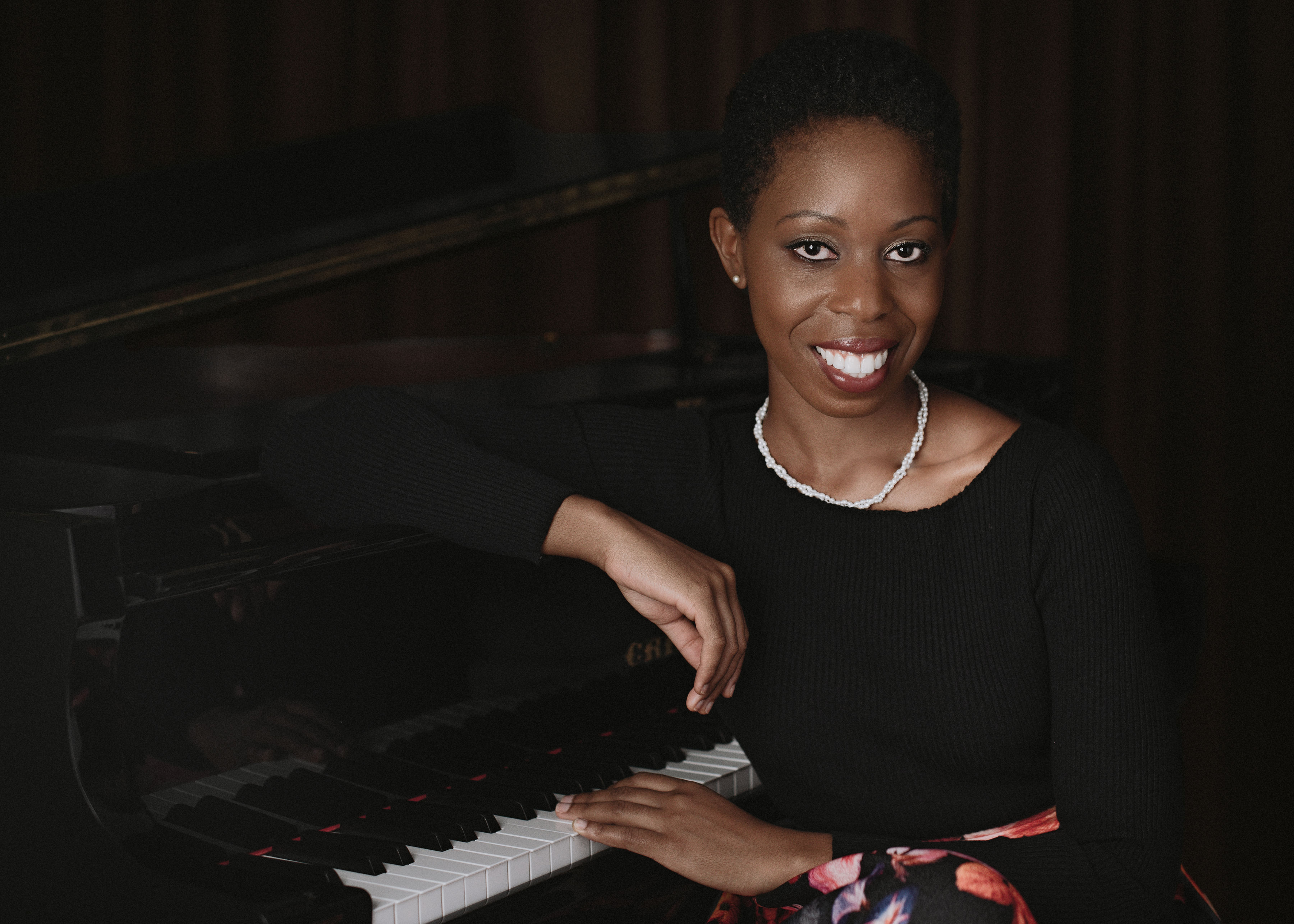
Samantha-16Samantha Ege is a British scholar, pianist and educator. Her PhD (University of York) centres on the African-American composer Florence Price. As a concert pianist, Ege’s focus on women composers has led to performances in Singapore, Australia, the UK and the US Ege has also championed Florence Price’s repertoire alongside violinist Er-Gene Kahng with duo recitals in Singapore, Hong Kong and the US.

Ege released her debut album in May 2018 with Wave Theory Records, entitled Four Women: Music for solo piano by Florence Price, Vítězslava Kaprálová, Ethel Bilsland and Margaret Bonds. The album featured the world première recording of Bilsland’s The Birthday Party, which led to Ege preparing an edition of the suite, now published by Faber Music. Four Women has been described as “an impressive collection…performed with virtuosic assurance.” Ege has also been commended “for her goal to bring the music of these composers to greater public awareness.”

Website: www.musicherstories.com


