Who or what inspired you to take up the organ and pursue a career in music?
When I was ten years old, my best friend at school asked whether I wanted to come and join the local church choir. I said that I wasn’t interested until he said that I would be paid for my services! When I went along to my first choir practice he showed me the organ and from that moment on I was determined to learn. It was a real Eureka moment.
You’re also the CEO of Dubai Airports, how does your musical background influence your work life?
I believe that the ability to think through complex problems and break them down into small pieces, then reassemble them is the same process as learning a challenging piece of repertoire; having the patience to learn an instrument that demands the coordination of so many different events has so many applications in business. Running the world’s largest international airport is certainly demanding, so the application and discipline that I have learnt from music is very helpful.
Who or what have been the most important influences on your musical life and career?
When I was eighteen I was introduced to Malcolm Hicks, who has had a long and distinguished career as an organist and conductor. He took me under his wing and enabled me to appreciate a whole different level of musicianship. I had some notable successes in competitions and diplomas with him and have accompanied many choral performances under Malcolm’s baton.
What have been the greatest challenges of your career so far?
Undoubtedly taking eighteen months to learn and perform the three-movement Suite, Opus 5, by Maurice Duruflé. It is a tour de force of the organ repertoire and many professional organists shy away from it. Inspired by Alan Rusbridger’s book ‘Play it Again’ which a pianist friend gave me, the book describes how it was possible to learn Chopin’s fearsome Ballade No 1 in G minor whilst being the editor of a major international newspaper. I decided I could learn the Duruflé Suite whilst running the world’s largest international airport. The most heart-warming part of the whole experience was the willingness of many professional musicians to give their time to help me prepare for my first performance.
Which performance/recordings are you most proud of?
In 2004 I was the soloist in Poulenc’s Concerto for Organ and Strings at Birmingham Symphony Hall, under the baton of Lionel Friend. It’s a great piece and when I was in my teens I listened tirelessly to the recording made by Maurice Duruflé in 1961 in the presence of Poulenc himself, so being able to perform the work was a great thrill.
Which particular works do you think you play best?
As a student I used to tackle the standard repertoire of Bach and Buxtehude but then ventured into the world of Paul Hindemith, particularly enjoying his three Sonatas for organ. However, romantic music has always enabled me to really express my deepest emotions and latterly I became hooked on the French romantic output from the 19th and 20th centuries, such as Louis Vierne and Cesar Franck.
How do you make your repertoire choices from season to season?
I always set myself the goal of learning new repertoire to expand the possibilities and contrast of performance. I enjoy creating connections and setting strong context in my programming as the organ can be rather dull to those who don’t encounter its repertoire outside of a sacred context.
Do you have a favourite concert venue to perform in and why?
The organ loft at Westminster Abbey is a very special place. Late at night when you are alone in the building you are very aware of more than 1,000 years of history all around you and the magnificence of the architecture and grand acoustic add so much to the performance of any major work.
What is your most memorable concert experience?
I used to play for the Waverley Singers, an accomplished choral society based in Farnham, Surrey, which was conducted by Malcolm Hicks. We undertook several concert tours and accompanying the choir in the splendour of the Cathedral of St Bavo in Haarlem in Holland was a very memorable experience. Malcolm recently found a photograph of me at the organ during our tour in 1999 which he gave me.
As a musician, what is your definition of success?
I lead a very diverse life so I am not sure that I can give the answer purely from a musician’s perspective. However, the ability to express one’s inner soul and communicate on a completely different level through the power of music is unparalleled in any other form of human communication and having the ability and determination to achieve this is immensely rewarding.
What do you consider to be the most important ideas and concepts to impart to aspiring musicians?
The subtlety of artistic impression goes so deep that there can never be an end to the attention to interpretative detail; grasping this at a young age and applying it through hours of preparation can really set an artist on a whole different level of musical awareness and appreciation.
Where would you like to be in 10 years’ time?
At home in East Sussex, at the console of the three-manual Aubertin organ which was installed in 2015.
What is your idea of perfect happiness?
Having spent my whole life wondering whether I should have become a full-time musician, becoming a full-time musician when I decide to relinquish my role running Dubai Airports
What is your most treasured possession?
My battered black briefcase which has been around the world with me countless times
What do you enjoy doing most?
Trying to befriend one of my three cats, called Kitty. She loves attention but then snaps into a tiger. Knowing exactly when to quit can become a near-death experience
What is your present state of mind?
I currently have the complexity of Durufle’s Toccata coursing through my head whilst sleeping and awake. It’s amazing how the human brain can absorb an idea, develop it and then create a whole new level of understanding without any apparent intervention.
Paul Griffiths performs at Westminster Abbey on 13th August at 17.45. Details here
Paul Griffiths began playing the organ at the age of ten and won first prize in the London Musical Competition Festival at the age of 13. Whilst studying with renowned organist and conductor Malcolm Hicks, he gained the ARCO, ARCM and LRAM within a six-month period and the FRCO two years later. In 1981, he was placed second in the Trianon Organ Competition.
Having been Organist and Choirmaster at St Mary’s Welwyn from 1980, he moved to Hong Kong in 1986, where he became Assistant Organist at St John’s Cathedral and Head of Organ at the Hong Kong Academy for Performing Arts. He also featured in broadcasts with the Hong Kong Philharmonic Orchestra and has also given recitals at the English Cathedrals of Ely, Peterborough, Wells, St Paul’s and at Westminster Abbey. Paul also features regularly as an organist and continuo player in concerts and recordings in the UK and overseas and in May 2002, made a guest appearance at Birmingham Symphony Hall with Dame Gillian Weir. He has also given recitals at St Mary Redcliffe, Bristol, St John’s Smith Square and London’s Temple Church. In 2003, Paul was appointed organist to the voluntary choir at Guildford Cathedral, where he studied the organ with Stephen Farr. In October 2004, Paul returned to Birmingham Symphony Hall to appear as the soloist in Poulenc’s Organ Concerto with the Birmingham Conservatoire Orchestra, conducted by Lionel Friend.
Outside of musical life, following 14 years as an Executive Director of Virgin Atlantic and the Virgin Rail Group, in January 2005 he was appointed Managing Director of London Gatwick Airport and, in 2007, moved to Dubai to become the first Chief Executive Officer of Dubai Airports, the owner and operator of the world’s largest international airport. He is regularly requested for interviews on the BBC to contribute towards aviation-related issues, including the debate on Heathrow’s 3rd runway.
Paul was appointed as a Companion of the Order of St Michael and St George in the Queen’s Birthday Honour List in 2015, for services to British prosperity overseas and to music.

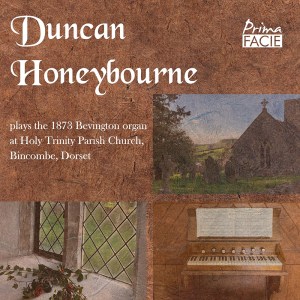 Duncan Honeybourne plays the 1873 Bevington organ at Holy Trinity parish church, Bincombe, Dorset (Prima Facie records PFCD220)
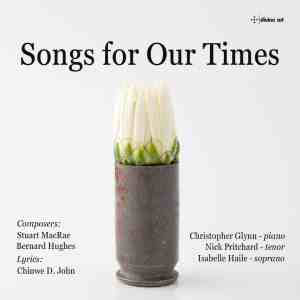 Songs for Our Times





 The Cross-Eyed Pianist