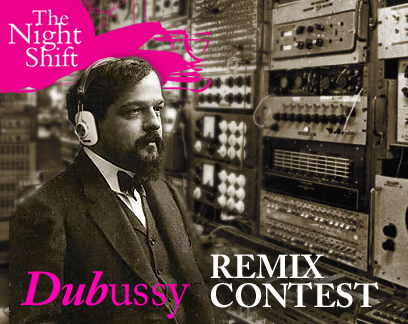
As Debussy enters his 150th anniversary, some of the most innovative names in music have teamed up to give DJs the chance to remix an entire orchestra.
Known for challenging classical conventions, the Orchestra of the Age of Enlightenment (OAE) have released rare recordings of Sir Simon Rattle conducting a rehearsal of Debussy’s La Mer. Judged by French electronic artist and BBC Radio 6 music favourite Chapelier Fou, the Dubussy Remix contest is aimed at giving new artists the chance to have as much fun as they like with a well known classical piece.
Dubussy is the OAE’s way of exploring how a structural pioneer like Debussy, inspired experimental DJs like Chapelier Fou and Flying Lotus and what comes out when these genre’s are thrown together.
“Structural things are useless in Debussy’s music…and it’s just for the love of sound…it’s almost something that you can touch. I wasn’t interested in classical music until I discovered Debussy”
Chapelier Fou
All entries must be in by 30 October 2012 with each track being between 3 and 5 minutes long.
1st Prize (to be chosen by Chapelier Fou) will receive four free tickets to The Night Shift – the OAE’s relaxed, rules free classical night on 22 November: www.oae.co.uk/thenightshift ; a bag of The Night Shift and Chapelier Fou goodies and the opportunity to be name-checked on all OAE and Chapelier Fou social media sites, as well as having your track premiered by our Night Shift DJ at a future gig.
2nd Prize (As voted for by the public) will receive two free tickets to the Night Shift and a selection of OAE and Night Shift prizes.
For more information please contact Matthew Grindon, Press Assistant, The OAE, on 0207 239 9373 or email matthew.grindon@oae.co.uk
Robert Levin in action (Photo credit Kris Snibbe/Harvard News Office)
Anyone expecting a ‘traditional’ concert experience at the Queen Elizabeth Hall on Tuesday night would have been disappointed – or maybe pleasantly surprised. Consistently innovative, the Orchestra of the Age of Enlightenment (OAE) are offering a new music concept in the form of The Works, in which you can learn more about a Great Classical Masterpiece in a fun and informal way in the company of the orchestra and an ‘expert’. Future events include harpsichordist Laurence Cummings on Bach, but for the first event of this new series, the OAE were joined by charismatic pianist and renowned Mozart specialist Robert Levin.
Levin, who has a passionate and forensic interest in the minutiae of Mozart’s music and his creative life and compositional processes, is a lively and engaging speaker. While not everyone may like his particular brand of New York Jewish ebullience nor necessarily agree with his “scholarship”, there is no doubting his infectious enthusiasm for his subject. He has studied Mozart’s manuscripts in microscopic detail to winkle out all the details of his creative process and to attempt to understand his precise vocabulary of rhythm, melody, counterpoint, harmony, architecture. As Levin says, “Mozart hides sophistication behind apparent simplicity” (thus, calling to mind Schnabel’s famous quote about Mozart’s music). His detailed study of Mozart informs both his teaching and his playing.
A few years ago, I attended a study day with him entitled ‘Mozart and the Piano’ in which he examined the evidence to suggest that Mozart was not only intimate with all the quirks and foibles, strengths and weaknesses of the musicians with whom he worked (a bassoon part written for a player with loose teeth, for example) but also with the capabilities – and limitations – of the instruments at his disposal. It was a fascinating and entertaining angle on Mozart’s music.
“If Mozart had had access to a modern Steinway, just think what he would have written!” Levin declared provocatively at the start of The Works. Of course, as Levin immediately countered, we cannot make such assumptions: Mozart worked with what was available at the time – the harpsichord, fortepiano and fledgling piano. What we can do, however, is look at the documentary evidence – the drafts, the autographed scores, his letters – to gain a glimpse into the compositional world of Mozart.
Levin has argued, convincingly, that the paper, ink and quill that Mozart used all point to a prolific genius who could turn his hand to almost anything, a consummate multi-tasker who would sketch out a draft of a piano concerto and then set it aside to work on more lucrative projects.
He also feels Mozart was the “Duke Ellington” of the 18th century, endlessly improvising off the cuff, and knocking off dazzling cadenzas at the drop of a hat. He didn’t need to write them down because each time he performed he would do something new.
Levin is also an improviser, and his intimate study of Mozart allows him to offer suggestions as to how Mozart may have performed (directing from the piano, of course) which sound fresh and natural, but never ersatz. Sometimes there is an astonishing latitude in Levin’s interpretations, but at no point have I ever felt, when hearing Levin perform, that he is taking unfounded liberties with the material. Rather, there is a sense of someone who is thoroughly immersed in the ‘language’ of Mozart, but who does not hold up what is written in the score as “sacred”. A degree of danger and unexpectedness is what makes Levin’s playing so intriguing, and he believes he has a responsibility to create something “new” in each performance he gives.
I am no purist about historically accurate performance on historically accurate instruments: I feel it is impossible for us to truly recreate the sound, feel, nuance, atmosphere of Mozart’s music in his time – and certain attempts to do this can come across as either overly esoteric, or an undignified ‘Disneyfication’ of the music. Robert Levin’s approach offers some interesting and thought-provoking angles on the subject: in his hands, Mozart’s idiosyncrasies become a wonderful asset and serve as a pretext for a better understanding of the man and his music, as well as reviving the art of improvisation in classical music and promoting novelty in musical performance.
Robert Levin talking about how differently things would have been done in Mozart’s day.
The Cross-Eyed Pianist is free to access and ad-free, and takes many hours every month to research, write, and maintain.
If you find joy and value in what I do, please consider making a donation to support the continuance of the site






 The Cross-Eyed Pianist