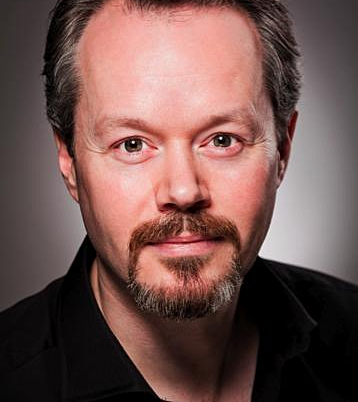
Who or what inspired you to take up singing, and make it your career? 

There was no great moment of revelation, more a progressive realisation that I wouldn’t be happy doing anything else. I’d sung with choirs and performed in amateur dramatic groups as a teenager, and enjoyed both hugely. Then around the age of 16 I won a county scholarship to have singing lessons at the Welsh College of Music and Drama. My teacher there was Beatrice Unsworth, and from the very first lesson she showed huge faith in me, and was brave enough to stick her neck out and tell me I had the potential to make a career of singing, if I decided that was what I wanted. It’s a far safer bet when giving advice to young singers to preach caution, and rightly so, but at some point an artistic career needs a leap of faith, and it takes great courage and vision to support a young artist in doing that.

Who or what were the most important influences on your musical life and career? 

There are too many to mention, and if I begin to name individuals I know I’ll miss someone out. In all honesty I’d say I’ve taken something, whether it be of great significance or only a small hint or reflection, from everyone I’ve met and worked with. On a personal level, I’m fortunate to have a hugely supportive network of family and friends who are all incredibly patient and understanding. Every singer needs those people if they’re to survive in the long run.

What have been the greatest challenges of your career so far? 

Getting into postgraduate music college in the first place, having come from an entirely amateur musical background up to that point. Getting through the tough first few years of my career, when I was strapped for both money and time. Continuing to motivate myself to get to work on each new piece in the first few stages of learning and memorisation.

Which performance/recordings are you most proud of? 

In terms of live performances, it’s tricky to know, since you as the performer never get to see it, and once it’s happened it’s gone forever, and more often than not you don’t have time to reflect on it before you’re on to starting work on the next project.

With recordings it’s different – you can come back to them a couple of years later and assess them more rationally. I’m very fond of my first album, Enaid – Songs of the Soul, which I recorded with Llyr Williams a few years ago – I think we came very close to achieving what we set out to achieve with it, and it still excites me to hear it, even though I’m sure we’d do it all differently now. On film, I’m pleased with the recording of Jackie O that was made when we performed it at the Teatro Comunale di Bologna – it’s a rarely-performed piece, and is very idiosyncratic, but I have a great fondness for it, and it brings back a lot of happy memories to watch it.

Which particular works do you think you perform best? 

I’m not the best one to assess that! But I’d say the composers for whom I feel most affinity in terms of their vocal writing are Mozart, Puccini and Wagner – with all three I get a strong sense of understanding what they were seeking in terms of vocal colour and dramatic and emotional content.

How do you make your repertoire choices from season to season? 

First and foremost, I’ll need to sing whatever someone is willing to pay me to sing. That’s not a facetious answer – it’s the basic truth of a professional singer’s life. At the same time, you need to keep an eye on the horizon and the direction you’re headed in the long term. So I’ll listen to my voice, or rather, what my voice is telling me in terms of where it’s happiest, where it’s strengthening and so on (in conjunction with advice from trusted teachers and coaches), with the aim of exploring new areas of repertoire which could be viable in a few years’ time. You have to be honest with yourself about your strengths and weaknesses, and be realistic about what you’re asking a casting panel to see and hear in you, while at the same time being clear in your own mind as to what you do best as an artist.

Do you have a favourite concert venue to perform in and why? 

If you twist my arm I’d say St David’s Hall in Cardiff, from the point of view of a combination of acoustic, atmosphere and above all sentimental value – it’s where I grew up watching live music, and it always means a lot to me to perform there.

Favourite pieces to perform? Listen to? 

Scarpia in Tosca is always a buzz. Anything by Wagner.

Who are your favourite musicians? 

Tom Jones, Titta Ruffo, Shakira.

What is your most memorable concert experience? 

It’s not repeatable in polite company – you’ll have to wait for my memoirs.

What do you consider to be the most important ideas and concepts to impart to aspiring musicians? 

Work hard. Learn to switch off. Remember that the work doesn’t lead to rewards – the work is the the reward. Don’t be too ready to take advice from old musicians…. By which I mean, be open to advice and new ideas, but don’t be afraid to reject them, or save them for (sometimes years) later. Remember the bottom line is that as an artist the final responsibility for your technique, career and art is yours, and your aim is to produce something unique, not an imitation of anyone else’s work.

Where would you like to be in 10 years’ time? 

Alive.

What is your idea of perfect happiness? 

Sitting on the sofa with my wife, with football on the TV and an interesting score on my lap.

What is your most treasured possession? 

My Bialetti Brikka coffee pot.

What do you enjoy doing most? 

What is your present state of mind?

Contented.
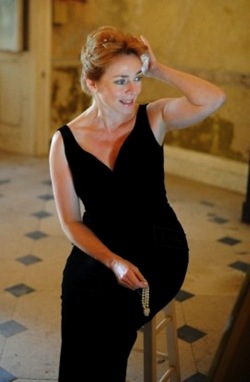
(photo: Josh Gooding)

Who or what inspired you to take up a career in singing and directing?

My grandmother was a painter and she always saw and showed me the world through an artist’s eyes. My mother was a singer, and although my father was a physicist, he would always play classical music at full volume at home or in the car, conducting the radio and screaming at the tempi.

Later, my passion for singing derived from the physical sensation when producing the classical sound, as well as from the different facets of the art form itself, including the drama, languages and poetry in the various genres of opera, oratorio and song.  After I had been active as a singer for many years, I wanted to be involved in opera productions at a much earlier stage in the process. I became interested in the ideas and concept of staging and directing opera, and found it riveting to work with a team on finding solutions to express a particular way of telling a story.

Who or what are the most important influences on your work? 

Love for what I do, and respect towards the piece in front of me and the people I am working with.

What have been the greatest challenges of your career so far? 

Figuring out what I needed to do in order to get to where I wanted to get to. This goes for my own life and career journey, but also for the individual projects and engagements I have been involved in.

What are you working on at the moment? 

I am currently working on my third, new production of Bizet’s Carmen at Winslow Hall Opera (WHO) in Buckinghamshire. I am directing and also singing the role of Carmen, bringing my number of performances of this role to around 165, but still feel there is so much to tell about the story and the character.  Joining me are a superb cast and team, and I can’t wait to get back into the experience that is WHO after last year’s success with Le Nozze di Figaro: high quality theatre making in very unique surroundings.

Italian tenor Gianluca Paganelli as Don José, South African baritone Njabulo Madlala (winner of the 2010 Kathleen Ferrier Competition) as Escamillo and Scottish-Polish soprano Natasha Day as Micaëla are leading a select cast which is supported by the company’s Founder and Music Director Robert Secret, set designer Francisco Rodriguez-Weill and lighting designer Tony Simpson.

What are the particular challenges/excitements of working in an opera company? 

An opera company has to fulfil many different roles. Either subsidised privately or by the state, it has to find a healthy balance of serving its audience, finding and re-confirming a strong position in the artistic life of the community and its social calendar and co-operating with other art forms and arts institutions.  But at the same time, it has to remain free to accommodate the integrity and space which the artistic process and the artists’ work demand.

Do you have a favourite venue? 

There is no easy answer to this question. My favourite venue tends to be where I am at the present time. Certainly, Winslow Hall Opera has a very special place for me as I have worked closely with this company for many years, beginning in 2003 when it was still based at Stowe. It is an ambitious and inventive opera festival surrounded by the exceptional backdrop that only a magnificent 17th Century mansion by Sir Christopher Wren – the only Wren building outside of London – can present. It is now owned by former restaurateur Christopher Gilmour and his wife Mardi Gilmour, who have brought this festival to life with great vision and courage and out of their love for opera.

Who are your favourite musicians/singers/directors? 

My favourite singer is the German tenor Fritz Wunderlich who unfortunately died too young at the age of 35. To me, his singing represents complete honesty in sound and emotion. Especially his Schubert songs are the “truest” kind of music-making that I know.  One of my favourite musicians is the pianist Martha Argerich with her technical brilliance, power and risk taking. Both artists’ music always travels with me.  But aside from those two, I get most of my inspiration from other artists such as jazz, soul and blues musicians and all kinds of cross over artists, painters and sculptors.

One of my favourite productions is Jean-Louis Martinoty’s Le Nozze di Figaro for the Théatre des Champs-Elysées in 2004, conducted by René Jacobs. Here, simplicity and beauty, detail and clear characterisations are given time and space in an admirable synthesis between the artistic and musical direction.

What is your most memorable performing experience? 

The performances that are most memorable to me are the ones where all my performance skills and techniques were freely at my disposal and working perfectly together. But I’m afraid I can count on two hands the amount of times that has happened.

What is your favourite music to sing? To listen to?

My favourite music to sing is Italian verismo. I’m afraid that I cannot possibly say what my favourite music to listen to is. The music in my car at this moment is Afro Celt, Bach’s St Matthew Passion, Tom Jones, Steve Ray Vaughn, Paolo Nutini and Richard Strauss’ four last songs.

What do you consider to be the most important ideas and concepts to impart to aspiring musicians/students? 

Be true and honest to yourself and others and then show yourself, your ideas and work with confidence. I am always amazed when holding auditions or interviewing potential team members, how quickly and clearly that comes across and how strong it features in the decision-making.

What is your idea of perfect happiness? 

The point at which a balance has been achieved between family, work, relaxation and finances.

What is your most treasured possession? 

I feel slightly foolish, but it does seem to be my dishwasher and my SatNav!

What do you enjoy doing most? 

Aside from work, I enjoy waking up in the morning to fresh snow and clear blue skies, deciding on half a day’s skiing, then sailing down a ski slope which is drenched in sunshine and cold, soft snow with my carvers at the bottom of my boots.

What is your present state of mind? 

Now that I’ve just been thinking about skiing down a mountain, I’d say delirious.

Yvonne Fontane will be performing the title role and directing Bizet’s Carmen at Winslow Hall Opera on July 25th, 27th, 28th, 30th, August 1st and 3rd.  Saturday and Sunday performances start at 5.00pm, weekday performances at 5.30pm.  All performances will have a 90-minute supper interval. To book tickets to Winslow Hall Opera, please call 07504 298575 or email winslowhallopera@outlook.com

For more information on Yvonne please visit www.yvonnefontane.co.uk

Who or what inspired you to make a career in music?


I always loved singing; I was head of choir and always took the lead in plays and musicals at school – I suppose it was a natural progression really however I didn’t really get into opera until I was studying for my A levels when I would take walking breaks and listen to Don Giovanni. It opened up a whole new world for me.

Who or what were the most important influences on your playing/composing?

As far as influential music for our cabaret it would be music from the 1930’s. My Smoke and Noise CD was an attempt at a modern day response to the arched and rather piquant songs by Berlin composer Mischa Spoliansky. I also adore Kurt Weil for his complexity, Sondheim for his superb word play and harmonies and Friedrich Hollander for the political content.Today there’s no better inspiration on the scene than Fascinating Aida; I’m a huge fan.

What have been the greatest challenges of your career so far?

The greatest challenge was when I injured my neck about six years ago and found that opera for me at the time was posed a threat to my physical safety. I was in so much pain and was working very hard trying to fulfil contracts but I had to take some time out and it took a long time for things to settle down. It was a scary time because the one thing I lived for suddenly seemed in jeopardy. That was when I started to write comic songs and form Kiss & Tell cabaret with Jeremy Limb.

Which performances/compositions/recordings are you most proud of?

Our most successful song is ‘Carbon Footprints in my Jimmy Choos’, but really whatever we write at the time I enjoy the most, especially if it’s newsworthy. Our newest song ‘The holiday song’ was a huge hit when we first performed it which made us so proud. I love to hear people laughing at our jokes.

Do you have a favourite concert venue to perform in?

I’ve sung at the Cadogan Hall a few times, even though its large I adore the space and it’s so close to home so I feel very relaxed. It’s also a thrill to sing at Queen Elizabeth Hall. I like the big venues as I tend to up my game and sing better !

Favourite pieces to perform? Listen to?

I love performing Mozart as I love the discipline and the beauty. The finale of The Marriage of Figaro is just as close to heaven as it gets for me. Equally I love the freedom of expression of the cabaret, especially performing the songs we have written, we can ad-lib and change lyrics to make them as up to date as possible. If I were going to a concert it would either have to be a Beethoven piano concerto or symphony or Prince who I have seen nine times in concert. I’m a die-hard Prince fan.

Who are your favourite/most inspirational musicians and performers?

For image and interpretation I would say Ute Lemper. For comic genius, Fascinating Aida and for beauty of the voice and expression, Maria Friedman. I worked with her on The King and I. She is a superb singer and actress… just top class.

What is your most memorable concert experience?

Touring around the USA singing Madame Butterfly was truly an amazing experience, I have some superb memories of singing with Andre Rieu; The ICC, a ten thousand seater venue in Berlin and the Philharmonic Hall in Cologne which has the most sensational acoustics.

What do you consider to be the most important ideas and concepts to impart to aspiring musicians?

Never underestimate the power of collaboration. Also get yourself out there: nowadays social media is so important and I personally love the idea of a fusion of art forms and mediums, It’s the future.

What are you working on at the moment?

I’m frantic with the Edinburgh Preview as I just had an initial meeting with Daniel Slater my director and he has changed the order of the songs which means a big script re-write but I work well under pressure and his ideas are great.

Where would you like to be in 10 years’ time?

I love what I do and just would like a steady stream of work with creative and inspirational people.

What is your idea of perfect happiness?

Perfect happiness is to have as many as the boxes ticked as possible; music, love, working with talented people and a glass of champagne once the first night is done and dusted; I’m looking forward to that…

What is your most treasured possession?

My boyfriend gave me the most beautiful necklace for my birthday last year which I adore. I love my hardback opera scores which each hold special memories of productions.

What do you enjoy doing most?

If it’s not singing, its swimming in the sea. I’d love to live near the sea one day.

What is your present state of mind?

Very happy and that’s a hard thing for me to achieve.

Melinda Huges will be presenting her show ‘French Kiss’ with her very own Cabaret group Kiss & Tell at the Edinburgh Fringe Festival 2013 on 2nd-10th August.

Melinda graduated with Honours from The Maastricht Conservatory, The Netherlands under Mya Besselink, then as a postgraduate from the Royal College of Music, London studying with Graziella Sciutti and Lillian Watson. She completed her studies at Brussels Opera Studio. For three years Melinda toured Europe’s concert halls as a soloist with The André Rieu Strauss Orchestra often appearing on television and radio.

Opera roles performed include: Tosca, Madame Butterfly, Rachel (La Juive), Fiordilgi, Mimi, Violetta, Donna Anna, The Countess, Pamina, Nedda, Marzelline, Ninette (l’amour des trios Oranges) Constanze, Frasquita, Gilda and Eurydice. She also covered Lady Thiang for Raymond Gubbay’s production of The King and I and has an extensive German Operetta repertoire as well as musical theatre.

Concerts include Mendelssohn’s Midsummer Night’s Dream (Auditorio Nacional, Madrid), Britten’s War Requiem (Norwich Cathedral), Pergolesi’s Stabat Mater and Händel’s Messiah (Oxford Philharmonia & Orquestra & di Córdoba, Spain) as well as recitals at St Martin in the Fields, St John’s Smith Square and The Concertgebouw, Amsterdam. She made a premier recording of Nunez’ Stabat Mater in Seville for Almaviva Records and her voice was used in the Rugby Six Nations League theme tune, Melinda was also part of Rankin & Sky Arts Street Campaign in 2011.

Her new Album Smoke and Noise (Nimbus) featuring songs by 1930’s composer Spolianksy and her satirical group “Kiss & Tell” received rave reviews in the UK and US. She has performed her satirical cabaret with her co-writer Jeremy Limb at The Hay Literary Festival, Cadogan Hall, Pizza on the Park, The Pheasantry and appeared with Barry Humphries on Radio 4.

She studies with Nelly Miriciouiu.

www.melindahughes.com
