
Guest post by Eva Doroszkowska
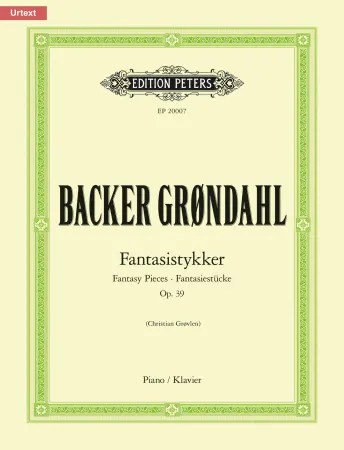
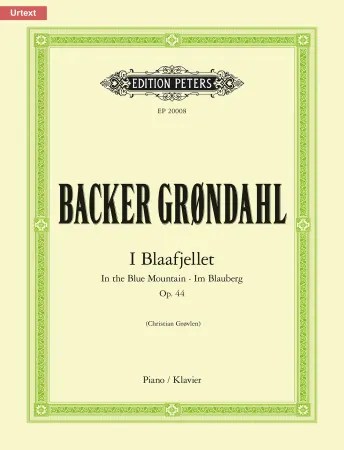
If patience is a virtue, then it could be coined a female trait. Hildegard von Bingen waited 900 years for a resurgence of interest in her music. Fortunately for Agathe Backer Grøndahl, it was only a century before she was honoured with a republica-tion and urtext edition of 2 of her piano cycles. The albums, Fantasistykker (Fantasy Pieces) Op. 39 and I Blaafjellet (In the Blue Mountains) Op. 44 have been re-issued, thanks to the work of pianist and editor Christian Grøvlen and Faber Music for Edition Peters.
Grøvlen, Director of Music at the Composer’s Homes for Kode, has been promoting the works with a flurry of concerts showcasing these sparkling bright new albums whilst championing one of Norway’s greatest pianists and folklorist composers. So it was on a cold February night, that I was fortunate to attend an event at the beautiful home of the Norwegian Ambassador’s residence in Kensington, London. Outside the velvet winter sky contrasted with the pale luminosity glowing from drawing room windows, as musicians, publishers and journalists alike, were welcomed into the warmth.
The audience were transported to a world of Nordic magic in a setting that provided the perfect backdrop for the poetry of Norwegian landscapes encap-sulated by the visual reminder of paintings of fjords that hung on the walls. Grøvlen elicited both curiosity and laughter from the audience as he regaled with insightful anecdotes from the composer’s life and performed with a lyrical intensity.
Of special interest was his comparison of Grøndahl’s style to her colleague and passionate advocate and supporter, Edvard Grieg. Grøvlen deftly demonstrated similarities and differences between the two composers with musical cadences summarising their respective characters. Grøndahl’s music hinted at a subtler darker enigmatic underworld, more mysterious in harmonic complexity.
Grøvlen traced a link between Grøndhal, her envrironment and relations to her sis-ter Harriet Backer’s paintings which include many intimate scenes of music making often featuring Grøndahl at the piano. The exhibition last year at the Musee d’ Orsay of Harriet’s work was entitled “Music of Colour”. This evening could have been entitled an exhibition, “Sounds of Light and Shade” as tone painting and hints of impressionism within Grondahl’s music were displayed. Also explained was the influence of the poetry of Vilhelm Krag (1871-1933), noted for his symbolism, melancholy and connections to nature. This resonated with what I knew of Grøndahl’s own life. Krag explored the melancholic side of the human mind and within Grondahl’s music there is this Nordic melancholy – her music often filled with an inexplicable darkness, despite the light that shines from within. An artist who struggled with depression and ill health, music was her refuge. Music, she wrote, helped her forget slush and rain, encouraging her to daydream instead. “There are no feelings or passions which it cannot create, arouse to the highest degree of randomness, you can cry or rage, be gripped by the most excited enthusiasm and feel more wretched and humble than the felon in chains.”
Yet whilst I was filled with pride to see the music about which I had written and talked celebrated in brand new print, the beautiful cream pages bound by a cover surrounded by the distinctive spring green border of Edition Peters, I left feeling frustrated. Yes, it is time her music is made approachable with worthy inclusions of smart title pages, credits and contents, academic preface and full scale portaits of Grøndahl in modest flowing dress, and cap. Yet despite all this, I couldn’t stem the mild irritation that here again sympathy was portrayed for a woman and what more she might have achieved were she a man?
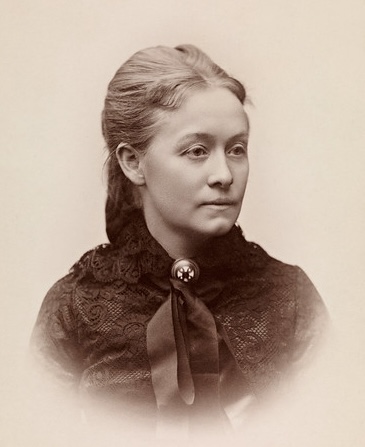
Here a woman was glimpsed through the 21st-century lens of expectations of what was missing, rather than seeing what was remarkably there burning bright in her own time. Presented by Grøvlen was an artist described as restrained, yet look deeper and a new picture emerges. Here after all is a woman who, as I wanted to yell from my seat, wrote a dawn chorus for the suffragette movement, who did indeed write and perform with and for orchestras and promoted herself despite the required modesty of the time. Why was that not mentioned? Here is a human who showed inconceivable will power pushing through boundaries to a life that was hard won for a woman of her era. Agathe Backer Grøndahl may have been “aggravatingly modest” as her era demanded, but she was also a woman whose bravery and courage took her to Europe as a young lady with a black jack truncheon in her pocket to protect herself from any angry or rowdy soldiers as pianist and recording artist of Grøndahl’s works, Sara Aimee Smiseth has pointed out. Look hard enough and what emerges is not the picture of a retiring wallflower chained unwillingly to a kitchen sink, but that of an exceptional artist fighting to follow her own creative path whilst fulfilling a role as mother and wife.
If you adjust the lens in the other direction another perspective emerges. Our gen-eration may be frustrated by the ideals of 19th-century decorum, but it was precisely the women’s salons of history where arts, celebrated in domestic settings, played an essential role in the flourishing of cultural traditions through the centuries. It was often in salon settings that the latest ideas were carried on chatter through windows out to the larger world. By virtue of Grøndahl’s career as a mother, musician and teacher firmly rooted to Nordic soil, she also had first hand access to her beloved folk music. Grøndahl more than Grieg transcribed these melodies, preserving them for future generations of male and female artists.
It is her work at home as a much-loved teacher and pianist that helped keep her name alive whilst raising standards of music in Norway.
Grøndahl may not have had the compositional career benefits of male gender, but in her own words to Bernard Shaw it is this “experience as a wife and mother that makes her an artist.”
Perhaps Grøndahl with all of her 400 songs and piano pieces wisely understood that it is by composing “salon miniatures” – the music of everyday inner details – and by experiencing the intricacies of life that her art will travel more feasibly than an epic sonata of grandiose ideas played by the few. Just as valuable as the giant sweeping brush strokes are the small yet miraculous details to be shared amongst generations of musicians at home as well as in the concert hall.
Whilst we celebrate the wonderful work of Edition Peters for replacing overcrowded print of antiquated editions and marching them into the clarity of the elegantly printed realm, let us also celebrate the achievements of a remarkable woman. Let us hope her story will not slip through the cracks of history.
Grøndahl brought to life the inner landscape of the soul. Perhaps this scattering of musical seeds will in the long run bear more fruit? I hope at least these informative editions will do much to contribute to hearing Grøndhal’s music, in the words of Vilhelm Krag, “grow beyond the frost of iron”.
Eva Maria Doroszkowska is an international pianist and teacher




 The Cross-Eyed Pianist