This new release of music by British composer Francis Pott, performed by Duncan Honeybourne, brings together piano works written between 1983 and 1997.

The title of the album, ‘A House of Ghosts’, reflects the character of the pieces: short works and miniatures which offer glimpses of places and voices that remain just out of reach, rather than an overall narrative. Pott’s music is elegant and restrained, reflecting on memory, landscape, and legend, occasional reference to medieval song (Minnelied, Blondel, Walsinghame), Chaucer (Pageant, with its distinctively ‘Medieval’ open fourth and fifth chords), T. S. Eliot (Revenant), and the abandoned community of St Kilda, a remote archipelago in Scotland (Farewell to Hirta). The mood of many of the pieces is wistful or nostalgic, with a timelessness which harks back to earlier times and musical styles: Pott’s influences include William Byrd, Gustav Mahler and Vaughan Williams, and one hears echoes of these composers, and others, in his harmonies, textures and long-spun melodies.

“A House of Ghosts is a sequence of a dozen short pieces concerned with the past, whether imagined, historical or (as in the case of the final piece) autobiographical. These movements are combined here with freestanding longer items, where sea music (Farewell to Hirta and Hunt’s Bay) is mixed with explorations of elusive memory (Le Temps qui n’est plus and Drowned Summer). Gently distinctive in its harmonic and tonal language, this music is the work of a professional pianist-composer with a refined and subtle insight into the physical and textural properties of the instrument.”

Duncan Honeybourne, pianist

I had the pleasure of page-turning for a performance by Duncan Honeybourne of several of the pieces featured on this album. This not only introduced me to Pott’s compelling soundworld but also offered a glimpse of his writing style. ‘A House of Ghosts’ is music written for the intimacy of the home, with the amateur pianist very much in mind. This is music that will appeal to the sophisticated amateur pianist who enjoys contemporary music that is melodic, structured and expressive, yet not overly-challenging. The music is highly pianistic (the composer is a pianist himself), approachable yet thought-provoking, consonant…. They may appear simple, but there is much scope for sensitivity in voicing, dynamics and pedalling to bring these finely-crafted pieces to life.

Duncan Honeybourne brings clarity, gracefulness and emotion to this elegant, atmospheric music, responding with much musical thought and sensitivity to its subtly-shifting colours and moods to create an album that is wholly enjoyable and deeply absorbing.

A House of Ghosts is released on digital streaming and download

Scores of Francis Pott’s music are available from Composers Edition

Kapustin: Between the Lines

Ophelia Gordon, piano

Nikolai Kapustin (1937–2020) occupies a distinctive place in 20th- and 21st-century music. A classically trained pianist and composer, Kapustin cleverly fused the formal, structural rigour of classical music with the rhythmic vitality and improvisational idioms of jazz. His works defy easy categorisation: though they sound spontaneously jazzy, they are entirely notated in classical form, leaving no space for actual improvisation. This paradox became the hallmark of his style.

Born in Horlivka, Ukraine, Kapustin studied piano at the Moscow Conservatory, under Alexander Goldenweiser, at a time when jazz was still viewed with suspicion by Soviet authorities. Kapustin’s fascination with American jazz pianists like Art Tatum, Oscar Peterson and Erroll Garner led him to explore the genre secretly and he absorbed its harmonic language, rhythmic energy, and phrasing to create his own compositional language. His music is vibrant, cerebral, witty, exuberant and alive.

British pianist Ophelia Gordon makes a striking recording debut with this album of works by Nikolai Kapustin, drawn to his music as it reflects her own background (she grew up in a household full of music, both jazz and classical), her musical versatility and her desire to challenge the barriers between different genres of music.

Ophelia says, “I dream of a world where classical and jazz musicians can perform side by side, with no gatekeeping or barriers. Kapustin’s music makes that dream feel possible. It sits beautifully in the space between genres. It speaks directly to jazz musicians through its harmony and rhythm, and to classical musicians through its texture and form.”

This album is a celebration of the space “between the lines” where Kapustin’s music sits. In preparation for the recording, Ophelia tracked down many long out-of-print vinyl recordings of the composer’s own performances to find the essence of Kapustin’s voice. The recording is also a milestone in that it’s the first full release of Kapustin’s music by a female British pianist.

The album opens with Big Band Sounds, Op. 46 (1986), a piece rich in swing and the textures and timbres of Big Band jazz. Ophelia sashays through it with panache, making a bold opening statement for the rest of her debut album.

Selections from the 24 Preludes follow. Based on Chopin’s model, most of the Preludes presented here are upbeat and foot-tapping, but No. 5 in D Major is more wistful, with hints of Bill Evans. Contemplation follows, a gentle, introspective piece which conjures up a late-night smoky jazz club. Ophelia gives this a wonderful spaciousness, so much so that it sounds improvised there and then.

The Paraphrase on “Aquarela do Brasil” is Kapustin’s take the famous Brazilian standard “Brazil,” composed by Ary Barroso in 1939. Ophelia played along with a samba beat “to lock into the groove” and the piece has a joyful, pacey mood, rich in colour and textures, with occasional moments of almost Lisztian bravura.

The eight Concert Etudes are probably Kapustin’s most well-known pieces and each has a distinct character – punchy, impressionistic, groovy, funky, the Etudes reflect the influences of jazz greats such as Erroll Garner, Art Tatum, Bill Evans, Chick Corea and Herbie Hancock. Ophelia really revels in this music, switching effortlessly between the different characters of each Etude – from the shimmering sixths (perhaps drawn from Chopin?) to the driving energy of Toccatina. There are sonorous bass sounds and hints of Rachmaninov in some of the chords, reminding us of Kapustin’s heritage. Performed here as the complete set, the Etudes are witty, poetic, fierce, relentless, and often beautiful too.

To close, the Paraphrase on Dizzy Gillespie’s “Manteca” for Two Pianos. With its nod to the virtuosic paraphrases of Franz Liszt, with its dramatic flourishes and sparkling fioriture, the piece has a wonderful vibrant energy. Unable to find another pianist with whom to record the piece, Ophelia learnt both parts herself:

“The process was lengthy and difficult but incredibly rewarding. I split the parts into “rhythm” and “melody.” Though both switch roles, it was essential to record the rhythm part first, then play the solo part alongside it. I now perform this live with the rhythm coming through a PA system!”

Recorded on a characterful 1961 Steinway, the piano sound is rich and warm, colourful and immediate, and engineered with a microphone setup designed to balance the immediacy of a jazz trio with the depth and clarity of the classical solo piano. Ophelia plays with a natural virtuosity which never feels contrived nor forced, completely at home with Kapustin’s rhythmic vitality, and myriad harmonies and textures. She clearly loves this music because, as she herself says in the notes, it allows her to “be all of myself at the piano”.

With detailed notes by Ophelia Gordon herself, lending a more personal take on traditional liner notes, this is an impressive debut recording that leaves one wanting to hear more from this bold and authentic artist.

Kapustin: Between the Lines is released on 14 November on the Divine Art label (CD and streaming).

(Artist image: Ben Cillard)

This new release from prize-winning Russian pianist Anna Geniushene explores the early creativity of the great Romantic composers Chopin, Schumann, Brahms, Berg and Tchaikovsky, revealing the ambition, curiosity and individuality that shaped their musical identities.

‘The title Opus 1 carries profound significance. It represents a beginning, an assertion of identity, and the boundless potential of creativity. For some composers, an Opus 1 was a carefully chosen first statement; for others, it was simply the first work they deemed worthy of publication. Regardless of intention, each of these pieces marks a moment when a composer stepped forward and said, “This is where my journey begins.”’ – Anna Geniushene, pianist

Anna Geniushene

‘Opus 1’ does not necessarily indicate the first ever piece written by the composer, but rather the first published work. The works featured on Anna Geniushene’s new album are interesting in that they all contain fascinating pre-echoes of the composers’ later music, as well as highlighting the diversity, originality and future maturity of these composers.

Chopin composed his Rondo in C Minor when he was just fifteen. This sparkling work is a vibrant opening for this album – a piece that already bears all the hallmarks of his mature style – virtuosity, expression and an unmistakable lyricism – yet feels that it owes more to the bravura tradition of early nineteenth-century pianism.

“My first published piece was Scherzo à la russe, Op. 1″ so wrote Tchaikovsky in a letter to Nadezha von Meck, in 1879. Dedicated to the great pianist Nikolai Rubinstein (who famously rejected Tchaikovsky’s first Piano Concerto as unplayable), the Scherzo a la russe and Impromptu in E-flat minor both show hints of the composer’s later style, particularly that of the Nutcracker ballet score. Tchaikovsky composed his Opus 1 when he was a young professor at the Moscow Conservatory and still finding his compositional voice.

The Scherzo, based on a Ukrainian song which the composer heard from the gardeners at Kamenka, the home of his sister, begins innocently enough, with a naive melody, played with a delightful simplicity by Geniushene, before moving into a warm, chorale-like section. The Impromptu, meanwhile, marked ‘Allegro Furioso’, opens with an excitable gallop, cast in unremitting quaver triplets, which gives way to an arresting, Chopin-esque middle section played with great expression and beauty of tone.

Schumann composed his ‘Abegg Variations‘ when he was 18. Despite its opus number, this work was neither Schumann’s first, nor his first set of variations. With its ‘letter-to-pitch’ derivations, the music prefigures ‘Carnaval’, and the later fugues on the name BACH, and showcases Schumann’s distinctive contrasting musical voice or rather “voices” – from lyrical grace to sudden dramatic outbursts, all infused with a poetic sensibility that came to define his music. Here, each variation is executed with delicacy of touch, a mellifluous, romantic tone, and sparkling flourishes coupled with a sensitive appreciation of Schumann’s contrasting moods.

The romanticism of Schumann is followed by Alban Berg’s single-movement Sonata. Composed in 1907-08 under the guidance of Arnold Schoenberg, the work is tightly constructed with a continuously unfolding narrative arc. Though written at the beginning of Berg’s career, this work sees Berg pushing towards the atonality, expressive depth and structural complexity that would come to define his later works, and the Sonata is deftly handled by Geniushene, bringing dramatic intensity and lyricism to this haunting piece.

While Berg’s compositional voice may not be fully formed in his Sonata, Brahms’s Sonata in C Major, Op. 1 is a work of towering ambition. Although it was not the first piece he composed, it was the first he chose to publish, signalling his arrival as a composer of serious intent. Completed in 1853, when Brahms was just twenty, the sonata was written at a time when he had recently made a profound impression on Robert and Clara Schumann—an encounter that would shape his early career.

Grand in scope, rooted in the German tradition of Beethoven and Schumann, the Sonata opens with a thrilling opening gesture reminiscent of Beethoven’s ‘Hammerklavier’ Sonata, offset by a tender second theme, which prefigures the composer’s later writing for the piano. The slow movement is tender and songful, the Scherzo all Beethovenian swagger and rhythmic vitality, while the Finale reprises the ‘Hammerklavier’ idea in a dancing Rondo theme with contrasting episodes. Here, Geniushene moves seamlessly between power and resolution, warmth and lyricism.

‘To perform these works is to engage with the raw energy of creation itself, to stand at the threshold of something new and full of possibility. This album is not just a collection of early works—it is a celebration of the act of beginning, a reminder that every great artistic journey starts with a first single step.’ – Anna Geniushene

This impressive release from Anna Geniushene offers fascinating insights into the early work of these great composers and demonstrates how their early creativity set them on a path of greatness, each with a distinctive and individual musical voice.

Opus 1 is available now on the Fuga Libera label.

Meet the Artist interview with Anna Geniushene

Mirrors & Echoes – Aïda Lahlou, piano

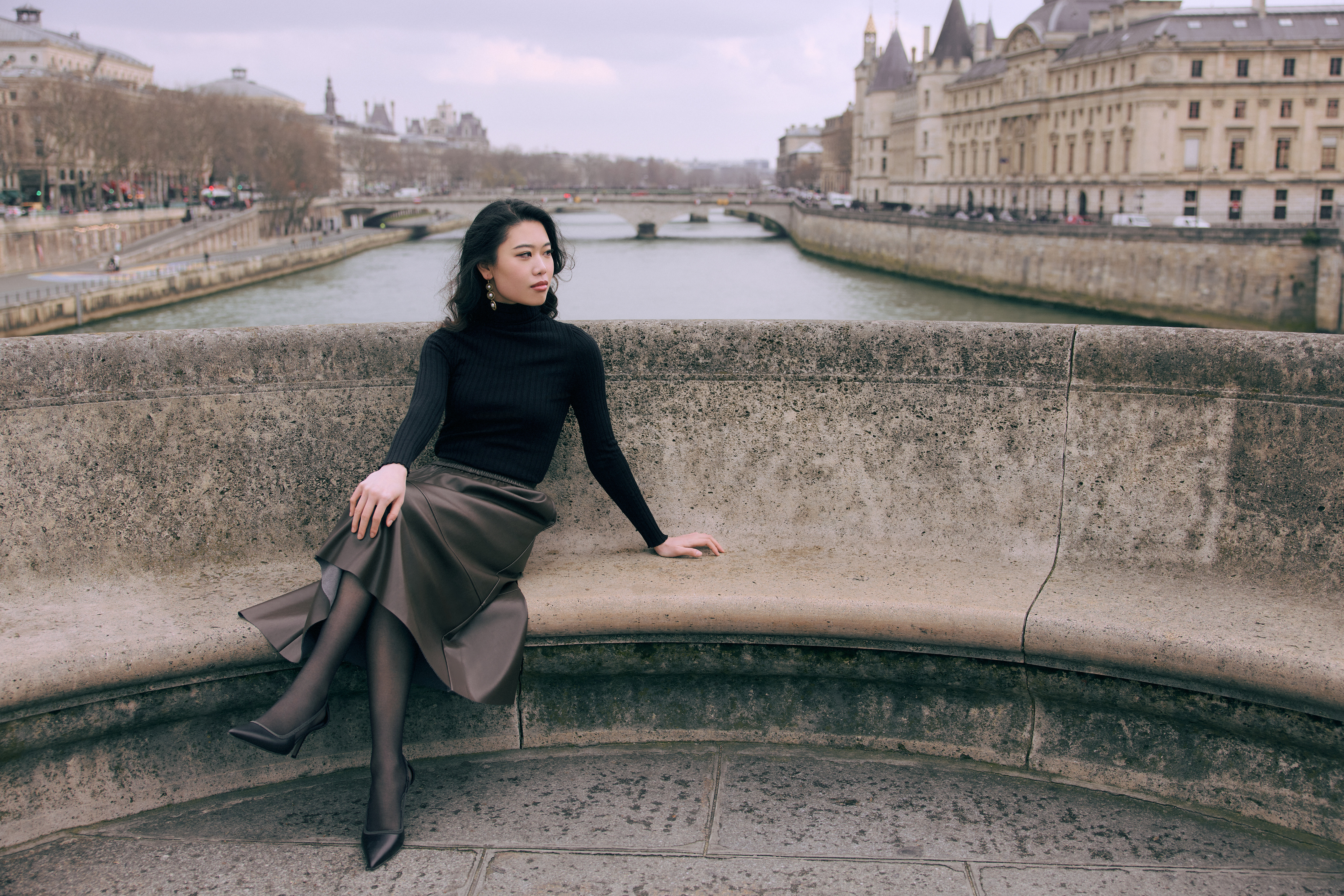
Moroccan pianist Aïda Lahlou makes an exciting and noteworthy recording début with Mirrors and Echoes, released by Resonus Classics on 19 September 2025.

Supported by Les Amis de Maurice Ravel, the album offers a vivid reimagining of Miroirs, placing it in dialogue with lesser-known piano miniatures from across the world to reveal surprising resonances and intertextual connections.

“Whether through spiritual texts, folkloric archetypes, or meditations on nature, each work in the album offers a moment of contemplation and self exploration.” Lahlou says. Drawing on Ravel’s own writing on Miroirs, she adds: “Ravel believed that music should act as a mirror, reflecting back the listener’s own interiority. This album seeks to transport the listener into that reflective space.”

Lahlou’s sensitive interpretation guides us through shifting sonic landscapes and themes of nature, spirituality, memory and transformation. The listening experience is not unlike a musical treasure hunt: Lahlou interweaves Ravel’s visionary five-movement cycle with rare piano miniatures from five continents—some rescued from obscurity, others newly arranged for this recording, like a Brahms motet or a 14th-century Andalucian song, each handpicked for its unexpected kinship with Ravel’s sonic world and its ability to evoke a sense of wonder.

My hope is that the album’s themes – nature, spirituality, and cross-cultural resonance – can inspire renewed awe for life and the richness of our world, especially at a time when it faces such urgent threats from war, pollution, and climate change.” (Aïda Lahlou)

Born in Casablanca and trained across Europe, Aïda Lahlou brings a multicultural lens to classical repertoire that feels both scholarly and deeply intuitive. The brilliant storytelling, weaving together works by Spendiaryan, Stevenson, Tansman, Garayev, Lecuona, and others, alongside arrangements of Brahms, Siloti and traditional melodies, culminates in a programme that is both exploratory and deeply personal. The result is a compelling artistic statement from a distinctive new voice in classical piano.

Mirrors & Echoes is released on CD and streaming on the Resonus Classics label.

Source: press release


About Aïda Lahlou

Born in Casablanca, pianist Aïda Lahlou began studying piano at the age of five with Yana Kaminska, and won her first international competition at eight. She later studied with Nicole Salmon-Boyer (École Normale Alfred Cortot) before receiving a scholarship to attend the prestigious Yehudi Menuhin School in Surrey. After reading Music at St John’s College, Cambridge, she continued her musical studies at the Guildhall School of Music and Drama, studying with Ronan O’Hora and Peter Bithell, and earning a Distinction in Piano Performance (MPerf).

Aïda has performed internationally from a young age, with appearances in venues including Wigmore Hall (London), BOZAR (Brussels), Théâtre National Mohamed V (Rabat), and the Hall of Organ and Chamber Music (Baku). She has performed as soloist with the Orchestre Symphonique Royal, becoming the youngest pianist to do so at the age of twenty, and has performed alongside artists such as Vadim Repin, Roby Lakatos, and Alina Ibragimova.

She has received over 20 national and international awards, most recently the Philip Crawshaw Prize at the Royal Overseas League Music Competition. A passionate educator and communicator, she also directs opera, volunteers with environmental groups, and created an award-winning one-woman show blending classical piano with stand-up comedy.

Praise for Aïda Lahlou

“Aïda Lahlou is a pianist of imagination and poetry, not shy of exploring sonority, colour, or inner voicings.” — The Classical Source

“Vivacious playing.” — Gramophone

“Aida…played with a poetic sensibility of refined beauty and a sense of style and musical intelligence of aristocratic authority.” — Christopher Axworthy

Website: aidalahlou.com