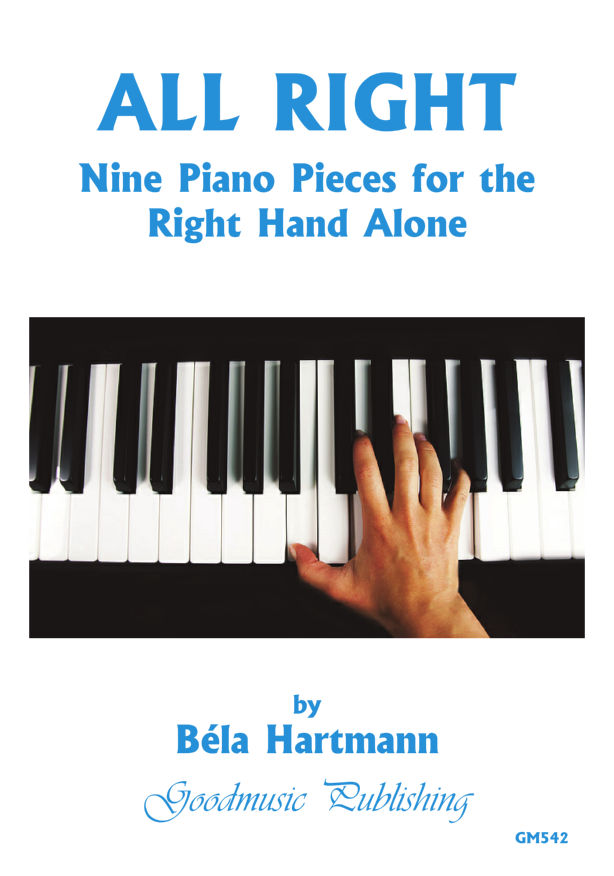
Nine Piano Pieces for the Right Hand Alone for advanced pianists by Béla Hartmann

In piano literature, works for the left hand alone have a more familiar history – often born of necessity after injury. Paul Wittgenstein, for example, famously commissioned left-hand concertos from Ravel and Hindemith. Perhaps the most famous music for left hand alone, apart from Ravel’s concerto, is Scriabin’s Prelude and Nocturne for the Left Hand, Op. 9

In his new book, pianist and pedagogue Béla Hartmann places the focus on the right hand, explaining that it “has had very little time spent on it, probably because it enjoys the bulk of our attention in normal piano music. It is certainly true that amongst pianists it is the right hand that must often take a sabbatical or retire completely due to overuse, misuse or pure bad luck, thereby leaving the left hand to keep the show going on by itself. However, the left hand suffers its fair share of injuries and it would seem a shame to neglect those occasions where the right hand may need or deserve to take a solo role.”

Hartmann himself suffered an injury to his left hand, which prompted him to explore create new music for those in need of some right handed challenges.

‘All Right’, a collection of nine piano pieces for the right hand alone, serves both a practical and artistic purpose: it fills a gap in the repertoire and challenges pianists to think differently about technical and expressive possibilities. This suite of nine miniatures is arranged in approximate order of difficulty – Consolation; Chase; Valse Fugitive; Menuet; March; Elegy; Song of the Thief; Etude; Prelude – and each piece has a distinct character, with widely varying styles. For example there’s a classical minuet and trio, a romantic virtuoso showpiece, elegiac moments, and more playful or introspective pieces.

Each piece cleverly balances technical demands with virtuosity and expression, making this music both instructive and enjoyable to play. Often, the right hand is both soloist and accompanist, and the fact that one hand is playing isn’t always obvious – or always foregrounded. Some pieces are energetic (Prelude, Chase), requiring nimble fingers and agility. Others test other techniques such as pedalling (Consolation) where notes in the lower register must be sustained below a chordal motif in the treble (itself a test in legato chord playing). Valse Fugitive, meanwhile, has contrasting articulation in the treble and bass, while other pieces require spread notes/arpeggiation and large leaps.

These pieces are far more than technical exercises. In fact, in their structure and style, they owe something to Chopin’s Études in that they offer the pianist attractive, imaginative and well-crafted music which also tests various pianistic skills. They offer real musical content for both student and teacher, which is rich, varied and emotionally engaging, and could also serve in therapeutic or adaptive contexts, for example, when a pianist’s left hand is injured or needs rest.

‘All Right’ is available from Good Music Publishing where you can view sample pages, listen to audio examples and order the music.


This site is free to access and advert-free, and takes many hours each month to compile and edit. If you find value and joy in this site, please consider making a donation to support its continuance:

It came as no surprise for me to discover that composer Mathieu Karsenti is also a visual artist, whose abstract work reflects the movement, layers, counterpoint and rhythm of music.



His music is often multi-layered and contrapuntal, abstract yet tonal, exploring sonic colours, timbres and textures to create atmospheric, evocative pieces. His new EP, Under Piano Skies, offers the listener a selection of “internal musical landscapes” inspired by weather and the sky. Performed by pianist Marie Awadis, the four pieces on this album reference clouds, weather and sky while taking the listener to abstract realms and places for reflection and pause.

Throughout Karsenti, capitalises on the piano’s resonance and sustaining abilities to create atmospheric washes of sound and colour, the edges between notes and chords often blurred, like a watercolour painting.  In some instances, echo and sound effects are added to enhance the piano sound, but in general the instrument’s own sonic capabilities are sufficient to achieve the composer’s intentions.  ‘Virga’, a piece which starts simply, with two voices, grows increasingly florid with the introduction of repetitive semi-quaver triplet figures over low, sustained chords. With generous use of the pedal, a dramatic resonance and vibration is created, redolent of Somei Satoh’s extraordinary ‘Incarnation II’, before reverting to the simplicity of the opening. 

‘Cerulean’, by contrast, uses a minimal amount of notes, carefully chosen and meticulously organised, to create a work of meditative qualities, its serenity only occasionally disturbed by unexpected harmonies or piquant note blends. 

‘Petrichor’, named after the word for that special smell of pavements after rain and including sound effects of rainfall at the opening and close of the piece, is similarly reflective, impressionistic in character with one or two nods to Debussy and Satie in its melody and harmony. 

‘Nimbus’, marked “dreamy, head in the clouds”, seems to owe something to Morton Feldman in its gentle dynamics, ethereal, ‘floating’ sounds and use of silence; as the final piece on the EP it may end definitively on a long, sustained chord, yet its timbres and mood continue to resonate long after the piano sound has died away. 

The music is elegantly, sensitively played by pianist Marie Awadis, who is able to bring clarity to the sound, especially in the higher range of the piano, while also appreciating the particular effects the composer intends. The result is an album of exquisitely measured, absorbing and atmospheric piano music

Mathieu Karsenti has made the score of the pieces available and this music will certainly appeal to those who enjoy minimalist/post-classical repertoire and exploring the sonic possibilities of the piano (ability level Grade 5-7). 

‘Under Piano Skies’ is available to download or stream and the scores are available to purchase from the composer’s website

Meet the Artist interview with Mathieu Karsenti

‘Open Up’ is the debut album from the Charlie Foxtrot Piano Collective, released on 16th July 2021. Written and produced by Caroline Wright, the album includes 11 tracks of original multi-tracked piano music.


The idea behind the album was to create a coherent set of compositions that indulge my love of piano but also explore the orchestral potential of the instrument. The creative process involved a mixture of composing, improvising, and arranging. I wanted to avoid using samples or MIDI, to maintain both an acoustic and improvisatory feel to the music, so everything was recorded on – or inside – a real grand piano. This meant numerous recording sessions for every track, as well as detailed mixing to achieve the right balance between different parts.

The album moves from relatively upbeat, simple tracks to darker, more complex pieces, with lots of modal harmonies and rhythmic ostinatos looped throughout. The music has a diverse range of influences, from classical to contemporary, as well as film, folk, jazz, dance and electronica. Some of the pieces are re-workings of older compositions (the oldest dating back to 1995!), while others were written in early 2021. There were many different inspirations for pieces: an amazing poem (The Hill We Climb), a beautiful photo (Falling Light), a wildlife documentary (Whale Song), some awful weather (Storm), a strong emotion (Anticipation), or a musical concept (Lockdown Boogie – which is really a study for the left-hand, in disguise!). The album title refers not only to opening up the piano to explore the sounds under the lid, but also to society opening up after the lockdowns of 2020-21, as well as personally opening up as an artist and deciding to put my music out into the world.


Open Up is available now

To listen to tracks in full or buy album (via Bandcamp): www.charliefoxtrotpianocollective.com

Videos:

Just Keep Going

Storm:

Falling Light:

Audio clips and links to streaming services (available after 16th July): https://charliefoxtrotpianocollective.hearnow.com/

Meet the Artist interview with Caroline Wright

Piano pieces inspired by Erik Satie

biography-default2016 marks the 150th anniversary of the birth of Erik Alfred Leslie Satie, and to celebrate this occasion British composer Richard Fowles has released a personal hommage to Satie and his musical orginality.

Today Satie’s Three Gymnopedies are amongst the most well-known and much-loved music for piano, but during his lifetime, Satie was relatively unknown to much of the musical world. An unremarkable student, he was bohemian by nature, sceptical of established ideas and authorities, and was considered lazy by his teachers. Despite his relatively low profile during his lifetime, Satie helped shape the music of the 20th century: he was an inspiration and mentor to the group of composers known as “Les Six”, which included Poulenc, Milhaud and Honegger, and influenced contemporaries such as Debussy and Ravel who recognised him as a “new spirit” with a highly original approach to composition. It was not until the mid-20th century that his work became more widely known and appreciated, thanks in part to the endorsement of American composer John Cage.

Composer Richard Fowles was encouraged to pursue this composing project by his piano teacher at Brunel University, Sally Goodworth, after he wrote a couple of Satie-inspired pieces as a student. The result is a suite of 16 piano miniatures in part inspired by Satie’s own music (Knossienne Nos 1-3 being the most obvious, where the eastern melodies of the original Gnossiennes are woven into a harmonic framework redolent of the original, but never an imitation of it) and also by the composer’s life and unusual personality. For example, ‘Sea Bird’ (track no. 6) was the nickname given by Satie to his uncle Adrian, like Satie an eccentric character and an important figure in Satie’s early life. The music juxtaposes quirky melodies which unusual harmonies to create a work which is moody, enigmatic and witty.

In fact, wit pervades these charming miniatures, particularly in the triptych ‘The Velvet Gentleman’ which references aspects of Satie’s attire with which he was most associated, including his identical grey velvet suits:

On most mornings after he moved to Arcueil, Satie would return to Paris on foot, a distance of about ten kilometres, stopping frequently at his favourite cafés on route. According to Templier, “he walked slowly, taking small steps, his umbrella held tight under his arm. When talking he would stop, bend one knee a little, adjust his pince-nez and place his fist on his lap. The he would take off once more with small deliberate steps.”

Robert Orledge, Satie Remembered. French translations by Roger Nichols.

See also: “A Day in the Life of a Musician” by Erik Satie

From: ‘Daily Routines’, a blog by Mason Currey (published in book form as Daily Rituals)

In many of the pieces, Fowles mirrors the “walking beat” that seems to pervade many of Satie’s own piano pieces, a meter which may have been the results of his “endless walking back and forth across the same landscape day after day . . . the total observation of a very limited and narrow environment.” (Roger Shattuck, in conversation with John Cage).

Other pieces in the collection are more melancholy: ‘A Walk to the Chat Noir on a Snowy Day’ conjures up the solitary figure of Satie, dressed in his grey velvet suit, making his customary walk to a favourite haunt in the centre of Paris. Meanwhile the set called ‘Biqui’ recalls Satie’s relationship with Suzanne Valadon and his feelings of devastation when the affair ended. Each piece is offered in Andante and Lento, the slower metres and repeated chord motifs lending a desolate yet intimate atmosphere to the music.

‘Sylvie’, the final track on the disc, is named after one of three poems written by Satie’s friend J.P. Contamine de Latour that Satie put to music in 1886.Its jazz harmonies and winding melody is infused with a tender, almost elegaic air.

Throughout the collection, Fowles avoids pastiche by offering us the essence of Satie’s music, and some of his contemporaries,  viewed through the lens of own originality and inventiveness which fuses eastern melodies with sensuous perfumed harmonies.

The music is performed on this disc by pianist Christina McMaster, whose affinity for this type of music is evident in her crisp articulation, preciseness of touch, and an acute sense of pacing which brings the music to life with vibrancy and atmosphere. And there is an added bonus, for pianists may also purchase the collection as sheet music (roughly Grade 6-8 level). Fowles has scored the music in a traditional way and also without barlines, à la Satie.

There is much to enjoy in this evocative collection, for those who love the piano music of Satie, and for those who are just beginning to explore it.

The sheet music is available now. Order here

The CD is released on 8th April.

Sample tracks here

Richard Fowles is an English composer, guitarist and teacher. He has worked as both a composer and session musician in some of the UK’s biggest recording studios and has provided the scores for a number of films and television programmes. He is also an in demand orchestrator. ‘Un Hommage à Erik’ is Richard’s debut album and book.